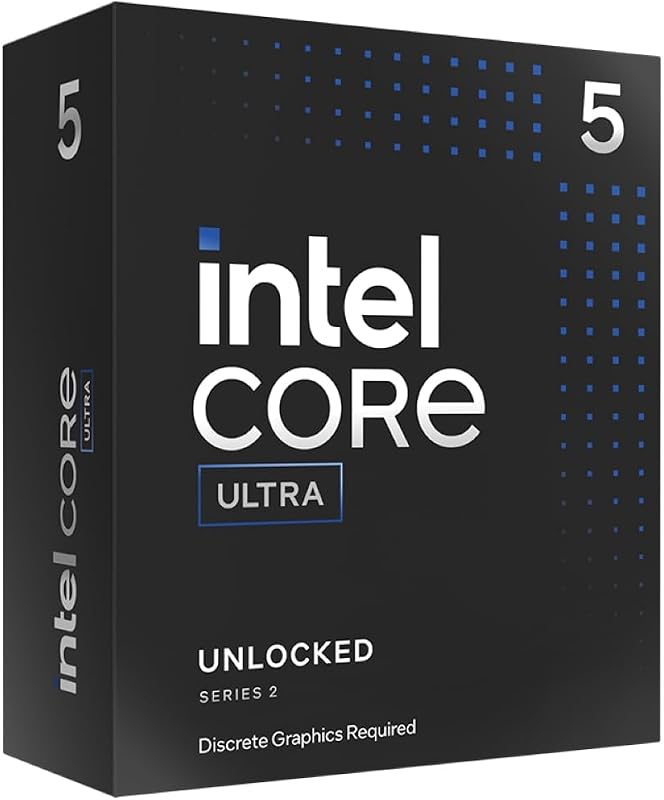
The primary division between the Intel Core i5-13500 and the Intel Core i5-13600KF lies in operational headroom versus all-inclusive hardware convenience. While the Core i5-13600KF delivers an unlocked 5.1 GHz maximum boost frequency backed by a 125-watt processor base power profile requiring standalone cooling and a dedicated graphics adapter, the Core i5-13500 settles at a locked 4.8 GHz ceiling with an efficient 65-watt envelope, an integrated graphics engine, and a bundled retail cooler.
Choose the Core i5-13500 if you want an efficient all-around desktop platform that works immediately without purchasing extra cooling or an add-in video card. Choose the Core i5-13600KF if you are assembling a dedicated gaming or high-performance rig equipped with aftermarket cooling and discrete graphics to exploit higher boost frequencies.


Intel Core i5-13500 vs Intel Core i5-13600KF at a Glance
| Feature | Intel Core i5-13500 | Intel Core i5-13600KF |
|---|---|---|
| Core and Thread Count | 14 cores (6 P-cores + 8 E-cores), 20 threads | 14 cores (6 P-cores + 8 E-cores), 20 threads |
| Maximum Boost Frequency | Up to 4.8 GHz (Locked) | Up to 5.1 GHz (Unlocked) |
| Processor Base Power | 65 watts | 125 watts |
| Installed Cache Memory | 24 MB | 24 MB |
| Integrated Graphics | Intel UHD Graphics 770 | None (Discrete graphics required) |
| Included Thermal Solution | Intel Laminar RH1 Cooler included | No thermal solution included |
| Socket Compatibility | LGA 1700 | LGA 1700 |
| Chipset Compatibility | Intel 600 and 700 Series | Intel 600 Series (might need BIOS update) and 700 Series |
| Memory Standards | DDR5 and DDR4 | DDR5 and DDR4 |
| Best For | General computing, compact builds, and value multitasking | Unlocked gaming rigs and high-performance creative desktops |
Clock Speed and Overclocking Headroom
The i5-13500 vs 13600kf clock speed metric is one of the most substantial hardware indicators separating these two processors. The Core i5-13600KF achieves an out-of-the-box maximum turbo speed of up to 5.1 GHz on its Performance cores, whereas the Core i5-13500 caps its maximum Turbo Boost frequency at 4.8 GHz. In interactive compute environments and games that depend on rapid instruction completion, that 300 MHz difference provides the Core i5-13600KF with an immediate baseline execution advantage. Furthermore, the unlocked multiplier on the Core i5-13600KF allows experienced system builders to tune operating parameters beyond stock factory specifications when paired with compatible hardware.
In contrast, the Core i5-13500 features locked multipliers, meaning its maximum clock frequencies are bounded strictly by Intel factory tables and its 4.8 GHz ceiling. For builders who prefer an appliance-like computing experience where operating parameters remain fixed and stability is guaranteed without manual tuning, this fixed operational ceiling eliminates the need for BIOS tweaking. Anyone analyzing an intel core i5-13500 review will note that the chip relies on Intel Turbo Boost Max Technology 3.0 to hit its top frequency dynamically, but it cannot be pushed into enthusiast-grade frequency tiers. For users looking at sibling models, examining an intel core i5-13500 vs i5-13600k analysis highlights similar frequency disparities.
The practical outcome of this clock gap surfaces when running instructions that scale linearly with single-thread frequency. The Core i5-13600KF delivers crisper response in high-frame-rate rendering, immediate software compiling bursts, and lightly threaded computational bottlenecks. Because the Core i5-13500 stays pinned at 4.8 GHz, it trades away that upper tier of responsiveness in exchange for simplified system demands.
Edge: Intel Core i5-13600KF delivers higher out-of-the-box clock frequencies up to 5.1 GHz and features an unlocked multiplier for manual tuning.
Power Consumption and Thermal Requirements
Energy draw and heat generation create a stark divide when examining intel core i5-13500 vs 13600kf power consumption profiles. The Core i5-13500 is specified with a 65-watt processor base power rating, representing a relatively conservative thermal footprint for a 14-core desktop processor. The Core i5-13600KF nearly doubles that baseline specification with a 125-watt processor base power tier. This disparity fundamentally alters the power supply capacity, voltage regulation requirements, and overall chassis cooling design required to keep each processor operating within safe limits.
Packaging differences reinforce these power demands. The Core i5-13500 ships directly with an Intel Laminar RH1 cooler inside the box, meaning purchasers do not need to invest extra effort or capital into sourcing third-party cooling hardware. While the stock cooler operates audibly under sustained workloads, it is factory-rated to manage the 65-watt profile. Conversely, the Core i5-13600KF listing explicitly states that no thermal solution is included in the package. Builders choosing the 13600KF must procure an aftermarket heatsink or liquid cooler capable of dissipating at least 125 watts of sustained thermal output, as observed in our intel core i5-13600k vs i5-13600kf comparison.
For small-form-factor builds or environments where ambient noise and overall electricity draw must be kept low, the 65-watt envelope of the Core i5-13500 offers distinct logistical advantages. The Core i5-13600KF will consistently generate more total heat inside the chassis, demanding unrestricted airflow and higher fan curves.
Edge: Intel Core i5-13500 operates at a much lower 65-watt base power rating and includes an Intel Laminar RH1 cooler in the box.
Graphics Capabilities and Video Output
The presence or absence of on-die graphics forms a critical architectural divergence when reviewing i5-13500 vs i5-13600kf integrated graphics capabilities. The Core i5-13500 includes fully functional Intel UHD Graphics 770 embedded directly on the silicon. This onboard graphics processor enables the CPU to output display signals directly through motherboard video ports without requiring an external add-in graphics card. In contrast, the Core i5-13600KF belongs to Intel’s “KF” family, which means discrete graphics are strictly required to post video to a monitor.
Having Intel UHD Graphics 770 installed inside the Core i5-13500 provides immense utility across several practical scenarios. Builders creating general productivity workstations, office machines, or home server systems can complete their build immediately without adding a dedicated GPU. Furthermore, if an installed dedicated graphics card ever encounters driver failure or hardware malfunction, the integrated graphics allow seamless troubleshooting and system recovery. In an intel core i5-13600kf review, this lack of onboard video represents a deliberate trade-off where users must budget for and install a dedicated graphics card before receiving any display output.
For creators, the integrated GPU also brings hardware video decoding capabilities that can offload media playback tasks independently of the primary GPU. With the Core i5-13600KF, every graphical operation, no matter how trivial, must be processed through the discrete graphics card.
Edge: Intel Core i5-13500 provides built-in Intel UHD Graphics 770, allowing full system operation without a dedicated graphics card.
Gaming Performance and System Balance
Deciding between the i5-13500 or i5-13600kf for gaming hinges on your monitor refresh rate and chosen graphics card tier. Both processors feature the same core count, pairing 6 Performance cores with 8 Efficient cores, alongside 24 MB of secondary cache. However, gaming performance in modern desktop titles often correlates strongly with single-core clock ceilings and low-latency instruction loops. The 5.1 GHz unlocked clock speed of the Core i5-13600KF provides a perceptible edge over the 4.8 GHz ceiling of the Core i5-13500 when rendering high frame rates in competitive esports or CPU-heavy simulation engines.
If you are pairing your processor with an upper-tier dedicated graphics card, is i5-13600kf worth it for modern gaming? In scenarios where frame rates push well past 144 Hz at 1080p resolution, the extra 300 MHz boost headroom of the Core i5-13600KF minimizes frame drops and ensures higher 1% low metrics. Readers reviewing our intel core i5-13400f vs i5-13600kf breakdown will find a similar dynamic where higher clock targets directly elevate competitive frame consistency. The Core i5-13500 remains a very capable gaming processor, but its locked 4.8 GHz maximum boost will plateau sooner in pure CPU-bound gaming scenarios.
However, for gaming at 1440p or 4K where graphical rendering load shifts overwhelmingly onto the discrete GPU, the gaming disparity between the two models compresses significantly. Even so, the Core i5-13600KF maintains the overall performance advantage whenever game engines demand maximum frequency throughput.
Edge: Intel Core i5-13600KF delivers superior high-refresh gaming performance due to its higher 5.1 GHz boost frequency.
Multithreaded Workloads and Productivity
When evaluating the intel i5-13500 or i5-13600kf for productivity, their identical core topologies make for a fascinating comparison. Both chips are built upon Intel’s performance hybrid architecture, incorporating 14 total physical cores (6 P-cores and 8 E-cores) capable of processing 20 simultaneous threads. Both models also feature 24 MB of cache to buffer heavy computational instruction sets, as well as Turbo Boost Max Technology 3.0 and support for both DDR5 and DDR4 memory standards.
The divergence appears during heavy, sustained multithreaded operations such as multi-track audio production, video transcoding, 3D model rendering, or archive compression. Under prolonged all-core rendering tasks, the 125-watt processor base power profile of the Core i5-13600KF allows its Performance and Efficient cores to sustain elevated operating frequencies for longer intervals without downthrottling. The Core i5-13500, constrained by its 65-watt base power rating, is engineered to manage power more conservatively. While an i5 13500 vs 13600kf benchmark comparison would show both processors handling heavy workloads competently, the 13600KF pulls ahead in raw throughput during continuous processing cycles.
For developers running local virtual machines or containers, the 20 threads across both chips handle high concurrency smoothly. Builders comparing 13th and 14th Gen tiers, like in our intel core i5-13500 vs i5-14600k analysis, often discover that sustained wattage headroom dictates multithreaded render times just as much as architectural generation. The 13600KF’s higher thermal power envelope delivers faster project completion times.
Edge: Intel Core i5-13600KF sustains higher all-core frequencies during demanding multithreaded renders thanks to its 125-watt power ceiling.
Motherboard Selection and Platform Longevity
Motherboard selection creates differing financial and technical prerequisites for these two processors, even though both utilize the Intel LGA 1700 socket. The listing data indicates that both the Core i5-13500 and Core i5-13600KF are compatible with Intel 600 Series and 700 Series chipset-based motherboards, and both support modern PCIe 5.0 and 4.0 lanes alongside Intel Optane Memory. However, the listing for the Core i5-13600KF explicitly notes that 600 series boards “might need BIOS update” to ensure full compatibility out of the box.
Furthermore, getting the most out of each processor’s unique feature set requires different motherboard classes. The unlocked Core i5-13600KF is designed to be paired with high-end Z690 or Z790 motherboards featuring robust power delivery systems and unlocked firmware settings to enable manual multiplier overclocking. In contrast, the locked 65-watt Core i5-13500 is ideally suited for mainstream B660 or B760 motherboards, which feature simpler VRM designs and do not require overclocking support. Those comparing alternative unlocked upgrade paths in our intel core i5-13600kf vs i5-14600k coverage will note how motherboard VRM demands escalate with unlocked K-series silicon.
Because the Core i5-13500 runs at a lower 65-watt base power profile and comes with its own cooler, it integrates effortlessly into virtually any LGA 1700 motherboard without requiring high-spec power phases or extensive firmware configuration. This broadens compatibility and simplifies motherboard selection for standard builds.
Edge: Intel Core i5-13500 pairs seamlessly with straightforward mainstream motherboards without requiring heavy power phases or overclocking chipsets.
Pros and Cons
Intel Core i5-13500

Pros
- Bundled Intel Laminar RH1 cooler included
- Integrated Intel UHD Graphics 770
- Lower 65W processor base power
- 14 cores and 20 threads multitasking
Cons
- Locked maximum clock speed of 4.8 GHz
- Lower frequency ceiling than the 13600KF
View Intel Core i5-13500 on Amazon
Intel Core i5-13600KF

Pros
- Higher 5.1 GHz boost clock speed
- Unlocked multiplier for tuning
- 14 cores and 20 threads multitasking
- Higher 125W power ceiling for sustained loads
Cons
- No bundled thermal solution included
- Requires discrete graphics card
- Higher 125W power consumption
View Intel Core i5-13600KF on Amazon
Who Should Buy Each One
Choose the Intel Core i5-13500 If
- You want an all-in-one package that includes the Intel Laminar RH1 cooler without buying third-party thermal hardware.
- You need integrated Intel UHD Graphics 770 for display output without purchasing a dedicated graphics card.
- You are building an energy-conscious desktop or compact PC centered around a 65-watt processor base power profile.
- You plan to use a mainstream B660 or B760 motherboard without investing in overclocking-grade power delivery.
Choose the Intel Core i5-13600KF If
- You prioritize higher single-core gaming performance and want to push clock speeds up to 5.1 GHz.
- You already own or plan to purchase a dedicated graphics card to fulfill the discrete graphics requirement.
- You want an unlocked processor to fine-tune clocks and voltages on an Intel Z-series motherboard.
- You have high-performance aftermarket cooling capable of sustaining a 125-watt processor base power envelope.
Final Verdict
For the vast majority of PC builders assembling an everyday desktop, workstation, or mainstream gaming PC, the Intel Core i5-13500 represents the more balanced and hassle-free choice. With 14 physical cores, 20 execution threads, integrated Intel UHD Graphics 770, and an included Intel Laminar RH1 thermal solution inside the box, it delivers remarkable multitasking capability while remaining strictly within a manageable 65-watt power envelope. It eliminates the necessity of purchasing separate cooling hardware or a dedicated graphics card, drastically simplifying system assembly on any LGA 1700 motherboard.
The Intel Core i5-13600KF wins decisively for dedicated gaming enthusiasts and advanced power users who demand the highest possible clock speeds and are willing to supply the necessary supporting hardware. Its unlocked 5.1 GHz boost ceiling and 125-watt thermal profile extract greater performance in CPU-bound gaming titles and intensive multithreaded creative exports. If your build already includes an aftermarket cooler and a discrete graphics card, the i5-13600kf vs intel core i5-13500 comparison clearly favors the 13600KF for maximum raw computing throughput.
FAQ
Does the Intel Core i5-13600KF include a stock cooler in the box
No, the listing confirms that no thermal solution is included with the Core i5-13600KF. Because it has a 125-watt processor base power rating, builders must purchase a compatible aftermarket LGA 1700 cooler.
Can the Intel Core i5-13500 output video without a graphics card
Yes, the Core i5-13500 includes integrated Intel UHD Graphics 770. You can plug your display cable directly into the video outputs on a compatible motherboard without installing a discrete GPU.
Can you overclock the Intel Core i5-13500
No, the Core i5-13500 features a locked multiplier and caps at a maximum frequency of up to 4.8 GHz. Only unlocked Intel processors like the Core i5-13600KF allow multiplier overclocking on supported chipsets.
Do both processors support DDR4 and DDR5 memory
Yes, both the Core i5-13500 and Core i5-13600KF feature memory controllers that support both DDR4 and DDR5 RAM standards across compatible LGA 1700 motherboards.
Will an Intel 600 series motherboard work with the Core i5-13600KF
Yes, the Core i5-13600KF is compatible with Intel 600 series chipsets, although the product listing notes that a BIOS update might be required before the processor can be recognized.
How many cores and threads do these processors have
Both processors share an identical core configuration featuring 14 physical cores (6 Performance cores and 8 Efficient cores) and 20 concurrent threads based on Intel’s performance hybrid architecture.