The single fundamental difference that decides the choice between the AMD Ryzen 5 7600X and the AMD Ryzen 9 7900X is parallel processing capacity: the 7600X uses a 6-core, 12-thread design tuned for agile single-threaded operations, while the 7900X doubles that hardware footprint to 12 cores and 24 threads to handle compute-dense multitasking workloads.
Dedicated gamers prioritizing thermal efficiency and responsive frame rates should choose the Ryzen 5 7600X. Digital creators, video editors, and engineering professionals needing continuous multi-core execution should choose the Ryzen 9 7900X.

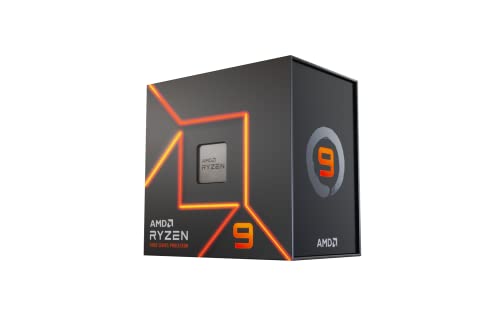
AMD Ryzen 5 7600X vs AMD Ryzen 9 7900X at a Glance
| Attribute | AMD Ryzen 5 7600X | AMD Ryzen 9 7900X |
|---|---|---|
| Processor Series | Ryzen 5 | Ryzen 9 |
| Process Technology | 5 nm | 5 nm |
| Physical Cores | 6 | 12 |
| Concurrent Threads | 12 | 24 |
| Base Clock Speed | 4.70 GHz | 4.70 GHz |
| Boost Clock Speed | 5.3 GHz | 5.6 GHz |
| L2 Cache | 6 MB | 12 MB |
| L3 Cache | 32 MB | 64 MB |
| Total Installed Cache | 38 MB | 76 MB |
| Wattage / TDP | 105 watts | 170 watts |
| Socket Type | Socket AM5 | Socket AM5 |
| Integrated Graphics | AMD Radeon Graphics | AMD Radeon Graphics |
| Best For | High-efficiency gaming builds | Heavy content creation and workstations |
Core Count and Multithreaded Processing
The primary architectural divergence in this Ryzen 9 7900X vs AMD Ryzen 5 7600X comparison centers on physical compute layout. The Ryzen 5 7600X features a hexa-core configuration supporting 12 concurrent threads. In standard desktop environments, 6 cores offer more than enough execution pipelines to handle operating system services, Discord voice feeds, and high-framerate gameplay simultaneously. Because most current consumer software remains optimized around 4 to 8 active threads, the 7600X rarely leaves execution units sitting completely idle during routine tasks.
By contrast, the Ryzen 9 7900X doubles the computational surface with a dodeca-core arrangement supplying 24 concurrent threads. Comparing the Ryzen 7600X vs 7900X core count reveals two entirely different operational thresholds. When you initiate software compiling, file compression, 3D scene asset generation, or local machine learning scripts, the 7900X spreads instruction chunks across all 24 threads. For shoppers weighing multi-core options such as the amd ryzen 5 7600x vs ryzen 7 7700x, stepping up to the 12-core silicon represents an immense surge in pure throughput.
This massive gap in processing hardware determines how smoothly a machine handles simultaneous foreground and background burdens. Running a heavy CPU-based rendering job on the 6-core 7600X will saturate its 12 threads and create noticeable UI lag if you attempt to edit photos simultaneously. The 7900X absorbs sustained computational tasks on one cluster of cores while leaving surplus physical execution threads entirely dedicated to your desktop interface, preventing stuttering or application freezing.
Edge: AMD Ryzen 9 7900X due to having twice the physical cores and thread count for multitasking and compute-heavy background tasks.
Clock Speeds and Gaming Performance
Single-core responsiveness dictates interactive game performance, and both chips utilize AMD 5 nm process technology to deliver exceptional operational frequencies. The Ryzen 5 7600X and Ryzen 9 7900X share the same 4.70 GHz base frequency, ensuring identical baseline execution speeds across system operations. However, their frequency ceilings diverge under single-core boost conditions, with the 7600X peaking at 5.3 GHz while the 7900X pushes up to 5.6 GHz.
When evaluating whether to choose the AMD Ryzen 5 7600X or Ryzen 9 7900X for gaming, that 300 MHz boost delta translates into minor differences during actual play. Modern games typically depend on low latency and focused core utilization rather than a sprawling cluster of idle threads. Enthusiasts researching specialized gaming silicon often weigh the amd ryzen 5 7600x vs ryzen 7 7800x3d for frame delivery, but comparing the standard 7600X against the 7900X shows that both deliver high-tier frame pacing. The 7900X extracts a modest boost in CPU-bound simulations and esports titles running at high refresh rates, but the visual experience remains remarkably close across both processors.
The practical trade-off is architectural complexity. The 7600X executes all of its gaming threads within a single physical core cluster, ensuring uniform access times and clean cache interaction without software scheduler intervention. The 7900X distributes its 12 cores across two separate compute modules, which occasionally requires Windows thread management to keep latency-sensitive gaming tasks pinned to the fastest module. While the 7900X hits faster peak frequencies, the 7600X remains a straightforward, focused engine for pure gaming setups.
Edge: AMD Ryzen 9 7900X offers higher maximum boost clocks, though gaming margins remain minor across most titles.
Power Consumption and TDP Requirements
Thermal management and system electrical demand define one of the most consequential divisions between these desktop chips. Examining the Ryzen 5 7600X vs Ryzen 9 7900X TDP profile illustrates AMD distinct thermal design targets. The Ryzen 5 7600X is rated at 105 watts, whereas the Ryzen 9 7900X scales up to 170 watts to sustain its dual-module structure and elevated clock frequencies under heavy loads.
In practical day-to-day operation, this 65-watt TDP difference impacts cooling selection and case temperatures. The 105-watt 7600X can be cooled cleanly using standard mid-range air coolers or compact dual-fan radiators, making it an outstanding fit for compact micro-ATX or Mini-ITX PC cases. In our AMD Ryzen 5 7600X review analysis, the chip draws modest power from the motherboard voltage regulation modules, reducing motherboard stress and lowering internal case heat build-up. Builders also cross-reference the amd ryzen 5 7600x vs ryzen 7 7700 when seeking lower thermal envelopes on the AM5 platform.
Conversely, managing the 170-watt Ryzen 9 7900X demands a substantially robust cooling solution. Sustaining maximum clock speeds across 12 cores pushes significant thermal energy into the processor heat spreader. Maintaining stable multi-core boost states requires premium air cooling towers or 280 mm to 360 mm liquid cooling systems alongside a power supply with ample wattage reserves. If your build enclosure features restricted airflow, the 170-watt output of the 7900X will require thoughtful fan curves and aggressive ventilation to avoid thermal throttling during multi-hour rendering cycles.
Edge: AMD Ryzen 5 7600X because its 105W rating operates with significantly less power draw and lower cooling demands than the 170W processor.
Cache Configuration and System Responsiveness
Memory latency and on-die cache capacity heavily influence how swiftly a processor accesses immediate instructional data. The Ryzen 5 7600X incorporates 6 MB of L2 cache (1 MB per physical core) paired with a 32 MB pool of L3 cache, totaling 38 MB of installed high-speed storage. This structure ensures that gaming engines and general productivity apps maintain high hit rates, reducing reliance on system RAM. When reviewing platform balance against competing designs such as the intel core i5-14600k vs amd ryzen 5 7600x, the 7600X demonstrates how capable a consolidated 38 MB cache can be.
On the opposite side, the Ryzen 9 7900X doubles every tier of cache allocation. It delivers 12 MB of dedicated L2 cache alongside 64 MB of shared L3 cache, providing a total of 76 MB installed cache. The expanded 64 MB L3 reservoir serves as an expansive holding pen for complex datasets, scientific calculations, and large codebases. This high capacity prevents execution stalls by keeping critical assets stored right next to the compute logic rather than repeatedly querying main system memory.
This doubled cache footprint becomes a meaningful asset during production-level multitasking. While the 38 MB capacity of the 7600X is plenty for gaming scripts, background assets, and active desktop software, the 76 MB allotment on the 7900X keeps expansive working files immediately available to the processing pipelines. For data-heavy applications that repeatedly loop through massive datasets, the larger cache pool translates to faster throughput and minimized platform latency.
Edge: AMD Ryzen 9 7900X due to doubled L2 and L3 cache memory that maximizes data throughput across heavy computational loops.
Video Editing and Content Creation Workloads
Content creation represents the operational category where the differences between these processors become absolute. In creative software suites, 7600X vs 7900X video editing performance hinges on whether you export compressed files, apply motion tracking, or work with multiple raw camera streams. The 6-core 7600X handles standard high-definition and moderate 4K video cuts reliably, but its 12 threads can become fully saturated during export processing, locking up spare system resources until rendering finishes.
When asking is Ryzen 9 7900X worth it for production environments, workstation results provide an emphatic confirmation. The 24 concurrent threads on the 7900X dramatically accelerate rendering passes, timeline transcoding, physics simulations, and audio effect mastering. In creative benchmarks like those examined in our amd ryzen 7 7800x3d vs ryzen 9 7900x comparison, productivity software scales almost linearly with thread availability. The 7900X cuts project export times drastically compared to 6-core chips, making it an invaluable production tool.
Synthesizing our AMD Ryzen 9 7900X review specifications highlights how the combination of 12 physical cores, 76 MB of total cache, and a 5.6 GHz boost ceiling eliminates timeline scrubbing hitches. Both processors feature the integrated AMD Radeon Graphics controller, which aids basic video display diagnostics and desktop visual output without requiring a discrete graphics card during initial setup. However, the sheer multi-threaded muscle of the 7900X makes it an exponentially more productive engine for creators handling daily client deliverables.
Edge: AMD Ryzen 9 7900X because its 24 concurrent threads cut export times and prevent system lag during intensive multi-layer video workflows.
Pros and Cons
AMD Ryzen 5 7600X

Pros
- Efficient 105-watt power consumption
- 3 GHz boost clock speed
- Solid 6-core 12-thread gaming architecture
- Integrated AMD Radeon Graphics
- Socket AM5 future platform compatibility
Cons
- Half the thread count of 7900X
- Slower rendering on compute-heavy tasks
View AMD Ryzen 5 7600X on Amazon
AMD Ryzen 9 7900X

Pros
- Massive 12-core 24-thread processing capacity
- High 5.6 GHz maximum boost frequency
- 76 MB combined L2 and L3 cache
- Integrated AMD Radeon Graphics controller
- Exceptional multitasking and rendering throughput
Cons
- High 170-watt power and cooling requirement
- Excessive core count for pure gaming setups
View AMD Ryzen 9 7900X on Amazon
Who Should Buy Each One
Choose the AMD Ryzen 5 7600X If
- Your primary desktop objective is gaming without running heavy production tasks in the background.
- You prefer a 105W TDP processor that runs comfortably on standard air cooling inside compact enclosures.
- You want a fast 5.3 GHz 6-core platform that leaves maximum power supply headroom for high-end graphics cards.
- Your typical workload consists of web browsing, office suites, light image editing, and single-application tasks.
Choose the AMD Ryzen 9 7900X If
- You spend extensive working hours exporting 4K media, compiling large software repositories, or rendering 3D scenes.
- You require 24 concurrent threads to keep your workstation fully responsive while background jobs execute.
- You have equipped your chassis with a high-capacity air cooler or 280 mm-plus liquid cooling loop rated for 170W TDP.
- You run virtualized test environments or multi-stream production suites that directly utilize 76 MB of installed cache.
Final Verdict
For the vast majority of PC builders and dedicated gaming enthusiasts, the AMD Ryzen 5 7600X represents the most practical, balanced choice. Its 6 physical cores and 12 threads provide the exact performance profile modern game engines demand, backed by a potent 5.3 GHz boost frequency and a manageable 105-watt thermal envelope. It simplifies system cooling requirements, pairs effortlessly with mid-range hardware, and avoids the scheduling complexities of dual-die configurations, making it an outstanding gaming engine on the AM5 socket.
However, when your computer functions as an income-generating workstation, the AMD Ryzen 9 7900X justifies its hardware demands completely. Doubling the physical compute resource to 12 cores and 24 threads, boosting peak frequency to 5.6 GHz, and doubling onboard cache to 76 MB transforms compute times in rendering, video editing, and software compilation. If your daily workflow routinely stresses more than 12 threads and your chassis can handle a 170-watt heat load, the Ryzen 9 7900X stands as the definitive multithreaded winner.
FAQ
Do the AMD Ryzen 5 7600X and Ryzen 9 7900X fit the same motherboard socket?
Yes. Both processors utilize AMD Socket AM5. The socket allows the processor to be installed directly onto the PCB without soldering, providing broad cross-compatibility across AM5 motherboards on Linux and Windows platforms.
Can you game smoothly on the AMD Ryzen 5 7600X without upgrading to 12 cores?
Yes. Modern video games prioritize strong single-core clock speeds and low memory latency rather than high core counts. The 6-core, 12-thread structure and 5.3 GHz boost clock of the 7600X provide exceptional frame rates across current titles without requiring a 12-core processor.
Do both processors come with integrated graphics controllers?
Yes. Both the Ryzen 5 7600X and Ryzen 9 7900X feature an integrated AMD Radeon Graphics controller. This provides desktop video output for troubleshooting, setup, and regular display operation without needing an immediate discrete graphics card.
What kind of cooling is required for the Ryzen 5 7600X compared to the Ryzen 9 7900X?
The Ryzen 5 7600X features a 105-watt power specification, which can be effectively cooled by standard tower air coolers or entry-level dual-fan liquid coolers. The Ryzen 9 7900X has a 170-watt TDP, requiring heavy-duty dual-tower air coolers or 280 mm to 360 mm liquid cooling systems to maintain peak boost frequencies under sustained multi-threaded loads.
Does the Ryzen 9 7900X offer double the gaming performance of the Ryzen 5 7600X?
No. While the 7900X features double the core count, concurrent threads, and cache capacity of the 7600X, gaming workloads do not scale linearly with core counts past 6 or 8 cores. Frame rate differences between the two chips remain narrow in most mainstream gaming scenarios.
Can both processors run on Linux and Windows operating systems?
Yes. The manufacturer listing confirms that both the Ryzen 5 7600X and the Ryzen 9 7900X support both Linux and Windows operating platforms with full 64-bit processing capability.


