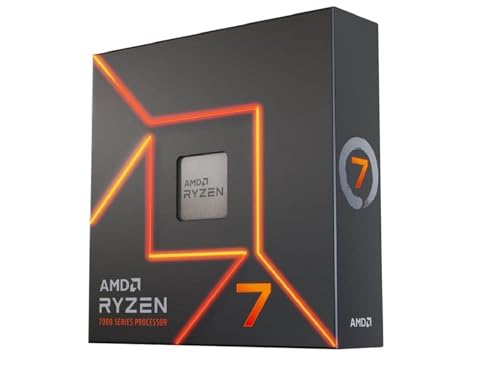
The core difference between these two processors comes down to whether your computer spends its time executing gaming loops or rendering compute-heavy creative workloads. The AMD Ryzen 7 7700X packages 8 cores and 16 threads inside an efficient 105-watt power envelope, while the AMD Ryzen 9 7950X doubles that compute density to 16 cores and 32 threads with a 170-watt ceiling to chew through massive multi-threaded tasks.
Choose the Ryzen 7 7700X if you are building a dedicated gaming and everyday performance rig that runs cool and pairs easily with standard cooling solutions. Choose the Ryzen 9 7950X if you are an engineer, 3D animator, or video professional whose daily productivity scales directly with multi-threaded processing power.

AMD Ryzen 7 7700X vs Ryzen 9 7950X at a Glance
| Feature | AMD Ryzen 7 7700X | AMD Ryzen 9 7950X |
|---|---|---|
| Processor Cores | 8 Cores | 16 Cores |
| Thread Count | 16 Threads | 32 Threads |
| Base Clock Speed | 4.5 GHz | 4.50 GHz |
| Max Boost Speed | 5.4 GHz | 5.7 GHz |
| L3 Cache | 32 MB | 64 MB |
| L2 Cache | 8 MB | 16 MB |
| Thermal Design Power | 105 Watts | 170 Watts |
| Manufacturing Process | 5 nm Zen 4 | 5 nm Zen 4 |
| Platform Socket | Socket AM5 | Socket AM5 |
| Bundled CPU Cooler | Cooler not included | Not listed |
| Best For | High-FPS gaming and balanced computing | Heavy multi-threaded production and rendering |
Core Count and Multi-Threaded Productivity
When evaluating desktop processors for demanding computing tasks, hardware execution capacity determines how quickly raw data transforms into finished output. The 7700X vs 7950X core count represents the most substantial hardware division between these two Zen 4 chips. The Ryzen 7 7700X utilizes an octa-core configuration with 16 concurrent threads, which provides more than enough computing muscle for high-refresh gaming, office workflows, audio workstations, and moderate video exports. However, modern creative software suites like Blender, Cinema 4D, and heavy code-compilation engines are built to consume every processing thread you feed them.
By contrast, the Ryzen 9 7950X doubles physical execution resources by providing a 16-core, 32-thread layout. In multi-threaded production environments, this disparity is transformative. Having 32 threads allows background assets to render while editing timelines remain responsive, preventing the system stalls that can occur on lower-core parts. When deciding between the Ryzen 7 7700X or Ryzen 9 7950X for video editing, the hexadeca-core architecture of the 7950X cuts rendering times substantially on complex timelines packed with visual effects, 4K color grades, and multi-camera clips. If you are comparing mid-range and top-tier silicon, our look at the amd ryzen 7 7700x vs ryzen 9 7900x explores how 12-core options bridge this divide.
For individuals running batch photo conversions, continuous software builds, or heavy 3D scene computations, the 7950X operates in a different performance class. The 7700X handles multithreaded jobs admirably for an 8-core CPU, but it cannot overcome the laws of parallel computing when faced with a chip that carries twice the physical hardware.
Edge: AMD Ryzen 9 7950X because it provides double the physical cores and processing threads for massive multi-threaded productivity.
Gaming Performance and Frame Rates
Gaming engines place their highest demands on single-core throughput, instruction latency, and memory access rather than massive thread counts. Most modern game titles utilize between four and eight cores effectively, meaning additional cores beyond eight often sit idle during gameplay. The Ryzen 7 7700X is engineered directly for this use case, with the listing highlighting its ability to deliver fast 100+ FPS performance in competitive and demanding titles. Its 5.4 GHz maximum boost clock ensures that primary game threads execute with minimal frame latency.
The Ryzen 9 7950X reaches a higher theoretical boost clock of 5.7 GHz and carries larger cache reserves, but this does not translate into double the frame rates. In many gaming scenarios, the extra compute die and inter-core scheduling of a 16-core processor introduce subtle overhead that offsets its raw clock frequency advantage. When gamers evaluate the Ryzen 7 7700X or Ryzen 9 7950X for gaming, real-world frame rates across most resolutions show near parity between the two chips, with the graphics card acting as the primary performance ceiling. Those seeking specialized gaming architectures should read our analysis of the amd ryzen 7 7800x3d vs ryzen 9 7950x to see how dedicated 3D cache alters the frame rate formula.
Because the Ryzen 7 7700X delivers practically identical gameplay responsiveness without demanding excessive thermal overhead or power, it stands as the far more sensible investment for a pure gaming build. The 7950X is unquestionably capable of running modern games at high frame rates, but buying 16 cores purely to launch PC games leaves half of the processor unused.
Edge: AMD Ryzen 7 7700X because it achieves competitive high-FPS gaming performance while utilizing its 8-core silicon efficiently.
Clock Speeds and Cache Architecture
Silicon clock frequencies and on-die cache hierarchies dictate how rapidly instructions travel between system RAM and the processor execution units. Looking closely at the AMD 7700X vs 7950X specs, both processors share an identical base clock speed of 4.5 GHz built on the 5 nm manufacturing process. However, the maximum boost capability diverges under load. The 7700X tops out at a 5.40 GHz overclocking speed, whereas the 7950X stretches to 5.70 GHz on its best-performing cores.
The cache structure shows an even wider gulf between the two models. The Ryzen 7 7700X features 8 MB of L2 cache alongside 32 MB of L3 cache, totaling 40 MB of combined high-speed secondary and tertiary storage. The Ryzen 9 7950X packs 16 MB of L2 cache and 64 MB of L3 cache, creating an 80 MB cache subsystem. As noted in any deep AMD Ryzen 7 7700X review, having lower cache pools is completely adequate for standard computing tasks, but the larger 80 MB pool on the 7950X dramatically improves cache hit rates during intense computational runs, database parsing, and large file transformations. Shoppers considering alternative ecosystem architectures can see how core allocations match up in our intel core i7-13700k vs amd ryzen 7 7700x breakdown.
Both processors feature an unlocked multiplier, enabling users to fine-tune clocks and voltages. Even so, the 7950X brings factory binning that reaches 300 MHz higher right out of the box, backed by twice the high-speed L2 and L3 memory pools to prevent pipeline stalls during heavy processing passes.
Edge: AMD Ryzen 9 7950X because of its higher 5.7 GHz boost frequency and double the L2 and L3 cache capacity.
Power Consumption and Thermal Demands
Power delivery and heat dissipation are critical factors when selecting components for modern desktop builds. Examining the AMD Ryzen 7 7700X vs 7950X power consumption profiles reveals two completely different thermal realities. The 7700X is rated for a modest 105-watt thermal design power. This lower electrical draw translates to simpler thermal management, allowing builders to use compact dual-tower air coolers or standard 240 mm all-in-one liquid setups without encountering thermal throttling under standard computing loads.
Conversely, any comprehensive Ryzen 9 7950X review must emphasize its aggressive 170-watt TDP profile. Pushing 16 cores to 5.7 GHz demands tremendous electrical input. When running sustained production renders, the 7950X quickly climbs to high operational temperatures and requires substantial cooling hardware, such as a premium 360 mm liquid cooler, along with a high-capacity power supply. For builders who want high core counts without the full 170-watt ceiling, our breakdown of the amd ryzen 9 7900x vs 7950x illustrates how intermediate thermal targets behave.
The listing explicitly notes that the 7700X comes with no cooler included in the box, and while the 7950X listing does not specify cooling accessories, high-tier desktop processors uniformly require aftermarket thermal solutions. The 7700X holds a major practical edge here: it produces far less ambient system heat, demands less wattage from the wall, and avoids putting strain on smaller computer chassis.
Edge: AMD Ryzen 7 7700X because its 105-watt rating runs cooler, draws less power, and requires less demanding thermal hardware.
Platform Features and Everyday Usability
Beyond raw compute pipelines, both of these processors share the exact same underlying architecture and motherboard platform. Both chips slot into the Socket AM5 ecosystem, bringing native support for DDR5-5200 system memory, 64-bit processing, and PCIe 5.0 lanes on compatible 600-series motherboards. Whether you choose the Ryzen 9 7950X vs AMD Ryzen 7 7700X, you secure future-proof input/output capabilities, fast NVMe storage expansion, and integrated AMD Radeon Graphics for reliable display output without an external GPU.
The question of whether is Ryzen 9 7950X worth it hinges entirely on workload utility rather than motherboard capabilities. If you do not execute high-end multithreaded computing tasks daily, the extra silicon on the 7950X remains dormant while drawing higher idle power and running warmer. Everyday computing tasks like web browsing, file management, software launching, and streaming feel identical on both processors because single-thread responsiveness is nearly indistinguishable. If you want to see how the AM5 ecosystem scales with lower power requirements, our comparison of the amd ryzen 7 7700 vs ryzen 9 7950x highlights alternative platform balances.
Because the 7700X gives users the full breadth of Socket AM5 modern features-including DDR5, PCIe 5.0, and integrated Radeon graphics-without the complexity of cooling a 16-core powerhouse, it represents the superior platform entry point for mainstream power users.
Edge: AMD Ryzen 7 7700X because it offers identical next-generation platform connectivity with lower operational complexity.
Pros and Cons
AMD Ryzen 7 7700X

Pros
- Efficient 105-watt power consumption
- Fast 5.4 GHz boost clock
- High 100+ FPS gaming capability
- Native DDR5-5200 and PCIe 5.0
- Integrated AMD Radeon Graphics
Cons
- Cooler not included
- Only 8 cores and 16 threads
- Smaller 32 MB L3 cache pool
View AMD Ryzen 7 7700X on Amazon
AMD Ryzen 9 7950X

Pros
- Massive 16 cores and 32 threads
- Blistering 5.7 GHz maximum boost clock
- Substantial 80 MB combined cache
- Built on advanced 5 nm process
- Integrated AMD Radeon Graphics controller
Cons
- Demanding 170-watt thermal rating
- Requires high-end cooling solution
- Excessive core count for pure gaming
View AMD Ryzen 9 7950X on Amazon
Who Should Buy Each One
Choose the AMD Ryzen 7 7700X If
- Your primary demanding activity is high-frame-rate PC gaming where single-thread clock speeds dictate performance.
- You want a system that runs easily within a 105-watt thermal envelope using standard air or mid-sized liquid cooling.
- You need the modern features of the Socket AM5 platform, including PCIe 5.0 and DDR5-5200 support, without paying for unused workstation cores.
- Your creative work is limited to occasional photo editing, standard 1080p or light 4K video exports, and general productivity.
Choose the AMD Ryzen 9 7950X If
- You run heavy 3D rendering, animation, or simulation software that scales across all 32 processing threads.
- You edit complex multi-layer 4K or 8K video timelines where fast background rendering and quick project exports are critical.
- You frequently compile large programming codebases or manage multiple virtual machines concurrently.
- Your workstation build already includes robust 360 mm liquid cooling and a premium power delivery system built for 170-watt continuous loads.
Final Verdict
For the vast majority of PC builders and desktop enthusiasts, the AMD Ryzen 7 7700X is the superior overall choice. It delivers exceptional single-core speeds reaching 5.4 GHz, robust 8-core and 16-thread processing capacity, and full access to Socket AM5 benefits like DDR5 and PCIe 5.0. It accomplishes this inside a sensible 105-watt thermal profile that runs cool and quiet without demanding exotic cooling components, making it the sweet spot for modern high-refresh gaming and responsive daily multitasking.
The AMD Ryzen 9 7950X takes the crown when time spent waiting for projects to render directly impacts your productivity. By doubling core and thread counts to 16 cores and 32 threads, boosting maximum clocks to 5.7 GHz, and doubling high-speed cache memory to 80 MB, the 7950X functions as a true desktop workstation workhorse. If your daily routine revolves around professional content creation, heavy 3D production, or intensive computing jobs, the extra power and heat of the 7950X are well worth managing for its unmatched multi-threaded speed.
FAQ
Is the Ryzen 9 7950X worth it over the Ryzen 7 7700X for pure gaming?
No. For pure gaming, the Ryzen 9 7950X does not deliver a meaningful real-world performance advantage over the Ryzen 7 7700X. Most current games utilize only a handful of processor cores, meaning the extra eight cores on the 7950X remain largely unutilized during gameplay. Both processors deliver fast 100+ FPS experiences, making the 7700X the far more sensible choice for a gaming-centric rig.
Do either the Ryzen 7 7700X or Ryzen 9 7950X come with a bundled CPU cooler?
The product listing for the AMD Ryzen 7 7700X explicitly states that a cooler is not included in the package. For the Ryzen 9 7950X, the listing does not specify a bundled cooling unit. High-performance processors in this category require dedicated aftermarket cooling solutions, such as a quality tower air cooler for the 7700X or a robust liquid cooler for the 7950X.
What type of RAM and motherboard do these processors require?
Both the Ryzen 7 7700X and Ryzen 9 7950X require a Socket AM5 motherboard, such as an AMD 600-series board. They require DDR5 memory, with native listing support up to DDR5-5200, and they are not backward compatible with older Socket AM4 motherboards or DDR4 RAM modules.
How much more power does the Ryzen 9 7950X consume compared to the 7700X?
The Ryzen 7 7700X carries a rated power draw of 105 watts, whereas the Ryzen 9 7950X is rated at 170 watts. Under heavy multi-threaded workloads, the 7950X draws significantly more electrical power from your power supply and outputs substantially more heat into your PC case, necessitating a higher-grade power supply and cooling system.
Do these processors feature integrated graphics for display output?
Yes. Both the AMD Ryzen 7 7700X and the AMD Ryzen 9 7950X feature integrated AMD Radeon Graphics. This allows you to set up the system, troubleshoot hardware, and run standard displays without needing a dedicated graphics card installed.
Can you overclock both the AMD Ryzen 7 7700X and Ryzen 9 7950X?
Yes. Both processors feature unlocked multipliers for overclocking, allowing users to fine-tune frequencies on supported AM5 motherboards. The 7700X is listed with a maximum boost speed of 5.4 GHz, while the 7950X features a higher factory boost capability of up to 5.7 GHz.