The decisive difference between the DeWalt DCS570 and the Milwaukee 2730-20 comes down to blade diameter and cutting capacity. The DeWalt DCS570 utilizes a full-size 7-1/4-inch blade delivering a deep 2-9/16-inch cut at 90 degrees, whereas the Milwaukee 2730-20 uses a compact 6-1/2-inch blade with a 2-3/16-inch cutting depth.
Choose the DeWalt DCS570 if you need maximum depth of cut and high bevel versatility for heavy framing lumber. Choose the Milwaukee 2730-20 if you want a lighter, agile saw with a left-blade orientation for trim carpentry and punch-list tasks.

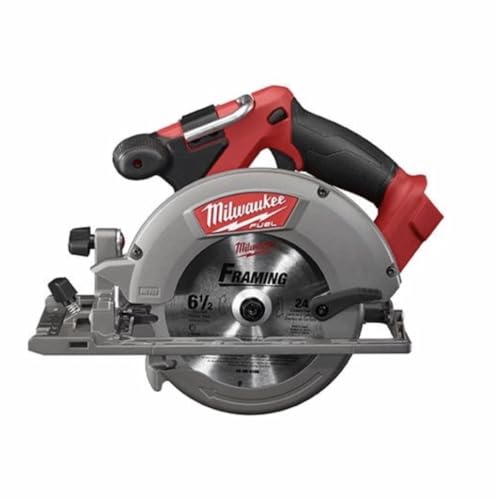
DeWalt DCS570 vs Milwaukee 2730-20 at a Glance
| Feature | DeWalt DCS570 | Milwaukee 2730-20 |
|---|---|---|
| Blade Diameter | 7-1/4 in. | 6-1/2 in. |
| Cutting Depth at 90° | 2-9/16 in. | 2-3/16 in. |
| Cutting Depth at 45° | Not listed | 1-5/8 in. |
| No-Load Speed | 5500 RPM | 5000 RPM |
| Bevel Capacity | Up to 57° | 0° to 50° |
| Motor Type | Brushless (900 W) | Brushless (18 A) |
| Electric Brake | Yes | Not listed |
| Bare Tool Weight | 7.5 lbs | 6.8 lbs |
| Shoe Material | Not listed | Magnesium |
| Blade Orientation | Right | Left |
| Best For | Framing and heavy dimensional lumber | Punch-list work and tight spaces |
Cutting Depth and Blade Size
Cutting capacity dictates what materials a circular saw can divide in a single pass without binding or rolling over stock. The DCS570 blade size measures a full 7-1/4 inches, producing a 2-9/16-inch depth of cut at 90 degrees. This extra capacity allows framing carpenters to power through dimensional 2x lumber with substantial blade exposure beneath the cut, maintaining clean chip clearance even on rough or wet jobsite lumber. In this Milwaukee 2730-20 vs DeWalt DCS570 comparison, the DeWalt saw matches the physical cut envelope of standard corded jobsite tools.
The Milwaukee 2730-20 relies on a 6-1/2-inch blade format that reaches 2-3/16 inches of depth at 90 degrees and 1-5/8 inches at 45 degrees. While 2-3/16 inches clears standard two-by material on square crosscuts, it leaves minimal margin for error when cutting uneven boards, sheet-goods layered on top of framing, or rough-sawn lumber. When evaluating a Milwaukee 6 1/2 vs DeWalt 7 1/4 circular saw, trading down in blade diameter sacrifices capacity to gain agility. As discussed in our dewalt dcs391 vs milwaukee 2730-20 overview, smaller diameter blades reduce overall tool bulk but limit material versatility.
In high-volume construction environments, the DCS570 vs 2730-20 cutting depth difference of 3/8-inch becomes critical during compound cutting. When a blade tilts for beveled cuts, effective cutting depth drops sharply. The DeWalt DCS570 retains adequate depth through steeper angles to complete complex framing cuts, whereas the Milwaukee saw can bottom out against thick materials when tilted. For pure cutting capacity across all common construction dimensions, full-size blades hold the advantage.
Edge: DeWalt DCS570 because its 7-1/4-inch blade provides an extra 3/8-inch of cutting depth at 90 degrees for greater lumber clearance.
Motor Power and Cutting Speed
Sustained rotational speed determines how smoothly a circular saw tracks through tough framing lumber without stalling under heavy feed pressure. The DeWalt DCS570 incorporates a brushless motor delivering 900 watts of output and a maximum no-load speed of 5500 RPM. This higher rotational velocity keeps blade teeth moving efficiently through dense framing materials, reducing rough tear-out and motor drag. The manufacturer documentation highlights that this brushless motor configuration can produce up to 330 crosscuts in pine 2×4 lumber on a single battery charge.
The Milwaukee 2730-20 runs on an M18 Fuel brushless motor that produces 5000 RPM with an 18-amp rating. While it delivers 500 fewer revolutions per minute than the DeWalt, the Fuel motor platform is engineered to maintain constant torque under working resistance. When comparing modern brushless setups, such as in our dewalt dcs573 vs milwaukee 2730-20 evaluation, electronic motor controls keep both platforms remarkably stable under standard cutting loads. The 5000 RPM speed of the 2730-20 handles common sheet goods and softwood framing smoothly.
Any comprehensive DeWalt DCS570 review must emphasize how 5500 RPM benefits long rips in dimensional plywood and wet lumber. Faster blade movement clears sawdust quickly, mitigating heat buildup along the blade body. While the Milwaukee 2730-20 cuts reliably, the DCS570 provides higher specified wattage and faster cutting speed for aggressive jobsite demands.
Edge: DeWalt DCS570 because its brushless motor produces 5500 RPM and 900 watts for faster linear cuts.
Bevel Capacity and Angled Cuts
Bevel versatility dictates whether a circular saw can handle compound roof pitches, rafter plumb cuts, and valley framing without hand-tool cleanup. The DeWalt DCS570 features a bevel mechanism that tilts up to 57 degrees. Standard framing work frequently encounters pitch transitions and compound angles that exceed 45 degrees, making the 57-degree stop on the DCS570 practical for specialized framing and truss fabrication.
The Milwaukee 2730-20 provides a bevel adjustment range from 0 degrees to 50 degrees, achieving a cutting depth of 1-5/8 inches at 45 degrees. A 50-degree capacity accommodates conventional roof framing, hip cuts, and basic carpentry bevels, but it leaves no margin for steeper compound angles. For contractors deciding between the DeWalt DCS570 or Milwaukee 2730-20 for framing, the additional 7 degrees of tilt on the DeWalt prevents the need to make secondary relief cuts on steep slopes.
Both tools feature bevel markings for quick angle setting, but mechanical range remains the deciding metric. The DCS570 allows carpenters to bevel deeper into aggressive architectural angles, whereas the Milwaukee 2730-20 focuses on standard carpentry angles while keeping the adjustment assembly compact.
Edge: DeWalt DCS570 because its 57-degree bevel capacity offers 7 degrees more range than the 50-degree limit on the Milwaukee saw.
Tool Weight, Ergonomics, and Handling
Handling qualities determine user fatigue when managing overhead cuts, working off ladders, or making repetitive cuts all day. The Milwaukee 2730-20 excels in physical agility, weighing 6.8 pounds according to its specification table (with a secondary tool weight listing of 6.3 pounds) and measuring 12.97 inches long by 6.48 inches wide by 7.46 inches high. Its nylon handle and magnesium shoe provide sturdy construction without adding unnecessary mass, making the tool well-balanced for one-handed positioning.
The DeWalt DCS570 weighs 7.5 pounds bare and measures 11 inches long by 8 inches wide by 10 inches high. Although the DeWalt is nearly two inches shorter in length, its 8-inch width and 10-inch height make it substantially bulkier in the hand. Carrying that additional tool weight up scaffolding or holding it extended horizontally across a full sheet of subfloor creates noticeable arm strain over time.
Blade position further influences tool ergonomics. The Milwaukee 2730-20 features a blade-left design, giving right-handed operators an unobstructed line of sight directly to the cutline without leaning across the motor housing. The DeWalt DCS570 utilizes a traditional blade-right setup. A thorough Milwaukee 2730-20 review reveals that for remodelers and trim carpenters working in tight spaces, the combination of lower weight and left-blade sightlines makes it easier to guide.
Edge: Milwaukee 2730-20 because its lighter 6.8-pound weight, narrower profile, and left-blade layout provide superior handling and line-of-sight visibility.
Safety Features and Included Components
Safety mechanisms and out-of-the-box equipment determine how practical a bare tool is on day one. The DeWalt DCS570 includes an integrated electric brake that stops the spinning 7-1/4-inch blade immediately when the trigger is released. An electric brake prevents accidental contact when setting the tool down on framing plates, staging, or sawhorses between cuts. Furthermore, the DCS570 comes supplied with a 24-tooth 7-1/4-inch circular saw blade and a blade-changing wrench, allowing immediate use with an existing battery.
The Milwaukee 2730-20 listing highlights a lightweight magnesium shoe, 5/8-inch arbor hole, and standard safety certifications including CSA, ETL, and UL. However, the listing does not specify an integrated electric brake. In terms of packaged hardware, the 2730-20 listing specifies only the bare unit and an instruction guide, requiring users to supply their own 6-1/2-inch blade before getting to work.
Having a factory-equipped electronic brake on a tool spinning at 5500 RPM provides clear jobsite peace of mind. Coupled with the included 24-tooth blade and dedicated wrench, the DCS570 delivers greater functional readiness and operator protection straight from the package.
Edge: DeWalt DCS570 because it features an electric brake and includes a 24-tooth blade and wrench in the box.
Battery System and Platform Compatibility
Both models function as bare tools within established professional cordless families: the DeWalt 20V MAX system and the Milwaukee M18 Fuel line. In this DeWalt 20V vs Milwaukee M18 circular saw decision, your current battery inventory plays a major role. If your workshop already relies on DeWalt 20V lithium-ion batteries and chargers, adding the DCS570 avoids the expense of setting up a second charging station. Those comparing other tools across platforms can review our dewalt dcs367 vs milwaukee 2720-20 breakdown to see how these ecosystems expand.
Conversely, tradespeople invested in the Milwaukee M18 cordless lineup will find that the 2730-20 accepts all standard M18 lithium-ion packs, with the manufacturer listing recommending a 4.0Ah battery pack or higher for optimal cordless runtime. If your gear already includes tools featured in our dewalt dcs380 vs milwaukee 2720-20 comparison, sticking with the M18 system preserves battery interchangeability on the job.
Because both brands offer deep tool ecosystems supported by lithium-ion battery technology, neither platform holds a clear technical advantage in battery availability alone. Both tools draw steady current from their respective 18V or 20V packs to maintain high brushless output across framing lumber and wood panels.
Edge: Tie because both the DeWalt 20V MAX and Milwaukee M18 platforms offer vast cordless tool lineups and reliable lithium-ion power.
Pros and Cons
DeWalt DCS570

Pros
- 7-1/4-inch blade with 2-9/16-inch cut depth
- Fast 5500 RPM brushless motor
- Deep 57-degree maximum bevel capacity
- Integrated electric blade brake
- Includes 24-tooth blade and wrench
Cons
- Heavier 7.5-pound bare tool weight
- Bulkier 8-inch width body profile
Milwaukee 2730-20

Pros
- Lightweight 6.8-pound bare tool weight
- Compact 12.97-inch tool frame
- Left-blade orientation for clear sightline
- Durable magnesium shoe construction
Cons
- Shallower 2-3/16-inch maximum cut depth
- Bevel capacity limited to 50 degrees
- Blade not included in package
View Milwaukee 2730-20 on Amazon
Who Should Buy Each One
Choose the DeWalt DCS570 If
- You cut dimensional 2x lumber, thick framing members, or stacked sheet goods requiring a 2-9/16-inch cutting depth.
- You frame complex roof structures and hip rafters that demand up to 57 degrees of bevel capacity.
- You value the added safety of an integrated electric brake that stops the blade quickly upon trigger release.
- You already own DeWalt 20V MAX batteries and want a saw that includes a 24-tooth blade and wrench out of the box.
Choose the Milwaukee 2730-20 If
- You want a lighter 6.8-pound saw for overhead work, soffits, and punch-list carpentry on ladders.
- You prefer a left-blade orientation for direct line-of-sight view along the cutline as a right-handed user.
- You already run Milwaukee M18 batteries and prefer a narrower, compact tool body for tight workspaces.
- You primarily cut 1x stock, standard 2x lumber, and plywood where a 2-3/16-inch cut depth is sufficient.
Final Verdict
For general contractors, deck builders, and structural framers, the DeWalt DCS570 is the superior overall choice. Its 7-1/4-inch blade provides a generous 2-9/16-inch cut depth at 90 degrees, easily clearing dimensional lumber even through aggressive compound bevels up to 57 degrees. With a 5500 RPM brushless motor, an integrated electric blade brake, and an included 24-tooth blade, the DCS570 performs as a full-fledged replacement for a traditional corded framing saw.
The Milwaukee 2730-20 remains the better selection for punch-list specialists, remodelers, and carpenters who prioritize agility over deep cut capacity. Weighing just 6.8 pounds with a compact frame, magnesium shoe, and left-blade layout, it delivers exceptional control for overhead work and tight cuts. If your typical cuts stay within its 2-3/16-inch depth limit and you already operate on the M18 platform, the 2730-20 offers unmatched maneuverability.
FAQ
What is the cutting depth difference between the DCS570 and 2730-20?
The DeWalt DCS570 provides a maximum cutting depth of 2-9/16 inches at 90 degrees with its 7-1/4-inch blade. The Milwaukee 2730-20 provides a cutting depth of 2-3/16 inches at 90 degrees and 1-5/8 inches at 45 degrees with its 6-1/2-inch blade.
Which saw is better for framing dimensional lumber?
The DeWalt DCS570 is better suited for framing because its 7-1/4-inch blade, 2-9/16-inch cutting capacity, and 57-degree bevel adjustment allow it to cut thicker timber and execute steep rafter cuts without running out of blade clearance.
Does the Milwaukee 2730-20 include an electric brake?
The product listing for the Milwaukee 2730-20 does not specify an electric brake, whereas the DeWalt DCS570 listing explicitly highlights an electric brake as a key special feature.
What accessories are included in the box with each saw?
The DeWalt DCS570 includes the 7-1/4-inch circular saw, one 24-tooth 7-1/4-inch blade, and a blade-changing wrench. The Milwaukee 2730-20 listing includes only the bare tool and an instruction guide.
Is Milwaukee 2730-20 worth it compared to a full-size saw?
Yes, the Milwaukee 2730-20 is worth it for tradespeople who value maneuverability, as its 6.8-pound weight, compact frame, and left-blade orientation reduce fatigue during overhead cuts and light remodeling tasks.
What are the no-load motor speeds for both circular saws?
The DeWalt DCS570 brushless motor achieves a no-load speed of 5500 RPM with a 900-watt rating, while the Milwaukee 2730-20 brushless motor operates at 5000 RPM with an 18-amp rating.
Are batteries included with the DeWalt DCS570 or Milwaukee 2730-20?
No, both models are sold as bare tools. The DeWalt DCS570 requires one 20V lithium-ion battery, and the Milwaukee 2730-20 requires one M18 18V lithium-ion battery, each purchased separately.