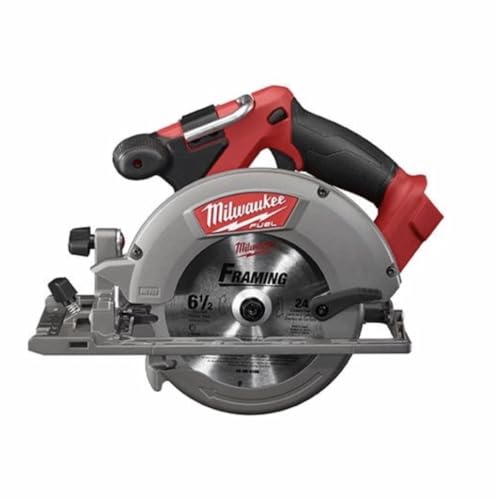
When deciding between the DeWalt DCS573 and the Milwaukee 2730-20, the primary factor that will dictate your choice is the difference between full-size cutting capacity and lightweight cutting portability. The DeWalt circular saw utilizes a 7-1/4-inch blade engineered for full cut depth on dimensional framing lumber and thick sheet goods, while the Milwaukee circular saw relies on a 6-1/2-inch blade platform designed to reduce overall tool bulk and upper-body fatigue during quick cuts and overhead tasks.
Choose the DeWalt DCS573 if your daily workload demands deep bevel cuts, maximum motor speed, and seamless integration with high-demand framing applications. Choose the Milwaukee 2730-20 if you want a compact, maneuverable saw with a left-side blade configuration that excels at punch-list trimming, punch-out remodeling, and working in tight quarters.

DeWalt DCS573 vs Milwaukee 2730-20 at a Glance
| Attribute | DeWalt DCS573 | Milwaukee 2730-20 |
|---|---|---|
| Blade Diameter | 7-1/4 inches | 6-1/2 inches |
| Maximum Cut Depth at 90 Degrees | 2-9/16 inches | 2-3/16 inches |
| Maximum Cut Depth at 45 Degrees | 2 inches | 1-5/8 inches |
| No-Load Speed | 5,500 RPM | 5,000 RPM |
| Motor Type | Brushless | Brushless |
| Voltage System | 20V MAX (FLEXVOLT Advantage) | 18V (M18 FUEL) |
| Bare Tool Weight | 8.2 pounds | 6.8 pounds |
| Tool Dimensions | 15.25″L x 9.75″W x 8.25″H | 12.97″L x 6.48″W x 7.46″H |
| Blade Orientation | The listing does not specify | Blade Left |
| Safety and Jobsite Features | Electric brake, LED light, rafter hook, dust port | Magnesium shoe, bevel to 50 degrees |
| Best For | Heavy framing, deep cuts, and maximum power | Lightweight trimming, punch lists, and overhead work |
Cutting Capacity and Blade Diameter
The defining operational divergence between these two cordless saws centers entirely on blade diameter and the resulting depth of cut. The DCS573 swings a full-sized 7-1/4-inch blade, which unlocks a maximum cutting depth of 2-9/16 inches at a 90-degree straight cut and a 2-inch cutting depth at a 45-degree bevel. This added capacity gives carpenters the clearance needed to slice through standard two-by dimensional lumber even when making compound bevel cuts, or when cutting through stacked sheet material and irregular framing stock in a single pass.
By contrast, the 2730-20 uses a smaller 6-1/2-inch blade size that reaches a maximum cut depth of 2-3/16 inches at 90 degrees and 1-5/8 inches at a 45-degree angle. While a 2-3/16-inch depth cleanly cuts standard two-by lumber on a perpendicular 90-degree pass, the 1-5/8-inch capacity at a 45-degree bevel leaves a very narrow margin when clearing nominal 1-1/2-inch lumber, especially if boards are slightly cupped or crowned. When evaluating the Milwaukee 2730-20 blade size against the deeper DeWalt DCS573 cut depth, the physical difference alters the scope of work you can accomplish without flipping boards over.
Similar capacity considerations arise when evaluating the dewalt dcs570 vs milwaukee 2730-20, where blade size dictates overall jobsite capability. For carpenters handling rough framing, heavy subflooring, or thick engineered lumber, the 7-1/4-inch blade format of the DCS573 provides cutting versatility that a 6-1/2-inch saw cannot match, eliminating blade-guard hang-ups on thick structural cuts.
Edge: DeWalt DCS573 delivers significantly greater cut depth at both 90-degree and 45-degree angles, making it far more capable on thick materials.
Motor Performance and Cutting Speed
Motor engineering determines how well a cordless circular saw sustains momentum through wet lumber, dense hardwoods, and knotty construction framing. The DCS573 features a brushless motor operating at 5,500 RPM, giving it a noticeable speed advantage over standard cordless models. In addition, DeWalt equips this tool with FLEXVOLT Advantage technology, which electronically senses the attached battery pack and unlocks up to 77 percent more power when paired with a DCB606 FLEXVOLT battery compared to a standard DCB205 20V MAX pack.
The 2730-20 runs on an 18V brushless motor that produces a no-load speed of 5,000 RPM with an 18-amp current rating. While 5,000 RPM provides smooth, clean crosscuts through plywood and two-by framing lumber, the DeWalt DCS573 RPM rating of 5,500 offers higher blade tip velocity for rapid linear rip cuts. The M18 FUEL motor inside the Milwaukee tool is exceptionally efficient and durable, but the listing does not specify an electronic power-boost technology comparable to DeWalt’s FLEXVOLT Advantage system.
Much like comparisons between the dewalt dcs391 vs milwaukee 2730-20, motor architecture directly influences whether a saw bogs down under continuous feed pressure. The DCS573 utilizes its higher rotational speed and battery-sensing electronics to chew through dense wood without bogging down, giving production framers extra reserve power when pushing the saw hard.
Edge: DeWalt DCS573 wins on raw motor performance due to its higher 5,500 RPM no-load speed and power-multiplying FLEXVOLT Advantage engineering.
Size, Weight, and Maneuverability
Portability and daily ergonomics present the opposite side of the capacity coin. The Milwaukee 2730-20 is built specifically for users who value physical agility, weighing in at just 6.8 pounds (with the description also noting a 6.3-pound tool weight) and measuring 12.97 inches long, 6.48 inches wide, and 7.46 inches high. Its compact profile makes it an effortless tool to carry up a ladder, slip between wall studs, or handle one-handed for rapid cutoff chores.
The DeWalt DCS573 is noticeably larger and heavier, measuring 15.25 inches in length, 9.75 inches in width, and 8.25 inches in height, with a bare weight of 8.2 pounds. Once you attach a large FLEXVOLT battery to capture the tool’s maximum power output, the complete operating assembly becomes substantially heavier than the Milwaukee setup. When reviewing the DCS573 vs 2730-20 specs, that extra weight and length can cause increased shoulder strain during prolonged overhead trimming or continuous ceiling cutouts.
Physical footprint and balance influence handling much as they do in the dewalt dcs367 vs milwaukee 2720-20 matchup, where compact dimensions benefit elevated work. Furthermore, the 2730-20 features a blade-left configuration, which provides right-handed users with an unobstructed line of sight directly over the shoe to the cut line. The DCS573 listing does not specify blade orientation, but the compact dimensions and lightweight build of the 2730-20 make it the superior tool for all-day carrying ease.
Edge: Milwaukee 2730-20 takes the lead in portability thanks to its lighter frame, shorter body length, and clear blade-left sightline.
Safety Features, Visibility, and Jobsite Utility
Jobsite productivity relies on smart auxiliary features that keep the operator safe and the working environment clean. The DCS573 comes comprehensively equipped with high-utility functional additions. It includes an electric brake that actively halts the spinning blade the instant the trigger is released, significantly reducing the danger of kickback or accidental contact between cuts. It also incorporates a bright LED work light that illuminates cut lines in dimly lit framing bays, an integrated rafter hook for convenient staging on roof trusses, and an included dust port compatible with the DeWalt AirLock system or a 35 mm dust extractor.
Safety controls and jobsite accessories matter just as significantly as they do when evaluating the dewalt dcs380 vs milwaukee 2720-20 for rough cutting duties. In comparison, the 2730-20 listing highlights a durable magnesium shoe and a bevel capacity ranging from 0 to 50 degrees, meeting UL, CSA, and ETL safety listings. However, the listing for the 2730-20 does not specify an electric brake, an LED work light, an integrated rafter hook, or a dust extraction port.
The DCS573 also incorporates a built-in Tool Connect Chip pocket that accepts the DCE042 chip (sold separately) for digital tool tracking through the Tool Connect Site Manager app. These added conveniences give the DeWalt saw a major functional advantage in workshop cleanliness, low-light visibility, and secure jobsite storage.
Edge: DeWalt DCS573 provides far superior convenience features, including an electric brake, integrated LED light, dust extraction port, and rafter hook.
Framing and Heavy Construction Utility
When asking whether to pick the DeWalt DCS573 or Milwaukee 2730-20 for framing, the mechanical demands of residential and commercial carpentry clearly favor full-capacity tools. Framing requires frequent bevel cuts on roof rafters, valley boards, and floor joists. Because the DCS573 maintains a full 2-inch cutting depth at 45 degrees, it cleanly slices through 1-1/2-inch dimensional lumber at severe angles without requiring the carpenter to flip the lumber or finish the cut with a handsaw.
Matching tool capacity to construction scope is as critical here as it is when selecting cutting tools in the dewalt dcs367 vs milwaukee 2821-20 comparison. The 2730-20 can cut straight through two-by lumber at 90 degrees with its 2-3/16-inch capacity, but its 1-5/8-inch depth at 45 degrees provides minimal leeway. If framing lumber is swollen from jobsite moisture or slightly distorted, a 1-5/8-inch depth can bind or fail to sever the timber completely at full bevel.
Furthermore, the built-in rafter hook on the DCS573 allows carpenters working on ladders, staging, or joist layouts to hang the tool safely over a 2×4 or rafter between cuts. In a direct Milwaukee 2730-20 vs DeWalt DCS573 framing evaluation, the DeWalt saw is purpose-built for heavy-duty structural timber, while the Milwaukee model functions best as an agile punch-list or secondary remodeling tool.
Edge: DeWalt DCS573 is engineered for heavy structural framing, offering the necessary bevel cut depth and hanging utility that demanding jobsite builds require.
Pros and Cons
DeWalt DCS573

Pros
- Full 7-1/4-inch blade capacity
- Deep 2-9/16-inch cut depth at 90 degrees
- Fast 5,500 RPM brushless motor
- Instant-stop electric brake
- Integrated rafter hook and LED light
Cons
- Heavier 8.2-pound bare tool weight
- Larger overall physical footprint
Milwaukee 2730-20

Pros
- Lightweight 6.8-pound bare tool body
- Compact 12.97-inch overall length
- Left-side blade for clear cut line visibility
- Sturdy magnesium shoe construction
Cons
- Shallower 2-3/16-inch maximum cut depth
- Listing does not specify electric brake or LED
View Milwaukee 2730-20 on Amazon
Who Should Buy Each One
Choose the DeWalt DCS573 If
- You need a full 2-9/16-inch cut depth at 90 degrees and 2 inches at 45 degrees for framing dimensional lumber.
- You want an instant-stopping electric brake and an integrated LED work light for elevated safety and visibility.
- You already own DeWalt 20V MAX or FLEXVOLT batteries and want up to 77 percent more power on demanding cuts.
- You need integrated dust collection hookups compatible with AirLock systems or standard 35 mm extractors.
Choose the Milwaukee 2730-20 If
- You prioritize a lightweight 6.8-pound tool frame to reduce upper-body fatigue on long workdays.
- You prefer a blade-left configuration for clear, direct cut line visibility as a right-handed operator.
- You are invested in the Milwaukee M18 battery platform and want a compact saw for sheet goods and straight two-by lumber.
- You frequently make overhead cuts, climb ladders, or work inside cramped spaces where a smaller footprint matters.
Final Verdict
For the vast majority of general contractors, carpenters, and woodworkers, the DeWalt DCS573 is the superior investment. Any thorough DeWalt DCS573 review highlights its true full-size 7-1/4-inch blade capability, commanding 5,500 RPM motor speed, and 2-inch cut depth at a 45-degree bevel. Combined with valuable jobsite features like an electric blade brake, an integrated rafter hook, an LED light, and optional dust extraction, the DCS573 delivers the full-scale performance required to tackle framing, decking, and rough construction tasks without compromise.
Still, is Milwaukee 2730-20 worth it for tradespeople who prioritize agility? Absolutely. As a dedicated Milwaukee 2730-20 review demonstrates, this 6-1/2-inch saw provides exceptional handling, weighing roughly 1.4 pounds less than the DeWalt while maintaining a durable magnesium shoe and 5,000 RPM brushless motor. If your daily routine consists primarily of sheet-good sizing, interior remodeling, punch-list fixes, and overhead cuts where excessive tool weight becomes exhausting, the Milwaukee 2730-20 serves as an outstanding, ultra-portable cutting companion.
FAQ
What is the difference in cut depth between the DeWalt DCS573 and Milwaukee 2730-20?
The DeWalt DCS573 provides a maximum cutting depth of 2-9/16 inches at 90 degrees and 2 inches at 45 degrees using its 7-1/4-inch blade. The Milwaukee 2730-20 delivers a maximum cutting depth of 2-3/16 inches at 90 degrees and 1-5/8 inches at 45 degrees with its 6-1/2-inch blade.
Can the DeWalt DCS573 run on standard DeWalt 20V batteries?
Yes, the DCS573 is fully compatible with standard DeWalt 20V MAX lithium-ion batteries. However, it features FLEXVOLT Advantage technology, meaning it communicates electronically with FLEXVOLT battery packs like the DCB606 to produce up to 77 percent more power than when paired with a standard DCB205 pack.
Which side is the blade mounted on for each saw?
The Milwaukee 2730-20 listing specifies a blade-left design, which allows right-handed operators to view the cut line and blade edge directly without leaning over the saw. The DeWalt DCS573 listing does not specify blade orientation.
Does the Milwaukee 2730-20 cut through 2x lumber at a 45-degree bevel?
The Milwaukee 2730-20 has a cutting depth of 1-5/8 inches at a 45-degree angle. Because standard two-by dimensional lumber measures 1-1/2 inches thick, it will cut through flat, clean stock at 45 degrees, but it leaves very little margin for lumber that is warped, cupped, or swollen.
What accessories come in the box with each circular saw?
The DeWalt DCS573 bare tool package includes the circular saw, a 24-tooth DWA171424 saw blade, a blade change wrench, and a dust port attachment. The Milwaukee 2730-20 package includes the bare saw unit and an instruction guide.
Is the Milwaukee 2730-20 brushless?
Yes, the Milwaukee 2730-20 is part of the M18 FUEL product line and is equipped with a brushless motor delivering a no-load speed of 5,000 RPM.