When deciding between the DeWalt DCD771 and the DeWalt DCD777, the single difference that decides the choice for most buyers is motor construction: the DCD771 relies on a traditional brushed motor paired with two compact batteries, whereas the DCD777 features an upgraded brushless motor that delivers greater runtime efficiency and higher power output.
Homeowners seeking a complete, ready-to-work starter kit for occasional household tasks should choose the DCD771, while active DIYers who demand longer runtime, a more compact tool body, and modern motor durability should invest in the DCD777.

DeWalt DCD771 vs DCD777 at a Glance
| Feature | DeWalt DCD771 | DeWalt DCD777 |
|---|---|---|
| Motor Type | Brushed | Brushless |
| Power Output | 300 UWO | 340 UWO |
| Maximum Rotational Speed | 1,500 RPM (2 Speeds: 0-450 & 1,500 RPM) | 1,500 RPM (2 Speeds) |
| Torque Rating | 530 in-lb (650 in-lb max listed) | 53.1 Nm |
| Chuck Size & Style | 1/2-inch single sleeve ratcheting | 1/2-inch single sleeve ratcheting |
| Battery Included | (2) 1.3 Ah 20V MAX Lithium-Ion | (1) 2.0 Ah 20V MAX Lithium-Ion |
| Tool Length | The listing does not specify | 7.6 inches front to back |
| Integrated Worklight | The listing does not specify | LED with 20-second trigger delay |
| Wood Drilling Capacity | 30 mm | 0.5 inches |
| Metal Drilling Capacity | 13 mm | 0.5 inches |
| Included Storage | Durable contractor bag | The listing does not specify |
| Best For | Intermittent household DIY and general repairs | Frequent DIY projects and extended drilling sessions |
Motor Technology and Efficiency
Motor design serves as the defining engineering divide in any head-to-head brushless vs brushed drill matchup. The DCD771 incorporates a conventional brushed motor, which relies on physical carbon brushes pressing against a rotating commutator to deliver electrical current. While this mechanical setup has been a dependable workhorse in power tools for decades, physical contact generates continuous friction and heat during operation. Over time, that internal friction drains battery reserves faster and creates wear on internal motor components during sustained drilling sessions.
In contrast, the DCD777 utilizes a modern brushless motor that replaces physical contact brushes with an electronic circuit board and magnetic rotor. By eliminating mechanical contact inside the drive unit, the tool wastes significantly less energy as ambient heat and transfers more raw electrical power directly into rotational driving force. This friction-free operation explains why the DCD777 achieves 340 unit watts out (UWO) of maximum power compared to the 300 UWO produced by the brushed DCD771, giving users noticeably higher efficiency under continuous load.
When assessing DCD771 vs DCD777 brushless performance across demanding home improvement tasks, this motor upgrade translates to cooler running temperatures, reduced internal component wear, and greater operational lifespan. The brushless platform in the DCD777 handles repeated screw driving and timber boring without the thermal stress typical of entry-level brushed designs, making it substantially better equipped for intensive project schedules.
Edge: DeWalt DCD777. Its brushless motor eliminates internal friction, delivering cooler operation, longer service life, and superior electrical efficiency under load.
Battery Capacity and Real-World Runtime
Runtime determines whether you spend your afternoon making progress on a build or waiting by an electrical outlet for battery packs to recharge. Looking at the DeWalt DCD771 specs, the kit includes two compact 20V MAX 1.3 Ah lithium-ion batteries. Having dual batteries allows users to keep one pack on the charger while the other powers the drill, creating a continuous rotation system. However, a 1.3 Ah pack stores a relatively modest charge reservoir, meaning each individual battery discharges fairly quickly when driving large lag screws or drilling through dense hardwoods.
The DCD777 approaches job-site stamina differently by supplying a single 2.0 Ah battery pack. Although the package includes only one battery rather than two, the 2.0 Ah capacity provides over 50 percent more energy storage than a single 1.3 Ah battery. When combined with the brushless motor’s efficient energy regulation, the brushed versus brushless drill motor difference becomes immediately apparent: the DCD777 draws fewer amps per minute of work, stretching every milliamp-hour of battery storage further than the brushed unit ever could.
In practical DCD771 vs DCD777 runtime evaluations, the DCD777 stays powered through substantially more fastener cycles on a single charge than the DCD771 manages on its smaller pack. While the DCD771 compensates by offering an instant swap with its second included battery, users working on extensive framing or deck building will find themselves swapping and recharging those 1.3 Ah packs frequently. The DCD777 minimizes tool interruptions by operating significantly longer before requiring a trip back to the charging station.
Edge: DeWalt DCD777. The combination of a 2.0 Ah battery pack and an energy-efficient brushless motor provides noticeably longer continuous working time per charge.
Power Output and Drilling Performance
Power output dictates the size of drill bits you can spin and how smoothly the tool drives heavy fasteners into tough materials without stalling. The DCD771 delivers up to 300 UWO and lists a torque rating between 530 and 650 in-lb, running on a 2-speed transmission that offers a low-speed fastening range (0-450 RPM) and a high-speed drilling setting (up to 1,500 RPM). This output provides ample muscle for standard residential tasks such as drilling 30 mm holes in softwood or boring 13 mm holes in light metal sheets.
When reviewing the DeWalt DCD777 specs, power jumps to 340 UWO, supported by a 53.1 Nm torque rating (approximately 470 in-lb) and a dual-speed transmission topping out at 1,500 RPM. While raw torque specifications across listings can vary based on testing standards, the 40 UWO increase in working power is meaningful. Unit watts out measures the tool’s ability to maintain rotational speed under resistance, meaning the DCD777 resists bogging down when driving wider spade bits or sinking long construction screws into framing lumber.
In day-to-day drilling tasks, both tools feature a 1/2-inch single-sleeve ratcheting chuck that accepts standard heavy-shank drill bits with solid bit-gripping strength. However, when drilling through stubborn knots or pushing toward maximum drilling capacities, the DCD777 maintains higher wheel speed and cleaner chip ejection due to its 340 UWO output. The DCD771 handles general maintenance admirably, but it slows down noticeably sooner when pushed against heavy mechanical resistance.
Edge: DeWalt DCD777. Delivering 340 UWO compared to 300 UWO on the DCD771, it maintains higher working speed and resists stalling under heavier drilling resistance.
Tool Dimensions, Ergonomics, and Worklight
Physical handling and spatial clearance can make or break a drill when working in cramped spots like under bathroom vanities, between wall studs, or inside kitchen cabinetry. The DCD777 is engineered specifically as a compact tool, measuring just 7.6 inches from the tip of the chuck to the back of the motor housing. This short front-to-back profile gives operators superior leverage in narrow gaps where full-sized cordless drills simply cannot fit without binding.
For the DCD771, the manufacturer listing does not specify the exact bare-tool front-to-back length, providing only kit package dimensions (13.88 inches long by 9.88 inches wide by 4.25 inches high). However, traditional brushed motors inherently require longer housings to accommodate internal carbon brushes and copper commutators, resulting in a noticeably longer tool body. While the ergonomic handle delivers comfortable grip contours and balanced handling for general benchtop tasks, the longer head makes navigating tight corners and cramped framing cavities more cumbersome.
Visibility is another major differentiator where modern brushless vs brushed motor technology enhancements shine. The DCD777 integrates a forward-facing LED worklight with a built-in 20-second trigger release delay. When you release the trigger, the light remains illuminated for 20 seconds, allowing you to inspect screw placement and locate pilot holes in dark corners without holding the trigger down. The DCD771 listing does not specify an integrated LED worklight, forcing users to rely on ambient room lighting or an external flashlight when working in poorly lit closets or basement corners.
Edge: DeWalt DCD777. Its compact 7.6-inch length provides better access in tight spots, while the integrated 20-second delay LED illuminates dark work areas effectively.
Kit Inclusions and Out-of-the-Box Value
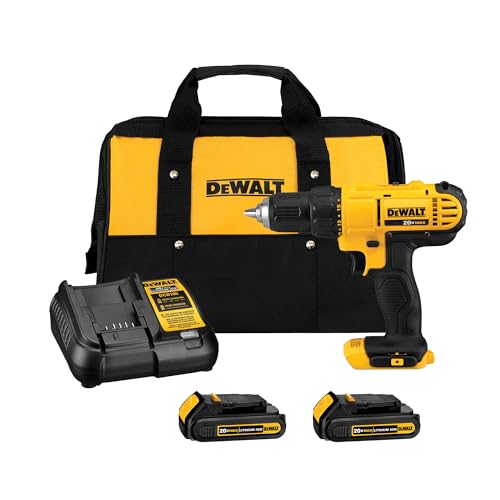
A cordless drill is only as practical as the accessories and power sources packaged in the box. Any comprehensive DeWalt DCD771 review must highlight its standout packaging advantage: the DCD771C2 kit includes two 20V MAX 1.3 Ah lithium-ion batteries, a compatible charger, and a durable heavy-duty contractor storage bag. Having two batteries immediately available right out of the box provides outstanding convenience for homeowners who want to complete chores without worrying about buying spare batteries separately.
The DCD777 package (model DCD777D1) takes a different approach by including only one 2.0 Ah battery and a charger, while the listing does not specify an included contractor bag. For buyers who do not already own other tools within the DeWalt 20V MAX ecosystem, owning a single battery creates inevitable downtime whenever that pack runs out of power during a weekend project. To achieve continuous two-battery rotation on the DCD777, users must purchase a second battery pack separately, adding extra cost and logistics to their setup.
Furthermore, the contractor bag included with the DCD771 offers a convenient, rugged method to transport and organize the drill, both battery packs, the charger, and a selection of drill bits in a utility closet or vehicle trunk. Because the DCD777 listing does not specify a storage bag or hard case, buyers must source their own toolbox or storage solution. For basic home maintenance, the all-in-one readiness of the DCD771 package provides distinct practical value.
Edge: DeWalt DCD771. Shipping with two batteries and a rugged contractor bag, it provides complete out-of-the-box readiness without requiring extra accessory purchases.
Application Suitability and DIY Versatility
Understanding the intended scope of work is essential when deciding between the DeWalt DCD771 or DCD777 for DIY applications. Both tools operate as versatile two-in-one machines, functioning equally well as variable-speed electric screwdrivers and cordless hand drills. They excel at assembling flat-pack furniture, hanging curtain rods, installing shelving brackets, mounting cabinetry, and boring pilot holes for wall anchors in drywall, plastics, and dimensional lumber.
However, both models share definite mechanical boundaries. According to the manufacturer data, neither tool is suitable for drilling into concrete or masonry, nor are they intended for heavy-duty industrial fabrication. Neither drill features a hammer-drill mechanism, meaning attempting to bore into poured concrete or brick foundations will simply dull standard bits and overheat the motor. For heavy structural steel or masonry anchors, a dedicated rotary hammer or hammer drill is mandatory.
Where the two models diverge within residential DIY is project intensity. When assessing brushless vs brushed mechanics, the DCD771 is tailored for short-duration home repairs, picture hanging, and quick maintenance tasks. The DCD777, backed by 340 UWO of power, a 7.6-inch compact chassis, and a 3-year limited warranty (the DCD771 listing does not specify warranty duration), handles extensive remodeling projects, deck building, and frequent woodworking tasks with far greater stamina and physical maneuverability.
Edge: Tie. Both models cover the same broad range of non-masonry household drilling and screwdriving applications, while both are restricted from concrete and heavy industrial work.
Pros and Cons
DeWalt DCD771

Pros
- Includes two 20V MAX batteries
- Contractor storage bag included
- Two-speed 1500 RPM transmission
- 1/2-inch single-sleeve ratcheting chuck
Cons
- Brushed motor reduces runtime efficiency
- Smaller 1.3 Ah battery capacity
- LED worklight not listed
DeWalt DCD777

Pros
- Efficient brushless motor technology
- Higher 340 UWO power output
- Compact 7.6-inch front-to-back length
- LED light with 20-second delay
- Larger 2.0 Ah battery pack
Cons
- Includes only one battery pack
- Contractor bag not listed in kit
Who Should Buy Each One
Choose the DeWalt DCD771 If
- You want a complete out-of-the-box drill kit that includes two batteries, a charger, and a durable contractor storage bag.
- Your projects primarily consist of basic household maintenance, furniture assembly, hanging wall art, and light drywall fastening.
- You value having an immediate spare battery charging on the wall so you can swap packs instantly during quick weekend tasks.
- You do not frequently work in tight cabinetry or dark spaces where a compact 7.6-inch tool head or delayed LED light is critical.
Choose the DeWalt DCD777 If
- You tackle frequent woodworking, room renovations, or extensive DIY projects that demand maximum runtime and motor durability.
- You need a compact 7.6-inch front-to-back tool profile to drive fasteners inside cramped cabinet boxes, closets, and between wall studs.
- You regularly work in dimly lit areas and need the integrated LED worklight with its 20-second trigger shutoff delay.
- You want 340 UWO of drilling muscle and plan to build an extensive collection on the shared DeWalt 20V MAX battery platform.
Final Verdict
In this comprehensive DeWalt 20V drill comparison, the DeWalt DCD777 emerges as the superior long-term investment for the vast majority of active woodworkers, remodelers, and serious DIYers. Its brushless motor architecture delivers notable practical advantages over brushed technology, including higher energy efficiency, cooler operation, and a more potent 340 UWO power output. Combined with a larger 2.0 Ah battery pack, a compact 7.6-inch head length, an integrated 20-second delay LED light, and a 3-year limited warranty, the DCD777 offers the refined performance required for modern home improvement projects.
The DeWalt DCD771 remains an attractive, reliable option for casual homeowners whose drilling needs are strictly intermittent. If your primary goal is to keep an accessible cordless drill in a utility closet for assembling occasional furniture, hanging shelves, and driving loose drywall screws, the DCD771 provides exceptional package completeness. With two 20V MAX batteries and a contractor bag included right out of the box, it delivers dependable, straightforward drilling utility without requiring you to purchase extra gear.
FAQ
Can either the DCD771 or DCD777 drill into concrete or brick?
No, neither the DCD771 nor the DCD777 is designed for concrete, brick, or masonry drilling. The manufacturer specifications explicitly note that the DCD771 is not suitable for masonry or concrete applications. Both tools are rotary drill/drivers without a hammer-drilling mechanism, making them suitable only for wood, plastics, drywall, and light metals.
Do the DCD771 and DCD777 share the same battery platform?
Yes, both models operate on the DeWalt 20V MAX lithium-ion battery platform. The 1.3 Ah batteries included with the DCD771 and the 2.0 Ah battery included with the DCD777 are fully interchangeable across both drill bodies and compatible with the broader ecosystem of DeWalt 20V MAX power tools and chargers.
Is the DCD777 worth the upgrade over the DCD771?
When asking is DCD777 worth it, the answer depends entirely on project frequency. For frequent DIYers and hobbyists, the upgrade to the DCD777 is well justified because its brushless motor provides longer runtime, 340 UWO of power, a compact 7.6-inch tool length, and an integrated LED worklight. For occasional household repairs, the DCD771 remains completely adequate.
Does the DeWalt DCD771 include a built-in worklight?
The product listing for the DCD771 does not specify an integrated LED worklight. In contrast, the DCD777 specifically features an integrated LED worklight equipped with a 20-second trigger release delay that keeps the work area illuminated after the trigger is released.
What does UWO mean on these DeWalt drills?
UWO stands for Unit Watts Out, which is DeWalt’s standardized metric for measuring the maximum power output of a drill driver. It reflects the combined speed and torque capabilities of the tool under load. The DCD777 delivers 340 UWO, giving it approximately 13 percent more working power under resistance than the 300 UWO delivered by the DCD771.
Which drill is better suited for working inside tight cabinets?
The DCD777 is noticeably better suited for confined spaces due to its compact 7.6-inch front-to-back length and its integrated LED worklight. Its shorter housing fits easily between narrow cabinet partitions, while the light illuminates dark cabinet corners during fastener installation.