The core decision between the DeWalt DWE7491RS and the Bosch 4100XC-10 comes down to whether you prioritize a larger cutting capacity paired with a geared fence or advanced electronic motor controls paired with effortless stand mechanics. While both machines operate on standard 15-amp jobsite power and ride on wheeled stands, the DeWalt engineered its chassis around a class-leading 32-1/2-inch rip width and a rack-and-pinion rail system, whereas the Bosch emphasizes circuit protection, constant cutting speed under heavy load, and rapid single-action mobility.
Woodworkers, deck builders, and cabinet installers who regularly rip full four-by-eight sheet goods or wide framing lumber should choose the DeWalt DWE7491RS for its fence accuracy and extra table clearance. Mobile remodeling contractors and solo tradespeople navigating stairs and crowded worksites should pick the Bosch 4100XC-10 for its lower transport weight, smooth motor ramp-up, and single-lever stand folding action.
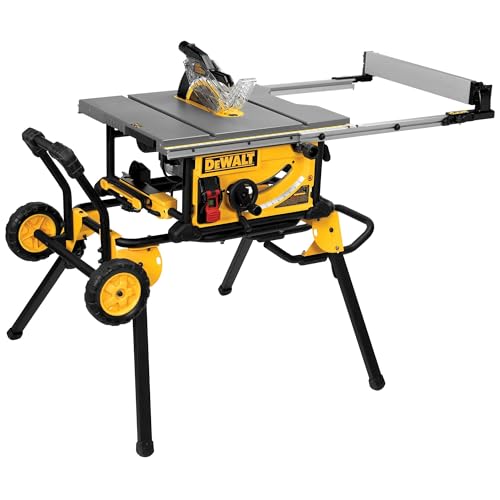
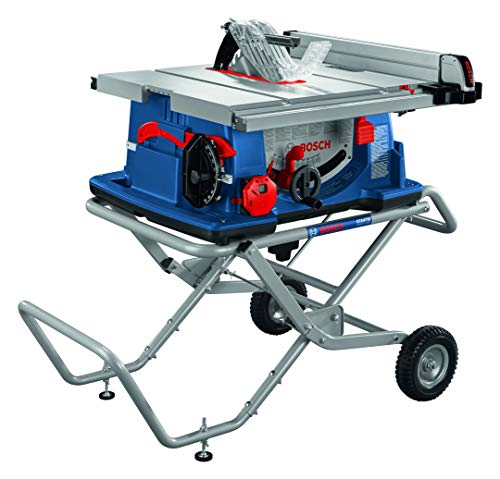
DeWalt DWE7491RS vs Bosch 4100XC-10 at a Glance
| Attribute | DeWalt DWE7491RS | Bosch 4100XC-10 |
|---|---|---|
| Motor Rating | 15 Amp | 15 Amp (4.0 Max HP) |
| No-Load Speed | 4,800 RPM | 3,650 RPM |
| Maximum Rip Capacity | 32-1/2 inches | 30 inches |
| Rip Fence Mechanism | Rack and Pinion Telescoping | SquareLock |
| Stand Mechanism | Folding Rolling Stand | GTA47W Gravity-Rise Wheeled Stand |
| Depth of Cut at 90° | 3-1/8 inches | Not listed |
| Depth of Cut at 45° | 2-1/4 inches | Not listed |
| Electronic Motor Management | Blade Brake | Soft-Start, Constant Response, Restart Protection |
| Factory Blade | 10-inch, 24-Tooth Carbide | 10-inch, 50-Tooth |
| Total Unit Weight | 110 pounds | 94 pounds |
| Dust Collection Port | 2-1/2 inches | Not listed |
| Warranty Coverage | 3-Year Limited Warranty | Limited Warranty |
| Best For | Workshop woodworkers and wide sheet ripping | Mobile contractors needing easy transport and soft starting |
Rip Capacity and Fence Accuracy
Rip capacity dictates the maximum width of stock you can safely guide between the saw blade and the fence. When comparing the DWE7491RS vs 4100XC-10 rip capacity, the DeWalt delivers 32-1/2 inches to the right of the blade, while the Bosch provides 30 inches. That 2-1/2-inch variance directly changes how you handle sheet goods: a 32-1/2-inch capacity allows you to cleanly bisect a standard four-foot-wide sheet of plywood or sheet material down the center with room to spare, whereas a 30-inch capacity limits your single-pass breakdown dimensions. For contractors ripping filler boards, wide shelving, or exterior siding, those extra inches prevent awkward workarounds on the jobsite.
The adjustment mechanism is where these two machines diverge dramatically in daily operation. The DeWalt DWE7491RS rack and pinion fence system utilizes geared tracks mounted to the front and rear rails. Turning the adjustment dial moves both ends of the fence simultaneously in micro-increments, locking it rigidly parallel to the blade without manual alignment checks. In contrast, the 4100XC-10 relies on the Bosch SquareLock rip fence, which glides along a smooth extrusion and locks via front-clamping pressure. While the SquareLock design self-aligns upon clamping and includes an auxiliary fence for narrow workpieces, fine-tuning a cut line requires tapping the assembly by hand rather than turning a micro-adjust wheel. Readers who track compact workshop tools will find similar precision comparisons in our dewalt dwe7491rs vs skil ts6307-00 guide.
DeWalt also builds a patented flip-over fence design into its rail extrusion, allowing the support rail to drop down flush with the table surface. This provides clear material support when guiding thin stock close to the blade without the main fence blocking your push stick. Bosch includes an auxiliary fence attachment to accomplish narrow rips, but it requires manual positioning rather than a built-in flip mechanism. For repetitive rip cuts in trim moldings and narrow wainscoting, DeWalt’s integrated support offers faster adjustments between wide and narrow setups.
Edge: DeWalt DWE7491RS offers 2-1/2 inches more rip clearance and uses a rack-and-pinion gearing system that maintains parallel alignment without manual tapping.
Stand Design and Jobsite Portability
A portable table saw is only as useful as its base. Transporting a heavy cutting platform across cracked asphalt, through finished doorways, and into truck beds requires a stand that balances physical stability with intuitive deployment. The Bosch 4100XC-10 Gravity Rise stand (specifically model GTA47W) represents one of the most respected mobility systems in the commercial tool space. It employs a patented single-action lever mechanism that uses the saw’s own center of gravity to assist in raising and lowering the tool. Rolling on 8-inch treaded rubber-composite tires, the GTA47W absorbs rough terrain, gravel, and jobsite debris smoothly while maintaining a solid footprint when locked open.
The DWE7491RS utilizes an integrated tubular steel rolling stand that functions with wide folding legs. While exceptionally rigid once planted on the ground, setting up the DeWalt requires manually extending the leg framework and locking the retaining pins. When breaking down the machine at the end of the day, the operator must release the legs and hinge the stand upright onto its transport wheels. It provides an exceptionally stable base that resists tipping during heavy sheet feeding, but the folding and unfolding sequence demands noticeably more physical effort than the fluid, lever-assisted action of the Bosch system.
Weight is the other critical factor governing portability. The complete DeWalt package weighs 110 pounds, whereas the Bosch assembly weighs 94 pounds. That 16-pound difference becomes significant when hoisting the tool into a pickup bed, negotiating interior staircases, or hauling it out of a basement remodel. If your primary focus is mobility across tight jobsites, reading our analysis of the dewalt dw745 vs bosch 4100xc-10 will highlight how chassis weight impacts daily efficiency. For tradespeople who work alone, the combination of the Gravity-Rise release and a lighter overall package makes the Bosch markedly easier to manage throughout a busy workday.
Edge: Bosch 4100XC-10 deploys faster via its single-action Gravity-Rise frame and reduces transit strain with a 16-pound weight advantage.
Motor Performance and Electronic Speed Controls
Both saws are powered by standard 15-amp, 120-volt electric motors, but the way they deliver rotational force differs in speed and internal circuitry. The DWE7491RS spins its blade at 4,800 RPM, giving it high perimeter blade speed that produces exceptionally clean rips in hardwoods, framing lumber, and 1x trim material. The motor incorporates a built-in blade brake to bring the arbor to a halt quickly after the trigger switch is released, improving workflow cadence between cuts.
The 4100XC-10 rotates at 3,650 RPM while generating a maximum output of 4.0 horsepower. Bosch chose to allocate motor power toward smart electronics rather than outright rotational velocity. The saw integrates soft-start circuitry, which ramps up motor velocity smoothly over a fraction of a second instead of jolting instantly to full power. This soft-start system dramatically lowers startup current spikes, preventing the irritating breaker trips that commonly occur when plugging a table saw into shared residential circuits or long extension cords. For contractors asking is Bosch 4100XC-10 worth it on older residential remodels, the elimination of tripped circuit panels is a major operational benefit.
Beyond startup management, the 4100XC-10 features Constant Response circuitry and overload protection. Constant Response monitors the load on the motor in real time, increasing power feed to the arbor when pushing thick, wet framing lumber or dense hardwoods through the blade to prevent bogging down. Bosch also builds restart protection into the switch assembly, preventing the tool from unexpectedly powering back on if the jobsite circuit drops power and suddenly restores it while the switch remains engaged. DeWalt provides dependable raw cutting speed, but Bosch delivers an electronically superior drive system that manages power fluctuations and protects the motor from abuse.
Edge: Bosch 4100XC-10 controls motor current with soft-start electronics, overload protection, and Constant Response speed stabilization under load.
Cutting Depth, Table Surface, and Material Support
Table saw capacity is measured in more than just rip fence travel; vertical depth-of-cut determines what stock thicknesses can be processed in a single pass. The DeWalt DWE7491RS provides an exact 3-1/8-inch depth-of-cut at a 90-degree blade angle and 2-1/4 inches at 45 degrees. This 3-1/8-inch depth allows an operator to cut completely through standard 2×12 framing lumber and thick dimensional hardwood boards in a single pass, or bevel-cut two-inch stock at a 45-degree angle without leaving uncut material. In contrast, the Bosch 4100XC-10 listing does not specify exact maximum cut depths at 90 or 45 degrees, requiring buyers to verify profile limitations if cutting thick stock is a primary requirement.
When assessing the platform size, the DWE7491RS features a tabletop measuring 21-7/8 inches wide by 26-3/8 inches long. The Bosch 4100XC-10 features an overall product footprint of 27 inches long by 30 inches wide, built around a large precision cast aluminum top. The Bosch cast aluminum surface provides an exceptionally flat, low-friction glide plane for cross-cutting panels and miter cuts. However, DeWalt’s table surface includes dedicated rear and side overhang support designed specifically to prevent long rips from falling or tilting as they cross the blade path.
For fine cabinetmakers deciding between the DeWalt DWE7491RS or Bosch 4100XC-10 for woodworking, fence extension rigidity and table flatness are critical considerations. DeWalt’s telescoping rails lock solidly at full extension, creating a rigid support wing that holds wide plywood panels flat against the table. While Bosch’s aluminum top offers outstanding build quality, DeWalt’s verified vertical clearance and robust rail support make it more versatile when handling thick raw timber. Those exploring high-end shop machinery can review the dewalt dwe7491rs vs sawstop jss-120a60 comparison to see how these dimensions hold up against premium alternatives.
Edge: DeWalt DWE7491RS provides confirmed 3-1/8-inch vertical cutting depth and integrated material supports for long, heavy lumber passes.
Safety Mechanisms, Dust Collection, and Out-of-the-Box Value
Worksite safety systems have evolved beyond static plastic splitters. The Bosch 4100XC-10 incorporates the Smart Guard System, an integrated multi-piece safety assembly consisting of an adjustable riving knife, anti-kickback pawls, and a barrier guard design. The Smart Guard barrier protects the operator from accidental blade contact while offering an unobstructed line of sight to the cut line, making it easy to track pencil markings through the guard. The DeWalt DWE7491RS counters with a tool-free guarding component adjustment system, allowing operators to rapidly snap the blade guard, riving knife, and anti-kickback pawls on and off without reaching for dedicated hand tools.
The included blades indicate the primary market focus of each manufacturer. Bosch ships the 4100XC-10 with a 10-inch, 50-tooth blade. A 50-tooth configuration is tailored toward clean crosscuts, fine trim, and sheet materials, minimizing chip-out on veneered plywood and finished molding. DeWalt bundles the DWE7491RS with a 10-inch, 24-tooth carbide blade. A 24-tooth count is an aggressive ripping blade, optimized for clearing sawdust rapidly through wet framing lumber and thick hardwoods, but prone to tear-out on delicate sheet veneer. While comparing tool accessories across brands, woodworkers often look at comprehensive cross-platform reviews like our dewalt dwe7485 vs bosch 4100xc-10 breakdown.
Dust management is another clear divergence point. The DeWalt DWE7491RS review data specifies a 2-1/2-inch dust collection port mounted on the rear of the blade shroud, which easily connects to standard shop vacuums and jobsite extractors. The Bosch 4100XC-10 listing does not specify the exact diameter of its dust port. In terms of long-term factory backing, DeWalt provides a 3-Year Limited Warranty, while Bosch backs the 4100XC-10 with a standard Limited Warranty. Both tools feature comprehensive onboard storage systems that secure the miter gauge, push stick, rip fence, blade wrenches, and guard components directly to the saw frame for transit.
Edge: Tie because DeWalt provides better dust collection connectivity and a longer warranty, while Bosch supplies a more versatile 50-tooth fine-finish blade.
Pros and Cons
DeWalt DWE7491RS

Pros
- 32-1/2-inch maximum rip capacity
- Geared rack-and-pinion fence system
- Fast 4,800 RPM blade speed
- Confirmed 3-1/8-inch vertical cut depth
- Three-year limited warranty coverage
Cons
- Heavy 110-pound total unit weight
- Includes coarse 24-tooth blade
- Manual multi-step stand folding process
View DeWalt DWE7491RS on Amazon
Bosch 4100XC-10

Pros
- Single-action Gravity-Rise rolling stand
- Soft-start and Constant Response circuitry
- Sixteen pounds lighter in transit
- Includes 50-tooth fine-cutting blade
- Smooth cast aluminum tabletop
Cons
- Rip capacity limited to 30 inches
- Friction-clamp fence lacks gear dial
- Vertical cut depth not listed
View Bosch 4100XC-10 on Amazon
Who Should Buy Each One
Choose the DeWalt DWE7491RS If
- You regularly rip 4×8 sheet goods and need the extra margin of a 32-1/2-inch rip capacity.
- You demand the instant, parallel accuracy of a rack-and-pinion fence adjustment dial.
- You cut thick 2×12 framing lumber or 3-inch hardwood blanks that require a verified 3-1/8-inch vertical cut depth.
- You value the peace of mind that comes with a 3-year limited factory warranty.
Choose the Bosch 4100XC-10 If
- You pack up and transport your table saw solo and need the effortless lift of the Gravity-Rise wheeled stand.
- You frequently work on shared residential circuits where soft-start electronics prevent tripped breakers.
- You cut dense materials that demand Constant Response circuitry to maintain blade RPM under load.
- You want a smooth cast aluminum tabletop and a 50-tooth blade ready for fine trim work right out of the box.
Final Verdict
When evaluating the Bosch 4100XC-10 vs DeWalt DWE7491RS, the DeWalt DWE7491RS emerges as the superior choice for most dedicated woodworkers, carpenters, and shop-based builders. Its 32-1/2-inch rip capacity solves the fundamental challenge of cutting full sheet goods in half, while the rack-and-pinion fence eliminates the guesswork and measuring taps required by standard clamp-style fences. Combined with a verified 3-1/8-inch vertical cut depth, a 4,800 RPM arbor speed, and a 3-year limited warranty, the DWE7491RS provides the cutting versatility and dimensional precision that workshop environments demand.
On the other hand, contractors comparing the older DeWalt DWE7491RS vs Bosch 4100-10 or the updated 4100XC-10 will find that Bosch holds the clear advantage in mobile jobsite logistics. The GTA47W Gravity-Rise stand remains the benchmark for fast, single-action tool deployment, and the 16-pound lighter carrying weight makes a noticeable difference at the end of a long shift. If you work on unpredictable jobsite power where startup breaker trips cause delays, the Bosch 4100XC-10 review metrics prove that its soft-start and Constant Response motor electronics make it the premier choice for traveling remodeling pros. For larger workshops coordinating multiple cutting stations, our dewalt dws780 vs bosch gcm12sd comparison highlights how each brand approaches jobsite miter cutting as well.
FAQ
What is the key difference between the DeWalt DWE7491RS and Bosch 4100XC-10 rip fence systems?
The DeWalt DWE7491RS uses a rack-and-pinion telescoping fence system that moves along geared front and rear rails via a turn dial, ensuring the fence remains rigidly parallel to the blade. The Bosch 4100XC-10 uses a SquareLock rip fence that slides freely along an extrusion and locks into square position through clamping pressure.
How does the DWE7491RS vs 4100XC-10 rip capacity affect cutting 4×8 plywood sheets?
The DeWalt DWE7491RS offers a 32-1/2-inch rip capacity, which is more than enough to split a 48-inch-wide (4-foot) sheet of plywood down the exact center. The Bosch 4100XC-10 provides a 30-inch rip capacity, which can also split a 48-inch sheet down the middle (requiring 24 inches), but gives you 2-1/2 inches less clearance for cutting wider panels.
Why is the Bosch 4100XC-10 Gravity Rise stand considered a major advantage?
The GTA47W Gravity-Rise Wheeled Stand included with the Bosch 4100XC-10 utilizes a patented single-action lever mechanism that harnesses the weight of the saw to assist in folding and unfolding. It allows a single operator to erect or collapse the saw in seconds and roll it across jobsite terrain on 8-inch rubber-composite treaded wheels.
Why does the DeWalt motor spin at 4,800 RPM while the Bosch runs at 3,650 RPM?
DeWalt engineers the DWE7491RS for high no-load rotational blade velocity to achieve rapid, clean material removal across hardwoods and framing stock. Bosch tunes the 4100XC-10 to 3,650 RPM while pairing it with Constant Response circuitry, which actively directs power to the motor under load to maintain consistent speed when cutting through dense stock.
What blades come included in the box with each saw?
The DeWalt DWE7491RS includes a 10-inch, 24-tooth carbide blade designed primarily for aggressive ripping through dimensional lumber and framing materials. The Bosch 4100XC-10 comes equipped with a 10-inch, 50-tooth blade, which is suited for cleaner cross-cutting and fine trim work with less tear-out.
What are the total weight differences when loading these saws into a vehicle?
The DeWalt DWE7491RS has a listed item weight of 110 pounds including its stand assembly, whereas the Bosch 4100XC-10 weighs 94 pounds. This makes the Bosch saw 16 pounds lighter, offering a tangible physical advantage when lifting the machine into a truck bed or carrying it up stairs.