The defining divide between these two 12-inch sliding miter saws comes down to your work environment: continuous corded endurance for stationary workshop benches versus cordless battery freedom for active jobsites. While both tools share legendary yellow-and-black build quality and wide horizontal crosscutting capabilities, deciding on a corded vs cordless 12 inch miter saw determines whether you spend your workday tethered to a wall outlet or managing battery charging cycles.
Choose the DeWalt DWS779 if you need a permanent, high-volume cutting station where unlimited runtime and oversized vertical fence capacities take priority over portability. Choose the DeWalt DCS785 if you are a mobile contractor or finish carpenter who demands jobsite maneuverability, advanced shadow-line blade alignment, and superior dust extraction without hunting for electrical outlets.


DeWalt DWS779 vs DeWalt DCS785 at a Glance
| Feature | DeWalt DWS779 | DeWalt DCS785 |
|---|---|---|
| Power Source | 120V Corded Electric (15 Amp) | 20V MAX* / FLEXVOLT Battery |
| Motor Speed | 3,800 RPM | Not listed |
| Horizontal Crosscut Capacity | 2×14 dimensional lumber at 90° | Up to 14 inches horizontally |
| Vertical Baseboard Capacity | 6-3/4 inches vertically against fence | 6-1/2 inches standing up |
| Nested Crown Capacity | 7-1/2 inches nested | 6-1/2 inches nested |
| Dust Collection Efficiency | Captures over 75% | Captures up to 97% |
| Blade Alignment System | Traditional sight line (manual) | Cutline blade positioning system |
| Weight | 67.7 lbs | 51.7 lbs (tool only), 65.9 lbs item weight |
| Included Blade | 12-inch, 80-tooth carbide blade | 12-inch, 60-tooth carbide blade |
| Best For | Dedicated workshop stations and framing shops | Mobile trim carpenters and remote jobsites |
Power Source and Cutting Runtime
The power architecture of a miter saw dictates how continuously you can work and how you stage your workspace. The corded DWS779 is driven by a heavy-duty 15-amp, 120-volt electric motor that spins the blade at 3,800 RPM. This configuration provides unwavering power delivery through dense hardwoods, thick framing lumber, and repetitive gang-cutting tasks. You never have to budget energy, monitor cell levels, or pause during a production run to swap packs. As long as you have access to a grounded circuit, the saw maintains full motor speed and torque under relentless load.
By contrast, the DCS785 runs entirely on cordless energy, establishing compatibility with the entire lineup of DeWalt 20V MAX and DEWALT FLEXVOLT batteries. To conserve power without sacrificing cutting performance, the saw utilizes an engineered bevel gear transmission that minimizes mechanical power loss, paired with innovative regenerative braking technology. In a factory DCS785 runtime test, this cordless setup achieved up to 371 cuts in 3-1/4-inch MDF base molding and up to 153 cuts in pressure-treated 4×4 timber on a single charge. If you frequently weigh stationary capability against portability, comparing models like the dewalt dws779 vs dws780 demonstrates how corded shop workflows contrast with mobile battery platforms.
The operational trade-off is runtime predictability versus outlet reliance. The DWS779 eliminates battery logistics, making it ideal for continuous cutting where stopping to charge batteries creates an immediate bottleneck. However, the DCS785 frees you completely from extension cords, breaker trips, and remote generator setups, delivering impressive cutting numbers per charge cycle for active contractors.
Edge: DeWalt DWS779. Continuous 15-amp corded power ensures non-stop production cutting without battery monitoring or recharge downtime.
Cutting Capacity and Fence Dimensions
Crosscut dimensions and fence clearances determine the scale of lumber, molding, and architectural millwork your saw can process in a single pass. Both models excel at wide crosscuts, easily severing up to 14 inches of horizontal material at 90 degrees. The DWS779 specifically lists horizontal capacity for 2×14 dimensional lumber at 90 degrees and 2×10 lumber when turned to a 45-degree miter. Both saws give carpenters the horizontal reach needed for wide stair treads, wide shelving, and dimensional framing stock without requiring flip cuts.
Vertical clearances against the fence reveal critical differences when evaluating the DeWalt DWS779 or DCS785 for trim carpentry. The DWS779 incorporates an innovative gearbox and belt-drive design alongside tall sliding fences to yield massive vertical clearances: 6-3/4 inches for baseboard standing vertically against the fence and up to 7-1/2 inches for nested crown molding. The DCS785 features slightly tighter vertical limits, providing 6-1/2 inches of clearance for vertical baseboard and 6-1/2 inches for nested crown molding. Readers looking into trim carpentry gear often study the dewalt dws780 vs dcs785 to evaluate how high-fence clearance alters molding prep.
Those extra fractions of an inch on the DWS779 mean you can cut taller multi-piece architectural baseboards and wide crown moldings nested against the fence rather than flat on the table via complex compound calculations. While the DCS785 handles standard commercial trim sizes with ease, the DWS779 provides the superior envelope for oversized interior moldings.
Edge: DeWalt DWS779. Taller fence clearance supports 7-1/2-inch nested crown and 6-3/4-inch vertical baseboard, outmeasuring the cordless alternative.
Cut Alignment and Accuracy Systems
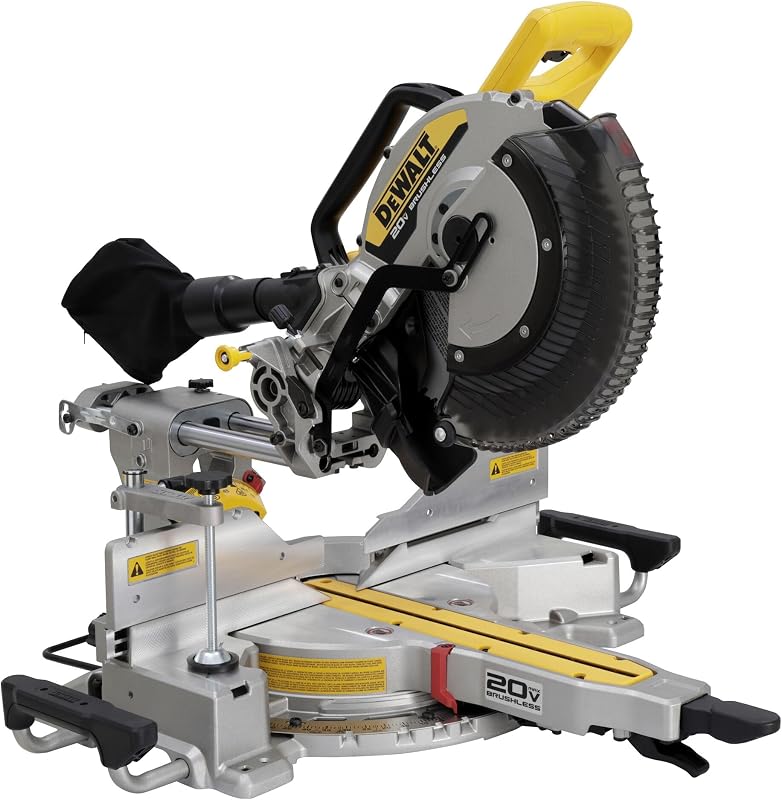
Accurate miter cuts depend heavily on how quickly and clearly you can align the spinning blade with your layout marks. The DCS785 features DeWalt’s integrated Cutline blade positioning system, which projects a crisp LED shadow of the blade directly onto the workpiece. Because the shadow uses the actual blade kerf to show the cut boundary, it requires zero recalibration when changing blade thicknesses or adjusting bevel angles. This system remains remarkably visible in varied lighting conditions, giving you immediate visual confirmation of your cut location.
The DWS779 relies entirely on traditional mechanical sighting methods. It does not include an LED shadow light or laser system from the factory. To place a cut precisely on the pencil line, you must bring the stationary blade down manually to touch the wood teeth against your layout mark before squeezing the trigger. For angle repeatability, the DWS779 relies on an adjustable stainless steel miter detent plate equipped with 10 positive stops, a cam lock handle, and a detent override that allows micro-adjustments past standard angle detents.
The DCS785 also speeds up angle setups by incorporating dedicated bevel pawls that instantly drop into common angles like 22.5 degrees and 33.9 degrees. When evaluating whether the DeWalt DCS785 review details justify upgrading, the presence of the Cutline system is frequently the deciding factor for finish carpenters who need rapid, error-free alignment on high-cost finish materials. For alternative comparisons featuring traditional alignments, see our analysis of the dewalt dws779 vs dws715.
Edge: DeWalt DCS785. The factory-installed Cutline shadow system offers instantaneous, adjustment-free cut visualization that the DWS779 lacks entirely.
Dust Extraction and Jobsite Cleanliness
Miter saws are notorious for launching fine particulate across finished interiors and shop floors, making integrated extraction a crucial health and efficiency metric. The DWS779 features a built-in dust collection chute that captures over 75% of the airborne dust generated during wood cutting operations, diverting debris into an included dust bag or through a standard vacuum connection. While this 75% capture rate manages bulk saw debris well enough for an open workshop or garage, it still leaves fine airborne particulate to settle on nearby surfaces.
The DCS785 raises extraction performance substantially, achieving a certified capture rate of up to 97% during operation. Even more valuable for mobile remodelers is the inclusion of integrated Wireless Tool Control. This technology pairs the cordless miter saw with a compatible dust extractor, automatically cycling the vacuum on and off with the pull of the saw trigger. The package includes both a dedicated dust bag and a vacuum adaptor to connect directly into jobsite extraction units.
For remodelers working inside occupied client homes, the difference between 75% and 97% collection efficiency is massive. The DCS785 drastically reduces masking, containment, and post-cut cleanup time. Contractors who examine the dewalt dcs785 vs metabo hpt c10fcg2 often note that premium dust extraction systems protect air quality far better than standard passive collection bags.
Edge: DeWalt DCS785. A 97% dust capture rating combined with Wireless Tool Control for automated vacuum operation offers vastly cleaner cutting.
Weight, Portability, and Jobsite Mobility
Moving a full-sized 12-inch sliding compound miter saw across a jobsite, up stairwells, or into a truck bed requires substantial physical effort. The DWS779 is engineered as a heavy-duty shop anchor, tipping the scales at 67.7 pounds. Its dual horizontal steel rails, linear ball bearings, and robust cast aluminum base provide exceptional rigidity for repetitive stationary cuts, but that same mass makes the tool cumbersome to move across job locations without dedicated rolling stands.
The DCS785 is specifically engineered for contractors who move their workstation daily. Weighing 51.7 pounds as a bare tool (with a total listed item shipping weight of 65.9 pounds), it integrates built-in carry handles that balance the chassis during transit. Shedding 16 pounds compared to the stationary corded saw dramatically reduces fatigue when transporting the tool through residential doorways or loading it into a work vehicle.
When deciding whether to choose the DeWalt DWS779 or DCS785 for jobsite deployments, cordless freedom magnifies the weight advantage. Skipping long heavy-gauge extension cords and breaker hunting means you can carry the DCS785 directly to the work area, set up on sawhorses, and start cutting immediately. For contractors comparing compact options, exploring the dewalt dws715 vs dcs785 reveals how full sliding capacity balances against physical footprint.
Edge: DeWalt DCS785. At 51.7 pounds bare tool weight with integrated carry handles and zero cords, it is far more portable than the 67.7-pound DWS779.
Included Accessories and Blade Outfitting
Outfitting right out of the box affects how quickly you can achieve clean cuts on different types of lumber. The DWS779 comes equipped from the factory with a 12-inch, 80-tooth carbide-tipped blade, a blade wrench, a vertical material clamp, and a dust bag. An 80-tooth blade is ideal for ultra-clean crosscutting in delicate trim, pre-finished moldings, and cabinet parts, minimizing tear-out without requiring an immediate blade upgrade.
The DCS785 ships with a 12-inch, 60-tooth carbide-tipped blade, alongside a dust bag and vacuum adapter. A 60-tooth blade provides excellent cutting speed and versatility for dimensional framing, exterior decking, and general trim carpentry, but it exhibits slightly more grain tear-out on delicate cabinet veneers than an 80-tooth finish blade. However, the DCS785 offsets this by including dedicated vacuum adapters to streamline dust extraction setups right away.
Both saws feature 5/8-inch or 1-inch arbor compatibility standard to 12-inch miter blades and include built-in spindle locks for quick blade changes. While the DWS779 provides a higher-tooth-count blade and material clamp upfront, the DCS785 includes the necessary adapters for modern shop vacuum connections.
Edge: Tie. The DWS779 includes an 80-tooth fine-finish blade and clamp, while the DCS785 supplies a versatile 60-tooth blade with dedicated extraction adaptors.
Pros and Cons
DeWalt DWS779

Pros
- Continuous 15-amp corded cutting power
- 7-1/2-inch nested crown molding capacity
- 6-3/4-inch vertical baseboard fence clearance
- Includes fine-cutting 80-tooth carbide blade
- Durable dual horizontal steel rail design
Cons
- Heavy 67.7-pound stationary tool weight
- No factory Cutline shadow light system
- Dust collection limited to 75% capture
DeWalt DCS785
Pros
- Cordless 20V MAX and FLEXVOLT compatibility
- Integrated Cutline shadow positioning system
- Captures up to 97% of cutting dust
- Wireless Tool Control vacuum activation
- Lightweight 51.7-pound bare tool chassis
Cons
- Lower vertical molding clearances than DWS779
- Requires battery monitoring and charging
- Includes 60-tooth rather than 80-tooth blade
Who Should Buy Each One
Choose the DeWalt DWS779 If
- You manage a permanent woodworking shop, garage workbench, or stationary framing station with access to reliable 120-volt power outlets.
- You regularly cut wide architectural moldings that demand maximum vertical capacity, including 7-1/2-inch nested crown and 6-3/4-inch vertical baseboard.
- Your production schedule involves continuous, all-day cutting runs where stopping to recharge or rotate battery packs disrupts output.
- You want an 80-tooth carbide blade included in the box for smooth, tear-out-free cuts on cabinetry and interior trim right away.
Choose the DeWalt DCS785 If
- You are a mobile contractor, framer, or finish carpenter operating on active jobsites without dependable utility power.
- You need the speed and precision of the Cutline blade positioning system for instant shadow-line alignment on layout marks.
- You perform interior remodeling or occupied renovations where 97% dust capture and Wireless Tool Control vacuum automation prevent airborne mess.
- You are already invested in the DeWalt 20V MAX or FLEXVOLT battery platform and want a lightweight 51.7-pound sliding miter saw.
Final Verdict
The choice between the DeWalt DWS779 and the DeWalt DCS785 represents a classic trade-off between permanent shop endurance and mobile cutting versatility. For woodworkers who run a stationary workshop bench, the DWS779 remains the preferred choice. Its continuous 15-amp corded motor provides unlimited cutting power without battery degradation, while its tall sliding fences offer unmatched vertical clearances for 7-1/2-inch nested crown molding and 6-3/4-inch baseboard standing vertically against the fence.
However, when evaluating a comprehensive DeWalt 12 inch miter saw comparison for jobsite utility, the DCS785 proves its value for contractors on the move. Between its 51.7-pound bare-tool transport weight, integrated Cutline shadow alignment system, 97% dust extraction efficiency with Wireless Tool Control, and regenerative braking that yields hundreds of cuts per charge, the cordless saw solves everyday jobsite friction. If your work moves from room to room or site to site, the cordless flexibility of the DCS785 is well worth the investment.
FAQ
Does the DeWalt DWS779 include a cutline light or laser?
No, the DWS779 does not include an LED shadow light or laser guide from the factory. Cut alignment requires manually lowering the blade teeth to verify placement against your layout mark.
Can the DeWalt DCS785 use both 20V MAX and FLEXVOLT batteries?
Yes, the DCS785 is engineered to operate across the entire lineup of DeWalt 20V MAX and DEWALT FLEXVOLT battery packs, allowing you to use existing batteries from either platform.
Which saw has greater vertical cut capacity for baseboard and crown molding?
The DWS779 provides greater vertical clearance, supporting up to 7-1/2 inches of nested crown molding and 6-3/4 inches of vertically standing baseboard, compared to 6-1/2 inches for both dimensions on the DCS785.
What is Wireless Tool Control on the DeWalt DCS785?
Wireless Tool Control is an integrated wireless communication system that pairs the DCS785 with a compatible DeWalt dust extractor, automatically turning the vacuum on and off when you pull the saw trigger.
How many cuts can the DeWalt DCS785 make on a single battery charge?
According to DeWalt product specifications, the DCS785 delivers up to 371 cuts in 3-1/4-inch MDF base molding and up to 153 cuts in pressure-treated 4×4 timber when equipped with an appropriate high-capacity pack.
Is the DeWalt DWS779 suitable for mobile jobsite framing?
While the DWS779 can be transported to jobsites, its 67.7-pound weight and reliance on continuous 120-volt corded electricity make it far less convenient for mobile framing than the 51.7-pound cordless DCS785.