The core distinction separating the Samsung 990 PRO and the TeamGroup MP44 centers on the division between peak random input/output transaction performance and expansive, high-density raw capacity. While both drives operate on the high-bandwidth PCIe 4.0 NVMe protocol to eliminate system bottlenecks, the 990 PRO pushes hardware-level encryption and class-leading random operations up to 1,400,000 IOPS, whereas the MP44 delivers a massive 4TB footprint utilizing an ultra-slim graphene heat spreader engineered to fit virtually any compact installation bay.
Buyers handling high-frequency workstation workloads, secure enterprise directories, or latency-sensitive DirectStorage titles should select the Samsung 990 PRO for its uncompromising random speeds and robust encryption suite. Users needing to store massive local game installations, 4K media footage, and heavy project folders without managing multiple drive letters should pick the TeamGroup MP44 for its gargantuan space and versatile thermal design.
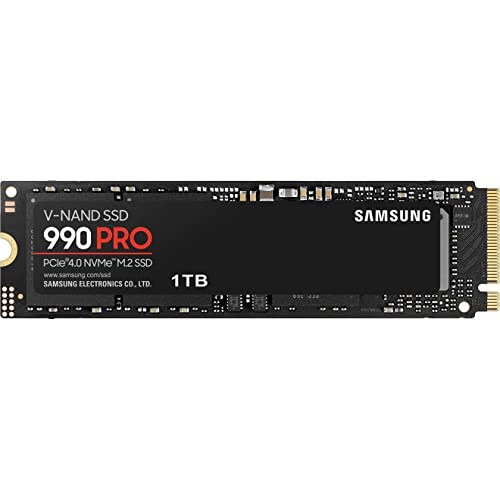

Samsung 990 PRO vs TeamGroup MP44 at a Glance
| Feature | Samsung 990 PRO | TeamGroup MP44 |
|---|---|---|
| Digital Storage Capacity | 1 TB | 4 TB |
| Interface Protocol | PCIe 4.0 x4, M.2 2280 | PCIe 4.0 x4, M.2 2280 |
| Peak Sequential Read Speed | Up to 7,450 MB/s | Up to 7,000 MB/s (7,400 MB/s listed in specs) |
| Peak Sequential Write Speed | Up to 6,900 MB/s | Up to 6,000 MB/s |
| Random Read / Write Speed | Up to 1,400K / 1,550K IOPS | Not listed |
| Thermal Dissipation Design | Nickel-coated controller, PCI-SIG D8 slim profile | Heat-dissipating graphene label |
| Hardware Data Security | AES 256-bit Encryption | Not listed |
| Drive Optimization Utility | Samsung Magician Software | Patented SSD Monitoring Software |
| Console Verification | Sony PlayStation 5 compatible | Sony PlayStation 5 compatible |
| Best For | High-IOPS workstations, encrypted drives, top-speed OS installations | Massive gaming archives, content creation scratchdisks, high-capacity systems |
Sequential Read and Write Performance
Sequential throughput defines how swiftly an internal drive transfers contiguous, large-block files such as uncompressed 4K video streams, expansive game installation packages, and full system backup archives. When examining the raw transfer ceilings under PCIe 4.0 architecture, the Samsung 990 PRO establishes a technical lead with sequential read speeds rated up to 7,450 MB/s and sequential write speeds reaching 6,900 MB/s. This performance taps near the theoretical saturation limit of the PCIe 4.0 x4 bus interface, offering reliable efficiency when moving hundreds of gigabytes in continuous bursts. Builders comparing options like the samsung 990 pro vs crucial t705 frequently look to these top-bracket Gen4 ceilings to understand where PCIe 4.0 peaks before moving to exotic Gen5 hardware.
The TeamGroup MP44 approaches sequential data transfers from a perspective centered on practical utility and responsive file deployment. According to the manufacturer listing, the MP44 achieves sequential read figures exceeding 7,000 MB/s (with specific listing parameters detailing up to 7,400 MB/s) alongside write figures up to 6,000 MB/s. Backed by dynamic SLC caching mechanisms, the MP44 rapidly ingests heavy media files, operating system updates, and game downloads without immediate throttling. While its peak write rate of 6,000 MB/s sits marginally beneath the 6,900 MB/s ceiling of the Samsung drive, the difference during typical desktop file transfers is measured in mere seconds over large multi-gigabyte files.
In real-world productivity scenarios, moving massive files from one high-speed drive to another highlights Samsung’s aggressive sequential read and write tuning. The 990 PRO pushes continuous data through its internal pipeline with minimal drop-off, leveraging Intelligent TurboWrite architecture to maintain optimal pace across heavy bursts. The MP44 counters by sustaining competitive transfer numbers across its entire high-volume pool, ensuring that even large file structures do not suffer sluggish movement. Shoppers weighing 990 PRO vs MP44 speed metrics will find that while both exploit the PCIe 4.0 lane ceiling effectively, Samsung edges out slightly higher maximum throughput numbers.
Edge: Samsung 990 PRO for higher peak sequential read and write ceilings that max out the PCIe 4.0 interface.
Random Access Speeds and Workstation Responsiveness
Random read and write metrics, expressed in Input/Output Operations Per Second (IOPS), dictate how an SSD handles thousands of tiny, non-contiguous files simultaneously. This performance directly impacts system boot times, background service responsiveness, code compilation tasks, and database querying. In any comprehensive Samsung 990 PRO review, the spotlight inevitably falls on its staggering random metrics: up to 1,400,000 IOPS for random reads and 1,550,000 IOPS for random writes. Samsung indicates this constitutes a 40 percent to 55 percent speed boost over the preceding 980 PRO, ensuring instant access to small registry entries, operating system components, and application dependencies.
Conversely, the TeamGroup MP44 listing focuses on high-capacity general throughput rather than detailing explicit IOPS figures. In real-world computing environments, high-capacity drives like the MP44 handle random requests capably through standard NVMe command queues and system memory buffering. However, without dedicated architectural enhancements focused entirely on extreme queue-depth random transactions, it does not aim to challenge the enterprise-grade transaction ceilings published by Samsung’s proprietary controller. Those interested in architectural differences across premium solid-state drives can cross-reference the samsung 990 pro vs kingston kc3000 to see how random performance balances against competing controller designs.
For demanding power users running virtual machines, software development environments, or dense multi-threaded professional suites, Samsung’s elevated random access throughput translates to tangible productivity gains. The drive retrieves fragmented system resources instantaneously, preventing UI stutters or compilation pauses during intense computational loads. While the TeamGroup MP44 provides more than adequate responsiveness for general desktop tasks, gaming libraries, and creative suites, it is not specifically tuned to deliver the extreme 1,400K IOPS transaction volume engineered into the Samsung drive.
Edge: Samsung 990 PRO due to verified random performance reaching up to 1,400,000 IOPS read and 1,550,000 IOPS write.
Storage Capacity and Space Allocation
Storage capacity determines not only how much software, media, and raw data a computer can house locally, but also how flexibly a user can partition their system over several years. The TeamGroup MP44 stands out definitively in this area by delivering a massive 4TB digital storage capacity on a single M.2 2280 stick. In modern computing, where single game installations regularly surpass 150GB and raw 4K video projects demand hundreds of gigabytes per shoot, having 4,000GB of accessible Gen4 storage on a single M.2 slot eliminates the immediate need for drive upgrades, external storage docks, or complex multiple-partition configurations.
In contrast, the evaluated Samsung 990 PRO configuration is limited to 1TB of digital storage space. While a 1TB footprint provides ample room for an operating system, essential professional software packages, and a curated selection of active games, modern workflows can exhaust that space rapidly. Users installing large productivity applications, multiple AAA gaming titles, and local backup images will find themselves actively auditing drive space and offloading cold data much earlier than they would with a 4TB platform. Those weighing storage upgrades can also observe capacity-versus-performance dynamics in comparisons like the samsung 990 evo plus vs 990 pro.
The practical advantage of the MP44 becomes particularly clear in modern small-form-factor motherboards and gaming laptops that offer only one or two total M.2 slots. Populating an isolated M.2 slot with the 4TB MP44 provides expansive breathing room, allowing creators and gamers to retain entire libraries locally without bottlenecking physical motherboard real estate. For anyone evaluating whether the TeamGroup MP44 is worth it purely from an expansion perspective, its quad-terabyte density offers a level of storage freedom that a 1TB drive cannot match.
Edge: TeamGroup MP44 for providing four times the digital storage capacity on a single M.2 card.
Thermal Dissipation and Form Factor Clearance
PCIe 4.0 solid-state drives generate substantial heat under continuous write operations, making effective thermal management vital for avoiding controller throttling. The TeamGroup MP44 introduces an innovative cooling approach by integrating an ultra-thin heat-dissipating graphene label directly over the NAND flash and controller components. Because graphene exhibits exceptional thermal conductivity while maintaining negligible physical thickness, this specialized label facilitates rapid heat transfer into the airflow or into a motherboard’s integrated metal heatsink. More importantly, its low-profile footprint guarantees zero mechanical clearance conflicts inside slim ultrabooks, gaming laptops, and enclosed console bays.
The Samsung 990 PRO approaches thermal regulation through internal controller engineering combined with specialized hardware coating. Samsung equips the drive with an in-house, nickel-coated controller alongside intelligent thermal control algorithms designed to dissipate heat efficiently across its surface. Engineered to conform strictly to the PCI-SIG D8 standard, the 990 PRO fits into standard desktop slots and laptops without awkward bulk. Furthermore, Samsung claims up to 50 percent improved performance per watt compared to the previous-generation 980 PRO, which helps keep operational temperatures under control during continuous throughput.
Both cooling methodologies offer unique advantages depending on the host hardware. Samsung’s nickel coating and optimized power efficiency work exceptionally well when paired with standard motherboard heatsinks, keeping the high-speed controller stable under extended DirectStorage operations. However, TeamGroup’s graphene label functions as an active thermal interface material that pairs seamlessly with any third-party metal cover or functions independently in tight enclosures where bulky heatspreaders cannot physically fit. Evaluating the physical Samsung 990 PRO vs TeamGroup MP44 specs reveals that both drives achieve excellent thermal compliance without requiring bulky add-on fins.
Edge: Tie. TeamGroup’s graphene label provides exceptional low-profile heatsink synergy, while Samsung’s nickel-coated controller and power-efficient design excel in thermally managed desktop environments.
Gaming Integration and PS5 Console Compatibility
For console enthusiasts and PC gamers, storage speed directly dictates boot sequences, level load times, and in-game asset streaming. Both the Samsung 990 PRO and TeamGroup MP44 officially list compatibility with the Sony PlayStation 5 console, meeting Sony’s strict PCIe 4.0 interface prerequisites. When choosing between the Samsung 990 PRO or TeamGroup MP44 for PS5 upgrades, users face a direct choice between loading optimization and unconstrained game library capacity.
The Samsung 990 PRO features up to a 65 percent improvement in random performance over older models, a specification tailored directly for modern DirectStorage APIs on PC and fast asset streaming on the PS5. Games that stream detailed textures on the fly benefit from the drive’s 1,400K IOPS read speed and rapid TurboWrite buffers, eliminating micro-stutters during open-world traversal. However, with modern console games frequently exceeding 100GB per title, a 1TB drive fills up quickly after installing only a handful of modern blockbusters, as seen in similar discussions like the samsung 990 pro vs kingston fury renegade ssd evaluation.
The TeamGroup MP44 alters the console gaming equation by providing a gargantuan 4TB footprint paired with sequential read speeds rated past 7,000 MB/s. Inside a PlayStation 5, the MP44 easily satisfies system throughput checks while allowing gamers to install dozens of massive modern games simultaneously without ever uninstalling titles to clear room. Furthermore, its ultra-slim graphene label slips cleanly beneath the console’s internal expansion slot metal cover, requiring only an affordable generic console heatsink to ensure optimal cooling. When deciding whether to pick the Samsung 990 PRO or TeamGroup MP44 for gaming, players prioritizing raw storage volume will find the MP44 nearly impossible to beat.
Edge: TeamGroup MP44 for console storage due to its massive 4TB footprint, though Samsung 990 PRO holds the advantage for high-IOPS DirectStorage PC gaming.
Data Security, Firmware Maintenance, and Drive Management
Professional workstation drives must safeguard critical operating system assets through robust data encryption and reliable software utilities. The Samsung 990 PRO incorporates full hardware-level AES 256-bit encryption, conforming to industry-standard data security protocols. This hardware encryption ensures that data stored on the drive remains completely secured against unauthorized physical access without placing any computational burden on the host CPU. For corporate environments, financial systems, and private creative projects, this hardware layer represents an indispensable security safeguard.
Drive management on the 990 PRO is driven by Samsung Magician software, widely recognized as one of the most comprehensive storage utility suites available. Magician provides an intuitive dashboard where users can check real-time drive health, monitor total bytes written, optimize performance parameters, run diagnostic scans, and deploy critical firmware updates safely. Comparing enterprise-ready drives like the samsung 990 pro vs 9100 pro demonstrates the immense value that unified, responsive management software brings to long-term system maintenance.
The TeamGroup MP44 includes patented SSD monitoring technology to track drive health and stability, giving users insight into operational status over time. However, the listing does not specify hardware-level AES 256-bit encryption support. For standard desktop gaming and everyday file storage, software-level encryption or unencrypted operation is standard practice. Nevertheless, for institutional systems, mobile laptops carrying proprietary data, or strict business environments, the absence of listed hardware encryption places the MP44 at a functional disadvantage against Samsung’s comprehensive enterprise toolset.
Edge: Samsung 990 PRO for certified AES 256-bit hardware encryption and the mature Samsung Magician utility suite.
Pros and Cons
Samsung 990 PRO

Pros
- Up to 7450 MB/s sequential read speed
- Up to 1400K IOPS random read performance
- Hardware-based AES 256-bit data encryption
- Comprehensive Samsung Magician software suite
- Nickel-coated controller for thermal control
Cons
- 1TB capacity restricts expansive local storage
- High queue-depth performance exceeds casual gaming needs
View Samsung 990 PRO on Amazon
TeamGroup MP44

Pros
- Massive 4TB digital storage capacity
- Ultra-thin heat-dissipating graphene thermal label
- PCIe Gen4 speeds exceeding 7000 MB/s
- Dynamic SLC cache integration
- Slim profile fits laptops and consoles
Cons
- Hardware encryption not specified in listing
- Lower maximum sequential write rating than 990 PRO
Who Should Buy Each One
Choose the Samsung 990 PRO If
- You run demanding workstation software, virtualization environments, or heavy multi-threaded code compilation tasks that demand up to 1,400,000 IOPS random read throughput.
- You need full hardware-level AES 256-bit encryption to protect proprietary business files, confidential client databases, or operating system drives.
- You want granular control over drive diagnostics, firmware updates, and health telemetry via the Samsung Magician software suite.
- You are building a dedicated high-speed boot drive optimized specifically for Microsoft DirectStorage PC gaming titles.
Choose the TeamGroup MP44 If
- You require a massive 4TB storage pool on a single M.2 slot to house an extensive modern gaming library, uncompressed 4K media footage, or large project directories.
- You need an ultra-slim drive with a graphene thermal label that fits easily into tight laptop chassis or console bays without bulky heatsink interference.
- You are expanding your Sony PlayStation 5 storage and want the freedom to download dozens of heavy titles without juggling installation space.
- You prioritize expansive local storage capacity while maintaining PCIe 4.0 read speeds exceeding 7,000 MB/s.
Final Verdict
For users building high-performance workstations, dedicated operating system boot drives, or security-focused business platforms, the Samsung 990 PRO remains the benchmark pick. Its combination of 7,450 MB/s sequential reads, up to 1,400K IOPS random transactions, AES 256-bit hardware encryption, and top-tier Samsung Magician monitoring makes it an exceptional performance drive. While its 1TB capacity requires disciplined storage management, the drive extracts the absolute maximum utility out of the PCIe 4.0 bandwidth ceiling.
On the other hand, the TeamGroup MP44 wins decisively for anyone whose daily bottleneck is physical storage space rather than synthetic queue-depth benchmarks. Offering a gargantuan 4TB capacity, capable sequential transfer speeds exceeding 7,000 MB/s, and an innovative heat-dissipating graphene label, it delivers immense storage utility across laptops, desktops, and consoles. If you need immense capacity without sacrificing Gen4 responsiveness, the MP44 is the superior everyday storage solution.
FAQ
Is the Samsung 990 PRO or TeamGroup MP44 for gaming a better overall choice?
The better choice depends on your gaming platform and library size. The Samsung 990 PRO provides superior random read performance reaching 1,400K IOPS, which accelerates DirectStorage PC titles and rapid asset loading. However, the TeamGroup MP44 provides a massive 4TB footprint that lets you store dozens of modern AAA games locally without constantly deleting titles to clear space.
Can you use the Samsung 990 PRO or TeamGroup MP44 for PS5 console expansion?
Yes, both drives are compatible with the Sony PlayStation 5 console, as both meet Sony’s M.2 NVMe PCIe 4.0 requirements. The MP44 offers the distinct advantage of 4TB capacity for massive game storage, while both drives require appropriate thermal management inside the PS5 console bay.
How does the 990 PRO vs MP44 speed compare during everyday desktop use?
In standard daily desktop computing, web browsing, and general application loading, both drives feel exceptionally responsive due to their PCIe 4.0 architecture. The 990 PRO holds an advantage in peak sequential speeds (7,450 MB/s vs 7,000+ MB/s) and random access IOPS, making it faster during heavy file transfers and multi-threaded compilation tasks.
Does the TeamGroup MP44 include hardware-level data encryption?
The product listing for the TeamGroup MP44 does not specify hardware-level encryption support. If your installation mandates full hardware AES 256-bit encryption for sensitive corporate or personal data, the Samsung 990 PRO explicitly provides this feature.
Why does the Samsung 990 PRO list higher IOPS figures than the TeamGroup MP44?
The Samsung 990 PRO incorporates an advanced proprietary controller optimized specifically for high queue-depth random transactions, hitting up to 1,400,000 IOPS read and 1,550,000 IOPS write. The TeamGroup MP44 prioritizes balanced high-density storage and SLC caching rather than advertising extreme enterprise-tier random IOPS figures.
Is TeamGroup MP44 worth it for users needing extreme storage density?
Yes, the TeamGroup MP44 is exceptionally well-suited for users needing large continuous capacity. Delivering 4TB on a single M.2 2280 module allows power users, gamers, and video editors to expand single-slot systems without needing auxiliary storage docks or external hard drives.
What software utilities are provided for drive health monitoring?
The Samsung 990 PRO is supported by Samsung Magician software, which enables firmware updates, health monitoring, secure erasing, and diagnostic testing. The TeamGroup MP44 includes patented SSD monitoring technology designed to track drive integrity and operational status.


