Choosing between the Corsair RM850x and the Seasonic Focus GX-750 comes down to a direct trade-off between total wattage headroom and certified electrical efficiency. Corsair delivers an 850-watt continuous power ceiling capable of buffering heavier graphical transient spikes, while Seasonic pairs a 750-watt output with superior Cybenetics Platinum efficiency and specialized passive thermal engineering.
Builders running high-draw graphics cards who need extra wattage cushion should buy the Corsair RM850x. Builders assembling a balanced gaming rig who want maximum electrical conversion efficiency and quiet hybrid cooling should buy the Seasonic Focus GX-750.
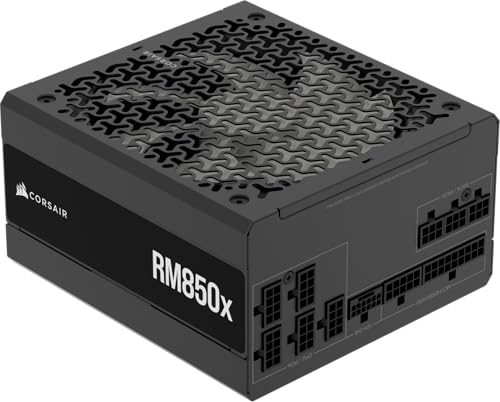
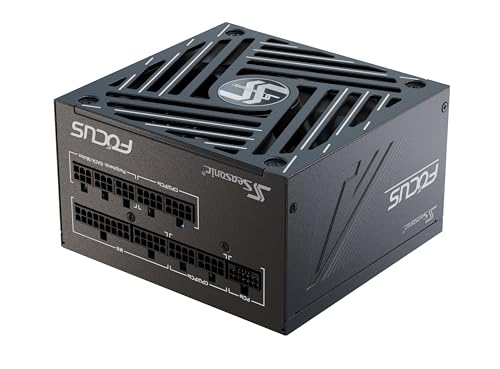
Corsair RM850x vs Seasonic Focus GX-750 at a Glance
| Feature | Corsair RM850x | Seasonic Focus GX-750 |
|---|---|---|
| Continuous Wattage | 850 Watts | 750 Watts |
| Efficiency Certification | Cybenetics Gold (Up to 91%) | Cybenetics Platinum and 80 PLUS Gold |
| ATX Specification | ATX 3.1 and PCIe 5.1 | ATX 3.1 and PCIe 5.1 |
| High-Power GPU Connector | Native 12V-2×6 Connector | Native 12V-2×6 Connector |
| Cooling Hardware | 140mm Fluid Dynamic Bearing Fan | 135mm FDB Fan with OptiSink Design |
| Fan Operating Modes | Low-Noise Operation | Hybrid Fan Control |
| Internal Capacitors | 100% Japanese 105°C Electrolytic | Not listed |
| Cable Construction | Embossed with Low-Profile Combs | Fully Modular |
| Input Voltage Range | 100V to 240V AC | 118.8V to 132V AC |
| Dimensions and Weight | 2.3 x 3.39 x 5.91 inches, 3.9 lbs | 5.5 x 5.9 x 3.4 inches, 3.5 lbs |
| Manufacturer Warranty | 10 Years | Not listed |
| Best For | High-draw GPUs needing wattage cushion | Efficiency-first gaming and low-noise systems |
Wattage Output and Transient Power Delivery
Continuous wattage determines the ceiling of high-performance components your desktop can sustain without triggering over-power protection. In the Corsair RM850x vs Seasonic Focus GX-750 wattage comparison, Corsair provides a 850-watt continuous rating, granting a 100-watt advantage over the 750-watt output of Seasonic. When running modern processors alongside flagship graphical hardware, this surplus capacity cushions power excursions during intense computational workflows and sudden rendering scenes.
Both models adhere to the updated ATX 3.1 standard, meaning both units resist severe transient power spikes mandated by modern PCIe 5.1 hardware. However, that extra 100 watts of sustained capacity on the RM850x lowers overall stress on the internal rails when running modern workloads. If your configuration includes extensive liquid cooling loops, multiple storage drives, and high-tier graphics cards, the additional headroom prevents your power supply from running at its absolute limit. Those evaluating upper-tier capacity may also want to research our corsair rm1000x vs seasonic focus gx-750 breakdown for setups pushing past standard envelopes.
The Seasonic Focus GX-750 handles modern hardware up through upper mid-range GPUs effortlessly, carrying listing confirmation for hardware like NVIDIA RTX 5070 Ti and AMD RX 9000 class components. For builders choosing between the Corsair RM850x or Seasonic Focus GX-750 for gaming rigs centered on standard 250-watt to 300-watt graphics cards, 750 watts remains more than sufficient. Yet, for unconstrained system power limits and extended overclocking profiles, the additional continuous reserve gives Corsair the decisive structural lead in sustained power output.
Edge: Corsair RM850x provides an additional 100 watts of continuous delivery to comfortably buffer demanding graphics hardware during high-load spikes.
Electrical Efficiency and Cybenetics Certification
Electrical efficiency measures how effectively a desktop power supply converts alternating current from the wall into direct current for system components without wasting energy as excess heat. A unit with superior efficiency minimizes internal thermal buildup, cuts fan noise requirements, and lowers wall power waste. Evaluating the Seasonic Focus GX-750 Cybenetics Platinum rating against Corsair reveals Seasonic operating at a fundamentally higher efficiency tier.
The Focus GX-750 holds both Cybenetics Platinum and 80 PLUS Gold certifications. Cybenetics testing enforces rigorous validation across diverse load profiles, operating temperatures, and power factor measurements. Attaining Cybenetics Platinum indicates the Focus GX-750 maintains exceptionally low conversion losses across typical operating ranges. To see how this unit compares against lower output Corsair units, check our guide on the corsair rm750x vs seasonic focus gx-750.
By comparison, the Corsair RM850x holds a Cybenetics Gold certification, rated for up to 91% efficiency. While Cybenetics Gold delivers dependable thermal containment and low idle losses, it operates below the strict efficiency thresholds reached by Platinum-grade hardware. Under sustained daily operations, Seasonic expels less waste heat inside your chassis, translating directly to cooler running internal components and less strain on internal thermal dissipation.
Edge: Seasonic Focus GX-750 achieves higher electrical conversion standards through its dual Cybenetics Platinum and 80 PLUS Gold ratings.
Thermal Architecture and Acoustic Performance
Thermal regulation directly impacts internal component lifespan and noise levels inside your computer chassis. Both manufacturers deploy high-grade fluid dynamic bearing (FDB) cooling fans, yet their physical implementations and heat dispersion engineering differ substantially. Evaluating any comprehensive Corsair RM850x review shows Corsair relying on an oversized 140mm FDB fan paired with 100% Japanese 105°C-rated electrolytic capacitors to sustain prolonged thermal stability.
Seasonic counters with a dedicated Focus GX-750 OptiSink architecture paired with a 135mm FDB fan and selectable hybrid fan control. The OptiSink design reorganizes internal heatsink mounting directly onto the circuit board, dramatically increasing internal heat dissipation surfaces and airflow channels. Combined with Seasonic hybrid fan control, the Focus GX-750 can operate in complete passive silence during idle or moderate desktop tasks, engaging the 135mm fan only when thermal thresholds demand mechanical airflow.
Corsair leverages the natural mechanical advantage of a wider 140mm fan, which moves substantial air volume at reduced rotational speeds to manage noise. However, Seasonic combines enhanced passive dissipation surfaces via OptiSink with an active zero-RPM hybrid switch. For users deciding whether is Seasonic Focus GX-750 worth it for silent office environments, its passive capabilities deliver an edge over standard low-noise curves. Builders researching alternative form factors can also consult our corsair sf750 vs seasonic focus gx-750 comparison to evaluate physical fan sizing dynamics.
Edge: Seasonic Focus GX-750 takes thermal honors with its internal OptiSink heatsink structure and selectable hybrid zero-RPM fan control.
ATX 3.1 Standards and GPU Power Delivery
Modern graphics cards place unprecedented demands on desktop power infrastructure due to rapid shifts in processing draw. Both the Corsair RM850x ATX 3.1 and the Seasonic Focus GX-750 ATX 3.1 are purpose-built to comply with Intel’s latest standards, ensuring backward and forward compatibility with modern PCIe 5.1 hardware. This design resists steep voltage drops during microsecond-level transient loads.
Each unit features a native 12V-2×6 connector, which replaces legacy multi-cable 8-pin adapters with a single dedicated cable capable of delivering high-wattage power directly to modern graphics cards. The Corsair RM850x 12V-2×6 cable routes straight from the power supply housing to the card, minimizing contact resistance and removing intermediate adapter failures. Seasonic matches this native integration completely, listing direct compatibility ready for cards like the NVIDIA RTX 5070 Ti and AMD RX 9000 series.
Because both units support identical ATX 3.1 compliance regulations and feature native 12V-2×6 connectors without requiring splitters, neither unit holds an architectural advantage in basic GPU power transport. If your build demands even greater wattage delivery alongside top-tier standards, consider reviewing the corsair rm850x vs seasonic vertex gx-1000 head-to-head analysis. Within this 750W to 850W bracket, both units provide identical ATX 3.1 safeguards.
Edge: Tie. Both models fully implement native 12V-2×6 PCIe 5.1 connectivity and adhere strictly to Intel ATX 3.1 transient handling standards.
Cable Design and Chassis Installation
Cable construction dictates installation simplicity, airflow obstruction, and the final aesthetic presentation of your computer build. The Corsair RM850x distinguishes itself by including premium embossed cables equipped with integrated low-profile cable combs. These embossed cables are engineered for maximum flexibility, bending easily through tight case grommets without the stiffness typically found in standard sleeved wiring.
In contrast, while the Seasonic Focus GX-750 features a fully modular design allowing builders to attach only the wires necessary for their configuration, its listing highlights standard modular cabling without pre-installed combs or specialized textured embossing. When assessing the Seasonic Focus GX-750 vs Corsair RM850x routing experience, Corsair makes securing neat, parallel cable runs significantly simpler right out of the box. Those looking at larger capacity Seasonic alternatives can evaluate the seasonic focus gx-750 vs vertex gx-1000 guide to explore higher-tier cable inclusions.
From an installation footprint perspective, the Seasonic Focus GX-750 measures 5.5 x 5.9 x 3.4 inches and weighs 3.5 pounds, presenting a lightweight and compact ATX chassis profile. The Corsair RM850x weighs 3.9 pounds with dimensions listed at 2.3 x 3.39 x 5.91 inches. While both fit standard ATX mounting brackets, Corsair’s inclusion of flexible embossed cables and low-profile combs provides an immediate mechanical advantage during assembly.
Edge: Corsair RM850x wins for build convenience due to its ultra-flexible embossed cables and bundled low-profile cable combs.
Input Voltage Tolerances and Long-Term Reliability
Clean power input and component durability dictate whether a power supply can handle dirty wall power or brownouts over years of service. A critical operational difference highlighted in the product specifications involves input voltage range. The Corsair RM850x supports a wide full-range input from 100V to 240V AC, allowing it to function reliably across fluctuating household grids or international electrical standards without interruption.
According to the official listing data, the Seasonic Focus GX-750 specifies an input range of 118.8V to 132V AC. This tighter operational window makes it narrower in tolerance for regions with inconsistent or lower AC line voltages. For North American users on standard 120V circuits this falls within parameters, but Corsair provides wider electrical tolerance out of the box.
Component longevity also tilts toward Corsair based on confirmed internal specifications. The RM850x listing explicitly confirms 100% Japanese 105°C-rated electrolytic capacitors throughout its internal design, paired with an extensive ten-year manufacturer warranty. The Seasonic Focus GX-750 data sheet remains silent regarding capacitor sourcing and explicit warranty duration, giving Corsair the definitive advantage in documented component quality and guaranteed operational lifespan.
Edge: Corsair RM850x provides a broader 100V to 240V AC input range, confirmed 105°C Japanese capacitors, and a 10-year warranty.
Pros and Cons
Corsair RM850x

Pros
- 850-watt continuous output rating
- Embossed cables with low-profile combs
- 100% Japanese 105°C electrolytic capacitors
- 10-year manufacturer warranty
- Full 100V to 240V AC input range
Cons
- Lower Cybenetics Gold efficiency tier
- Heavier 3.9-pound chassis
Seasonic Focus GX-750

Pros
- Cybenetics Platinum and 80 PLUS Gold efficiency
- OptiSink passive thermal cooling design
- Selectable hybrid zero-RPM fan control
- Compact 3.5-pound enclosure
Cons
- Lower 750-watt continuous capacity ceiling
- Narrower 118.8V to 132V AC input range
- Standard modular cables without combs
View Seasonic Focus GX-750 on Amazon
Who Should Buy Each One
Choose the Corsair RM850x If
- You run high-draw graphics cards or unlocked CPUs that benefit from 850 watts of continuous power headroom.
- You want ultra-flexible embossed cables with low-profile combs for neat cable management without buying aftermarket kits.
- You require a full-range 100V to 240V AC input rating to protect against regional voltage fluctuations.
- You value documented 100% Japanese 105°C electrolytic capacitors backed by a 10-year manufacturer warranty.
Choose the Seasonic Focus GX-750 If
- You prioritize energy conservation and lower heat dissipation backed by Cybenetics Platinum efficiency.
- You want semi-passive thermal operation with a selectable hybrid fan control switch for total silence at low loads.
- Your system configuration targets upper mid-tier hardware such as the RTX 5070 Ti or RX 9000 within a 750W ceiling.
- You want an advanced internal heatsink layout powered by Seasonic OptiSink engineering.
Final Verdict
For the majority of PC builders assembling a modern gaming or workstation rig, the Corsair RM850x is the superior selection. Its 850-watt continuous output rating provides crucial buffer capacity for demanding graphic spikes, and its ATX 3.1 standard with a native 12V-2×6 cable supports modern high-power GPUs directly. Paired with 100% Japanese 105°C capacitors, a verified ten-year warranty, full-range 100V-240V input support, and flexible embossed cables with combs, it delivers exceptional reliability and installation ease.
The Seasonic Focus GX-750 remains the ideal choice for energy-conscious builders running tightly optimized configurations within a 750-watt ceiling. Its Cybenetics Platinum certification ensures higher electrical conversion efficiency with minimal wasted heat, while its OptiSink layout and hybrid zero-RPM fan control keep system acoustics whisper quiet under casual workloads. If keeping electrical waste and acoustic output to an absolute minimum is your priority, the Focus GX-750 excels.
FAQ
Does the Corsair RM850x support the ATX 3.1 standard?
Yes. The Corsair RM850x is fully compliant with the Intel ATX 3.1 power standard, supporting PCIe 5.1 hardware and offering resilience against extreme transient power excursions.
What efficiency certification does the Seasonic Focus GX-750 have?
The Seasonic Focus GX-750 holds both a Cybenetics Platinum rating and an 80 PLUS Gold certification, signifying high-tier electrical conversion efficiency and minimal waste heat.
Do either of these power supplies require an adapter for modern graphics cards?
Neither unit requires an adapter. Both the Corsair RM850x and the Seasonic Focus GX-750 feature a native 12V-2×6 power connector designed for direct GPU-to-PSU connections on compatible graphics cards.
What is the OptiSink design on the Seasonic Focus GX-750?
OptiSink is an internal thermal architecture from Seasonic that redesigns heatsink placement on the printed circuit board, expanding heat dissipation surfaces to improve passive cooling performance.
What type of cables are included with the Corsair RM850x?
The Corsair RM850x comes with fully modular, ultra-flexible embossed cables that feature integrated low-profile cable combs to make routing neat and straightforward.
Which graphics cards is the Seasonic Focus GX-750 listed to support?
The Seasonic Focus GX-750 listing specifically notes compatibility readiness for next-generation hardware including the NVIDIA RTX 5070 Ti and AMD RX 9000 series graphics cards.
What are the cooling fan sizes on these two power supplies?
The Corsair RM850x features a 140mm fluid dynamic bearing fan, while the Seasonic Focus GX-750 features a 135mm fluid dynamic bearing fan equipped with hybrid fan control.


