The single physical difference that will decide the choice for most PC builders between the Corsair SF750 and the Seasonic Focus GX-750 is enclosure form factor. Corsair engineered the SF750 as an ultra-compact SFX power supply designed specifically for space-constrained small-form-factor builds, whereas Seasonic built the Focus GX-750 as a full-size ATX power supply meant to slide directly into standard mid-tower and full-tower desktop chassis without adaptation.
Builders putting together a tight mini-ITX enclosure should choose the Corsair SF750 for its tiny footprint and flexible ribbon cables, while builders assembling a standard ATX tower chassis should choose the Seasonic Focus GX-750 for its larger cooling fan and native desktop mounting.

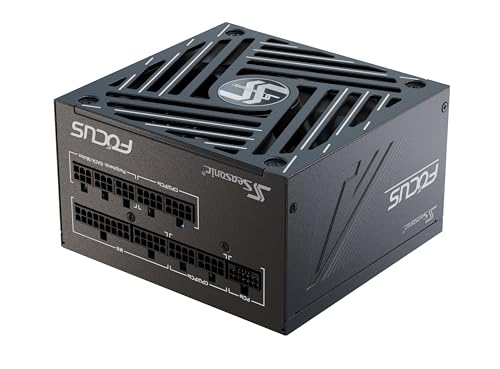
Corsair SF750 vs Seasonic Focus GX-750 at a Glance
| Feature | Corsair SF750 | Seasonic Focus GX-750 |
|---|---|---|
| Form Factor | SFX (with SFX-to-ATX bracket) | ATX |
| Continuous Wattage | 750 Watts | 750 Watts |
| Efficiency Rating | 80 PLUS Platinum | 80 PLUS Gold & Cybenetics Platinum |
| Design Standard | ATX 3.1 & PCIe 5.1 | ATX 3.1 & PCIe 5.1 |
| Cooling Fan Size | 92mm PWM Fluid Dynamic Bearing | 135mm Fluid Dynamic Bearing |
| Zero-RPM Fan Mode | Yes (Zero RPM Mode) | Yes (Hybrid Fan Control) |
| Modular Cabling | Fully Modular (Type-5 Micro-Fit) | Fully Modular |
| Capacitor Specification | 105°C Rated Japanese Capacitors | Not listed |
| Dimensions | Not listed (SFX standard) | 5.5 x 5.9 x 3.4 inches |
| Best For | Small-Form-Factor & Mini-ITX Builds | Standard ATX Mid-Tower & Full-Tower PCs |
Form Factor and Case Compatibility
Physical size dictates whether a power supply can physically mount inside your chassis and how much breathing room remains for cable routing, radiators, and high-end graphics cards. In this Corsair SF750 vs Seasonic Focus GX-750 form factor comparison, the chassis volume disparity is immediately obvious. The SF750 adheres to the strict SFX form factor, a miniaturized specification engineered to fit inside shoebox-sized cases, sandwich-layout enclosures, and custom desktop cubes where every cubic millimeter matters. To add versatility, Corsair packages an SFX-to-ATX adapter bracket in the box, which lets you install this tiny unit into a standard desktop frame if you want to free up lower chamber space for custom liquid cooling loops or bulky intake fans.
The Seasonic Focus GX-750, on the other hand, is a traditional ATX power supply with dimensions of 5.5 x 5.9 x 3.4 inches and an item weight of 3.5 pounds. This standard footprint aligns directly with ATX chassis cutouts, power supply shrouds, and standard mounting screw patterns. While the Focus GX-750 is relatively compact for an ATX model at 140mm (5.5 inches) long, its bulk makes it completely incompatible with dedicated mini-ITX cases that lack an ATX mounting bracket. If you are comparing high-wattage hardware setups in broader build layouts, looking at our corsair sf750 vs seasonic vertex gx-1000 breakdown illustrates how high-output SFX and desktop chassis units continue to diverge in overall volume.
Deciding between the Corsair SF750 or Seasonic Focus GX-750 for SFF builds requires checking your case specifications carefully. Putting the Focus GX-750 into an SFF chassis is usually impossible unless the case specifically advertises full ATX power supply compatibility, and even then, standard ATX depth eats into your maximum GPU clearance. Conversely, running the SF750 in an ATX chassis is functionally sound thanks to the included bracket, though the shorter cables that accompany SFX units may require extensions in taller towers.
Edge: Corsair SF750, because its native SFX footprint fits both mini-ITX builds and standard desktop cases using the included SFX-to-ATX bracket.
Cooling Hardware and Fan Acoustics
Cooling performance and acoustic output depend heavily on the physical surface area inside the power supply housing and the size of the cooling fan used to exhaust heat. Because the Seasonic Focus GX-750 uses a standard desktop enclosure, Seasonic engineers had room to equip it with a large 135mm fluid dynamic bearing (FDB) fan. Larger fan blades can displace a substantial volume of air at significantly lower rotational speeds, keeping airflow noise down under load. Seasonic pairs this 135mm fan with an OptiSink design and a Hybrid Fan Control system that turns the fan completely off during low-to-moderate computational workloads.
The Corsair SF750 operates in a drastically confined housing, which restricts its active cooling to a 92mm PWM fluid dynamic bearing fan. Corsair counters the inherent physics of smaller fans by incorporating an intelligent Zero RPM Mode, meaning the 92mm fan stays stationary and produces zero decibels during idle desktop tasks or light productivity. However, once power draw rises and internal temperatures increase, a 92mm fan must spin faster than a 135mm fan to move a comparable amount of air through tightly grouped internal components. Builders interested in how desktop acoustics scale between these brands can examine our corsair rm750x vs seasonic focus gx-750 comparison.
Both power supplies prioritize silence at idle through zero-RPM technologies, but the Seasonic unit has a clear thermal advantage under sustained heavy gaming sessions. The combination of a generous 135mm fan diameter and Seasonic’s OptiSink layout allows the Focus GX-750 to manage thermals with less acoustic pitch strain than a compact 92mm impeller working against tightly packed heatsinks.
Edge: Seasonic Focus GX-750, due to its larger 135mm fluid dynamic bearing fan and OptiSink thermal dissipation design.
Efficiency Ratings and Power Conversion
Electrical efficiency measures how much power drawn from the wall outlet converts into usable direct current for your computer components versus how much energy is lost as waste heat. The Corsair SF750 2024 vs Seasonic Focus GX-750 comparison reveals distinct testing certifications. The Corsair SF750 earns an official 80 PLUS Platinum certification. In a high-density power supply, Platinum efficiency is crucial because reduced thermal waste prevents heat buildup inside miniature enclosures that have limited auxiliary chassis ventilation.
The Seasonic Focus GX-750 brings dual certification credentials, carrying an 80 PLUS Gold rating alongside a Cybenetics Platinum certification. The 80 PLUS Gold baseline indicates strong efficiency under typical desktop loads, while the Cybenetics Platinum rating validates higher real-world electrical efficiency and rigorous acoustic standards across diverse operating states. If you are researching how Seasonic scales its efficiency tiers across different product lines, our seasonic focus gx-750 vs vertex gx-1000 analysis provides further context on high-efficiency platforms.
While both power supplies convert electricity with minimal waste, the Corsair SF750 holds the technical edge on the traditional 80 PLUS testing matrix with its full 80 PLUS Platinum stamp. For builders running machines in tight spaces where every watt of dissipated heat elevates internal ambient temperatures, the Platinum-rated conversion profile of the SF750 provides measurable peace of mind.
Edge: Corsair SF750, by delivering 80 PLUS Platinum certified efficiency to keep waste heat minimal in cramped spaces.
Cable Routing and Modular Connector Architecture
Cable management can transform a computer build from a smooth assembly process into a frustrating struggle. The Corsair SF750 addresses tight enclosures by featuring fully modular Type-5 Micro-Fit connectors paired with flexible cabling. These Type-5 connectors are physically smaller than legacy power supply terminal blocks, allowing the cable harness to occupy considerably less bulk at the rear of the power supply casing. The flexible ribbon-style sleeving bends easily around sharp chassis corners, liquid cooling tubes, and motherboards, which is essential for compact SFF layouts.
The Seasonic Focus GX-750 also features a fully modular design, but it utilizes standard full-size ATX cable terminations. Seasonic equips this modern revision with native ATX 3.1 and PCIe 5.1 compatibility, highlighted by a native 12V-2×6 power connector engineered for modern graphics cards such as the NVIDIA GeForce RTX 5070 Ti and AMD Radeon RX 9000 series mentioned in the listing. Standard ATX cables are longer and bulkier than SFX cables, which is an advantage in a mid-tower case because the leads easily reach the top EPS connectors and bottom chassis cutouts without straining. Builders comparing desktop cable runs may also want to review the corsair rm850x vs seasonic focus gx-750 breakdown for similar modular comparisons.
Choosing between Corsair SF750 or Seasonic Focus GX-750 for ATX cases brings cable length directly into play. The SF750’s Type-5 Micro-Fit cables are specifically cut to shorter lengths suited for mini-ITX cases; using them in a large glass-paneled mid-tower often results in taut cable lines that cannot hide behind the motherboard tray. Conversely, the longer cables of the Focus GX-750 would create massive excess clutter inside a compact enclosure. Each modular layout directly mirrors its target chassis category.
Edge: Tie. The SF750 excels at tight-clearance bend radius with Type-5 Micro-Fit cables, while the Focus GX-750 provides proper cable lengths and a native 12V-2×6 lead for desktop towers.
Component Standards and Long-Term Reliability
Power supply longevity is tied to internal component selection, modern electrical protections, and resistance to severe transient power spikes. Corsair built the SF750 using 105°C-rated Japanese electrolytic capacitors, which resist thermal degradation over extended operational lifespans. Corsair backs this hardware with an ATX 3.1 and PCIe 5.1 architecture built to withstand rapid transient GPU load spikes, backed by a seven-year manufacturer warranty for long-term peace of mind.
The Seasonic Focus GX-750 similarly supports the latest ATX 3.1 and PCIe 5.1 industry standards. Seasonic integrates its proprietary OptiSink design, an engineering approach that mounts internal components directly to custom heatsinks and copper pathways to improve thermal conduction. However, regarding internal capacitor sourcing, temperature ratings, and specific warranty duration, the listing does not specify those exact component details for this Focus GX-750 revision.
Because both units adhere to the Intel ATX 3.1 specification, both power supplies provide robust resistance to momentary transient power spikes from high-end graphics cards. However, any thorough Corsair SF750 review highlights the proven reliability of its 105°C Japanese capacitors and clear seven-year warranty coverage, giving Corsair a more transparent bill of materials in published specifications.
Edge: Corsair SF750, due to its explicitly specified 105°C Japanese capacitors and seven-year manufacturer warranty.
Pros and Cons
Corsair SF750

Pros
- Compact SFX form factor
- 80 PLUS Platinum efficiency rating
- Flexible Type-5 Micro-Fit cabling
- SFX-to-ATX adapter bracket included
- 105°C Japanese capacitors
Cons
- Smaller 92mm cooling fan
- Shorter cables for large ATX towers
Seasonic Focus GX-750

Pros
- Large 135mm FDB cooling fan
- OptiSink thermal dissipation architecture
- 80 PLUS Gold and Cybenetics Platinum
- Native 12V-2×6 graphics connector
- Standard ATX mounting and cable lengths
Cons
- Too large for dedicated mini-ITX cases
- Cables occupy more space in compact builds
View Seasonic Focus GX-750 on Amazon
Who Should Buy Each One
Choose the Corsair SF750 If
- You are assembling a dedicated small-form-factor or mini-ITX computer where an ATX unit cannot fit.
- You require flexible, compact Type-5 Micro-Fit cables that tuck cleanly into narrow case channels.
- You want 80 PLUS Platinum electrical efficiency to keep internal case temperatures as low as possible.
- You plan to use an ATX chassis now but want the flexibility to migrate to an SFF case later using the included bracket.
Choose the Seasonic Focus GX-750 If
- You are building your system inside a standard ATX mid-tower or full-tower enclosure.
- You prefer the acoustic profile of a large 135mm cooling fan paired with OptiSink heat dissipation.
- You want standard-length desktop modular cables that easily reach across larger motherboard trays.
- You need native 12V-2×6 GPU power connectivity tailored for modern desktop graphics cards.
Final Verdict
For builders wondering whether the SF750 vs Focus GX-750 matchup has a clear universal champion, the answer comes down to structural dimensions. The Corsair SF750 is our top recommendation for the vast majority of specialty PC builders because it achieves what few power supplies can: delivering 750 watts of 80 PLUS Platinum power, ATX 3.1 compliance, and 105°C Japanese capacitors inside a miniaturized SFX frame. With the included SFX-to-ATX adapter bracket, the SF750 can operate in almost any computer case on the market, making it one of the most versatile and space-efficient power supplies available today. Anyone asking is Corsair SF750 worth it will find that its engineering density and modular flexibility justify its standing.
However, the Seasonic Focus GX-750 remains the superior and more sensible pick for builders putting together a traditional desktop PC in a standard mid-tower or full-tower chassis. Installing an SFX unit in a spacious desktop case often forces you to buy separate cable extensions, whereas the Focus GX-750 delivers proper cable lengths, an expansive 135mm fluid dynamic bearing fan, and native 12V-2×6 connectivity right out of the box. Anyone asking is Seasonic Focus GX-750 worth it for standard desktop builds will appreciate its quiet hybrid cooling and effortless ATX integration.
FAQ
Can I install the Corsair SF750 in a standard ATX computer case?
Yes. The Corsair SF750 includes an SFX-to-ATX adapter bracket inside the packaging. This metal plate screws onto standard ATX power supply cutouts, allowing you to mount the smaller SFX unit securely into mid-tower and full-tower computer chassis.
Can the Seasonic Focus GX-750 fit into a mini-ITX small-form-factor case?
Generally no. The Seasonic Focus GX-750 measures 5.5 x 5.9 x 3.4 inches, conforming to the standard ATX form factor. It will not fit into dedicated SFF cases designed strictly for SFX or SFX-L power supplies, though a few larger mini-ITX cases do provide ATX power supply clearance.
Are both power supplies compliant with ATX 3.1 and PCIe 5.1 standards?
Yes. Both the Corsair SF750 and the Seasonic Focus GX-750 are ATX 3.1 compliant and PCIe 5.1 ready. This ensures both units are built to resist transient power spikes produced by modern high-performance graphics cards.
Do either of these power supplies run silently under light computing loads?
Yes, both models feature semi-passive fan curves. The Corsair SF750 utilizes a Zero RPM Mode that completely shuts off its 92mm fan during low loads, while the Seasonic Focus GX-750 utilizes a Hybrid Fan Control system that keeps its 135mm fan inactive until system temperatures or power draw demand active cooling.
What graphics cards are supported by the Seasonic Focus GX-750 native connector?
According to its listing, the Seasonic Focus GX-750 features a native 12V-2×6 connector ready for modern GPUs, specifically highlighting compatibility for graphics cards like the NVIDIA GeForce RTX 5070 Ti and AMD Radeon RX 9000 series.
Why does the Corsair SF750 use Type-5 Micro-Fit connectors?
Corsair uses Type-5 Micro-Fit connectors on the SF750 because they are physically smaller than traditional power supply sockets. This reduces the surface area required for modular ports on the power supply casing and ensures the flexible cables occupy minimal room inside compact small-form-factor cases.
What is the warranty period on the Corsair SF750?
The Corsair SF750 comes with a seven-year manufacturer warranty for long-term operational confidence, as confirmed in the product listing. The listing for the Seasonic Focus GX-750 does not specify its exact warranty length.


