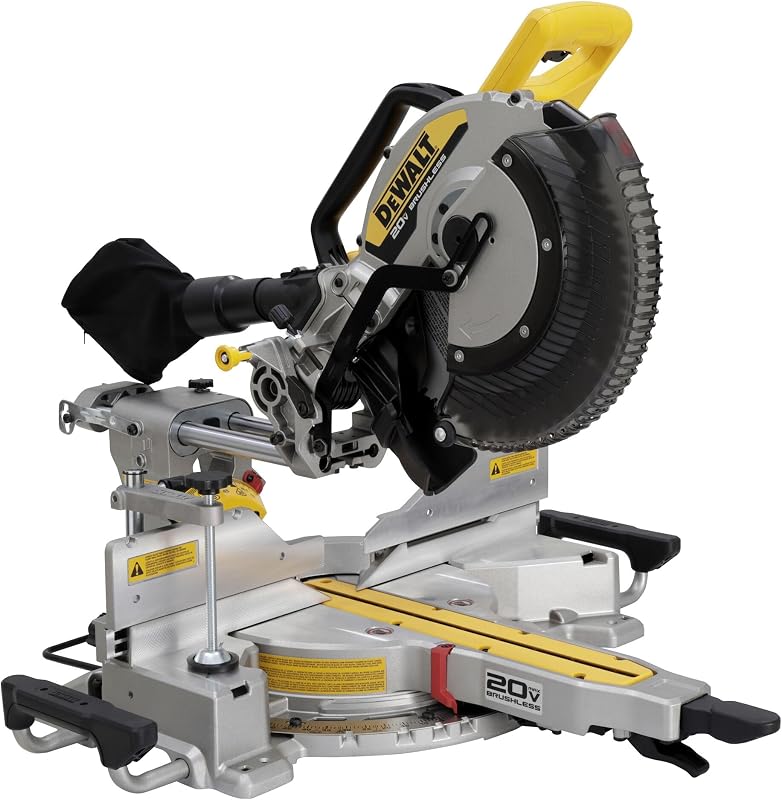
Choosing between the DeWalt DCS785 and the Bosch CM10GD comes down to a fundamental trade-off between cordless cutting reach and stationary workshop clearance. The DCS785 uses a battery platform to drive a 12-inch blade capable of a massive 14-inch horizontal cut across framing lumber, whereas the CM10GD employs a corded 15-amp motor and an articulated folding arm system designed to collapse flat against a shop wall without rear rail protrusion.
Carpenters who work on active residential builds without guaranteed outlet access should choose the DCS785 for its mobile cordless freedom, while cabinetmakers and fine woodworkers working in compact workshops should select the CM10GD for its zero-clearance axial arm and upfront bevel controls.


DeWalt DCS785 vs Bosch CM10GD at a Glance
| Feature | DeWalt DCS785 | Bosch CM10GD |
|---|---|---|
| Blade Diameter | 12 inches | 10 inches |
| Power Source | Cordless (20V MAX / FLEXVOLT) | Corded Electric (120V, 15 Amp, 1800W) |
| Horizontal Cut Capacity | 14 inches | 12 inches |
| Vertical Baseboard Capacity | 6-1/2 inches | 5-1/2 inches |
| Nested Crown Molding Capacity | 6-1/2 inches | 6 inches (45 spring) |
| Slide Mechanism | Traditional sliding rails | Axial-Glide articulated hinge arms |
| No-Load Speed | Not listed | 4,800 RPM |
| Bare Tool Weight | 51.7 lbs | Not listed |
| Shipping / Item Weight | 65.9 lbs | 64 lbs |
| Best For | High-capacity jobsite framing and trim mobility | Space-constrained woodworking shops and station benches |
Cutting Capacity and Blade Clearance
The primary mechanical distinction in this Bosch CM10GD vs DeWalt DCS785 comparison centers on crosscut capacity and blade size. The DCS785 utilizes a 12-inch blade configuration that maximizes horizontal reach, delivering up to a 14-inch crosscut. This extended reach allows operators to slice through wide stair treads, engineered framing timbers, and broad shelving boards in a single stroke without having to flip the workpiece. In vertical orientations, the larger blade clearance enables a 6-1/2-inch vertical baseboard cut standing upright against the fence and handles 6-1/2-inch nested crown molding.
By contrast, the CM10GD features a 10-inch blade setup that delivers a 12-inch horizontal cut capacity. While this is sufficient for standard framing lumber and dimensional stock, it falls short of wider multi-board lumber runs. Vertically, the CM10GD handles a 5-1/2-inch baseboard cut placed against the fence and accommodates up to 6 inches of crown molding nested at a 45-degree spring angle. Bosch equips the saw with tall 4-1/4-inch sliding fences to stabilize this stock during upright positioning, providing adequate support for standard interior casing and base profiles.
For builders assessing the DeWalt DCS785 cut capacity against competing stationary options like those detailed in our dewalt dws780 vs dcs785 review, the two extra inches of crosscut width on the 12-inch arbor make a pronounced functional difference. When handling oversized exterior siding, wider composite decking boards, or oversized dimensional lumber, the extra horizontal sweep of the DCS785 eliminates step-cutting workarounds completely.
Edge: DeWalt DCS785 provides two additional inches of horizontal cut capacity and greater vertical clearance for upright trim.
Workshop Footprint and Glide Mechanism
Workspace layout dictates whether a sliding miter saw can function against a wall or requires valuable center-floor space. The CM10GD incorporates Bosch’s patented Axial-Glide system, which completely abandons conventional dual sliding steel rails. Instead, it utilizes articulated cast-aluminum folding hinge arms. This design reduces the front-to-back Bosch CM10GD footprint by up to 10 inches compared to standard rail-driven sliding saws with similar capacities. Because nothing extends out the back of the tool housing, you can mount the CM10GD directly against a shop wall on a dedicated workbench without interference.
The DCS785 relies on a traditional linear sliding rail assembly. While this provides rigid forward and backward travel along precision bearings, the guide tubes require open space behind the saw. When pushed fully through a 14-inch stroke, the rear overhang demands extra clearance from structural framing, trailer walls, or garage partitions. This linear rail geometry is standard for heavy jobsite tools, but it demands significantly more total workbench depth in stationary workshop setups.
Beyond spatial clearance, the mechanical action of the Bosch CM10GD axial glide mechanism delivers exceptional long-term alignment. Traditional rails can collect abrasive sawdust and develop micro-deflections or rail play over years of heavy use. Bosch’s sealed bearing articulated arms are built for durable precision, eliminating rail slop entirely throughout the lifespan of the tool. For woodworkers comparing workshop sliding setups, as seen in the dewalt dws780 vs bosch cm10gd breakdown, the compact axial geometry remains unmatched for tight shop spaces.
Edge: Bosch CM10GD saves up to 10 inches of rear space and eliminates rail wear through its articulated axial-glide arms.
Power Delivery, Runtime, and Jobsite Portability
Power architecture establishes where and how long each saw can operate. The CM10GD is powered by a corded 120-volt, 15-amp electric motor drawing 1,800 watts. Spinning at 4,800 no-load RPM, this constant motor provides uninterrupted rotational energy for continuous cutting sessions. Users never need to track battery levels, cycle charging docks, or adjust feed rates to preserve amp-hours. It is designed to sit plugged into a dedicated circuit, delivering sustained torque during repetitive rips and dense hardwood miters.
The DCS785 operates as a cordless platform powered by DeWalt 20V MAX or FLEXVOLT battery packs. This battery-driven setup grants complete portability, freeing framing crews from generator setups, temporary power poles, and tripping hazards on raw jobsite subfloors. To optimize battery efficiency, the saw uses regenerative braking technology and a specialized bevel gear transmission engineered to minimize power transfer loss. In published manufacturer tests, this powertrain delivers up to 371 cuts in 3-1/4-inch MDF base molding and up to 153 cuts in pressure-treated 4×4 timber on a single charge.
Portability between work zones also reflects this split. The DCS785 is built with integrated side carry handles and weighs 51.7 pounds as a bare tool (with an overall item weight listed at 65.9 pounds). By comparison, the corded CM10GD lists an item weight of 64 pounds, but its dense, cast-metal folding arm assembly concentrates mass toward the center. Readers evaluating portable cutting stations against smaller jobsite tools, such as the lightweight models in our dewalt dcs785 vs metabo hpt c10fcg2 analysis, will find that the DCS785 provides the best balance of oversized cut capacity and cordless independence.
Edge: DeWalt DCS785 delivers high-yield regenerative cordless mobility that frees operators from extension cords and site generators.
Bevel and Miter Adjustment Systems
Speed and accuracy when setting complex compound angles directly influence finish quality. The CM10GD features upfront bevel controls, positioning the bevel lock lever and the bevel range selector at the front of the unit. This ergonomic configuration allows operators to change bevel orientations from 0 to 47 degrees left or right without reaching behind the motor housing or leaning across the blade carriage. The bevel scale includes clear positive stops at 0, 33.9, and 45 degrees left and right. For miter work, the CM10GD provides a stainless steel scale with detents at 0, 15, 22.5, 31.6, 45, and 60 degrees, alongside a thumb-actuated push-button detent override that enables micro-adjustments between preset detents.
The DCS785 simplifies compound adjustments through double-bevel engineering and quick-set touchpoints. DeWalt integrates mechanical bevel pawls designed to drop swiftly into common trim angles, including 22.5-degree and 33.9-degree positions. Its depth-of-cut stop allows operators to configure grooving and trenching passes quickly. While the DCS785 features tactile detents and durable scales, setting bevel angles requires accessing the rear-facing lock mechanism common to traditional double-bevel miter saws.
When evaluating the DeWalt DCS785 or Bosch CM10GD for trim carpentry, upfront bevel controls save substantial setup time on production runs. Constantly reaching around the saw carriage to loosen and tighten bevel clamps when trimming out rooms with varied wall angles slows down workflow. Bosch’s forward-facing controls keep the technician in front of the cutline at all times, preventing accidental shifting of the workpiece.
Edge: Bosch CM10GD delivers superior ergonomics with upfront bevel controls and a push-button miter detent override.
Dust Extraction and Cutline Accuracy
Keeping a workspace clean and establishing precise cut indicators are crucial factors on both finished jobsites and inside shared garages. The DCS785 introduces an advanced dust collection architecture that captures up to 97% of airborne dust during cutting. It includes a standard collection bag and vacuum adapter in the box. Furthermore, it incorporates Wireless Tool Control, which pairs the saw with compatible cordless dust extractors so the vacuum cycles on and off automatically with the saw trigger. For cut accuracy, DeWalt uses the Cutline blade positioning system, casting a crisp LED shadow of the blade kerf onto the timber that never requires recalibration or alignment adjustments after blade swaps.
The CM10GD provides standard dust extraction through an integrated port positioned behind the blade housing, though its capture efficiency is not rated with a specific percentage. For cut setup, Bosch emphasizes precision mechanical alignment. The heavy-duty stainless steel miter scales are stamped with easy-to-read degree marks alongside roof pitch angles to simplify structural rafters and valley cuts. The articulated arms hold tight tolerances without side-to-side deflection, ensuring that the carbide teeth land precisely where intended across wide crosscuts.
When woodworkers debate whether to choose the DeWalt DCS785 or Bosch CM10GD for woodworking, indoor cleanliness and shadow line visibility often tip the scales. In comparisons between traditional slide saws and workshop machines, like those seen in our dewalt dws779 vs bosch cm10gd head-to-head, DeWalt’s 97% capture rate and trigger-linked wireless vacuum integration offer a marked advantage for indoor finish work inside completed homes.
Edge: DeWalt DCS785 wins with 97% dust capture, Wireless Tool Control activation, and an adjustment-free shadow cutline.
Pros and Cons
DeWalt DCS785
Pros
- Massive 14-inch horizontal cut capacity
- Cordless compatibility with 20V and FLEXVOLT packs
- Regenerative braking maximizes battery runtime
- Captures up to 97% of dust
- Wireless Tool Control vacuum activation
Cons
- Sliding rails require rear wall clearance
- Rear-mounted bevel controls require reaching behind
Bosch CM10GD

Pros
- Axial-Glide arms save 10 inches rear space
- Upfront bevel lock and range selector controls
- Continuous 15-amp corded power delivery
- Push-button miter detent override system
- Durable articulated arms eliminate rail play
Cons
- Tied strictly to 120V electrical outlets
- Smaller 12-inch horizontal cut capacity
Who Should Buy Each One
Choose the DeWalt DCS785 If
- You need complete cordless freedom across framing sites, exterior decks, and new construction without active grid power.
- You regularly crosscut broad structural boards or wide composite materials requiring up to 14 inches of horizontal reach.
- You demand high-efficiency dust collection that captures up to 97% of debris with automatic wireless vacuum activation.
- You cut tall baseboards up to 6-1/2 inches vertically against the fence without laying the material flat.
Choose the Bosch CM10GD If
- Your workshop or garage miter saw bench is positioned tight against a wall where standard slide rails cannot fit.
- You want continuous, uninterrupted power from a 15-amp corded electric motor that never requires charging batteries.
- You frequently change bevel angles and want the safety and convenience of upfront bevel controls and detent overrides.
- You prefer an articulated hinge mechanism that eliminates long-term rail deflection and mechanical play over years of heavy use.
Final Verdict
Both tools represent pinnacle engineering within their respective categories, but they solve entirely different spatial and logistical problems. In any comprehensive DeWalt DCS785 review, this cordless unit stands out as a high-capacity jobsite powerhouse. With its massive 14-inch horizontal cut capacity, 20V MAX and FLEXVOLT battery platform compatibility, regenerative braking system, and 97% dust capture with Wireless Tool Control, the DCS785 is the definitive pick for mobile tradespeople, framers, and finish contractors who need unrestricted reach anywhere on site.
Conversely, a dedicated Bosch CM10GD review reveals a tool purpose-built for the permanent workshop. If you work in a compact garage where space is at a premium, the answer to whether is Bosch CM10GD worth it is an absolute yes. Its Axial-Glide folding arms save up to 10 inches of rear clearance, while its upfront bevel locks and continuous 15-amp, 4,800 RPM motor make it an exceptional dedicated station for serious woodworking and repetitive joinery. To explore how other stationary designs compare to modern glide mechanisms, consider reviewing our analysis of the dewalt dws715 vs bosch cm10gd.
FAQ
How does the Bosch CM10GD axial glide system differ from traditional sliding rails?
The CM10GD replaces cylindrical steel rails with articulated cast-aluminum folding arms. Traditional slide saws push dual rails out behind the unit as the carriage retracts, requiring 10 to 12 inches of open rear clearance. The Bosch Axial-Glide system folds inward alongside the saw frame, allowing the tool to sit completely flush against a workshop wall while eliminating rail slop and play over time.
What battery options work with the DeWalt DCS785 cordless miter saw?
The DCS785 is engineered with broad cordless compatibility, accepting the entire range of DeWalt 20V MAX battery packs as well as higher-capacity DeWalt FLEXVOLT batteries. This gives tradespeople who already own tools across these cordless lines the ability to share battery packs seamlessly across their equipment fleet.
Is Bosch CM10GD worth it for small woodworking shops?
Yes, the CM10GD is widely regarded as one of the best workshop saws for tight footprints. Because its articulated arms operate entirely within the saw’s own envelope, users can construct shallow 24- to 30-inch deep miter benches directly against wall studs. This saves floor space compared to conventional sliding saws that protrude into walking aisles.
How many cuts can the DeWalt DCS785 produce on a single charge?
According to manufacturer testing data, the DCS785’s regenerative braking and bevel gear transmission deliver up to 371 cuts in 3-1/4-inch MDF base molding and up to 153 cuts in pressure-treated 4×4 timber. Actual DeWalt DCS785 cordless run time will vary depending on the amp-hour rating of the battery installed, the hardness of the species, and ambient temperature conditions.
Does the Bosch CM10GD allow bevel adjustments without reaching behind the unit?
Yes, the CM10GD features an upfront bevel lock lever and bevel range selector mounted directly on the front control quadrant. This design allows you to unlock, change, and lock down bevel angles between 0 and 47 degrees left or right without reaching behind the motor carriage or putting hands near the blade path.
Can the DeWalt DCS785 cut wide dimensional lumber in a single pass?
Yes, the DCS785 delivers up to 14 inches of horizontal crosscut capacity when utilizing its full sliding stroke. This allows operators to slice completely through 2×12 lumber, 1×14 boards, and wide stair treads in a single smooth forward-and-downward pass without flipping the stock over.


