The single difference that decides the choice between the Noctua NH-L9i and the Thermalright Phantom Spirit 120 is physical form factor: one is an ultra-compact low-profile cooler engineered for sub-four-liter enclosures, while the other is a massive dual-tower heatsink built for full-scale chassis airflow. Your case dimensions and the thermal demands of your processor dictate which cooler can physically fit and function in your build.
Choose the Noctua NH-L9i if you are assembling a slim home theater PC or an ultra-small form factor rig where vertical clearance stops at forty millimeters. Choose the Thermalright Phantom Spirit 120 if you have a standard mid-tower or spacious case and need high-headroom cooling for demanding multi-core desktop processors.
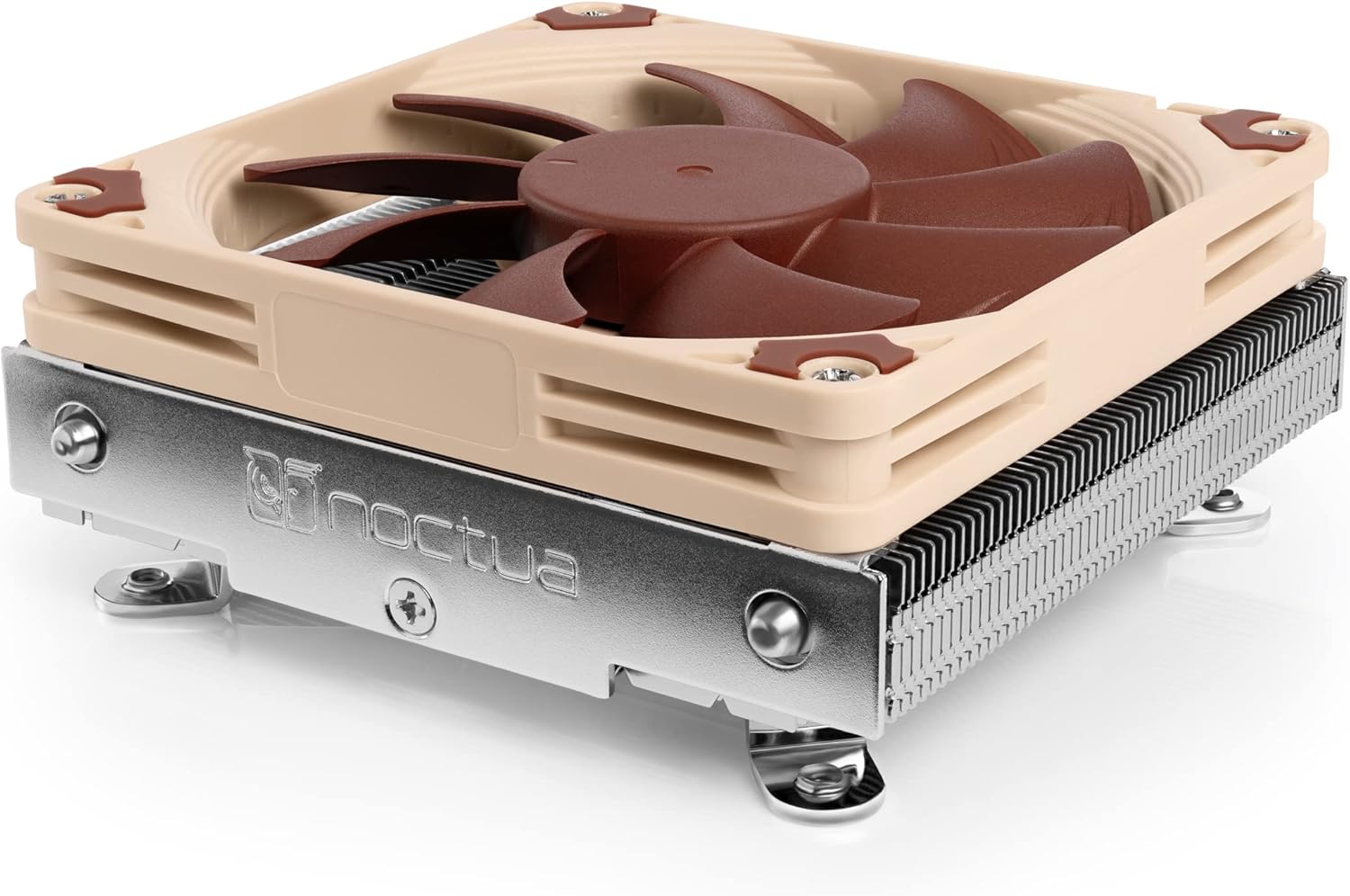

Noctua NH-L9i vs Thermalright Phantom Spirit 120 at a Glance
| Feature | Noctua NH-L9i | Thermalright Phantom Spirit 120 |
|---|---|---|
| Cooler Form Factor | Ultra-low-profile single stack | Dual-tower heatsink |
| Total Height | 37 mm (1.46 in) | 157 mm (6.18 in) |
| Footprint (Length x Width) | 95 x 95 mm (3.74 x 3.74 in) | 125 x 135 mm (4.92 x 5.31 in) |
| Heat Pipe Count | Not listed | 7 heat pipes (AGHP 4.0) |
| Fan Configuration | 1x 92mm slim fan (NF-A9x14 HS-PWM) | 2x 120mm fans (TL-C12B V2 PWM) |
| Maximum Fan Speed | 2500 RPM | 1500 RPM |
| Airflow Volume | 57.5 m³/h | 66.17 CFM |
| Rated Sound Level | 23.6 dB | 25.6 dB |
| Platform Compatibility | Intel LGA1150, LGA1151, LGA1155, LGA1156, LGA1200 | Intel LGA1700, 115X, 1851, 1200, 2011; AMD AM4, AM5 |
| Manufacturer Warranty | 6-year manufacturer warranty | Not listed |
| Best For | Ultra-slim ITX and HTPC systems | High-demand gaming and desktop workstations |
Heatsink Dimensions and Case Clearance
Chassis clearance is the non-negotiable threshold that governs any Thermalright Phantom Spirit 120 vs Noctua NH-L9i comparison. The Noctua NH-L9i measures an ultra-slim 37 mm in total height, including its factory-installed NF-A9x14 fan, with length and width dimensions fixed at 95 by 95 mm. This tiny footprint enables it to slide into narrow console-style enclosures, bespoke small-form-factor compartments, and slim desk units where vertical space above the motherboard is strictly restricted. For builders evaluating a noctua nh-l9i vs thermalright peerless assassin 120 match, the low-profile chassis constraint remains the exact dividing line.
In stark contrast, the Thermalright Phantom Spirit 120 stands 157 mm tall, spanning 125 mm in length and 135 mm in width. When measuring Phantom Spirit 120 vs NH-L9i height, the dual-tower Thermalright unit demands four times the vertical clearance of its low-profile competitor. That vertical requirement immediately excludes the Phantom Spirit from slim HTPC cases, console-style ITX enclosures, and low-volume modular frames. Accommodating the PS120 requires a conventional mini-tower or mid-tower case featuring an interior chamber engineered for standard tower heatsinks.
If you purchase a cooler that exceeds your chassis door or side mesh, no configuration tweak can salvage the build. The NH-L9i solves absolute spatial crises by keeping its cooling array completely flush with typical motherboard keep-out zones. The Phantom Spirit 120 requires significant vertical volume, trading spatial accessibility for surface area. When evaluating whether a compact enclosure can host the Noctua NH-L9i or Phantom Spirit 120 for ITX, check the chassis specification sheet for cooler height clearance before deciding.
Edge: Noctua NH-L9i for ultra-compact enclosures; Thermalright Phantom Spirit 120 for standard cases where 157 mm clearance is available.
Cooling Surface Area and Heat Dissipation Potential
Heat dissipation capacity directly controls system stability and sustained clock speeds under heavy multi-threaded processing. The Thermalright Phantom Spirit 120 utilizes a dual-tower cooling array anchored by seven AGHP 4.0 heat pipes and twin 120 mm cooling fans. This massive twin-fin array provides an expansive aggregate surface area designed to soak and disperse heavy thermal output from high-wattage desktop processors. When looking at Phantom Spirit 120 vs Noctua NH-L9i temps across sustained workloads, the sheer mass and pipe count of the Phantom Spirit allow it to handle demanding modern microarchitectures effortlessly.
The Noctua NH-L9i relies on a dense, single-stack fin assembly connected to a copper base and copper heat pipes with soldered joints and nickel plating. While its construction quality is exceptional, its physical volume is bound by the 37 mm ceiling. The manufacturer specifically positions this cooler for processors with moderate heat loads, such as Intel Core i7, i5, or i3 models (including the 11900, 11700, 11600, and 10700). It cannot absorb the continuous thermal bursts of unconstrained modern flagship silicon because the physical heat-sink volume and fin count are structurally restricted by design.
For builders assessing multi-core workloads, modern multi-threaded rendering, or unthrottled productivity tasks, the Thermalright heatsink provides the heavy-duty surface area needed to sustain lower operational temperatures. A deeper look at heavy-duty desktop coolers, such as our thermalright phantom spirit 120 vs be quiet! dark rock pro 5 comparison, reinforces how dual-tower mass benefits intensive computing. The NH-L9i fulfills its mandate of preventing thermal shutdown in tight spaces, but it cannot match a dual-tower configuration for sheer cooling throughput.
Edge: Thermalright Phantom Spirit 120, driven by its 7-pipe dual-tower architecture and superior dissipation surface.
Fan Configuration, Airflow, and Acoustic Profile
Moving air across cooling fins requires careful balance between noise levels and airflow throughput. The Thermalright Phantom Spirit 120 features two 120 mm TL-C12B V2 PWM fans operating on S-FDB bearings, generating up to 66.17 CFM of airflow at a maximum rotational speed of 1500 RPM. This dual-fan layout pushes substantial air through two independent fin towers at a relatively modest rotation speed, keeping the factory sound ceiling at 25.6 dB under maximum load. Comparing dual-fan configurations like the thermalright phantom spirit 120 vs scythe fuma 3 highlights how slower, larger fans maintain solid airflow with controlled acoustics.
The Noctua NH-L9i utilizes a single NF-A9x14 HS-PWM slim 92 mm fan that spins up to 2500 RPM to push 57.5 cubic meters per hour of air through its dense fin stack. Noctua rates this setup at an acoustic ceiling of 23.6 dB. Noctua also supplies an NA-RC7 Low-Noise Adaptor (L.N.A) in the box, which reduces fan speed and operational sound further for quiet-focused environments. The packaging also includes dedicated mounting screws for 92x92x25 mm fans, allowing builders to replace the 14 mm slim fan with a standard-thickness fan if chassis depth permits.
Because the NH-L9i uses a smaller 92 mm diameter blade assembly, it must spin at higher revolutions per minute to displace air through its fins. Thermalright relies on two 120 mm fans that sweep a larger volume of air at just 1500 RPM. While the Noctua achieves a lower rated maximum noise rating on paper at 23.6 dB versus Thermalright’s 25.6 dB, the Thermalright moves significantly more total air volume across its twin towers.
Edge: Tie; the NH-L9i runs quieter at its maximum ceiling with bundled acoustic tuning adaptors, while the Phantom Spirit 120 moves significantly more volumetric air.
Socket Compatibility and Platform Versatility
Motherboard compatibility determines whether a CPU cooler can physically secure to your processor socket out of the packaging. The Thermalright Phantom Spirit 120 provides wide versatility across modern generations from both major CPU manufacturers. Its mounting hardware supports Intel sockets LGA1700, LGA1851, LGA1200, LGA115X, and LGA2011, alongside AMD AM4 and AM5 platforms. This extensive coverage allows builders to migrate the cooler between socket refreshes, including contemporary AMD Ryzen setups and new Intel builds.
The Noctua NH-L9i in this specific edition is strictly an Intel-focused low-profile solution. Its included SecuFirm2 mounting kit accommodates Intel LGA1150, LGA1151, LGA1155, LGA1156, and LGA1200 platforms. The listing does not specify native out-of-the-box hardware for AMD AM4, AMD AM5, or Intel LGA1700 sockets for this particular unit. Builders using AMD processors or Intel LGA1700/LGA1851 desktop chips cannot install this model without verified supplementary mounting hardware.
Platform longevity is a major buying criterion for PC builders planning hardware upgrades over several years. While Noctua’s SecuFirm2 mechanism is renowned for smooth, secure installation, its compatibility in this package is restricted to older Intel desktop sockets. As shown when comparing other versatile coolers in our noctua nh-u12a vs thermalright phantom spirit 120 guide, comprehensive multi-socket support right in the box saves builders from hunting for extra brackets.
Edge: Thermalright Phantom Spirit 120, offering native compatibility with both current AMD and modern Intel motherboards.
Component Clearance and Memory Slot Overhang
Component clearance around the processor socket often causes installation headaches, particularly on dense Mini-ITX motherboards. The Noctua NH-L9i features a compact 95 by 95 mm footprint specifically calculated to match the standard Intel socket keep-out zone. This engineering ensures 100 percent RAM and PCIe compatibility, meaning the cooler never overhangs the system memory slots or encroaches on the primary PCIe expansion lane. You can install memory modules of any height without worrying about heatsink interference.
The Thermalright Phantom Spirit 120 features a broad 125 by 135 mm dual-tower frame that extends directly over the motherboard area surrounding the socket. Because the front 120 mm fan sits over the primary memory slots, tall RAM modules with high heatspreaders can collide with the fan frame. Resolving this issue typically requires clipping the front fan higher along the fin stack, which increases the cooler’s total installed height beyond its 157 mm baseline and can interfere with chassis side panels. Builders examining the thermalright peerless assassin 120 vs phantom spirit 120 balance similar clearance considerations.
For builders assembling cramped configurations where graphics cards sit directly alongside the socket, the zero-overhang design of the NH-L9i guarantees seamless component access. With the Noctua, you can swap RAM sticks, access M.2 heatsinks, or disengage the PCIe retention latch without removing the CPU heatsink. The Phantom Spirit 120 requires careful pre-measurement of memory height and chassis width to avoid spacing headaches.
Edge: Noctua NH-L9i, delivering total zero-overhang clearance for memory and PCIe cards.
Build Quality, Materials, and Long-Term Protection
Material construction influences both heat transfer efficiency and mechanical reliability over years of operational stress. The Noctua NH-L9i features an all-metal assembly constructed with a copper base, copper heat pipes, aluminum cooling fins, soldered joints, and full nickel plating. Soldered joints between the heat pipes and fins maintain structural bond integrity through repeated heating and cooling cycles, preventing the thermal degradation that can occur over time with press-fit fins. Noctua backs this engineering with a comprehensive 6-year manufacturer warranty, alongside included NT-H1 thermal compound.
The Thermalright Phantom Spirit 120 features seven heat pipes utilizing AGHP 4.0 technology, dual aluminum fin stacks, and dual S-FDB bearing fans. Thermalright lists the material type for this unit as silicone in its technical product data, and the listing does not specify a stated manufacturer warranty duration. The cooler includes the PS120 heatsink and mounting hardware, providing heavy-duty physical mass for modern processors, but lacks the detailed long-term warranty disclosures provided by Noctua.
Noctua’s inclusion of a metal case badge, specialized fan screws for thicker 25 mm fans, premium NT-H1 compound, and the NA-RC7 noise reducer creates a complete packaging ecosystem. If you value documented long-term manufacturer support and premium metal craftsmanship, the Noctua package stands out. The Thermalright package delivers an extraordinary amount of physical cooling hardware, but Noctua leads in warranty coverage and finishing details.
Edge: Noctua NH-L9i, offering soldered nickel-plated copper construction and a 6-year manufacturer warranty.
Pros and Cons
Noctua NH-L9i

Pros
- Ultra-low 37 mm total height
- Zero RAM and PCIe slot overhang
- Includes 6-year manufacturer warranty
- Quiet 23.6 dB sound profile
- Bundled Low-Noise Adaptor and NT-H1 compound
Cons
- Limited to moderate processor heat loads
- Restricted to older Intel socket compatibility
Thermalright Phantom Spirit 120

Pros
- Seven AGHP 4.0 heat pipes
- Dual 120 mm PWM cooling fans
- Broad compatibility including AM5 and LGA1700
- High 66.17 CFM airflow capacity
Cons
- 157 mm height requires deep chassis
- Front fan can overhang memory slots
- Warranty duration not specified in listing
View Thermalright Phantom Spirit 120 on Amazon
Who Should Buy Each One
Choose the Noctua NH-L9i If
- You are building an ultra-compact Mini-ITX or HTPC chassis with vertical cooler clearance under 50 mm.
- You use tall, custom-profile RAM modules and need guaranteed zero overhang above memory slots.
- You are running an Intel LGA1200 or LGA115x processor with a moderate heat load.
- You prioritize documented six-year manufacturer warranty backing and a bundled low-noise adaptor.
Choose the Thermalright Phantom Spirit 120 If
- Your case provides at least 157 mm of vertical clearance for dual-tower CPU coolers.
- You run high-demand desktop processors on modern platforms like AMD AM5, AM4, or Intel LGA1700 and LGA1851.
- You need the heavy heat dissipation potential of seven heat pipes and dual 120 mm PWM fans.
- You want maximum airflow volume to sustain demanding desktop workloads or gaming sessions.
Final Verdict
For standard desktop systems housed in mid-tower or roomy mini-tower enclosures, the Thermalright Phantom Spirit 120 is the superior performer. Its dual-tower architecture, seven heat pipes, and dual 120 mm fans supply massive thermal dissipation capacity that easily outpaces low-profile designs. It supports contemporary AMD AM5 and modern Intel LGA1700 sockets out of the box, making it the practical choice for mainstream desktop builders who have the 157 mm of vertical height required to install it.
However, the Noctua NH-L9i remains unmatched when spatial constraints eliminate full-sized tower coolers from consideration. Standing just 37 mm tall with a zero-interference 95 by 95 mm footprint, it fits into tight enclosures where the Thermalright simply cannot go. If you are building a specialized HTPC or slim small-form-factor machine on an Intel LGA1200 or LGA115x motherboard, the Noctua NH-L9i delivers premium quality, silent-focused operation, and flawless clearance.
FAQ
Can the Noctua NH-L9i cool an Intel Core i9 processor?
The Noctua NH-L9i listing specifically identifies the cooler as a deluxe choice for Intel Core i7, i5, or i3 processors with moderate heat loads, referencing models like the 11900, 11700, 11600, and 10700. Core i9 processors operating under heavy multi-threaded workloads produce thermal output that may exceed the intended heat-dissipation capacity of a 37 mm low-profile heatsink, potentially leading to thermal throttling under continuous load.
How does Phantom Spirit 120 vs NH-L9i height affect Mini-ITX case selection?
The height difference fundamentally determines chassis compatibility. The Noctua NH-L9i stands 37 mm tall, allowing it to fit into ultra-slim console-style cases, custom small-form-factor enclosures, and 1U server racks. The Thermalright Phantom Spirit 120 stands 157 mm tall, which requires wider ITX cases or standard tower enclosures designed with clearance for full-sized desktop cooling towers.
Is the Thermalright Phantom Spirit 120 compatible with AMD AM5 motherboards?
Yes, the Thermalright Phantom Spirit 120 explicitly lists support for AMD AM4 and AM5 platforms, as well as Intel LGA1700, 1851, 1200, 115X, and 2011 sockets. In contrast, the Noctua NH-L9i covered here is designed specifically for Intel LGA1150, LGA1151, LGA1155, LGA1156, and LGA1200 sockets and does not list out-of-the-box AMD support.
Can you swap the fan on the Noctua NH-L9i for a thicker model?
Yes, the Noctua NH-L9i comes standard with the slim 14 mm NF-A9x14 fan, but the package includes dedicated screws for mounting thicker 92x92x25 mm fans. If your PC chassis has extra vertical headroom beyond 37 mm, installing a 25 mm thick fan can increase airflow through the cooling fins while retaining the heatsink’s compact 95×95 mm motherboard footprint.
When considering the Noctua NH-L9i or Phantom Spirit 120 for gaming, which is better?
For standard gaming systems built in mid-tower cases, the Thermalright Phantom Spirit 120 is the better option because its twin towers and dual 120 mm fans disperse heat from modern gaming processors far more effectively. The Noctua NH-L9i is suitable for gaming only when building in compact portable enclosures where a tower cooler physically cannot fit and the CPU runs at moderate power levels.
Does the Thermalright Phantom Spirit 120 block standard RAM slots?
Because the Thermalright Phantom Spirit 120 measures 135 mm in width with dual 120 mm fans, the front fan typically extends over the motherboard memory slots. Standard-height RAM modules fit underneath, but memory modules with tall, elaborate heatspreaders may collide with the fan. In such cases, you must mount the front fan slightly higher on the tower fins, increasing total vertical height.
What accessories come bundled with the Noctua NH-L9i?
The Noctua NH-L9i includes a comprehensive accessory package consisting of the NF-A9x14 HS-PWM premium fan, the NA-RC7 Low-Noise Adaptor (L.N.A), NT-H1 high-grade thermal compound, the SecuFirm2 mounting kit for Intel sockets, replacement screws for 92x92x25 mm fans, and a Noctua metal case badge.


