When deciding between jobsite table saws, the most critical divergence centers on blade diameter, table surface dimensions, and transport configuration. The choice between an agile, space-saving 8-1/4-inch benchtop saw and a full-size 10-inch worksite saw mounted on a rolling gravity-rise stand dictates not only what materials you can cut in a single pass, but also how much effort it takes to load, store, and position your equipment on the job.
Choose the DeWalt DWE7485 if you require a lightweight, compact platform that a single worker can easily carry up staircases and store in tight work vans. Choose the Bosch 4100XC-10 if your projects demand a full 10-inch blade, an integrated wheeled stand for rolling across jobsites, and the expanded capacity needed to rip wide sheet goods.

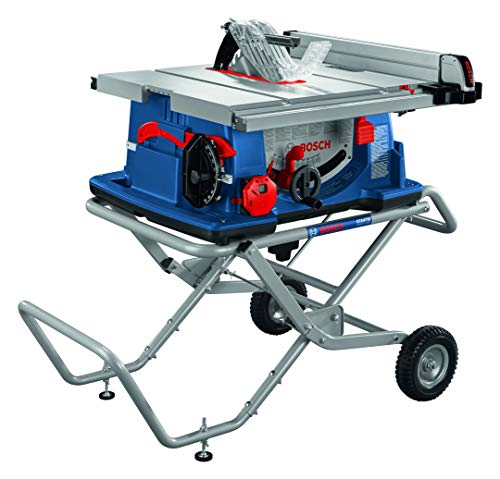
DeWalt DWE7485 vs Bosch 4100XC-10 at a Glance
| Attribute | DeWalt DWE7485 | Bosch 4100XC-10 |
|---|---|---|
| Blade Diameter | 8-1/4 inches | 10 inches |
| Rip Capacity | 24.5 inches | 30 inches |
| Motor Rating | 15 Amp, 5800 RPM | 15 Amp, 4.0 Max HP, 3650 RPM |
| Fence System | Rack and pinion telescoping fence | SquareLock rip fence with auxiliary fence |
| Weight | 54 pounds | 94 pounds |
| Dimensions | 22.75 x 22.75 x 13 inches | 27 x 30 x 13 inches |
| Included Stand | Not listed | GTA47W Gravity-Rise Wheeled Stand |
| Electronics and Soft-Start | Power-loss reset | Soft-start and Constant Response circuitry |
| Safety Features | Site-Pro Modular Guarding, riving knife, pawls | Smart Guard System, motor brake, restart protection |
| Best For | Solo tradespeople prioritizing compact portability | Worksite crews needing rolling mobility and full capacity |
Blade Size and Cutting Depth
The core mechanical difference when evaluating the DeWalt DWE7485 blade size vs Bosch 4100XC-10 is the physical diameter of the arbor-mounted blade. A table saw blade diameter dictates the maximum vertical cutting depth achievable in a 90-degree pass and a 45-degree bevel cut. Larger blades clear thicker lumber in a single operation, reducing the necessity of flipping stock or completing cuts on secondary tools. Woodworkers and framing carpenters frequently encounter dimensional materials that demand generous vertical clearance at both standard and beveled angles.
According to the product specifications, the DWE7485 operates an 8-1/4-inch blade spun by a motor running at 5,800 RPM, whereas the 4100XC-10 houses a standard 10-inch blade spinning at 3,650 RPM and includes a 50-tooth blade in the box. While the listings do not specify the exact depth of cut in fractional inches for either machine, an 8-1/4-inch blade inherently provides a lower vertical blade projection than a 10-inch platform. Buyers comparing full-size machines in our dewalt dwe7491rs vs bosch 4100xc-10 overview will notice that 10-inch blades also provide broad access to specialized aftermarket tooling and blades.
Opting for the smaller blade format on the DWE7485 saves overall tool volume and weight, which makes it ideal for ripping 3/4-inch plywood, OSB, and 1x trim stock. However, for users tackling thicker solid lumber, heavy structural posts, or compound bevels, the 10-inch blade on the 4100XC-10 offers the vertical overhead required to prevent secondary cutting steps on alternative tools.
Edge: Bosch 4100XC-10 because its full 10-inch blade capacity provides greater cutting depth versatility across heavy materials.
Rip Capacity and Table Surface
Rip capacity determines the maximum width of material that can be safely stabilized and cut between the blade and the fence. When breaking down four-by-eight sheet goods, a saw must provide sufficient table width and fence extension to prevent workpieces from tilting or binding. A large table surface acts as an essential foundation for operator control, keeping wide sheets planar against the spinning blade throughout the cut cycle.
The DWE7485 vs 4100XC-10 rip capacity numbers show a pronounced difference. The DWE7485 provides 24.5 inches of rip capacity to the right of the blade, which is calibrated specifically to rip a 48-inch sheet of plywood or OSB directly in half. Its table measures within total exterior dimensions of 22.75 x 22.75 x 13 inches. In contrast, the 4100XC-10 features an expansive 30-inch ripping capacity resting on a large cast aluminum top, supported by an exterior envelope measuring 27 inches long by 30 inches wide by 13 inches high.
For carpenters working predominantly with sheet goods, the 24.5-inch capacity of the DWE7485 is capable of handling standard center rips, but it leaves little room for wider oversized cuts. The 30-inch rip capacity on the 4100XC-10 gives users an extra 5.5 inches of lateral travel. That expanded deck space makes it much simpler to manage wide cabinetry panels, wider shelving blanks, and awkward building components without setting up external outfeed or side supports immediately.
Edge: Bosch 4100XC-10 because its 30-inch rip capacity and large cast aluminum surface provide superior stability for wide materials.
Motor Performance and Electronic Controls
A table saw motor must deliver sustained cutting power across diverse wood densities while managing electrical current safely. Heavy-duty jobsite cutting places significant stress on the drive system, which can result in thermal strain, circuit overloads, or bogging down mid-cut if the motor lacks modern power management electronics. Evaluating these systems is essential when considering whether the Bosch 4100XC-10 is worth it for demanding commercial environments.
The DWE7485 is powered by a 15-Amp, 1800-watt motor that spins at a brisk 5,800 RPM. This high rotation speed produces rapid, clean cuts through sheet goods and nominal boards, backed by a straightforward power-loss reset system that prevents accidental restarts if power drops. The 4100XC-10 is also equipped with a 15-Amp motor, rated at 4.0 max HP and 3,650 RPM, but it pairs this hardware with advanced circuitry. Specifically, Bosch integrates soft-start circuitry to minimize high startup current draw and reduce tripped breakers, alongside Constant Response circuitry that automatically maintains motor speed under load.
The practical result of these motor features is distinct in field use. The DWE7485 relies on raw rotational speed to power through cuts, but it draws full startup current immediately when the switch is engaged. The 4100XC-10 ramps up smoothly to protect temporary jobsite power panels or generators, and its Constant Response electronics dynamically adjust power to prevent the motor from stalling when plowing through wet framing lumber or dense hardwoods.
Edge: Bosch 4100XC-10 because of its soft-start electronics and Constant Response circuitry that regulates motor speed under heavy loads.
Portability, Weight, and Stand Integration
Transporting a table saw between vehicles, jobsites, and multi-story buildings directly impacts day-to-day workflow. A tool that is too heavy to move comfortably becomes a bottleneck, while a tool that lacks a rolling base requires dedicated physical lifting every time the workspace shifts. When deciding between the DeWalt DWE7485 or Bosch 4100XC-10 for jobsite use, physical mobility is often the deciding factor.
Weighing in at 54 pounds, the DWE7485 is built explicitly as a compact benchtop unit. It features a heavy-duty metal roll cage base designed to withstand rough handling while providing integrated carry points for hand transport. The listing does not include a wheeled stand, keeping the overall footprint condensed to 22.75 x 22.75 x 13 inches. On the other hand, the 4100XC-10 weighs 94 pounds and includes the GTA47W Gravity-Rise Wheeled Stand. This stand features 8-inch treaded rubber-composite tires and a single-action design that allows users to deploy and collapse the saw rapidly on site.
If you regularly work alone and need to haul equipment into basements, across unpaved lots, or into compact residential spaces, the 54-pound DWE7485 is vastly easier to lift in and out of a truck single-handedly. Similar portability contrasts are explored when sizing up other cutting tools in our dewalt dw745 vs bosch 4100xc-10 comparison. Conversely, once the 94-pound 4100XC-10 is on the ground, its wheeled Gravity-Rise stand allows it to roll over jobsite debris without any lifting required, serving as a self-contained, rolling workstation.
Edge: DeWalt DWE7485 because its 54-pound weight and compact frame allow true one-person carry portability without requiring a rolling cart.
Fence Systems and Ripping Accuracy
The fence is the mechanical heart of any table saw. A fence that flexes, slips out of parallel alignment, or requires repeated manual measuring with a tape slows down production and produces ruined cuts. Clean joinery and parallel rips require a clamping mechanism that locks true to the blade with absolute repeatability, which is a major focus in any DeWalt DWE7485 review or Bosch 4100XC-10 review.
The DWE7485 relies on DeWalt’s signature rack and pinion telescoping fence rails. This mechanism uses geared tracks at the front and rear of the table that move in lockstep when turning an adjustment dial. This design ensures that the fence remains parallel to the blade across its entire travel distance, making fine dimensional adjustments quick and predictable. The 4100XC-10 utilizes Bosch’s SquareLock rip fence, an aluminum fence engineered to self-align and clamp firmly to the front rail, accompanied by an enhanced auxiliary fence tailored specifically for guiding narrow workpieces safely.
While the SquareLock fence on the 4100XC-10 provides strong clamping force and includes a specialized auxiliary fence for thin strips, rack and pinion gearing remains the gold standard for portable saw fence accuracy. The geared rails on the DWE7485 eliminate the minor lateral deflection that can occur when sliding an uncoupled fence along a bare extrusion rail before clamping down.
Edge: DeWalt DWE7485 because its geared rack and pinion fence system provides exceptionally smooth, parallel adjustments without fence racking.
Safety Systems and Guarding Mechanisms
Table saws are among the most hazardous power tools on any site, making active and passive safety mechanisms critical to evaluate. Effective guarding systems isolate the operator from the blade, prevent violent work kickbacks, and guard against accidental power surges. Safety considerations also influence whether the DeWalt DWE7485 or Bosch 4100XC-10 for woodworking is the safer addition to a busy shared shop.
The DWE7485 features the Site-Pro Modular Guarding System, which enables tool-free adjustments of the blade guard assembly, non-through cut riving knife, and anti-kickback pawls. It also incorporates a power-loss reset switch, which prevents the motor from restarting automatically if power is restored after an unexpected outage while the switch remains in the on position. All components, including the push stick and blade-change wrenches, store securely on board the metal roll cage frame.
The 4100XC-10 counters with the Smart Guard System, which features a multi-position guard barrier that helps prevent blade contact while offering an unobstructed view of the cutline, paired with a riving knife and anti-kickback pawls. Bosch also includes restart protection, overload protection, and an integrated motor brake. Much like the advanced safety mechanisms evaluated in our dewalt dws780 vs bosch gcm12sd analysis, an electric motor brake drastically reduces the time a spinning blade takes to come to a full stop after shutting the tool off, significantly reducing post-cut exposure risks.
Edge: Bosch 4100XC-10 because the addition of an integrated blade brake provides faster stopping times alongside comprehensive guard protections.
Pros and Cons
DeWalt DWE7485

Pros
- Lightweight 54-pound total weight
- Accurate rack and pinion fence
- Fast 5,800 RPM motor speed
- Compact roll cage frame
- Complete on-board accessory storage
Cons
- Smaller 8-1/4-inch blade diameter
- No wheeled stand included
- Rip capacity capped at 24.5 inches
Bosch 4100XC-10

Pros
- Full 10-inch blade capacity
- Wide 30-inch ripping capacity
- Included Gravity-Rise wheeled stand
- Soft-start and Constant Response circuitry
- Integrated motor brake
Cons
- Heavier 94-pound total weight
- Significantly larger storage footprint
- Slower 3,650 RPM blade speed
View Bosch 4100XC-10 on Amazon
Who Should Buy Each One
Choose the DeWalt DWE7485 If
- You need an ultra-compact table saw that fits effortlessly into smaller vehicle trunks, truck caps, or crowded storage closets.
- You frequently work on your own and must carry your saw up stairs, through narrow hallways, or onto scaffolding without assistance.
- You value a geared rack and pinion fence system for rapid, micro-accurate fence alignment that stays parallel.
- Your primary workflow revolves around standard 3/4-inch plywood, OSB, and 1x material where an 8-1/4-inch blade provides plenty of capacity.
Choose the Bosch 4100XC-10 If
- You need the extra cutting depth of a full 10-inch blade to slice through thicker dimensional timbers and deep bevel profiles.
- You require a wide 30-inch rip capacity on a spacious cast aluminum tabletop for handling expansive sheet goods.
- You prefer a complete mobile cutting station that rolls across rough jobsite terrain via a gravity-rise wheeled stand.
- You want advanced motor electronics including soft-start to protect breakers, constant speed regulation, and an active motor brake.
Final Verdict
When assessing these two saws directly, the Bosch 4100XC-10 emerges as the overall superior choice for primary worksite setups where capacity, stability, and mobile stand deployment take priority. Its 10-inch blade, 30-inch ripping capacity, cast aluminum table, and heavy-duty Gravity-Rise wheeled stand establish it as a full-service platform capable of handling any common framing, trim, or remodeling task. The integrated soft-start and electronic motor brake add valuable layers of jobsite electrical friendliness and active operator safety that make the saw well worth the investment for demanding crews.
Nevertheless, the DeWalt DWE7485 is undeniably the better saw for solo tradespeople, mobile installers, and contractors with severe storage limitations. At only 54 pounds, it strips away the bulk and weight of traditional 10-inch wheeled saws while retaining an outstanding rack and pinion fence system and sufficient 24.5-inch rip capacity to divide 4×8 sheet goods. If space is tight and one-person portability is your chief priority, the compact DWE7485 delivers exceptional execution without compromising ripping precision.
FAQ
Can the DeWalt DWE7485 rip a full 4×8 sheet of plywood?
Yes. The DWE7485 provides 24.5 inches of rip capacity to the right of the blade. Because standard sheet goods measure 48 inches wide, this capacity allows you to rip a full 4×8 sheet of plywood or OSB directly down the middle in a single pass.
Does the Bosch 4100XC-10 come with a stand included?
Yes. The Bosch 4100XC-10 includes the GTA47W Gravity-Rise Wheeled Stand. It features 8-inch treaded rubber-composite tires and a single-action folding design that allows for quick setup, breakdown, and transport across jobsite terrain.
Can you use a 10-inch blade on the DeWalt DWE7485?
No. The DWE7485 is engineered specifically as an 8-1/4-inch table saw. Its physical chassis, blade guard assembly, riving knife, and motor arbor are designed to fit 8-1/4-inch blades and cannot safely accommodate a 10-inch blade.
What does the power-loss reset feature do on the DeWalt DWE7485?
The power-loss reset prevents the saw from accidentally restarting following a sudden power disruption. If the electrical cord is unplugged or a breaker trips while the saw switch is left in the on position, the motor will not automatically spin back up when power is restored until the switch is manually cycled off and back on.
Does the Bosch 4100XC-10 have a motor brake?
Yes. The Bosch 4100XC-10 listing specifies an integrated brake as a special feature. This active brake mechanism rapidly decelerates the 10-inch blade once the power switch is turned off, reducing the run-down coasting time between cuts.
What is Constant Response circuitry on the Bosch 4100XC-10?
Constant Response circuitry is an electronic motor management system that helps maintain cutting speed under load. When the blade encounters dense, wet, or knotty wood that would typically cause a motor to bog down, the circuitry dynamically regulates power delivery to sustain consistent cutting performance.
Is the DeWalt DWE7485 worth it for small workshops?
Yes. For small workshops where space is limited, the DWE7485 is highly practical. It measures just 22.75 x 22.75 x 13 inches, weighs 54 pounds, and features complete on-board storage for its fence, miter gauge, wrenches, and guard assembly, making it easy to stow beneath a workbench when not in use.
Related reading: dewalt dws715 vs bosch gcm12sd.