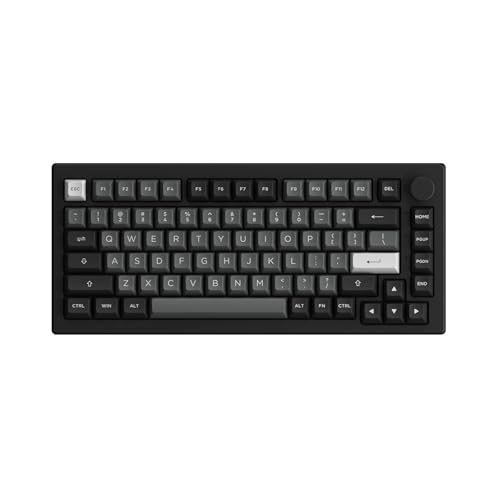
Choosing between two compact wireless mechanical keyboards often comes down to deciding whether you prioritize untethered operating endurance or acoustic cushion and ergonomic keycap sculpting. The Akko 5075B Plus delivers a dedicated gasket-mounted internal structure paired with spherical double-shot PBT keycaps in an ASA profile, whereas the Epomaker TH80 V2 centers its value on an immense 8000mAh internal battery designed for marathon desktop uptime.
Choose the 5075B Plus if you want a soft, bounce-isolated typing experience with sculpted keycaps straight out of the box. Choose the TH80 V2 if your priority is managing up to five devices wirelessly with weeks of uninterrupted power between charges.

Akko 5075B Plus vs Epomaker TH80 V2 at a Glance
| Feature | Akko 5075B Plus | Epomaker TH80 V2 |
|---|---|---|
| Layout and Key Count | 75% Layout, 84 Keys | 75% Layout, 79 Keys |
| Hardware Controls | Multi-media rotary encoder | Metal rotary knob |
| Internal Mounting Style | Gasket mounted | Sound-optimizing multi-layer structure |
| Acoustic Dampening Layers | Silicone plate foam, IXPE switch pad, case foam | PORON, IXPE, latex, silicone, PED pad |
| Battery Capacity | 3000mAh | 8000mAh (up to 200+ hours continuous play) |
| Wireless Connectivity | Bluetooth 5.0, Multi-host 2.4GHz, USB-C | Bluetooth, 2.4GHz, USB-C (remembers up to 5 devices) |
| Gaming Latency and Polling | Not listed | 1000Hz polling rate, 2ms latency |
| Stock Switches | V3 Creamy Yellow Pro (Linear) | Custom switches (Creamy Linear or Clarky Clicky) |
| Keycap Profile and Material | Double Shot PBT, ASA Profile | Changeable keycaps (material and profile not listed) |
| Lighting Configuration | Built-in per-key RGB with side-LED accents | Per-key south-facing RGB with RGB side-plate |
| Physical Dimensions | 13.19 x 5.75 x 1.65 inches | 12.73 x 5.54 x 1.74 inches |
| Best For | Typing comfort and acoustic isolation | Untethered endurance and multi-device setups |
Battery Life and Power Management
Wireless mechanical keyboards demand a careful compromise between internal battery volume and chassis portability. When comparing akko 5075b plus vs nuphy air75 v2 alternatives, desk real estate and internal clearance dictate how much lithium-ion capacity an enclosure can carry. In this matchup, power storage forms the starkest dividing line between the two models.
The TH80 V2 houses a massive 8000mAh battery pack, which Epomaker rates for more than 200 hours of continuous wireless gameplay on a single charge cycle. This enormous capacity makes the keyboard a legitimate workstation centerpiece for users who despise desk clutter and rarely want to plug in a USB cable. In head-to-head akko 5075b plus vs epomaker th80 v2 battery life assessments, the 5075B Plus operates with a 3000mAh battery. While a 3000mAh capacity provides adequate multi-day wireless capability for standard business and leisure use, it holds less than half the total reserve energy of its rival.
For users who intend to run bright backlight animations, per-key RGB patterns, and decorative side-rail diffusers continuously, high capacity prevents rapid battery depletion. The substantial reserve inside the TH80 V2 cushions the heavy power draw of LED illumination and high-frequency wireless polling, allowing you to leave the charging cable stored away for extended periods.
Edge: Epomaker TH80 V2 wins decisively due to an 8000mAh capacity that delivers over 200 hours of continuous wireless use.
Acoustic Dampening and Mounting Architecture
The interior architecture of a modern mechanical keyboard determines how each keystroke feels under bottom-out pressure and how the sound resonance dissipates through the case. Tray-mounted designs screw the switch plate directly into the bottom housing, which often creates stiff impact points and uneven acoustic feedback across the alpha cluster. Premium keyboard engineering instead relies on isolation mounting or specialized sound-absorption layering to create a deeper, more uniform sound profile.
The 5075B Plus utilizes a true gasket mount architecture. By suspending the plate assembly on flexible gasket tabs, the board isolates switch impacts from the rigid exterior plastics. Akko pairs this mechanical suspension with a dedicated noise-reduction stack featuring silicone plate foam, case dampening foam, and an IXPE switch pad. In any akko 5075b plus typing test, this combination absorbs harsh vibrations and produces a gentle, comfortable rebound that reduces fingertip fatigue during lengthy typing sessions. Enthusiasts exploring gmmk pro vs akko 5075b plus comparisons frequently highlight this gasket design as a major asset for daily typing comfort.
Epomaker tackles acoustic tuning on the TH80 V2 through a multi-tier sound-optimizing structure rather than a traditional gasket design. The interior incorporates five separate dampening elements: PORON foam, IXPE foam, latex padding, silicone sound isolation, and an acoustic PED pad. In an epomaker th80 v2 sound test, this specialized layering eliminates pinging and stabilizer rattles while emphasizing a deep, rounded frequency signature right out of the box. While Epomaker delivers a dense, highly muffled keystroke, Akko offers the softer structural flex of a gasket-mounted switch plate.
Edge: Akko 5075B Plus takes the lead by pairing multi-layer foam dampening with a flexible gasket-mounted structure.
Gaming Performance and Wireless Latency
Input responsiveness, anti-ghosting matrices, and stable data transmission dictate whether a wireless keyboard can reliably handle fast-paced competitive gaming. Players evaluating the akko 5075b plus or epomaker th80 v2 for gaming must weigh published low-latency technical specifications against general tri-mode connectivity.
The TH80 V2 is explicitly engineered for competitive responsiveness. Epomaker publishes clear technical parameters for the board, including a 1000Hz (1k) polling rate and a rapid 2ms low-latency rating alongside full anti-ghosting support. These metrics ensure that high-frequency keystroke sequences register instantly without dropped inputs or sluggish wireless handshakes. The board links to PCs and peripherals via low-latency 2.4GHz wireless, Bluetooth, or a wired USB connection, retaining settings for up to five connected devices.
The 5075B Plus offers robust wireless versatility through Bluetooth 5.0, multi-host 2.4GHz with an included USB receiver, and standard wired Type-C connectivity. However, specific millisecond input latency figures and exact 2.4GHz polling rates are not specified in the official listing details. Similar to questions raised in ducky one 3 vs akko 5075b plus discussions, gamers tracking exact akko 5075b plus wireless latency figures must rely on general 2.4GHz stability rather than manufacturer-certified sub-2ms benchmarks.
Edge: Epomaker TH80 V2 provides transparent competitive gaming credentials with verified 1000Hz polling and 2ms input latency.
Keycaps, Switches, and Hot-Swap Flexibility
The contact points between fingertips and switches define the everyday tactile character of any keyboard. Keycap height, profile curvature, plastic composition, and switch actuation determine both typing ergonomics and long-term durability against oil accumulation.
The 5075B Plus comes equipped with Akko V3 Creamy Yellow Pro switches, which feature a smooth linear travel curve. Complementing these switches are double-shot PBT keycaps molded in Akko’s proprietary ASA profile. The ASA height combines the vintage spherical cup shape of classic SA keycaps with a lower, more accessible height profile that prevents wrist strain. Double-shot PBT manufacturing ensures legends never fade or wear down from repeated use. Furthermore, the 5075B Plus incorporates premium 5-pin hot-swappable switch sockets, making switch upgrades effortless without soldering tools, a factor frequently praised in any detailed akko 5075b plus review.
Epomaker outfits the TH80 V2 with custom-tailored switches offering creamy linear or clarky clicky switch options. The keyboard also features universal hot-swappable sockets and changeable keycaps. However, the listing does not specify the exact plastic material or height profile used for the stock keycaps. While epomaker th80 v2 switches deliver smooth operation, Akko provides fully disclosed premium double-shot PBT keycaps with a sculpted spherical profile, as noted by typists weighing the akko 5075b plus vs lofree flow.
Edge: Akko 5075B Plus wins for its double-shot PBT construction and sculpted ASA profile keycaps.
Layout, Hardware Controls, and Software Customization
Form factor efficiency and daily physical controls directly impact productivity across creative workflows, office tasks, and gaming. The 75-percent layout remains a favorite because it retains dedicated navigation arrows and function rows while eliminating the wide numeric keypad.
The 5075B Plus features an 84-key arrangement framed in a classic Black & Silver colorway, measuring 13.19 inches long by 5.75 inches wide and 1.65 inches tall. It integrates a dedicated multi-media rotary encoder knob for quick audio and media control. Key remapping and lighting customizations are handled via the Akko Cloud Driver, which supports per-key RGB backlighting and unique side-LED light illumination. The manufacturer listing notes an AZERTY layout configuration and ambidextrous hand orientation across a single-section build.
The TH80 V2 streamlines the footprint slightly to 79 keys plus a metal rotary knob, measuring 12.73 inches long by 5.54 inches wide and 1.74 inches tall. It incorporates per-key south-facing LEDs, which avoid physical interference with alternative Cherry-profile keycap sets, as well as an integrated RGB accent side-plate. Epomaker’s companion software allows for macro editing, dynamic lighting patterns, and comprehensive key remapping. The memory profile remembers up to five distinct hardware pairings, providing extensive adaptability that answers whether the board fits multi-device workspaces, a common theme in an epomaker th80 v2 review or when comparing the akko 5075b plus vs 8bitdo retro mechanical.
Edge: Tie. The TH80 V2 saves minor desk space and offers south-facing LEDs, while the 5075B Plus retains more individual keys.
Pros and Cons
Akko 5075B Plus

Pros
- Flexible gasket mount architecture
- Double-shot PBT ASA profile keycaps
- 5-pin hot-swappable switch sockets
- Dual side-LED and per-key RGB backlighting
Cons
- Smaller 3000mAh battery capacity
- Wireless latency figures not listed
View Akko 5075B Plus on Amazon
Epomaker TH80 V2

Pros
- Massive 8000mAh battery capacity
- Rated for 200+ hours continuous play
- Fast 1000Hz polling and 2ms latency
- Multi-device pairing up to 5 systems
Cons
- Keycap material not specified in listing
- Lacks true gasket mount suspension
View Epomaker TH80 V2 on Amazon
Who Should Buy Each One
Choose the Akko 5075B Plus If
- You want a true gasket-mounted keyboard that cushions keystrokes and minimizes typing fatigue.
- You prefer spherical, sculpted ASA profile keycaps crafted from durable double-shot PBT.
- You favor a complete 84-key arrangement that keeps dedicated keys intact alongside a rotary encoder.
- You appreciate distinctive ambient lighting with both per-key backlighting and chassis side-LED diffusers.
Choose the Epomaker TH80 V2 If
- You require unmatched wireless runtime supported by a massive 8000mAh battery pack.
- You need to toggle between up to five connected devices across Bluetooth, 2.4GHz, and wired connections.
- You play fast-paced games that demand verified 1000Hz polling and 2ms input response times.
- You plan to install aftermarket Cherry-profile keycaps and want south-facing LEDs to prevent switch housing interference.
Final Verdict
For users who value prolonged untethered convenience and competitive wireless speed, the Epomaker TH80 V2 stands as the superior hardware platform. Its colossal 8000mAh battery delivers over 200 hours of continuous gameplay, leaving standard wireless boards far behind. Combined with multi-device memory storage for up to five systems, transparent 1000Hz polling, and a comprehensive five-layer dampening structure, it delivers exceptional productivity and gaming versatility.
The Akko 5075B Plus remains the preferred recommendation for typists who prioritize mechanical feel, bounce, and ergonomic fingertip placement. With its genuine gasket isolation mounting, three-part foam dampening system, V3 Creamy Yellow Pro linear switches, and thick double-shot PBT ASA keycaps, it produces a softer and more comfortable typing profile. Select the 5075B Plus for pure typing ergonomics, or grab the TH80 V2 if zero-compromise wireless battery endurance leads your checklist.
FAQ
What is the battery difference between the Akko 5075B Plus and Epomaker TH80 V2?
The Epomaker TH80 V2 features an 8000mAh battery rated for more than 200 hours of continuous playtime. The Akko 5075B Plus contains a 3000mAh battery, offering adequate multi-day operation but requiring significantly more frequent recharging cycles.
Can I swap the switches on both keyboards without soldering?
Yes. Both keyboards feature hot-swappable switch sockets. The Akko 5075B Plus specifies 5-pin hot-swap sockets compatible with standard mechanical switches, and the Epomaker TH80 V2 also features fully hot-swappable switch sockets.
Which keyboard offers lower latency for fast gaming?
The Epomaker TH80 V2 specifies a 1000Hz polling rate and a 2ms low-latency rating alongside full anti-ghosting. The Akko 5075B Plus includes a multi-host 2.4GHz wireless connection, but its exact polling rate and millisecond latency figures are not specified in the listing details.
How do the internal mounting styles differ between these two models?
The Akko 5075B Plus utilizes a gasket-mounted construction that rests the plate on dampening tabs to create mechanical flex and soften impacts. The Epomaker TH80 V2 relies on a sound-optimizing dampening stack containing PORON, IXPE, latex, silicone, and a PED pad to absorb internal acoustics.
Are the stock keycaps on both boards made from PBT?
The Akko 5075B Plus explicitly comes with double-shot PBT keycaps sculpted in an ASA spherical profile. The Epomaker TH80 V2 listing confirms changeable keycaps, but the specific material composition and profile are not listed.
Do both keyboards include physical volume knobs?
Yes. The Akko 5075B Plus includes a multi-media rotary encoder knob, and the Epomaker TH80 V2 comes equipped with a metal rotary knob for quick hardware adjustments.