The decisive difference between these two studio packages lies in their operational architecture: the Shure SM7B is a dedicated analog XLR transducer built for traditional broadcast signal chains with outboard hardware, whereas the Rode PodMic USB is a dual-connectivity microphone featuring both USB-C and XLR connections alongside internal digital processing.
Choose the Shure SM7B if you want an industry-proven dynamic microphone bundled with dedicated studio monitor headphones and have the audio interface gear to power an analog signal. Choose the Rode PodMic USB if you want a versatile, plug-and-play solution that lets you record directly to a computer with onboard hardware effects while preserving an analog path for standard mixers.
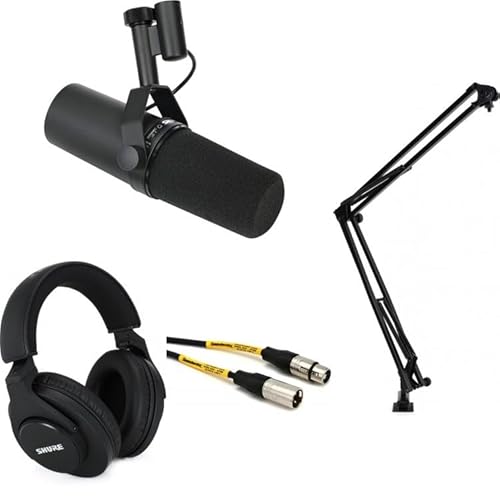

Shure SM7B vs Rode PodMic USB at a Glance
| Attribute | Shure SM7B | Rode PodMic USB |
|---|---|---|
| Connectivity Technology | Analog XLR | Simultaneous USB-C and Balanced XLR |
| Polar Pattern | Unidirectional (Cardioid) | Cardioid |
| Transducer & Capsule Type | Large diaphragm dynamic | Neodymium dynamic capsule |
| Digital Audio Resolution | Not listed (Pure analog) | 24-bit / 48 kHz |
| Frequency Response | Not listed | 20 Hz – 20 kHz |
| Internal Signal Processing | Two physical voice-tailoring settings | Onboard APHEX DSP (Compressor, Noise Gate, Aural Exciter, Big Bottom) |
| Preamplification & Monitoring | Requires external preamp; no onboard headphone jack | Revolution Preamp; 3.5mm zero-latency headphone port with level control |
| Enclosure Material | Stainless steel | Alloy steel |
| Included Stand Hardware | SH-BROADCAST1 boom (32.25-inch extension, 2.17-inch clamp) | BOOMARM1 boom (27-inch reach, 2.8 lb weight capacity) |
| Included Monitoring Hardware | SRH440A closed-back studio headphones | Not included (3.5mm onboard jack provided) |
| Best For | Dedicated analog broadcast setups and acoustic isolation | Direct-to-digital creators needing versatile dual-output flexibility |
Connectivity and Workflow Integration
Output versatility establishes how cleanly a microphone integrates into your current recording setup and whether it can adapt when your production needs expand. In this head-to-head comparison of the rode podmic usb vs shure sm7b, the physical connection types dictate completely different hardware environments. The SM7B relies strictly on a standard 3-pin XLR output, sending an unamplified analog signal through the included 10-foot Cableworks Composer Series cable to an external preamplifier, mixer, or audio interface. If you are comparing traditional broadcast architectures like the shure sm7b vs rode podmic, the classic analog path requires you to provide all analog-to-digital conversion before audio reaches your recording software.
By contrast, the PodMic USB incorporates simultaneous USB-C digital audio and balanced analog XLR connectivity within a single housing. Evaluating rode podmic usb xlr vs usb operation shows that the microphone can feed an analog mixer over its balanced XLR jack while simultaneously delivering a 24-bit/48 kHz digital stream directly to a computer via USB-C. This dual-output capability eliminates the barrier between mobile podcast production on a laptop and permanent studio integration on a hardware console, letting creators record redundant safety tracks across both outputs at the same time.
The operational cost of the SM7B is the absolute requirement for external conversion hardware, making standalone field tracking or laptop-only streaming impossible without carrying extra equipment. The PodMic USB sidesteps interface dependencies entirely when connected digitally, yet retains the ability to plug into professional audio consoles when the studio expands. For streamers, remote podcasters, or shared production desks, this dual capability represents a massive logistical advantage.
Edge: Rode PodMic USB provides significantly greater routing flexibility thanks to its simultaneous USB-C digital and balanced XLR analog connectivity.
Signal Processing and Gain Hardware
Dynamic microphones require substantial amplification to bring speech to broadcast levels, and processing that raw vocal capture often demands external shaping tools. In any realistic shure sm7b review, a central talking point is the microphone’s passive gain structure and how that impacts gear selection. The SM7B listing specifies a 75 dB signal-to-noise ratio and features two onboard frequency tailoring settings that adjust the microphone’s response for speech and voiceover tasks. However, because it contains no active preamplification circuitry, addressing shure sm7b preamp requirements is a critical factor; users must connect the mic to a dedicated preamp or audio interface capable of providing clean, high-gain amplification without introducing system hiss.
The PodMic USB bypasses external gain hurdles when operated over digital connections by utilizing an internal, ultra-low-noise Revolution Preamp designed specifically to feed its 24-bit analog-to-digital converter. Beyond clean signal boost, the primary technical highlight is the rode podmic usb built-in dsp. The internal hardware houses APHEX-licensed audio processing that runs directly on the microphone’s internal chip, eliminating the need to consume computer CPU cycles for real-time vocal cleanup.
This onboard DSP suite includes an integrated noise gate to cut out background mechanical hum and keyboard clatter between spoken phrases, a compressor to control dynamic vocal peaks for consistent delivery, and APHEX Aural Exciter and Big Bottom processing to enrich vocal presence and low-end authority. While the SM7B gives you pure, untouched analog audio ready for external rack hardware or software plugins, the PodMic USB processes the audio stream inside the microphone itself before the data packet ever reaches the digital recording software. Similar integrated hybrid processing can also be seen when examining the shure mv7+ vs rode podmic usb, highlighting how modern USB dynamic mics prioritize self-contained vocal polish.
Edge: Rode PodMic USB takes this category by combining an ultra-low-noise internal Revolution Preamp with onboard APHEX hardware processing.
Vocal Tone and Acoustic Performance
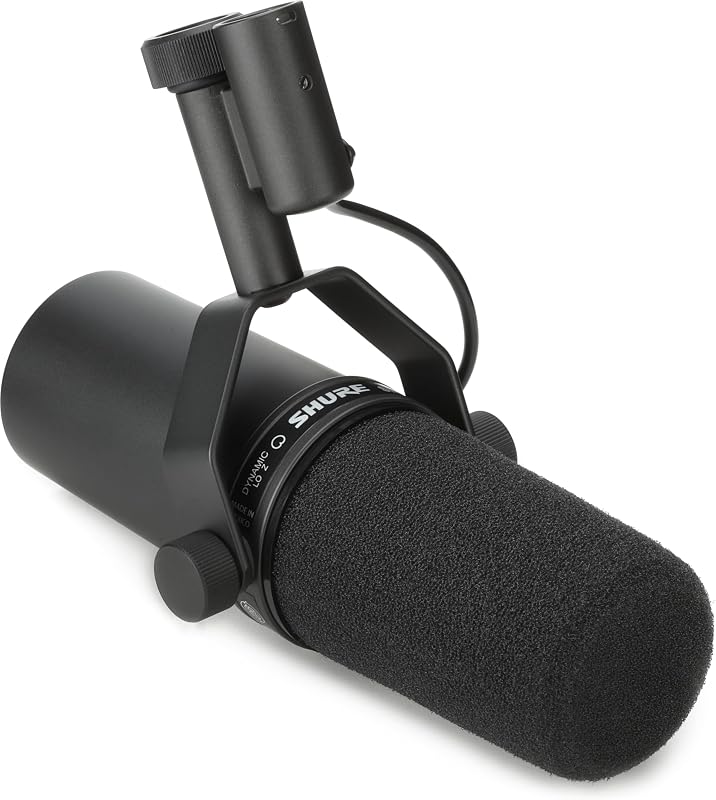
Both units use dynamic transducer designs tailored for vocal recording, speech capture, and broadcast work, but their acoustic execution addresses different production challenges. When analyzing shure sm7b vs podmic usb sound quality, the SM7B is positioned as the gold-standard vocal microphone for capturing natural-sounding spoken dialogue, voiceover, radio, and automated dialogue replacement (ADR). Its large diaphragm dynamic capsule and unidirectional cardioid pattern provide focused off-axis sound rejection, allowing it to capture clean, dry dialogue even when positioned in less-than-ideal room acoustics. Its two physical tailoring switches allow creators to shape the voice profile directly on the mic body to adapt to various vocal registers.
The PodMic USB features a neodymium dynamic capsule that delivers a broad frequency response spanning 20 Hz to 20 kHz. Neodymium magnets typically offer responsive transient handling and high output sensitivity compared to standard dynamic assemblies. To tame aggressive plosives and handling artifacts, the PodMic USB integrates an internal pop filter alongside an internal shockmount to decouple the capsule from desk vibrations, complemented by an external pop filter included directly in the bundle kit. This multi-stage diffusion network assists podcasters who work close to the capsule to maximize proximity effect without clipping the audio track.
Deciding between the shure sm7b or rode podmic usb for podcasting in an untreated home office depends heavily on how you manage isolation. The SM7B’s unidirectional large-diaphragm architecture is celebrated for ignoring room reverberation and mechanical ambience, producing an authentic, uncolored foundation favored by audio engineers. The PodMic USB matches that tight cardioid rejection and complements it with its 20 Hz to 20 kHz span and hardware-level noise gating. For pure, natural broadcast warmth that translates seamlessly across vocal genres, the SM7B remains an undisputed benchmark.
Edge: Shure SM7B delivers exceptional uncolored vocal capture, natural-sounding dialogue, and proven background isolation.
Monitoring and Headphone Integration
Real-time vocal monitoring allows content creators and voice artists to evaluate mic technique, prevent accidental clipping, and hear remote interview guests without latency delays. The two packages take entirely different approaches to monitoring. The SM7B, functioning purely as a passive analog microphone, contains no built-in headphone amplifier or monitoring ports on its stainless steel chassis. Instead, monitoring must be handled downstream through your external mixer or USB interface.
To provide a complete monitoring chain, the SM7B bundle includes Shure SRH440A closed-back studio headphones. The SRH440A headphones feature 40mm neodymium drivers tuned for accurate audio reproduction across podcast recording and live studio tracking. With closed-back earcups that isolate the user from room sound and prevent headphone spill from bleeding back into the open microphone, along with a 9.84-foot straight cable and a gold-plated adapter, this bundle gives the creator an accurate, professional listening device out of the box.
Conversely, the PodMic USB incorporates monitoring circuitry directly into the microphone frame. A built-in 3.5mm headphone output delivers zero-latency direct hardware monitoring with dedicated on-mic volume control. This lets streamers and hosts hear their processed vocal tone, along with computer playback, instantly without any perceptible buffer delay. However, the PodMic USB package does not include a physical pair of headphones, requiring you to provide your own 3.5mm listening set. If you are exploring USB microphone configurations, similar monitoring trade-offs appear in comparisons like the shure sm7b vs rode nt-usb+, where integrated outputs eliminate interface bulk.
Edge: Tie. The PodMic USB provides zero-latency on-mic 3.5mm monitoring with hardware level controls, while the SM7B bundle includes a dedicated pair of professional SRH440A studio monitor headphones.
Boom Arm and Hardware Bundle Construction
A desktop microphone’s daily usability relies heavily on physical mounting stability, reach, and cable management. Both bundles feature articulating desktop boom arms designed to suspend the microphones securely above desks, but their mechanical specifications differ in length, weight rating, and tensioning systems. The SM7B bundle supplies the SH-BROADCAST1 Deluxe Articulating Desktop Mic Boom Stand, which offers an extended 32.25-inch arm reach and a 2.17-inch clamp range to anchor to thick surfaces. It features 360-degree rotation, an integrated cable channel to conceal the included 10-foot XLR cable, and a threaded adapter that seats the 16-ounce stainless steel SM7B microphone stably in place.
The PodMic USB package includes the BOOMARM1 desktop boom arm, constructed from an aluminum-alloy frame with a maximum reach of 27 inches. The BOOMARM1 uses long-lasting, silent external tension springs that support microphones weighing up to 2.8 pounds, preventing metallic creaks or groans when the host repositions the mic during live streaming. It features a flat base design, dual 3/8-inch and 5/8-inch microphone stand thread compatibility, and carries the 2.8-pound alloy steel PodMic USB assembly securely above the desk workspace.
When comparing physical footprint and extension, the SH-BROADCAST1 bundled with the SM7B offers more reach across wide studio consoles with its 32.25-inch span, compared to the 27-inch reach of the BOOMARM1. Furthermore, the SM7B’s integrated 360-degree rotation mount and dedicated cable channel provide a cleaner routing aesthetic for camera-facing streaming setups. For creators who regularly navigate multiple desktop accessories, checking alternative boom arm and mic pairings such as the shure mv7 vs rode podmic reveals how essential integrated cable channels and extended reach are for maintaining an organized broadcast studio.
Edge: Shure SM7B wins on hardware mechanics thanks to the SH-BROADCAST1’s longer 32.25-inch reach, broader 2.17-inch desk clamp range, and dedicated internal cable channel.
Streaming and Live Production Utility
Live streaming places strict constraints on audio hardware: latency must be near zero, background room sounds like mechanical keyboard clicks must be suppressed, and setup complexity needs to remain manageable during broadcasts. When weighing the shure sm7b or rode podmic usb for streaming, ease of configuration is paramount. The SM7B excels in broadcast environments where an engineer or experienced streamer runs audio through hardware mixers, external preamps, and dedicated hardware gates. Its unidirectional dynamic pickup ensures that room reflections and fan noise are minimized, giving the stream a rich, radio-style presence.
However, any detailed rode podmic usb review must highlight how seamlessly the PodMic USB addresses the unique demands of solitary streamers. Operating directly through USB-C, the PodMic USB’s onboard APHEX noise gate cuts out ambient keyboard tapping and mouse clicks when the streamer is not talking, preventing unwanted desk noises from dirtying the broadcast. The built-in compressor levels out excited volume spikes during intense gameplay moments, shielding viewers from jarring audio distortion without requiring the creator to configure third-party software filters inside streaming programs.
For independent creators asking is rode podmic usb worth it for single-operator streaming desks, the answer lies in its all-in-one simplicity. Running a single USB-C cable from the microphone to the streaming rig provides broadcast-level conversion, amplification, hardware gating, compression, and zero-latency earphone monitoring in one compact system. The SM7B delivers peerless audio pedigree, but demands significantly more peripheral gear to achieve the same live dynamics control that the PodMic USB provides on a single chip. Similar streaming utility balances can be explored when comparing the shure mv7+ vs rode podmic.
Edge: Rode PodMic USB is better equipped for solo live streaming due to its single-cable USB-C connectivity and real-time onboard noise gating and compression.
Pros and Cons
Shure SM7B
Pros
- Legendary broadcast vocal sound quality
- Includes SRH440A studio monitoring headphones
- Durable stainless steel enclosure construction
- Extended 32.25-inch boom arm reach
- Physical voice-tailoring response switches
Cons
- Requires external preamp and interface
- Lacks onboard headphone monitoring jack
- No direct digital USB connectivity
Rode PodMic USB

Pros
- Simultaneous USB-C and XLR outputs
- Onboard APHEX DSP noise gate and compressor
- Integrated ultra-low-noise Revolution Preamp
- Zero-latency 3.5mm monitoring with level control
- Includes both internal and external pop filters
Cons
- Headphones not included in bundle
- Shorter 27-inch boom arm extension
View Rode PodMic USB on Amazon
Who Should Buy Each One
Choose the Shure SM7B If
- You own or plan to purchase a dedicated audio interface or mixer capable of delivering clean, high-gain preamplification.
- You need an industry-standard microphone built from stainless steel for studio voiceover, radio, podcasting, or ADR.
- You want an all-in-one analog bundle that includes professional SRH440A closed-back studio monitoring headphones.
- Your studio setup requires a longer boom arm reach, benefiting from the SH-BROADCAST1 stand’s 32.25-inch extension and cable channels.
Choose the Rode PodMic USB If
- You want a direct USB-C connection to record on laptops or desktop computers without purchasing an external audio interface.
- You need the versatility of simultaneous USB-C digital audio and balanced XLR analog routing for redundant or hybrid recording.
- You want onboard APHEX hardware processing, including a real-time compressor, noise gate, Aural Exciter, and Big Bottom effects.
- You require zero-latency direct headphone monitoring with on-mic level controls directly on the microphone body.
Final Verdict
For content creators, podcasters, and streamers who require maximum workflow versatility, the Rode PodMic USB is the smarter, more practical overall investment. By incorporating simultaneous USB-C and balanced XLR outputs, an internal Revolution Preamp, 24-bit/48 kHz conversion, and onboard APHEX DSP processing for real-time noise gating and compression, it solves the traditional pain points of dynamic microphones without requiring a rack of outboard gear. It allows solo creators to achieve a polished, broadcast-ready sound over a single USB cable while maintaining complete compatibility with professional analog studio mixers whenever the production scales up.
The Shure SM7B remains the superior choice for dedicated recording studios, voiceover professionals, and broadcasters who already possess high-grade preamplification hardware and prioritize pure, uncompromised analog performance. With its stainless steel build, proven acoustic rejection, two hardware vocal tailoring switches, and a bundle package that includes both an extended 32.25-inch boom arm and Shure SRH440A studio monitoring headphones, the SM7B provides an authentic studio foundation that will anchor your audio chain for decades to come.
FAQ
What are the Shure SM7B preamp requirements for clean speech recording?
Because the Shure SM7B is a passive dynamic microphone with a 75 dB signal-to-noise ratio, it outputs a relatively low signal level compared to condenser microphones. To record clean spoken vocals without introducing noticeable background hiss, you need an audio interface, mixer, or external inline preamplifier capable of delivering substantial clean gain. If your interface preamps have limited gain ranges, running the SM7B directly into them may result in quiet recordings or elevated noise when boosting levels in software.
Can the Rode PodMic USB output through XLR and USB at the same time?
Yes, the listing specifies that the Rode PodMic USB features simultaneous USB-C and balanced XLR outputs. This allows creators to send a 24-bit/48 kHz digital signal straight to a computer or laptop while concurrently outputting an analog signal through the balanced XLR connection to a hardware mixer, digital recorder, or secondary interface for live backup tracking.
Does the Shure SM7B have a built-in headphone jack for direct monitoring?
No, the Shure SM7B is a purely analog microphone with a single XLR connection and does not feature any integrated monitoring circuitry, digital converters, or headphone jacks on its chassis. However, the bundled kit includes Shure SRH440A closed-back studio headphones, which you plug directly into your external audio interface, mixer, or headphone amplifier to monitor your vocal capture.
What audio processing features are included in the Rode PodMic USB built-in DSP?
The Rode PodMic USB features an onboard APHEX digital signal processing chip that runs directly on the microphone hardware. The DSP suite includes a noise gate to silence background desk and keyboard clatter between words, a compressor to smooth out dynamic vocal spikes for balanced volume, and APHEX Aural Exciter and Big Bottom processing to enhance vocal clarity, presence, and low-frequency depth.
How do the boom arms included in each bundle compare in reach and design?
The Shure SM7B package includes the SH-BROADCAST1 desktop boom arm, which provides an extended 32.25-inch reach, a 2.17-inch desk clamp range, 360-degree rotation, and an integrated cable channel to hide the XLR lead. The Rode PodMic USB bundle features the BOOMARM1 aluminum-alloy boom arm, which has a 27-inch reach, silent external tension springs, flat base clamping, and supports mic assemblies weighing up to 2.8 pounds.
Is the Rode PodMic USB worth it if you already own an analog XLR audio interface?
Yes, the Rode PodMic USB remains a compelling choice even if you own an analog interface because it functions as a standard balanced XLR dynamic microphone while retaining all its digital capabilities. When mobile or away from your studio desk, you can leave your audio interface behind and run the microphone directly into a laptop via USB-C while retaining access to its internal Revolution Preamp, zero-latency headphone monitoring, and APHEX DSP processing.