The primary distinction between the Rode NT-USB+ and the Rode PodMic centers on capsule technology and connectivity: the NT-USB+ is an all-in-one USB condenser microphone with internal digital processing and zero-latency headphone monitoring, whereas the PodMic is an analog XLR dynamic microphone engineered for broadcast vocal capture through external audio equipment.
Choose the NT-USB+ if you want a plug-and-play desktop mic that connects directly to your computer or mobile device with onboard sound shaping. Choose the PodMic if you want a durable dynamic broadcast setup configured for multi-host recording through dedicated XLR interfaces.
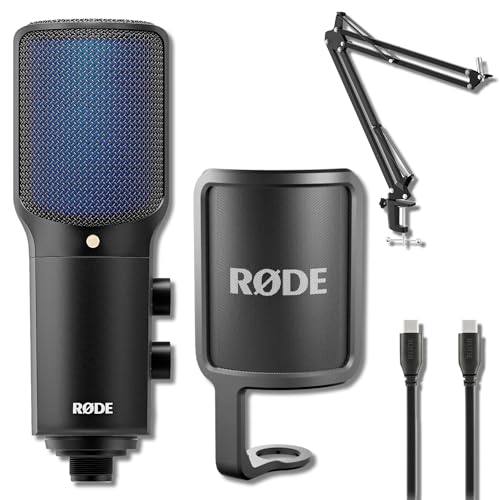

Rode NT-USB+ vs Rode PodMic at a Glance
| Feature | Rode NT-USB+ | Rode PodMic |
|---|---|---|
| Transducer Type | 1/2-Inch Studio Condenser | Dynamic |
| Polar Pattern | Tight Cardioid | Cardioid (Unidirectional) |
| Connectivity | USB Type-C | XLR |
| Frequency Response | 20 Hz to 20 kHz | 13 KHz |
| Digital Audio Conversion | 24-bit / 48 kHz | Not listed (External conversion required) |
| Built-In DSP | APHEX Processing (Revolution Preamp) | Not listed (Analog design) |
| Impedance | Not listed | 320 ohm |
| Direct Monitoring | 3.5 mm zero-latency output with level and mix dials | Requires external hardware (Headphones included in bundle) |
| Included Mounts and Arms | StreamEye 27-inch aluminum boom arm | Two 35-inch broadcast arms with integrated 10ft XLR cables |
| Best For | Solo streamers, voice-over, and single-computer desktop work | Multi-host podcast studios and traditional XLR mixing setups |
Acoustic Capsule Design and Room Sensitivity
Microphone capsules dictate how sound waves convert into electrical signals, defining how sensitive a microphone is to voice nuances as well as ambient noise. The Rode NT-USB+ employs a 1/2-inch studio condenser capsule that operates across a wide frequency range of 20 Hz to 20 kHz. Condenser capsules rely on a lightweight, charged diaphragm that responds instantly to subtle vocal inflections, breath details, and high-frequency harmonics. While this architecture produces open, crisp vocal tracks, it also exposes room reflections, keyboard clatter, and PC fan noise if your recording area lacks acoustic dampening. Creators exploring a rode nt-usb+ vs podmic usb comparison frequently note that condenser sensitivity requires careful gain staging when working in untreated environments.
In contrast, the Rode PodMic relies on a rugged dynamic capsule with an internal pop filter and a frequency response rated to 13 KHz. Dynamic capsules feature a heavier diaphragm attached to a moving coil, making them inherently less sensitive to low-level acoustic disturbances. The PodMic requires close proximity to your mouth to capture a full vocal profile, but this physical characteristic delivers passive rejection of unwanted room echo, street noise, and mechanical desk vibrations. When conducting an informal Rode NT-USB+ vs PodMic sound test, speech captured on the PodMic sounds tightly contained and broadcast-focused, whereas the NT-USB+ delivers a wider, airier frequency spectrum that picks up room ambiance alongside the speaker.
Choosing between these acoustic architectures comes down to your studio treatment and vocal delivery style. If your workspace contains bare walls or background commotion, the dynamic design of the PodMic eliminates room bleed naturally without heavy digital gating. If your space is quiet and you need extended high-frequency clarity for voice-over or musical performance, the NT-USB+ condenser capsule captures acoustic depth that dynamic capsules cut off.
Edge: Rode PodMic for superior passive rejection of room noise and ambient desk sounds in untreated spaces.
Connectivity, Signal Routing, and Hardware Requirements
Signal delivery represents the primary architectural split between these two vocal tools. The NT-USB+ operates entirely over a modern USB Type-C interface, handling analog-to-digital audio conversion internally at studio-standard 24-bit / 48 kHz resolution. It routes audio directly into laptops, desktop computers, and smartphones through a single cord, eliminating secondary sound cards. The integrated ultra-low-noise Revolution Preamp delivers plenty of clean gain to the condenser capsule before digitizing the signal, allowing creators to unpack the hardware, insert the cable, and record immediately.
The PodMic functions as a traditional analog broadcast microphone utilizing balanced 3-pin XLR connections. Because it carries no onboard digital converters or preamps, it cannot plug directly into a standard computer port. Operating the PodMic requires a dedicated audio interface, mixer, or standalone digital recorder capable of handling its 320 ohm output impedance. When weighing a shure mv7 vs rode podmic or standard USB vs XLR microphone setup, the PodMic requires an external hardware ecosystem, though this bundle includes two 10-foot XLR cables pre-routed inside the boom arms to streamline physical cabling.
This technical difference dictates ongoing workflow friction. The NT-USB+ provides true portability, letting you record professional audio into mobile devices or remote workstations without extra gear. The PodMic locks you into an XLR interface workflow, which adds desktop hardware footprint but enables analog routing through hardware processors, multi-channel physical faders, and dedicated studio gear. Anyone reviewing their setup needs to consider whether they prefer the clean, self-contained simplicity of USB or the modular flexibility of XLR cables.
Edge: Rode NT-USB+ for direct USB-C connectivity and integrated 24-bit / 48 kHz conversion that requires no external interface.
Onboard Processing and Real-Time Hardware Monitoring
Vocal post-processing can consume substantial editing time unless addressed at the hardware level. The NT-USB+ integrates onboard APHEX digital signal processing driven by internal hardware chips. Through companion software apps such as RØDE Connect, RØDE Central, and RØDE Reporter, users can engage high-pass filters, noise gates, compression, and signature APHEX effects including the Aural Exciter and Big Bottom. Because this processing occurs inside the NT-USB+ hardware rather than relying on computer CPU cycles, your vocal signal enters your recording software already leveled, polished, and free of low-end rumble.
Hardware monitoring on the NT-USB+ is handled via a dedicated 3.5 mm zero-latency headphone jack positioned directly on the microphone chassis. Because the headphone feed is wired before the digital conversion path, you hear your voice in real time with zero software delay. Dedicated physical dials on the body of the mic let you adjust overall headphone volume as well as blend direct microphone monitoring with computer playback audio. In an in-depth Rode NT-USB+ review, these physical mix controls stand out as a massive quality-of-life advantage for live streaming and voice tracking.
The PodMic takes a purely analog approach, featuring no onboard digital signal processing chips, companion apps, or USB controls. While the Amazon listing mentions a mute function and voice-activated recording under specific platform criteria, the microphone itself outputs an unprocessed analog signal that relies entirely on your audio interface or outboard gear for equalizing, compression, and gating. The PodMic bundle includes two Turnstile Audio closed-back studio monitor headphones with enhanced bass response and noise isolation, but latency-free monitoring must be provided by your interface hardware rather than the microphone body itself.
Edge: Rode NT-USB+ for internal APHEX digital signal processing and onboard real-time headphone blend dials.
Mounting Hardware, Cable Management, and Studio Durability
Both packages provide robust metal microphone housings paired with articulated boom arms, but their mechanical implementations differ substantially. The NT-USB+ bundle includes the StreamEye BOOMARM1, a 27-inch aluminum alloy boom arm that clamps to desk surfaces. It features external tension springs designed for silent adjustments during voice recording, securing the microphone at speaking height over work areas. With solid metal construction on both the microphone chassis and the boom arm, the NT-USB+ setup withstands daily movement while maintaining a clean, compact desk footprint.
The PodMic bundle doubles the hardware investment by including two complete microphone setups. Each PodMic features a heavy-duty, solid metal body built to endure punishing daily broadcast studio environments. To support these mics, the bundle incorporates two 35-inch H&A broadcast arms equipped with internal spring mechanisms. Unlike external spring arms, internal springs reduce visual clutter and prevent creaking sounds from radiating into the microphone body. Furthermore, these 35-inch arms feature integrated 10-foot XLR cables routed through internal channels, keeping studio desks completely clean of loose wiring.
When evaluating physical stability and workspace reach, the 35-inch H&A arms provide an additional 8 inches of horizontal extension compared to the 27-inch StreamEye arm. This extra reach is crucial when maneuvering microphones across deep editing desks or around dual computer monitors. Combined with the internal cable routing and rugged dynamic build, the PodMic bundle offers superior heavy-duty physical infrastructure for fixed studio installations.
Edge: Rode PodMic for offering two extended 35-inch broadcast arms featuring clean internal cable management and durable dynamic construction.
Setup Complexity and Multi-Host Production Scalability
Your production format heavily influences which microphone architecture makes practical sense. When deciding between the Rode NT-USB+ or PodMic for podcasting, the number of participants in the room is the decisive factor. The NT-USB+ is fundamentally optimized for single-host production. While RØDE Connect software allows up to four compatible digital mics to connect to a single computer, USB audio routing across multiple microphones can introduce driver conflicts, operating system routing hurdles, and digital bus bottlenecks.
The PodMic bundle is explicitly engineered for multi-person studio recording right out of the box. Supplying two identical broadcast dynamic microphones, two articulating boom arms, two sets of monitoring headphones, and integrated XLR cabling, it gives co-hosted shows a matched acoustic signature. Readers exploring a rode podmic vs podmic usb or shure mv7+ vs rode podmic layout will find that standard XLR mics scale seamlessly into 2-channel, 4-channel, or 8-channel audio interfaces. Every host receives an independent physical gain knob, separate headphone volume, and isolated track recording without software overhead.
For solo creators, voice artists, and remote streamers, setting up an external multi-channel mixer is unnecessary friction. The plug-and-play simplicity of the NT-USB+ lets a single creator launch a stream or cut a voice track in seconds. However, if your long-term goal involves hosting in-person interviews or co-hosted podcasts, scaling dynamic XLR hardware like the PodMic is far more reliable and production-ready than chaining multiple USB devices together.
Edge: Rode PodMic for native dual-microphone hardware scaling that simplifies multi-host podcast recording.
Pros and Cons
Rode NT-USB+

Pros
- Plug-and-play USB-C connectivity
- Built-in APHEX DSP processing
- Studio 24-bit / 48 kHz conversion
- Zero-latency headphone monitor with mix dials
- Wide 20 Hz to 20 kHz response
Cons
- Condenser capsule picks up room noise
- Single microphone setup per bundle
- Boom arm reach limited to 27 inches
Rode PodMic

Pros
- Two complete microphones included
- Dual 35-inch arms with internal XLR cables
- Dynamic capsule rejects ambient room echo
- Includes two closed-back studio headphones
- Durable solid metal broadcast construction
Cons
- Requires external XLR audio interface
- No onboard digital signal processing
- Analog design lacks direct USB connection
Who Should Buy Each One
Choose the Rode NT-USB+ If
- You record solo voice tracks, stream on Twitch or YouTube, and want an immediate USB-C connection to your PC, laptop, or smartphone without an audio interface.
- You want broadcast-ready vocal tone straight from the microphone using internal APHEX processing like the Big Bottom and Aural Exciter effects.
- You need zero-latency headphone monitoring with physical on-mic dials to balance your microphone volume against desktop audio playback.
- Your studio setup has adequate acoustic dampening to take full advantage of a sensitive, wide-bandwidth 1/2-inch studio condenser capsule.
Choose the Rode PodMic If
- You run an in-person, co-hosted show and need a turnkey dual-mic setup complete with two broadcast arms, two sets of headphones, and integrated XLR cabling.
- You record in an untreated bedroom or office where a dynamic capsule is required to reject room echo, keyboard clicks, and computer fan noise.
- You already own or plan to purchase a multi-channel XLR audio interface, mixer, or broadcast production console.
- You require heavy-duty metal construction and 35-inch internally sprung boom arms for clean desk cable management.
Final Verdict
For the majority of solo creators, streamers, and remote professionals, the Rode NT-USB+ is the smarter, more practical purchase. It combines a detailed 1/2-inch studio condenser capsule, an ultra-low-noise Revolution Preamp, 24-bit / 48 kHz digital conversion, and onboard APHEX hardware processing into a single metal chassis. By putting zero-latency monitoring controls right on the microphone body and connecting directly through USB-C, it eliminates the clutter, extra cables, and added hardware required by analog setups. If you work alone at your desk and want pristine voice capture with minimal fuss, the NT-USB+ delivers studio-grade sound immediately.
However, the Rode PodMic bundle wins hands down for creators building a dedicated, multi-person podcast studio. With two rugged dynamic broadcast microphones, two extended 35-inch boom arms featuring internal XLR cable channels, and two closed-back studio monitor headphones, it provides an entire two-person recording station in one package. When paired with an external XLR audio interface, the PodMic delivers tight, room-rejecting vocal clarity that outshines condenser mics in acoustically imperfect spaces. When considering if the shure sm7b vs rode podmic usb path or traditional PodMic route fits your goals, choose the PodMic whenever multi-host expansion and acoustic isolation matter most.
FAQ
Is the Rode PodMic worth it without an external audio interface?
The Rode PodMic cannot connect directly to a computer without an external audio interface, mixer, or USB adapter. It is an analog dynamic microphone equipped solely with a balanced XLR output and a 320 ohm impedance rating. To record sound into software, you must plug the PodMic into an interface that provides preamplification and digital audio conversion.
What is the Rode NT-USB+ vs PodMic difference in microphone capsule type?
The Rode NT-USB+ uses a 1/2-inch studio condenser capsule with a broad frequency response of 20 Hz to 20 kHz, making it highly sensitive to vocal nuances, breath detail, and room ambiance. The Rode PodMic uses a dynamic broadcast capsule rated up to 13 KHz, which requires closer speaking proximity but naturally rejects background noise, room reflections, and ambient computer hum.
Can I use the Rode NT-USB+ or PodMic for podcasting with multiple guests on a single computer?
The PodMic is vastly superior for multi-guest podcasting because XLR microphones connect easily to multi-channel audio interfaces, giving each speaker an independent gain control and separate audio track. While the NT-USB+ can be grouped using RØDE Connect software, managing multiple USB audio devices on a single computer is generally more complex than using dedicated XLR hardware.
Does the Rode NT-USB+ require special software to use the APHEX DSP?
The NT-USB+ contains the APHEX processing chip inside the microphone hardware itself, but activating, adjusting, and saving the DSP parameters requires connecting to RØDE companion apps like RØDE Central, RØDE Connect, or RØDE Reporter. Once configured, the onboard chip processes the signal in real time before sending it to your recording or streaming software.
Is the Rode NT-USB+ or PodMic for streaming better suited for mechanical keyboard noise?
The Rode PodMic handles mechanical keyboard noise much better due to its dynamic capsule design and tighter acoustic pickup. Condenser microphones like the Rode NT-USB+ feature ultra-responsive diaphragms that easily detect high-frequency transients such as key clicks and mouse taps, unless heavy digital noise gating is applied via the onboard APHEX processor.
Is the Rode NT-USB+ worth it for mobile device recording?
Yes, the Rode NT-USB+ is an excellent choice for mobile workflows because its USB Type-C connector allows direct connection to compatible laptops, tablets, and smartphones. Because it handles digital conversion and monitoring internally, you can capture studio-grade 24-bit / 48 kHz vocal tracks on mobile devices without carrying an external power supply or portable sound mixer.