The fundamental divide between the Rode NT-USB+ and the Elgato Wave 3 comes down to voice-shaping hardware versus multi-source broadcast routing. While the Rode NT-USB+ focuses on studio-grade APHEX digital signal processing and an ultra-low-noise Revolution Preamp to polish raw spoken vocals at the hardware level, the Elgato Wave 3 emphasizes live stream management through its Wave Link virtual sub-mixing architecture and Clipguard 2.0 anti-distortion protection.
Choose the Rode NT-USB+ if you want an all-metal studio condenser with dedicated hardware mix knobs, an included aluminum boom arm, and broadcast-ready onboard voice sculpting for podcasts or voiceover work. Choose the Elgato Wave 3 if your primary goal is managing complex live streaming audio with multichannel virtual routing, quick tap-to-mute control, and automated overload prevention.

Rode NT-USB+ vs Elgato Wave 3 at a Glance
| Attribute | Rode NT-USB+ | Elgato Wave 3 |
|---|---|---|
| Capsule Type | 1/2-inch studio condenser | Studio condenser |
| Polar Pattern | Tight Cardioid | Super Cardioid |
| Frequency Response | 20 Hz to 20 kHz | The listing does not specify |
| Digital Conversion | 24-bit / 48 kHz | The listing does not specify |
| Signal-to-Noise Ratio | The listing does not specify | 110 dB |
| Internal DSP | APHEX (Aural Exciter, Big Bottom, Comp, Gate) | Wave FX Processor (DSP voice shaping, VST support) |
| Overload Protection | Ultra-low-noise Revolution Preamp | Clipguard 2.0 multi-stage protection & Auto Gain |
| Hardware Controls | Headphone volume & mic-to-playback balance dials | Multifunction dial, LED indicators & tap-to-mute |
| Included Mounting | StreamEye BOOMARM1 27-inch boom arm & stand | Desktop stand |
| Device Compatibility | Laptop, Personal Computer, Smartphone | Laptop, Personal Computer (PC, Mac) |
| Best For | Podcasting, voice-over recording, and vocal depth | Live game streaming and multi-track audio sub-mixing |
Onboard DSP and Voice Processing: APHEX vs Wave FX
Digital signal processing inside a desktop condenser microphone fundamentally alters how much post-production work you must perform after recording a session. When evaluating the Rode NT-USB+ vs Wave 3 vocals, the hardware processing pipelines take entirely different approaches to tone shaping. The NT-USB+ integrates genuine APHEX voice processing directly into its internal architecture. Accessible through compatible desktop and mobile applications like RØDE Connect, RØDE Central, and RØDE Reporter, this suite includes a high-pass filter, a noise gate, studio compression, and RØDE’s signature Aural Exciter and Big Bottom processors. The Big Bottom processor introduces low-end harmonic resonance that simulates the rich proximity effect of high-end broadcast dynamics, while the Aural Exciter introduces high-frequency clarity without creating harsh sibilance. For solo voice-over artists and spoken-word producers comparing options like the rode nt-usb+ vs podmic, this onboard DSP delivers a finished, polished audio signal directly to your recording track without demanding CPU cycles from your computer.
In contrast, the Wave 3 relies on Elgato’s Wave FX Processor, which serves as a unified digital bridge between the microphone hardware and PC-side audio management. The Wave 3 provides onboard voice shaping that includes a dedicated voice enhancer, compressor, and parametric equalization. Furthermore, Elgato’s platform allows creators to load third-party VST audio plugins directly into the microphone signal chain inside the Wave Link ecosystem. When assessing Wave Link vs APHEX processing, the fundamental trade-off lies between curated analog-style warmth and modular digital flexibility. The APHEX engine in the NT-USB+ is engineered specifically to flatter spoken vocal tones with fixed, proven broadcast algorithms that require minimal calibration to sound natural. Elgato’s Wave FX system offers wider modularity by letting creators stack multiple third-party VSTs, but it demands more active fine-tuning to prevent vocal thinness or phase artifacts during long recording blocks.
If your daily workflow centers around voiceover capture, narration, or video essay recording where acoustic richness must be locked in before hitting the track, the APHEX implementation gives the NT-USB+ an immediate advantage. The processing lives within the microphone’s signal flow, guaranteeing consistent vocal characteristics whether you record into a high-end digital audio workstation on a laptop or capture quick field tracks onto a smartphone. The Wave 3 requires tighter integration with its desktop software to unleash the full scope of its EQ and VST chains, making it more dependent on your operating system setup.
Edge: Rode NT-USB+ delivers richer, all-in-one broadcast vocal warmth right from the capsule through its integrated APHEX Big Bottom and Aural Exciter hardware processing.
Signal Protection and Gain Management: Revolution Preamp vs Clipguard 2.0
Gain calibration and transient management can make or break live audio, particularly when an unexpected shout, sudden laugh, or emotional exclamation hits a sensitive condenser capsule. When evaluating Elgato Wave 3 Clipguard vs Rode NT-USB+, the mechanisms used to prevent audio distortion represent two distinct design philosophies. The Wave 3 tackles clipping through proprietary multi-stage Clipguard 2.0 technology alongside an automated Auto Gain function. Clipguard works by constantly analyzing the incoming analog signal; when input volume spikes to a level that would typically overwhelm the analog-to-digital converter, the system seamlessly redirects the audio through a secondary, lower-volume signal path. The result is a clean waveform free of the harsh, squared-off digital clipping that ruins live broadcasts. Combined with Auto Gain, which analyzes vocal levels to calibrate preamp gain automatically, the Wave 3 operates as a virtually foolproof tool for unpredictable environments, a trait often highlighted in comparisons like the elgato wave 3 vs audio-technica at2020.
The NT-USB+ handles gain management through traditional high-headroom hardware rather than secondary digital routing paths. It features RØDE’s proprietary Revolution Preamp, an ultra-low-noise, high-gain analog stage developed to preserve extreme clarity across a 20 Hz to 20 kHz frequency response. The Revolution Preamp provides substantial clean gain, meaning you do not have to drive the input sensitivity to extreme limits to capture quiet conversational speech. However, the listing for the NT-USB+ does not specify an automated anti-clipping limiter like Clipguard. If a creator suddenly shouts into the 1/2-inch studio condenser capsule, the signal can still exceed 0 dBFS internal conversion limits if the initial gain was set too aggressively in the companion software.
For creators working in controlled studio spaces where mic discipline is practiced, the Revolution Preamp delivers pristine, low-noise fidelity that allows subtle vocal nuances to shine without hiss or electronic coloration. But for live performers, reactive gamers, and high-energy co-hosts who cannot monitor input meters during an active session, the multi-stage Clipguard 2.0 system on the Wave 3 provides peace of mind that no manual preamp gain calibration can match.
Edge: Elgato Wave 3 wins on peak level security, as Clipguard 2.0 and Auto Gain actively eliminate digital distortion during sudden volume spikes.
Hardware Controls and Direct Headphone Monitoring
Real-time physical control during a broadcast or recording session allows you to adapt instantly without breaking eye contact with your camera or clicking away from an active window. The NT-USB+ approaches physical controls from an analog monitoring perspective. On the side of its all-metal body, you will find two independent rotary dials dedicated to latency-free audio tracking. The first dial controls the 3.5 mm headphone output volume, while the second controls the direct-monitoring balance, allowing you to blend zero-latency capsule audio with playback audio from your computer or smartphone. Because this monitoring tap is wired before the digital path, you hear your natural voice with zero software round-trip latency, making it effortless to maintain proper vocal projection without disorienting echo.
The Wave 3 consolidates its physical interface into a single front-facing multifunction dial paired with real-time LED feedback and a capacitive tap-to-mute sensor on the top surface. Pressing the multifunction dial toggles control between input gain, headphone volume, and the monitor blend between mic direct sound and PC audio, with the illuminated LED array indicating your current level at a glance. The capacitive mute sensor requires only a light touch to silence the microphone, completely avoiding the mechanical clicking sounds that physical toggle switches transmit into a condenser capsule. Creators looking at competitive alternatives like the elgato wave 3 vs hyperx quadcast s frequently emphasize this tap-to-mute capability for gaming and live meetings.
Choosing between these two interfaces comes down to tactile separation versus multifunctional convenience. The NT-USB+ gives you immediate, dedicated physical wheels for monitor mix and headphone volume, meaning you never need to remember which mode a dial is currently assigned to. On the other hand, the Wave 3 provides the indispensable convenience of an instant, silent tap-to-mute feature and real-time LED metering, both of which are absent from the physical chassis of the NT-USB+.
Edge: Tie. The Rode NT-USB+ offers superior dedicated dials for direct mix monitoring, while the Elgato Wave 3 delivers vital live-streaming utilities with its capacitive tap-to-mute and LED metering.
Desktop Integration and Included Mounting Hardware
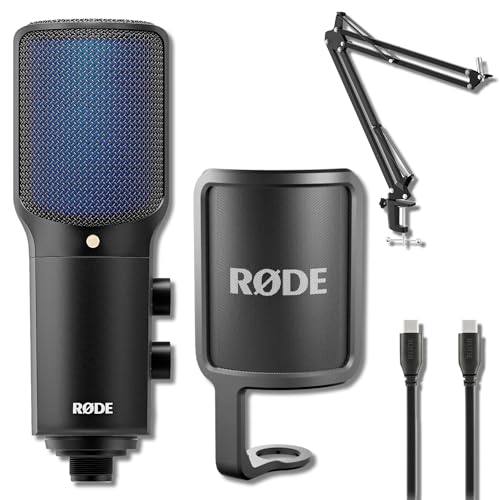
Condenser capsules are naturally sensitive instruments that pick up desk thumps, keyboard clatter, and mechanical vibrations unless isolated from the working surface. The NT-USB+ package directly addresses this reality by shipping as a complete broadcast starter kit. In addition to an included desk stand, this bundle includes the StreamEye BOOMARM1, a 27-inch desktop boom arm constructed from aluminum alloy with an integrated desk clamp mount. External tension springs hold the microphone firmly in position without creaking or sagging over time, allowing you to elevate the NT-USB+ over busy desk areas and position the 1/2-inch cardioid capsule within the ideal two-to-four-inch speaking zone. This package eliminates the need to purchase separate mounting hardware, making it a compelling option for anyone considering a dedicated voice setup like the shure sm7b vs elgato wave 3.
The Wave 3 ships primarily as a compact standalone unit with an included desktop stand. Built with a combination of metal and plastic elements, the microphone weighs a light 7.52 ounces and features dimensions of 3.9 x 3.9 x 8.4 inches. Its compact footprint makes it convenient to place on crowded desks, and the integrated U-mount bracket provides tilting adjustability. However, keeping a sensitive condenser on a desktop stand leaves the capsule vulnerable to keystroke reverberation and desk bumps, and the listing does not include a boom arm in the box. To achieve proper mouth placement without leaning forward, Wave 3 owners often have to source a separate boom arm and mounting adapter.
Physical build quality also reflects the functional priorities of each product. The NT-USB+ features an all-metal enclosure designed for durability in home studios, voiceover booths, and mobile gear bags. The Wave 3 incorporates plastic alongside metal to maintain an ultra-lightweight profile, making it easy to mount on lightweight armatures but feeling somewhat less substantial in the hand. By bundling a 27-inch aluminum suspension arm right out of the box, the NT-USB+ package solves the mechanical isolation problem immediately.
Edge: Rode NT-USB+ wins decisively on physical setup value by providing an all-metal chassis and an included 27-inch aluminum boom arm that isolates the capsule from desk noise.
Software Routing and Live Workflow Integration
How an audio device integrates with your operating system determines whether it can manage an entire live show or simply record an isolated track. When asking whether to pick the Rode NT-USB+ or Elgato Wave 3 for streaming, the software ecosystem is the defining factor. The Wave 3 is built specifically to serve as the master audio hub of a broadcasting workstation through the proprietary Wave Link software. Wave Link functions as a digital mixer, creating virtual audio channels on your PC or Mac. You can route game audio, voice chat, web browser media, sound alerts, and music playback into independent virtual inputs. Wave Link then allows you to create two completely separate audio mixes: one mix that you hear in your direct-monitoring headphones, and an entirely different sub-mix sent directly to your broadcast audience via OBS Studio or Twitch.
The NT-USB+ integrates with RØDE’s suite of software tools, including RØDE Central for hardware configuration and firmware updates, RØDE Reporter for streamlined mobile capture, and RØDE Connect. RØDE Connect acts as a dedicated podcasting and multi-microphone solution, allowing creators to connect compatible USB microphones to a single computer while managing basic sub-mixing and applying the internal APHEX processing chain. For creators weighing the rode podmic usb vs elgato wave 3, the RØDE software platform shines brightest in traditional podcast layouts, interviews, and remote panel recordings. Furthermore, the NT-USB+ offers broad device compatibility, natively connecting to laptops, personal computers, and smartphones via USB-C for mobile voice capture.
Despite the utility of RØDE Connect for voice recordings, it does not match the granular routing flexibility of Wave Link when managing a live, complex video stream. Gamers who need to mute copyright-sensitive music for their stream VODs while keeping it audible in their own headphones will find the Wave 3 ecosystem unmatched. The NT-USB+ excels when producing focused vocal tracks, but the Wave 3 serves as a complete broadcast control station.
Edge: Elgato Wave 3 takes the lead for live streaming, offering the superior Wave Link sub-mixing engine with dual independent audio outputs.
Pros and Cons
Rode NT-USB+

Pros
- Onboard APHEX DSP with Big Bottom and Aural Exciter
- Ultra-low-noise Revolution Preamp
- Dedicated mix balance and headphone volume knobs
- Included 27-inch aluminum desktop boom arm
- Durable all-metal enclosure construction
Cons
- Lacks capacitive tap-to-mute button
- No multi-stage anti-clipping limiter
Elgato Wave 3

Pros
- Multi-stage Clipguard 2.0 prevents digital clipping
- Wave Link software creates dual audio sub-mixes
- Capacitive tap-to-mute sensor with LED feedback
- Native VST plugin support via Wave FX Processor
- Auto Gain calibrates input levels automatically
Cons
- Enclosure incorporates plastic components
- Boom arm not included in listing package
Who Should Buy Each One
Choose the Rode NT-USB+ If
- You record podcasts, audiobooks, or voiceovers where onboard APHEX Big Bottom and Aural Exciter processing deliver finished broadcast warmth without manual post-production.
- You want a complete studio voice starter kit that includes a 27-inch aluminum desktop boom arm to suspend the microphone above desk clatter.
- You need dedicated physical analog knobs on the microphone body to adjust headphone volume and direct monitoring mix balance independently.
- You plan to capture professional voice tracks across multiple platforms, including direct recording into smartphones as well as laptops and desktop computers.
Choose the Elgato Wave 3 If
- You manage live interactive broadcasts on Twitch or YouTube and require Wave Link software to create separate audio sub-mixes for yourself and your audience.
- You have an expressive, high-energy vocal style and need Clipguard 2.0 multi-stage protection and Auto Gain to prevent loud transients from distorting.
- You rely on quick physical adjustments during live sessions, benefiting from a capacitive tap-to-mute button and real-time LED feedback.
- You want a lightweight, compact condenser microphone weighing just 7.52 ounces with native support for third-party VST audio plugins.
Final Verdict
If your creative focus centers on pure vocal fidelity, spoken-word content, and studio-style production, the Rode NT-USB+ stands out as the superior recording instrument. By pairing a 1/2-inch studio condenser capsule and an ultra-low-noise Revolution Preamp with onboard APHEX audio processing, it captures rich, resonant vocal tracks that require virtually no equalization in post-production. The inclusion of an all-metal chassis, dedicated monitoring balance knobs, and a 27-inch aluminum desktop boom arm ensures you have an acoustically isolated, professional voice station ready for work straight out of the package. In any comprehensive Rode NT-USB+ review, the microphone proves its worth whenever vocal body, presence, and plug-and-play mobile compatibility are the top priorities.
However, if you produce live content and need to orchestrate multiple digital audio channels simultaneously, the Elgato Wave 3 is the undisputed operational champion. When asking is Elgato Wave 3 worth it for content creation, the value becomes clear through its Wave Link mixing engine, seamless VST integration, and multi-stage Clipguard 2.0 protection that makes digital clipping virtually impossible. While its lighter frame uses plastic elements and the package lacks a boom arm, its capacitive tap-to-mute sensor and sub-mixing capabilities make it the superior command center for gaming streamers and live broadcasters. In an honest Elgato Wave 3 review, it remains the standard for creators whose audio needs extend beyond a single vocal track into a dynamic, multichannel live show.
FAQ
Can the Rode NT-USB+ be connected directly to a smartphone?
Yes, the Rode NT-USB+ features standard USB Type-C connectivity and lists official device compatibility with smartphones alongside laptops and personal computers. Creators can capture high-fidelity audio directly into mobile recording applications such as RØDE Reporter without needing an external audio interface.
How does Elgato Wave 3 Clipguard 2.0 prevent audio distortion?
Clipguard 2.0 is an intelligent multi-stage anti-distortion system. When an incoming vocal transient reaches a volume that would normally overload the microphone’s analog-to-digital converter, Clipguard instantly reroutes the signal through a secondary, lower-volume audio path. This ensures that sudden loud screams, laughs, or shouts remain clean and free from harsh digital clipping.
Does the Rode NT-USB+ package come with mounting hardware?
Yes, this specific Rode NT-USB+ bundle includes the StreamEye BOOMARM1 desktop boom arm. Built from aluminum alloy with a 27-inch horizontal reach and desk clamp mount, it utilizes internal and external tension springs to position the microphone at speaking distance without creaking or sagging, alongside an included desktop stand.
Is the Rode NT-USB+ or Elgato Wave 3 better for podcasting?
When deciding whether to choose the Rode NT-USB+ or Elgato Wave 3 for podcasting, the NT-USB+ is generally the stronger choice. Its integrated APHEX processing-specifically the Big Bottom and Aural Exciter effects-adds broadcast low-end resonance and vocal clarity directly to the recording, reducing the time you must spend processing audio in an editing suite.
Does the Elgato Wave 3 support third-party audio plugins?
Yes, the Wave 3 supports third-party VST plugins through the Wave Link desktop application. The Wave FX Processor unifies the microphone’s onboard DSP effects, such as its voice enhancer, compressor, and EQ, with external VST plugins into a single, cohesive signal chain.
What are the primary differences between the polar patterns of these microphones?
The Rode NT-USB+ features a tight cardioid polar pattern designed to focus directly on sound arriving in front of its 1/2-inch studio capsule while rejecting ambient room noise from the rear. The Elgato Wave 3 listing specifies a super cardioid pickup pattern, which provides a narrower directional pickup angle at the front to isolate speech from keyboard clatter and peripheral room reflections.