The core distinction between the Breville Barista Express and the De’Longhi Dedica comes down to integrated bean processing versus compact counter convenience. The Barista Express is an all-in-one espresso workstation equipped with a built-in conical burr grinder, precise digital temperature control, and a commercial-style microfoam steam wand. In contrast, the Dedica is an ultra-compact, six-inch-wide pump espresso machine designed exclusively for pre-ground coffee or pods, pairing rapid thermoblock heating with straightforward push-button operation.
Choose the Breville Barista Express if you want an authentic, bean-to-cup espresso ritual that lets you dial in grind size, dose, and milk microfoam from a single machine. Select the De’Longhi Dedica if kitchen real estate is your primary constraint and you prefer pulling quick shots with ground coffee or pods without managing an integrated grinder.
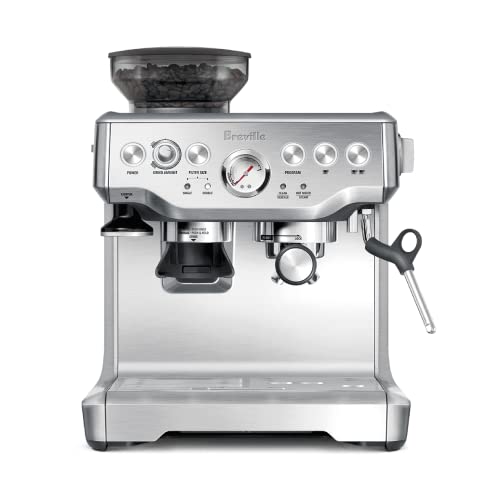

Breville Barista Express vs De’Longhi Dedica at a Glance
| Feature | Breville Barista Express | De’Longhi Dedica |
|---|---|---|
| Coffee Input Type | Whole beans (integrated grinder) | Ground coffee, espresso pods |
| Built-In Grinder | Precision conical burr grinder with 1/2 lb hopper | None (requires separate grinder or pre-ground) |
| Machine Dimensions (D x W x H) | 13.8 x 12.5 x 15.9 inches | 13.0 x 5.9 x 12.0 inches |
| Machine Weight | 22.1 pounds | 9.3 pounds |
| Water Tank Capacity | 67 oz (with replaceable filter) | 1 liter (approximately 33.8 oz) |
| Operating Power and Voltage | 1600 watts, 120 volts | 1450 watts, 110 volts |
| Pressure and Temperature System | Low-pressure pre-infusion, PID digital temperature regulation | 15-bar pump, high-performance thermoblock |
| Milk Frothing Capability | Manual microfoam wand for latte art | Manual frother with Advanced Cappuccino System |
| Included Portafilter and Baskets | 54mm stainless steel portafilter; 1 & 2 cup single and dual-wall baskets | 3-in-1 filter holder for single, double, and pods |
| Best For | Hands-on home baristas prioritizing fresh beans | Space-limited kitchens seeking fast, simple brewing |
Grinding Capabilities and Coffee Input
Freshly grinding beans directly before brewing is widely recognized as the foundation of balanced espresso. The Breville Barista Express built-in grinder vs De’Longhi Dedica configuration highlights two fundamentally opposed philosophies of home brewing. The Barista Express houses an integrated stainless steel conical burr grinder with an intuitive grind size dial and an innovative hands-free cradle. You can dose freshly ground beans directly into the 54mm portafilter, using either single or double-wall baskets. This gives you the flexibility to adapt your grind to light, medium, or dark roasts, managing grind volume and particle size directly on the machine without purchasing standalone equipment.
The De’Longhi Dedica does not feature a grinder. Instead, it relies on a 3-in-1 filter holder engineered to process ground espresso or Easy Serving Espresso (ESE) pods. For home baristas using pre-ground retail coffee, the Dedica eliminates the mess, noise, and calibration time associated with burrs and dosing. However, brewing pre-ground coffee limits your ability to adjust extraction speed or eliminate bitterness and sourness through grind refinement. If you later decide you want freshly ground beans, you must invest in and allocate counter space to a standalone burr grinder.
For coffee drinkers seeking a true bean-to-cup machine, the all-inclusive design of the Barista Express ensures you can grind, tamp, and brew in under a minute without supplementary counter gadgets. Dedica owners who want equivalent grind freshness will need an extra appliance, offsetting some of the machine’s initial space-saving appeal. If you are comparing larger all-in-one setups, you might also examine our breville barista express vs de’longhi magnifica breakdown to see how super-automatic grinding compares.
Edge: Breville Barista Express, because its integrated conical burr grinder and hands-free dosing cradle eliminate the need for separate grinding hardware while maximizing bean freshness.
Counter Footprint and Kitchen Fit
Kitchen space often dictates espresso machine choices, and the contrast between these two models is dramatic. Evaluating the Breville Barista Express or De’Longhi Dedica for small kitchens reveals an obvious winner in pure compactness. The Dedica measures just 5.9 inches wide, 13 inches deep, and 12 inches high, making it one of the slimmest pump espresso machines on the market. Weighing only 9.3 pounds, it easily tucks under low-hanging cabinets, occupies a fraction of a standard countertop run, and can be moved effortlessly during kitchen cleaning.
The Barista Express, by comparison, commands substantial space. Measuring 12.5 inches wide, 13.8 inches deep, and 15.9 inches high, it requires more than double the counter width of the Dedica. At 22.1 pounds, its solid steel construction ensures it remains firmly anchored during portafilter locking and manual tamping, but moving it across the counter is not an everyday task. Furthermore, because its half-pound bean hopper sits on the top deck, you must ensure sufficient vertical clearance below upper cabinets to pour in whole beans comfortably.
While the Barista Express is undeniably large, it also consolidates the footprint of two machines into one. Pairing the 5.9-inch Dedica with a quality dedicated grinder often yields a combined width close to the 12.5 inches of the Barista Express. But taken as standalone units, the Dedica delivers unparalleled spatial efficiency. For readers considering slim Breville alternatives, our breville bambino plus vs de’longhi dedica matchup looks closely at compact footprints without built-in grinders.
Edge: De’Longhi Dedica, because its ultra-slim 5.9-inch width and lightweight 9.3-pound chassis allow it to fit virtually any cramped countertop or apartment kitchen.
Extraction Control and Temperature Stability
Espresso extraction relies on heat management and water pressure to dissolve aromatic compounds without extracting excessive tannins. The Barista Express approaches extraction with semi-commercial sophistication. It utilizes digital temperature regulation (PID) to deliver water at precise brewing temperatures, paired with low-pressure pre-infusion. Pre-infusion gently moistens the coffee puck at lower pressure before ramping up, expanding the grounds evenly to prevent channeling and deliver balanced extraction across single or double shots.
The Dedica features a 1450-watt high-performance thermoblock and a 15-bar professional pressure pump. It relies on an illuminated button control panel with an integrated flow-stop feature, allowing users to customize single or double shot volumes to match personal preferences. The 15-bar pump provides ample pressure to drive water through its pressurized filter baskets, which are specially calibrated to generate crema even when using pre-ground coffee or varying tamp pressures. However, it lacks low-pressure pre-infusion and user-configurable digital PID stabilization.
In practice, the Barista Express rewards users who want to master espresso extraction mechanics, providing visual feedback and consistent temperature profiles for single-origin roasts. The Dedica prioritizes instant readiness and forgiving extraction through its pressurized baskets. Those interested in how upgraded Breville systems handle rapid heating can review the breville barista express vs barista pro guide, but within this pairing, the Barista Express provides superior extraction refinement.
Edge: Breville Barista Express, because digital PID temperature control and gradual low-pressure pre-infusion provide far superior control over flavor balance.
Milk Texturing and Steam Performance
Creating cappuccinos, lattes, and flat whites requires steam power capable of heating milk while folding in air to create velvety texture. Examining the Breville Barista Express steam wand vs De’Longhi Dedica milk frother highlights distinctly different approaches to milk prep. The Barista Express features a powerful manual stainless steel steam wand engineered to produce true microfoam. This textured foam blends seamlessly with espresso, offering the precise viscosity and silky finish necessary for pouring latte art at home.
The De’Longhi Dedica utilizes a manual frother powered by De’Longhi’s Advanced Cappuccino System. This frothing wand is built to aerate milk rapidly with minimal user intervention, generating thick, stiff foam suitable for traditional cappuccinos. While it produces rich, long-lasting froth effortlessly, the air incorporation is coarser than what commercial-style wands produce, making intricate latte art difficult to achieve without modifying the frothing tip.
The Barista Express also ships with a dedicated stainless steel milk jug, ensuring you have the proper vessel on day one. With the Dedica, you must source your own frothing pitcher. If your daily drink is a dense-foam cappuccino, the Dedica accomplishes the task quickly. If your goal is microfoam for specialty milk drinks, the Barista Express is in another tier entirely. Readers wanting to explore advanced milk systems might also find our breville barista pro vs de’longhi magnifica comparison insightful.
Edge: Breville Barista Express, because its commercial-style manual steam wand creates genuine microfoam suitable for smooth lattes and latte art.
Ease of Use and Learning Curve
When deciding between the Breville Barista Express or De’Longhi Dedica for beginners, the learning curve is an essential consideration. The Dedica is exceptionally straightforward. Its interface consists of three illuminated buttons: single shot, double shot, and steam. You insert ground coffee or an ESE pod into the filter holder, twist it into the group head, press a button, and the flow-stop feature cuts off extraction automatically. There is little room for user error, making the morning routine fast and repeatable from the very first use.
The Barista Express is an authentic manual espresso machine that demands patience. Getting café-quality results involves understanding the interplay between grind size, dose weight, and tamp pressure. Breville provides helpful tools to assist with this learning process-including single and dual-wall filter baskets, a 54mm portafilter, an integrated tamper, and the Razor dose trimming tool-alongside two free bags of specialty coffee upon registration. Even with these tools, dial-in adjustments are unavoidable when switching bean varieties or roast levels.
For a beginner wanting instant coffee with minimal study, the Dedica is far less intimidating. But for a beginner eager to build practical espresso skills, the Barista Express provides the comprehensive hardware kit needed to grow from novice to seasoned home barista. If you want a more compact Breville manual experience, look into the breville bambino plus vs barista express evaluation.
Edge: De’Longhi Dedica, because its three-button interface, pressurized baskets, and pod compatibility require virtually no practice to operate successfully.
Included Accessories and Build Construction
The tangible quality of an espresso machine is reflected in its materials and out-of-the-box accessory package. The Barista Express is enclosed in heavy brushed stainless steel and comes equipped with an extensive toolkit. Inside the box, you receive a 54mm stainless steel portafilter, four filter baskets (both single and dual-wall versions for 1 and 2 cups), the Razor dose trimming tool, an integrated removable tamper, a stainless steel milk jug, a water filter with holder, cleaning tablets, a cleaning disc, an Allen key, and a cleaning brush tool. Every tool required for daily brewing and maintenance is included.
The Dedica features an attractive stainless steel exterior that adds minimalist Italian design to your countertop, backed by a 1450-watt internal thermoblock. Its removable water tank holds 1 liter, and its removable drip tray accommodates cups or mugs up to 5 inches tall. However, its bundled accessories are significantly more modest, centering primarily around the 3-in-1 filter holder and standard plastic measuring scoop. Advanced tools like a heavy metal tamper, dosing tools, and a milk pitcher must be bought separately.
The Barista Express also boasts a massive 67 oz water reservoir compared to the Dedica’s 1-liter (33.8 oz) tank. This means far fewer refills when pulling back-to-back shots or using steam. Across the board, Breville supplies a professional-grade kit that requires no secondary purchases to achieve complete functionality.
Edge: Breville Barista Express, due to its heavy 22.1-pound steel construction, 67 oz reservoir, and complete commercial-style accessory kit.
Pros and Cons
Breville Barista Express

Pros
- Integrated conical burr grinder with on-demand dosing
- Digital PID temperature control for precise extraction
- Commercial-style steam wand produces true latte microfoam
- Generous 67 oz water reservoir with filter
- Complete accessory package including metal tamper and milk jug
Cons
- Large 12.5-inch footprint demands substantial counter space
- Steeper learning curve required to dial in shots
View Breville Barista Express on Amazon
De’Longhi Dedica

Pros
- Ultra-compact 5.9-inch wide Italian design
- Accommodates ground espresso and convenient ESE pods
- Simple illuminated three-button control panel with flow stop
- Removable drip tray fits mugs up to 5 inches
- Fast-heating 15-bar thermoblock system
Cons
- No integrated grinder for whole beans
- Smaller 1-liter water tank requires frequent refilling
View De’Longhi Dedica on Amazon
Who Should Buy Each One
Choose the Breville Barista Express If
- You want fresh whole beans ground on demand directly into your portafilter using an integrated conical burr grinder.
- You aspire to practice milk texturing and pour latte art using a powerful manual microfoam steam wand.
- You appreciate granular brewing control, including digital PID temperature management and low-pressure pre-infusion.
- You want a complete, heavy-duty stainless steel setup that includes a tamper, milk pitcher, water filter, and precision trimming tool.
Choose the De’Longhi Dedica If
- You have minimal kitchen counter space and need an ultra-slim machine that measures under 6 inches wide.
- You prefer brewing with pre-ground coffee or mess-free ESE pods rather than dealing with loose whole beans and grinder calibration.
- You want a straightforward, push-button machine with an intuitive illuminated panel and automated flow stop.
- You need an espresso maker that accommodates taller mugs up to 5 inches tall with a removable drip tray.
Final Verdict
When assessing this De’Longhi Dedica vs Breville Barista Express matchup, the Breville Barista Express emerges as the superior comprehensive espresso machine. By integrating an adjustable conical burr grinder, precise PID digital temperature regulation, pre-infusion, and a microfoam steam wand, it delivers everything required for authentic third-wave specialty coffee. If you are asking is Breville Barista Express worth it, the answer is yes for anyone who views espresso preparation as an enjoyable morning craft rather than just a quick caffeine delivery mechanism.
The De’Longhi Dedica remains an exceptional option for households where physical counter space is at an absolute premium. If you wonder is De’Longhi Dedica worth it, it unquestionably proves its value for city dwellers, small offices, and casual drinkers who prioritize a 5.9-inch footprint and simple pod or ground coffee brewing. While it lacks the extraction depth and microfoam finesse of the Barista Express, the Dedica delivers reliable 15-bar espresso with unmatched spatial efficiency.
FAQ
Can you use pre-ground coffee in the Breville Barista Express?
Yes. Although the Breville Barista Express features an integrated conical burr grinder for whole beans, it includes dual-wall filter baskets specifically optimized for pre-ground coffee. You can simply bypass the grinding cradle and spoon pre-ground coffee directly into the portafilter basket before tamping.
Does the De’Longhi Dedica include a coffee grinder?
No, the De’Longhi Dedica does not feature an integrated grinder. It is designed to brew using pre-ground coffee or ESE (Easy Serving Espresso) pods using its included 3-in-1 filter holder. If you wish to grind fresh beans for the Dedica, you will need to purchase a standalone coffee grinder.
Can the De’Longhi Dedica fit travel mugs or tall cups?
Yes. The De’Longhi Dedica features a double drip tray design. By removing the top drip tray insert, the machine accommodates larger glasses and coffee mugs up to 5 inches in height, making it versatile for longer drinks and Americanos.
How do you steam milk for latte art on both machines?
The Breville Barista Express steam wand is designed specifically to produce fine microfoam, incorporating tiny bubbles that create a velvety texture suitable for pouring latte art. The De’Longhi Dedica uses an Advanced Cappuccino System frother that introduces larger volumes of air to produce thick, stiff foam, which is excellent for traditional cappuccinos but less suited for delicate latte art.
What is the benefit of the Breville Barista Express PID temperature control?
Digital temperature control (PID) monitors and regulates the heating element in the Breville Barista Express to ensure water is delivered at an exact, stable temperature during extraction. This prevents burnt or sour shots caused by temperature fluctuations, ensuring consistent espresso flavor extraction.
Is the Breville Barista Express or De’Longhi Dedica better for beginners?
For absolute simplicity and zero learning curve, the De’Longhi Dedica is easier for beginners because it uses pre-ground coffee or pods with three illuminated buttons and automated flow stop. However, for a beginner eager to learn authentic barista techniques like dosing, tamping, and microfoaming, the Breville Barista Express is the better platform because it supplies all the necessary tools in one package.
How do the water tank capacities compare between these two machines?
The Breville Barista Express has a significantly larger water reservoir with a 67-ounce capacity and an included replaceable water filter. The De’Longhi Dedica features a 1-liter (approximately 33.8-ounce) removable water tank, which requires more frequent refilling if you pull multiple drinks or use the steam wand regularly.


