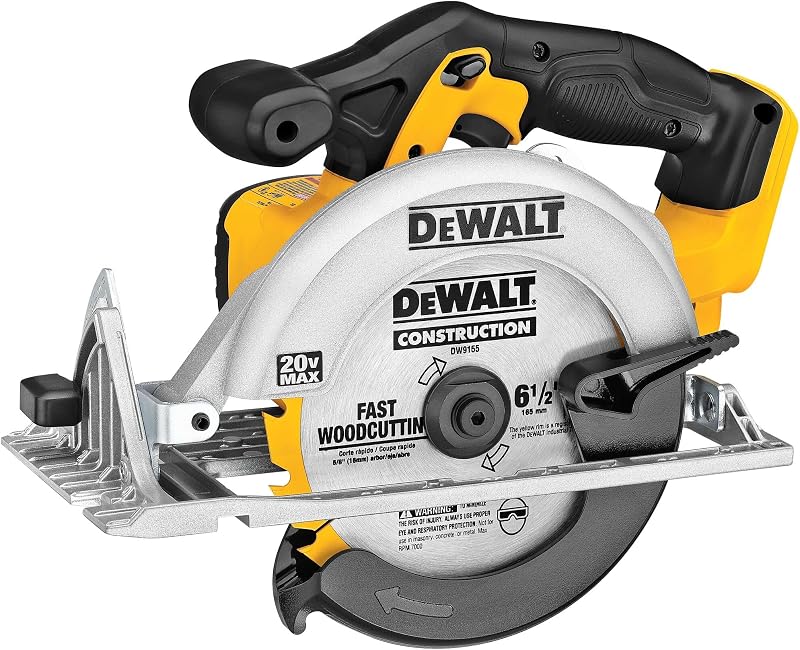
Choosing between the DeWalt DCS570 and the DeWalt DCS391 comes down to a fundamental trade-off between full-size cutting capacity paired with brushless power and compact, lightweight handling for everyday carpentry tasks. The DCS570 swings a full-sized 7-1/4-inch blade driven by an efficient brushless motor that churns out 5500 RPM and reaches a 2-9/16-inch cutting depth, making it built for demanding framing and thick timber. In contrast, the DCS391 utilizes a smaller 6-1/2-inch blade powered by a 5150 RPM motor, delivering a maximum 90-degree cut depth of 2-1/8 inches in a lightweight package engineered for sheet goods and rapid cut-offs.
Carpenters, framers, and contractors tackling heavy-duty dimensional lumber will benefit most from the brushless endurance, higher bevel range, and deep reach of the DCS570. Woodworkers, remodeler apprentices, and dedicated home crafters who prioritize reduced fatigue during repetitive overhead tasks or sheet breakdown should look toward the nimble DCS391.


DeWalt DCS570 vs DeWalt DCS391 at a Glance
| Feature | DeWalt DCS570 | DeWalt DCS391 |
|---|---|---|
| Blade Diameter | 7-1/4 inches | 6-1/2 inches |
| Motor Type | Brushless | Brushed |
| No-Load Speed | 5500 RPM | 5150 RPM |
| Power Output | 900 watts | Not listed |
| Max Cut Depth at 90° | 2-9/16 inches | 2-1/8 inches |
| Max Cut Depth at 45° | Not listed | 1-5/8 inches |
| Bevel Capacity | Up to 57 degrees | 0 to 50 degrees |
| Electric Brake | Yes | Not listed |
| Blade Change System | Hex wrench (included) | Keyless blade change with spindle lock |
| Weight | 7.5 pounds | 3.16 kg (approx. 6.96 lbs) |
| Included Blade | 7-1/4″ 24-tooth blade | 6-1/2″ 18-tooth carbide-tipped blade |
| Best For | Framing, bevel work, heavy-duty construction | Sheet goods, trim carpentry, lightweight DIY |
Blade Size and Cutting Depth
The primary mechanical distinction in any circular saw matchup rests in the arbor assembly and blade clearance. Comparing the DCS570 vs DCS391 cutting depth reveals why blade diameter dictates the scope of jobs each saw can handle safely. The DCS570 is engineered around a standard 7-1/4-inch blade that yields an impressive 2-9/16-inch cutting depth at 90 degrees. This extra reach allows operators to slice through two-by dimensional lumber with ample tooth clearance, cleanly severing engineered timbers, subflooring packs, and post caps in a single pass without binding.
On the other side of this DeWalt DCS570 vs DCS391 blade size comparison, the DCS391 runs a 6-1/2-inch blade. Its maximum vertical cut depth stands at 2-1/8 inches (2.125 inches) at 90 degrees and reduces to 1-5/8 inches (1.625 inches) when tilted to a 45-degree bevel. While 2-1/8 inches is more than enough to crosscut a common 2×4 (which measures 1-1/2 inches thick), it leaves less margin when dealing with warped framing lumber or cutting layered stock. When evaluating the dewalt dcs570 vs dcs573 or other full-frame cordless tools, depth of cut consistently defines professional capability.
Beyond raw numbers, blade size dictates blade availability on commercial sites. The 7-1/4-inch format used by the DCS570 is the most widespread diameter on modern jobsites, making it effortless to source specialty blades for demolition, fiber cement, or fine finishing. The 6-1/2-inch blade on the DCS391 is common among compact cordless saws, but selection at local supply yards can be narrower. For users requiring maximum cut capacity across varied stock thicknesses, the larger diameter provides substantial headroom.
Edge: DeWalt DCS570 delivers superior cutting depth at 2-9/16 inches, easily outperforming the 2-1/8-inch capacity of the smaller platform.
Motor Technology and Power Output
Motor engineering directly dictates how well a cordless tool maintains blade velocity when chewing through dense knots and damp pressure-treated wood. The DCS570 features a brushless motor rated at 900 watts that spins at a brisk 5500 RPM. Brushless architecture eliminates the mechanical friction of carbon brushes, translating battery voltage directly into rotational torque. DeWalt rates this tool to achieve up to 330 crosscuts in 2×4 pine on a single charge, demonstrating high electronic efficiency under load.
In contrast, the DCS391 relies on a traditional brushed motor configuration delivering 5150 RPM (listed in specifications at 5100 RPM). While brushed motors are time-tested and offer dependable startup torque, they run hotter and introduce internal friction that draws down battery reserves faster. In any thorough DeWalt DCS391 review, the motor proves fully capable of slicing through framing timber and sheet goods, but it exhibits more bog-down resistance than a brushless unit when pushed through wet structural lumber. Readers exploring the dewalt dcs573 vs dcs391 comparison will note similar performance leaps when jumping across motor generations.
The DCS570 brushless vs DCS391 debate highlights modern motor control. The brushless motor in the DCS570 continuously monitors current draw, delivering extra juice to prevent stalling when encountering dense grain. This keeps the blade spinning at its 5500 RPM threshold, minimizing tear-out and preventing kickback caused by sudden speed drops. The DCS391 delivers ample power for standard workshop tasks, but the DCS570 provides the heavy-duty muscle required for sustained jobsite production.
Edge: DeWalt DCS570 wins decisively with its 900-watt brushless motor, higher 5500 RPM speed, and superior runtime under load.
Bevel Capacity and Angle Cutting
Bevel versatility determines whether a circular saw can complete intricate roof framing, compound valleys, and exterior siding cuts without forcing the carpenter to finish the cut with a handsaw. The DCS570 provides an aggressive bevel capacity extending all the way to 57 degrees. This extended angle range allows roofers and framers to cut extreme angles on rafters, trusses, and fascia boards directly on the saw table without using clumsy offset jigs.
The DCS391 features a 0 to 50-degree bevel capacity. While 50 degrees handles traditional 45-degree framing joints with 5 degrees of relief to spare, it cannot make the steep pitch cuts required on modern complex roof lines. Furthermore, because the DCS391 maxes out at a 1-5/8-inch cut depth at 45 degrees, it just barely clears standard 1-1/2-inch lumber. If the board has slight dimensional swelling or the blade wanders, the cut may not sever cleanly through the bottom face. Comparing this performance against rival platforms in the dewalt dcs570 vs milwaukee 2730-20 matchup underscores how bevel capacity directly impacts framing versatility.
Angle markings and detents on the DCS570 are laid out for swift site adjustments, enabling operators to lock in bevels rapidly. The DCS391 offers functional bevel adjustments suitable for general carpentry, but its mechanical limit at 50 degrees restricts its role in complex structural joinery. When asking whether to pick the DeWalt DCS570 or DCS391 for framing, the extra 7 degrees of bevel tilt on the DCS570 makes an enormous practical difference.
Edge: DeWalt DCS570 takes this category thanks to its extended 57-degree bevel capacity and greater depth clearance on compound cuts.
Ergonomics, Dimensions, and Weight
Handling qualities determine how comfortable a tool remains after five hours of breaking down sheet goods or trimming rafter tails. The DCS391 shines in this operational arena. It weighs 3.16 kg (approximately 6.96 pounds) bare tool, and incorporates a high-strength, lightweight magnesium shoe engineered for durability and cut stability. DeWalt also equipped the DCS391 with an optimized rubber overmolded comfort grip that dampens vibration and delivers balanced single-handed control during horizontal panel rips.
The DCS570 comes in at 7.5 pounds bare tool. While only about half a pound heavier than the DCS391, its larger 7-1/4-inch guard assembly, brushless motor stator, and beefier shoe create a more front-heavy footprint. Its external dimensions measure 11 inches long, 8 inches wide, and 10 inches high, compared to the DCS391 at 15.5 inches long, 8.5 inches wide, and 10.5 inches high. Despite being shorter in overall length, the DCS570 feels denser and commands a firmer two-handed stance when tracking straight cut lines.
For overhead work, cutting soffits, or working off a ladder, every ounce saved on the tool body prevents shoulder fatigue. The lighter magnesium construction of the DCS391 makes it easier to guide through extended plywood cuts on sawhorses. Users examining the dewalt dcs391 vs makita xsh04z will recognize that compact sidewinders excel precisely because they minimize operator strain over long work shifts.
Edge: DeWalt DCS391 earns the edge with its lighter 3.16 kg build, magnesium shoe, and optimized ergonomic overmold.
Blade Changing, Safety, and Daily Usability
Jobsite productivity depends not only on cutting speed but also on how quickly an operator can service the blade and safely set the tool down between passes. A standout safety feature on the DCS570 is its integrated electronic brake. The moment the operator releases the trigger, the brake rapidly decelerates the spinning 7-1/4-inch blade to a complete stop. This reduces the risk of accidental contact, prevents damage to sawhorses or finished materials, and lets the user transition immediately to their next measurement.
The DCS391 counters with a keyless blade change mechanism and spindle lock. Changing blades on the jobsite often involves hunting for a lost hex wrench or arbor pin. With the keyless system on the DCS391, swapping an 18-tooth rough framing blade for a fine-tooth plywood blade is fast and completely tool-free. However, the DCS391 listing does not specify an electric brake, meaning the blade coasts down under friction after trigger release. For comparisons featuring alternative braking systems, see the dewalt dcs391 vs milwaukee 2730-20 breakdown.
The DCS570 includes a dedicated blade-changing wrench stored on the tool frame, requiring standard manual tightening during blade swaps. While wrench changes take a few seconds longer than keyless levers, the addition of an electronic brake on the DCS570 provides a serious daily safety advantage. Balancing the convenience of keyless blade changes against the protective value of an instant electronic brake makes this comparison a direct draw based on user priorities.
Edge: Tie because the DCS570 provides the critical safety of an electronic brake, while the DCS391 delivers keyless blade changing convenience.
Pros and Cons
DeWalt DCS570

Pros
- Deep 2-9/16-inch cutting depth at 90 degrees
- Efficient 900-watt brushless motor
- High 5500 RPM speed under load
- Extended 57-degree bevel capacity
- Integrated electronic blade brake
Cons
- Heavier at 7.5 pounds bare tool
- Requires hex wrench for blade changes
DeWalt DCS391
Pros
- Lightweight 3.16 kg magnesium shoe build
- Tool-free keyless blade change system
- Comfortable rubber overmolded grip
- Solid 5150 RPM cutting speed
Cons
- Shallower 2-1/8-inch maximum cut depth
- Bevel capacity limited to 50 degrees
- Brushed motor design
Who Should Buy Each One
Choose the DeWalt DCS570 If
- You need full 2-9/16-inch cutting depth to slice through dimensional lumber, framing packs, and posts in one pass.
- You cut steep roof pitches and valley rafters that require bevel adjustments beyond 50 degrees up to 57 degrees.
- You want the sustained runtime and electronic torque retention of a 900-watt brushless motor delivering 5500 RPM.
- You prioritize safety and workflow efficiency through an integrated electronic blade brake that halts rotation instantly.
Choose the DeWalt DCS391 If
- You primarily cut sheet goods, plywood, subflooring, and standard 2×4 framing studs where a 2-1/8-inch cut depth is plenty.
- You want a lighter 3.16 kg saw with a durable magnesium shoe to minimize shoulder fatigue during overhead and repetitive cuts.
- You prefer a keyless blade change system with a spindle lock so you never need to search for a hex wrench on the jobsite.
- You are a DIYer or home woodworker looking for a dependable 20V sidewinder saw for general home renovation.
Final Verdict
In this DeWalt 7 1/4 vs 6 1/2 circular saw evaluation, the DeWalt DCS570 emerges as the superior all-around cutting tool for serious construction, framing, and heavy remodeling. Its brushless power plant generates 900 watts of output at 5500 RPM, outpacing the brushed motor of the DCS391 under heavy load. Paired with a massive 2-9/16-inch cutting depth at 90 degrees, an extended 57-degree bevel mechanism, and an essential electronic blade brake, the DCS570 provides the performance and safety envelope that professional jobsites require.
Nonetheless, the DeWalt DCS391 remains an outstanding solution for woodworkers, trim carpenters, and DIY enthusiasts. When asking is DCS391 worth it, the answer is a resounding yes for anyone whose projects focus on sheet goods, panel breakdown, and basic two-by framing. Its lightweight 3.16 kg build, magnesium shoe, and tool-free keyless blade change make it noticeably easier to maneuver across long plywood cuts without fatigue. Choose the DCS570 for heavy framing muscle, or select the DCS391 for lightweight, nimble versatility.
FAQ
Can the DeWalt DCS391 cut through a 2×4 at a 45-degree bevel?
Yes. The DeWalt DCS391 provides a maximum cut depth of 1-5/8 inches at a 45-degree angle. Because a standard 2×4 board has an actual thickness of 1-1/2 inches, the saw cuts cleanly through the stock on a single pass, provided the lumber is flat and free of heavy crowning.
Does the DeWalt DCS570 have an electronic blade brake?
Yes, the DeWalt DCS570 listing confirms it features an electric brake. The brake activates immediately once you release the trigger, quickly stopping the blade to protect the user and prevent workpiece gouging.
What blade sizes do the DeWalt DCS570 and DCS391 use?
The DeWalt DCS570 uses standard 7-1/4-inch (184mm) circular saw blades, while the DeWalt DCS391 uses 6-1/2-inch circular saw blades. The DCS570 includes a 24-tooth blade in the box, and the DCS391 includes an 18-tooth carbide-tipped blade.
Is the DeWalt DCS391 motor brushless?
No, the DeWalt DCS391 uses a traditional brushed motor delivering 5150 RPM. If you require brushless motor efficiency, the DeWalt DCS570 features a brushless design rated at 900 watts and 5500 RPM.
Which saw offers greater bevel capacity for framing roofs?
The DeWalt DCS570 offers greater bevel flexibility, tilting up to 57 degrees. The DeWalt DCS391 offers a bevel range from 0 to 50 degrees, making the DCS570 better suited for steep roof pitches and compound angles.
How do the blade changing systems differ between these two models?
The DeWalt DCS391 features a keyless blade change system paired with a spindle lock, allowing operators to change blades without hand tools. The DeWalt DCS570 requires the included blade-changing hex wrench to loosen and tighten the arbor bolt.
What components are included with the bare tool packages?
The DeWalt DCS570 package includes the 7-1/4-inch circular saw, one 7-1/4-inch 24-tooth blade, and a blade-changing wrench. The DeWalt DCS391 includes the 6-1/2-inch circular saw and an 18-tooth carbide-tipped blade. Both listings are sold as bare tools without batteries or chargers.


