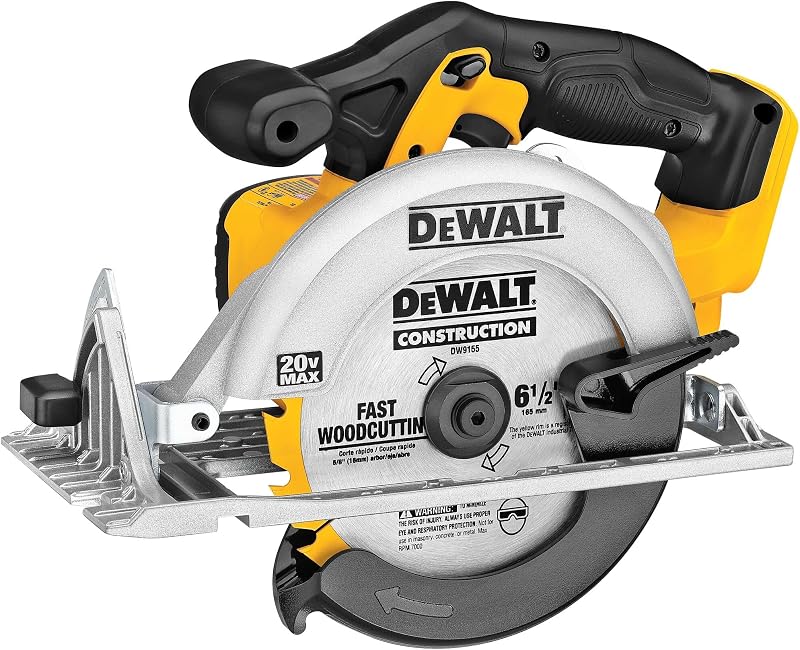
The core difference between the DeWalt DCS391 and the Makita XSH04Z comes down to motor architecture and overall physical footprint: the Makita incorporates an electronically controlled brushless motor inside an ultra-compact body measuring just 10-5/8 inches long, whereas the DeWalt uses a traditional high-velocity brushed motor paired with a heavy-duty magnesium shoe engineered for reliable, full-length rip cuts.
Choose the DeWalt DCS391 if you already operate on the DeWalt 20V MAX battery ecosystem and prioritize high blade speed for standard dimensional lumber cutting. Choose the Makita XSH04Z if you need a lightweight, sub-compact framing saw that delivers deeper 90-degree cuts and cooler brushless efficiency in tight quarters.


DeWalt DCS391 vs Makita XSH04Z at a Glance
| Feature | DeWalt DCS391 | Makita XSH04Z |
|---|---|---|
| Motor Type | Brushed motor | BL Brushless motor |
| No-Load Speed | 5,150 RPM | 5,000 RPM |
| Blade Diameter | 6-1/2 inches | 6-1/2 inches |
| Max Cut Depth at 90° | 2-1/8 inches | 2-1/4 inches |
| Max Cut Depth at 45° | 1-5/8 inches | The listing does not specify |
| Bevel Capacity | 0° to 50° | 0° to 50° |
| Shoe Material | High-strength magnesium | The listing does not specify |
| Bare Tool Weight | 3.16 kg (approx. 6.96 lbs) | 4 pounds |
| Overall Length | 15.5 inches | 10-5/8 inches |
| Best For | General framing and rough carpentry on 20V platforms | Overhead cutting, punch-list work, and compact framing |
Cutting Depth and Bevel Capacity
Cutting capacity dictates how thick of a board a circular saw can slice through in a single pass without binding or requiring a secondary cut from the reverse side. The DeWalt DCS391 vs Makita XSH04Z cutting depth matchup reveals a subtle yet meaningful physical distinction between these two 6-1/2-inch tools. The DCS391 provides a maximum vertical cut depth of 2-1/8 inches (2.125 inches) at 90 degrees and 1-5/8 inches (1.625 inches) at a 45-degree angle. This depth allows the DCS391 to clear standard 2x lumber (which measures 1-1/2 inches thick) cleanly even when working on an incline. If you want to compare how DeWalt circular saws handle varied applications, see our guide on the dewalt dcs573 vs dcs391.
The Makita XSH04Z pushes cut capacity slightly further at square angles, delivering a maximum cut depth of 2-1/4 inches (2.25 inches) at 90 degrees. That extra eighth of an inch provides useful clearance when trimming subfloor sheets through rough surfaces or making straight cuts across dimensional timber that might vary in actual thickness due to moisture or mill inconsistencies. While the listing does not specify the exact depth capacity of the XSH04Z at 45 degrees, both saws offer an identical bevel range of 0 to 50 degrees, permitting aggressive angle cuts for rafter tails, compound miters, and general framing joints.
In everyday use, both saws comfortably process 2×4 and 2×6 framing lumber in a single pass at 90 degrees. However, the XSH04Z provides an advantage when tackling slightly thicker stock or sheet materials stacked together on sawhorses. The DCS391 counters with clearly specified, reliable bevel depths at 45 degrees, which guarantees that common compound framing cuts will not fall short on 2x stock. For woodworkers and framers choosing strictly on vertical cut capacity, the extra 1/8-inch clearance on the Makita gives it the theoretical advantage at square alignment.
Edge: Makita XSH04Z for its deeper 2-1/4-inch cut capacity at 90 degrees.
Motor Technology and Cutting Power
Motor configuration directly influences runtime, tool longevity, and how well a blade maintains rotational velocity under heavy cutting loads. In this Makita XSH04Z brushless review dimension, the XSH04Z features an electronically controlled BL Brushless motor engineered to eliminate friction-generating carbon brushes. Makita built this power plant to run cooler and more efficiently, pairing it with Automatic Speed Change technology that adjusts rotational speed and torque dynamically when the blade encounters high-resistance grain or knotty stock. The motor spins the 6-1/2-inch arbor at up to 5,000 RPM.
The DCS391 relies on a proven brushed motor design rated at 5,150 RPM (with the specification sheet also recording 5,100 RPM). While it lacks the electronic motor controller found in brushless tools, its high rotational speed delivers fast surface-cutting speed across dimensional lumber and plywood sheathing. In a direct DeWalt DCS391 review of continuous framing work, the high RPM allows clean crosscuts without tear-out, provided the 18-tooth blade is sharp. If you are comparing mid-range and heavy-duty alternatives, check our breakdown of the dewalt dcs570 vs makita xsh04z.
The operational trade-off centers on efficiency versus traditional simplicity. The brushless system in the Makita generates less internal heat, which preserves motor windings and yields more work per battery charge. The Automatic Speed Change feature also keeps the blade from bogging down during heavy rip cuts by boosting torque when RPM drops. The DCS391 delivers slightly higher free-spinning RPM right out of the gate, but because brushed motors generate more heat and friction, it tends to drain batteries faster during high-volume ripping sessions.
Edge: Makita XSH04Z for its brushless motor design and dynamic load-sensing torque adjustment.
Size, Weight, and Ergonomics
Handling ergonomics determine how long a carpenter can operate a cordless circular saw before wrist fatigue sets in, especially during overhead cuts, staging work, or rafters. This is where the Makita sub compact circular saw vs DeWalt 20V distinction becomes most prominent. The Makita XSH04Z is designated as an 18V LXT Sub-Compact model, measuring an exceptionally compact 10-5/8 inches in overall length. The bare tool weighs 4 pounds, and it reaches only 6.4 pounds when fitted with an 18V LXT Compact 2.0Ah battery, making it one of the easiest saws to maneuver in cramped ceiling joists or tight stud bays.
The DCS391 represents a standard sidewinder footprint. The listing specifies dimensions of 15.5 inches in length, 8.5 inches in width, and 10.5 inches in height, with a tool weight of 3.16 kg (approximately 6.96 pounds bare). To optimize balance and handling across this larger frame, DeWalt incorporates an optimized rubber overmolded comfort grip. This ergonomic handle helps users maintain stability during long two-handed rip cuts along 8-foot plywood panels, where the added tool mass can help steady the cut line against wandering.
For remodelers, roofers, and punch-list technicians working on ladders, the 10-5/8-inch overall length and 4-pound bare weight of the XSH04Z provide superior maneuverability. It reduces arm strain during repetitive horizontal cuts and fits inside compact tool totes where the 15.5-inch DeWalt cannot go. Conversely, framers who prefer the substantial, grounded feel of a traditional sidewinder on flat sawhorses might appreciate the planted stance of the DCS391.
Edge: Makita XSH04Z for its significantly lighter 4-pound bare weight and 10-5/8-inch compact length.
Shoe Quality and Jobsite Durability
The base plate or shoe of a circular saw takes substantial jobsite abuse, sliding across gritty OSB, dropping onto concrete, and absorbing impacts during framing setups. The DCS391 stands out here with a high-strength, lightweight magnesium shoe. Magnesium is widely recognized on construction sites for its ability to resist bending and warping when dropped, ensuring that the base plate remains parallel to the blade for consistent cut accuracy over years of rough use. Those comparing full-size cordless framing tools can also review our look at the dewalt dcs573 vs makita xsh04z.
The Makita XSH04Z listing does not specify the base plate material, focusing instead on its sub-compact chassis and electronic motor housing. While Makita designs its LXT tools for trade use, the absence of an explicitly stated magnesium shoe means buyers cannot verify whether the base plate offers the same high impact resistance as the DeWalt. The XSH04Z does, however, include an electric brake that stops the blade quickly after releasing the trigger, enhancing operator safety and preventing accidental blade strikes against materials or cords when setting the tool down.
When it comes to warranty protection, DeWalt covers the DCS391 with a 3-year limited warranty, backing its magnesium-clad construction against manufacturing defects. Makita backs the XSH04Z with a limited warranty, though the listing does not detail the exact multi-year duration. For demanding jobsite conditions where tools are frequently handled roughly by multiple crew members, the known resilience of the DeWalt magnesium shoe offers tangible peace of mind.
Edge: DeWalt DCS391 for its jobsite-proven magnesium shoe and clear 3-year limited warranty coverage.
Included Accessories and Blade Configuration
The accessories supplied out of the box determine how quickly a tool can be integrated into your workflow and what secondary tasks it can perform immediately. Regarding the DeWalt DCS391 blade size, the saw comes equipped with a 6-1/2-inch, 18-tooth carbide-tipped blade. An 18-tooth configuration on a 6-1/2-inch disc is tailored specifically for aggressive, rapid framing cuts and rough ripping through dimensional 2x lumber, clearing sawdust quickly through large gullets. The DCS391 also features a spindle lock and keyless blade change system to speed up disc swaps on the job.
The Makita XSH04Z ships with a higher tooth-count disc: a 6-1/2-inch, 24-tooth carbide-tipped saw blade (part number A-85092). A 24-tooth blade produces cleaner, smoother cuts in plywood, trim, and finish goods than an 18-tooth blade, reducing splintering along the cut line. Additionally, Makita packages the XSH04Z with a dedicated dust extracting attachment (part number 199230-9) and a hex wrench (part number 783203-8) for blade maintenance. The dust nozzle lets woodworkers connect the saw directly to vacuum systems, maintaining a cleaner workspace indoors.
The DCS391 offers the convenience of tool-free blade swaps via its keyless system, eliminating the hassle of searching for an arbor wrench when changing dull blades. However, the Makita XSH04Z package provides greater out-of-the-box versatility by including dust extraction hardware and a finer 24-tooth blade suitable for both framing and cleaner sheet-good cuts. If your jobsite demands active dust management in finished spaces, the Makita dust attachment is a decisive feature.
Edge: Makita XSH04Z for including a 24-tooth blade and a dust extraction attachment.
Battery Platform and Tool Ecosystem
Because both tools are sold as bare units without batteries or chargers, your existing cordless platform plays a critical role in the purchase decision. The DCS391 operates on DeWalt’s expansive 20V MAX lithium-ion platform. This system includes dozens of heavy-duty construction tools, meaning users with existing DeWalt drill kits or reciprocating saws can pop their batteries straight into the DCS391 without purchasing extra charging hardware. If you frequently use demolition tools, you might also compare how DeWalt and Makita platforms differ in our breakdown of the dewalt dcs367 vs makita xrj05z.
The XSH04Z runs on the Makita 18V LXT battery line. Makita claims this platform is the world’s largest 18V cordless tool system, giving tradespeople access to hundreds of compatible tools ranging from high-torque impact wrenches to outdoor power equipment. Makita’s Sub-Compact series is specifically engineered to provide 12V handling dynamics while retaining full compatibility with standard 18V LXT batteries, such as the compact 2.0Ah pack cited in the listing. For readers evaluating other 20V cordless options, our review of the dewalt dcs391 vs milwaukee 2730-20 outlines how DeWalt measures up against competing platforms.
From an ecosystem perspective, neither brand holds an absolute advantage over the other, as both 20V MAX and 18V LXT offer immense tool variety and proven reliability on commercial jobsites. The deciding factor here is battery efficiency: the brushless motor on the XSH04Z draws less current per cut, allowing users to achieve substantial productivity even with lighter, compact batteries, whereas the DCS391 performs best when paired with higher-capacity packs to support its brushed 5,150 RPM motor.
Edge: Tie.
Pros and Cons
DeWalt DCS391
Pros
- Fast 5,150 RPM motor speed
- Durable lightweight magnesium shoe
- Tool-free keyless blade change
- Clear 3-year limited warranty
Cons
- Traditional brushed motor design
- Heavier 3.16 kg bare frame
Makita XSH04Z

Pros
- Efficient BL Brushless motor
- Ultra-compact 10-5/8-inch overall length
- Deeper 2-1/4-inch cut capacity at 90°
- Included dust extracting attachment
- Built-in electric blade brake
Cons
- Requires hex wrench for blade changes
- Listing omits 45-degree cutting depth
Who Should Buy Each One
Choose the DeWalt DCS391 If
- You already own DeWalt 20V MAX batteries and want an affordable bare tool for rough carpentry.
- You need the rugged durability of a high-strength magnesium shoe for harsh jobsite environments.
- Your primary tasks involve fast dimensional lumber crosscutting where an aggressive 18-tooth blade and 5,150 RPM excel.
- You prefer keyless blade changes that do not require tracking down a separate hex wrench.
Choose the Makita XSH04Z If
- You want a sub-compact saw measuring under 11 inches that minimizes fatigue during overhead or vertical cutting.
- You demand brushless motor efficiency with Automatic Speed Change technology to maximize runtime per charge.
- You require a deeper 2-1/4-inch cut depth at 90 degrees to clear thicker building materials in one pass.
- You do indoor remodel work and need an included dust extracting attachment to connect to a shop vacuum.
Final Verdict
When weighing the DeWalt DCS391 or Makita XSH04Z for framing, the Makita XSH04Z emerges as the more technologically advanced tool. Its compact 10-5/8-inch frame, 4-pound bare weight, brushless motor, electronic brake, and deeper 2-1/4-inch cut capacity give it a clear edge in maneuverability, cutting depth, and runtime efficiency. If you are asking is Makita XSH04Z worth it, the addition of a 24-tooth blade and a dedicated dust extracting adapter makes it an exceptional tool for both framing and clean punch-list remodeling.
The DeWalt DCS391 remains an outstanding, battle-tested option for carpenters committed to the DeWalt 20V MAX platform. With its 5,150 RPM motor, heavy-duty magnesium shoe, keyless blade changing mechanism, and generous 3-year limited warranty, the DCS391 is built to handle the rough-and-tumble conditions of everyday construction sites. If you already have 20V MAX batteries on your workbench and prioritize straightforward power and rugged build quality over sub-compact sizing, the DCS391 is a dependable workhorse.
FAQ
What is the primary difference between the DeWalt DCS391 and the Makita XSH04Z?
The main difference lies in motor technology and tool size. The Makita XSH04Z features an 18V brushless motor housed in an ultra-compact 10-5/8-inch body weighing 4 pounds bare, while the DeWalt DCS391 uses a 20V brushed motor spinning at 5,150 RPM inside a traditional 15.5-inch sidewinder frame featuring a magnesium shoe.
What blade size do these circular saws use?
Both circular saws use standard 6-1/2-inch round blades. The DeWalt DCS391 includes an 18-tooth carbide-tipped blade designed for fast framing cuts, whereas the Makita XSH04Z includes a 24-tooth carbide-tipped blade designed for smoother cuts in sheet goods and finish materials.
Can the DeWalt DCS391 cut through 2x dimensional lumber at a 45-degree bevel?
Yes. The DCS391 has a maximum cut depth of 1-5/8 inches (1.625 inches) at a 45-degree bevel, which provides enough clearance to slice through standard 2x lumber (actual thickness 1-1/2 inches) on an angle.
Does the Makita XSH04Z feature an electric blade brake?
Yes. The Makita listing specifies an electric brake as a special feature, which rapidly halts blade rotation once the user releases the trigger to improve jobsite safety.
Do either of these circular saws come with a battery and charger?
No. Both models are sold as bare tools. The DeWalt DCS391 requires a DeWalt 20V MAX lithium-ion battery, while the Makita XSH04Z requires an 18V LXT lithium-ion battery (sold separately).
Does the DeWalt DCS391 have a brushless motor?
No. The DCS391 is powered by a standard brushed motor delivering 5,150 RPM. If you require a brushless motor, the Makita XSH04Z features an electronically controlled BL Brushless motor.
Can I connect a shop vacuum to the Makita XSH04Z?
Yes. The Makita XSH04Z comes standard with a dust extracting attachment (part number 199230-9) that mounts to the saw body to channel sawdust directly into an extraction hose.


