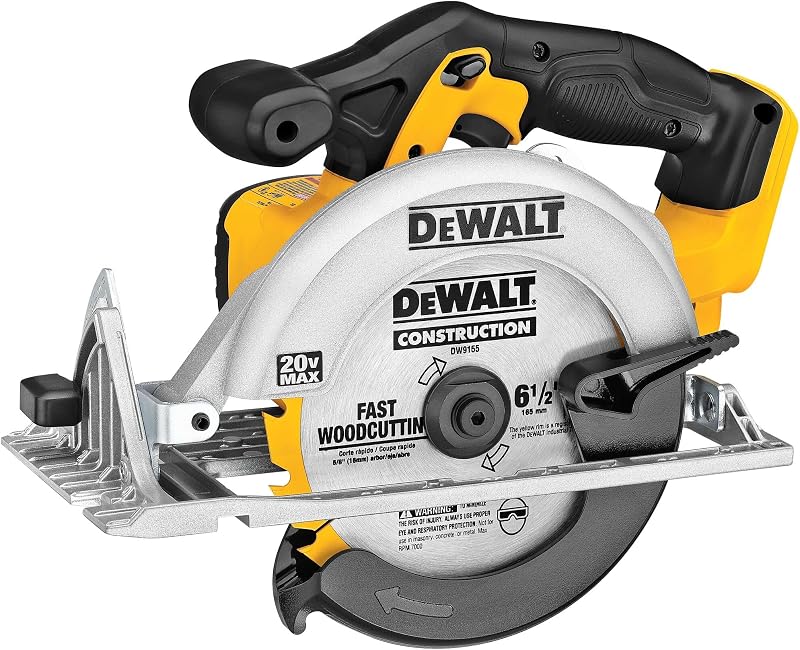
The primary difference separating these two cordless circular saws comes down to blade diameter and physical footprint: a full-size 7-1/4-inch platform engineered for maximum cutting depth versus a 6-1/2-inch sub-compact chassis built for agile handling in tight quarters. When evaluating the DeWalt DCS570 against the Makita XSH04Z, tradespeople must balance whether their daily work demands maximum single-pass material capacity or reduced physical fatigue during extended cutting sessions.
Choose the DeWalt DCS570 if you need a true 2-9/16-inch cutting depth and a 57-degree bevel capacity to power through heavy structural framing. Choose the Makita XSH04Z if you prioritize a 4-pound bare tool profile that slips into compact spaces and reduces overhead strain on roof decking and punch-list tasks.


DeWalt DCS570 vs Makita XSH04Z at a Glance
| Feature | DeWalt DCS570 | Makita XSH04Z |
|---|---|---|
| Blade Diameter | 7-1/4 inches | 6-1/2 inches |
| Maximum Cutting Depth at 90° | 2-9/16 inches | 2-1/4 inches |
| No-Load Speed | 5,500 RPM | 5,000 RPM |
| Motor Output / Technology | Brushless (900 watts) | Brushless (Automatic Speed Change) |
| Bevel Capacity | Up to 57° | 0° to 50° |
| Bare Tool Weight | 7.5 pounds | 4.0 pounds |
| Overall Length | 11 inches | 10-5/8 inches |
| Blade Orientation | Not listed | Blade-right |
| Dust Collection Adapter | Not listed | Included (199230-9) |
| Best For | Framing crews and high-capacity cuts | Roofers and overhead trim work |
Cutting Depth and Blade Size
Blade diameter governs what a circular saw can slice through in a single pass, especially when cutting dimensional lumber at an angle. The DeWalt DCS570 uses a standard full-size 7-1/4-inch blade that yields a generous 2-9/16-inch cutting depth at 90 degrees. This extra reach allows operators to slice through two-by dimensional stock even when running atop thick straightedges, guide tracks, or uneven framing members without bottoming out the shoe. Buyers looking at capacity upgrades often study the dewalt dcs570 vs dcs391 to see how blade size shifts real-world jobsite utility.
In contrast, the Makita XSH04Z utilizes a 6-1/2-inch blade format that achieves a 2-1/4-inch cutting capacity at 90 degrees. While 2-1/4 inches easily handles standard 2×4 and 2×6 framing lumber in straight 90-degree passes, it leaves less clearance when trimming thicker subflooring bundles or performing steep compound bevel cuts. The smaller blade diameter on the Makita saw reduces rotating mass, but it narrows the margin of error when cutting rough-sawn timbers or gang-cutting multiple sheet goods at once.
For standard construction projects where 7-1/4-inch blades are universal across every work vehicle, the DeWalt cutting depth advantage eliminates limitations on lumber thickness. The Makita cutting capacity remains fully functional for standard dimensional lumber, yet it requires more deliberate planning on layered materials.
Edge: DeWalt DCS570 because its 7-1/4-inch blade delivers 2-9/16 inches of depth to handle thick stock and straightedge guides without stalling.
Motor Performance and Cutting Speed
Motor engineering dictates how quickly a saw advances through knotty lumber and dense sheet goods without binding. The DCS570 features a brushless motor rated at 900 watts that produces a no-load speed of 5,500 RPM. DeWalt rates this tool to deliver up to 330 crosscuts in 2×4 pine on a single charge, maintaining high blade velocity under load to reduce tear-out and prevent blade stall during aggressive ripping. Those comparing heavy-duty motor outputs also assess the dewalt dcs570 vs milwaukee 2730-20 to gauge how brushless platforms sustain torque in rough framing.
Makita equips the XSH04Z with an electronically controlled BL brushless motor that delivers 5,000 RPM. A notable mechanical feature of this motor is Makita Automatic Speed Change technology, which monitors blade resistance and dynamically shifts torque and rotational speed during the cut. When slicing through dense knots or wet framing material, the tool adjusts power delivery to optimize motor efficiency and protect the battery pack from premature depletion.
While the Makita saw brings sophisticated electronics to regulate power draw, the DeWalt saw offers an outright rotational speed advantage with 5,500 RPM and a 900-watt rating. That higher top-end speed produces rapid rips in plywood and exterior sheathing, saving time over hundreds of repetitive production cuts.
Edge: DeWalt DCS570 thanks to its higher 5,500 RPM operating speed and 900-watt brushless motor output.
Size, Weight, and Maneuverability
Carrying a circular saw across roof trusses, staging, or scaffold decks changes how tool weight impacts productivity. The Makita XSH04Z belongs to Makita 18V LXT Sub-Compact series, designed specifically to pack 18-volt cutting power into a 12-volt size class. The bare tool weighs just 4.0 pounds (reaching 6.4 pounds when fitted with a compact 2.0Ah battery pack) and measures a compact 10-5/8 inches in overall length. This compact design allows carpenters to manipulate the saw one-handed when trimming rafter tails or working overhead without tiring out their shoulders.
The DeWalt DCS570 is a full-sized construction tool measuring 11 inches long, 8 inches wide, and 10 inches high, with a bare tool weight of 7.5 pounds. Once a 20V MAX battery pack is locked onto the base, the DCS570 carries noticeable mass. While that extra weight helps stabilize the saw shoe flat against sheet goods during long, continuous rips on sawhorses, it becomes fatiguing when working above shoulder level or balancing on a ladder. Readers examining mid-tier options frequently weigh the dewalt dcs573 vs makita xsh04z when balancing raw weight against frame durability.
For remodelers working in cramped utility chases or roofers balancing on steep slopes, the Makita sub-compact form factor provides superior balance and handling. The DCS570 feels grounded on flat horizontal surfaces, but the XSH04Z moves with unmatched freedom in restricted workspaces.
Edge: Makita XSH04Z because its 4.0-pound bare tool weight and 10-5/8-inch chassis dramatically reduce user fatigue.
Bevel Range and Compound Angles
Bevel versatility dictates how cleanly a circular saw handles valley cuts, rafter bevels, and non-standard roof pitches. The DeWalt DCS570 provides a bevel capacity up to 57 degrees. This extended angle range surpasses standard 45-degree stops, giving framers the freedom to complete steep pitch roof cuts, birdsmouth adjustments, and complex compound miters directly on the sawhorses without reaching for a handsaw or specialized miter saw.
The Makita XSH04Z offers a bevel capacity of 0 to 50 degrees. A 50-degree bevel easily covers standard 45-degree angle requirements for wall framing, basic rafters, and exterior trim. However, it lacks the upper-register tilt needed when framing aggressive roof hips or valleys that demand bevels beyond 50 degrees. Carpenters deciding between angle flexibility and compact size often review the dewalt dcs391 vs makita xsh04z to identify where bevel stops meet their project requirements.
Both models feature integrated electric brakes to bring the spinning blade to a rapid halt the moment the trigger is released, enhancing safety when resetting for subsequent angled cuts. However, the DeWalt tool provides an extra 7 degrees of tilting range that gives structural framers a distinct advantage on custom roof layouts.
Edge: DeWalt DCS570 due to its wider 57-degree bevel range compared to the 50-degree limit on the Makita.
Dust Collection and Included Accessories
Cleanliness and out-of-the-box readiness matter whether cutting materials inside finished living spaces or running production rips on the jobsite. The Makita XSH04Z ships with a dedicated dust extracting attachment (part number 199230-9), a 6-1/2-inch 24-tooth carbide-tipped saw blade, and a hex wrench that stores neatly on the tool body. The included dust port allows users to connect the saw directly to an extraction vacuum hose, capturing fine sawdust during indoor remodeling and cabinet fitting.
The DeWalt DCS570 package includes the 7-1/4-inch saw, a 24-tooth carbide blade, and a blade changing wrench. The DCS570 listing does not specify an included vacuum port or dust extraction nozzle in the bare-tool packaging. While the open design ejects chips efficiently away from the cut line on outdoor framing jobs, it creates more airborne debris when operating in finished residential interiors.
Makita thought through the needs of punch-list remodelers by providing the vacuum adapter as standard equipment. Users working indoors will appreciate being able to hook up dust extraction immediately without sourcing aftermarket adapters.
Edge: Makita XSH04Z because it includes a factory dust extraction vacuum attachment in the box.
Pros and Cons
DeWalt DCS570

Pros
- Full 2-9/16-inch cutting depth at 90 degrees
- Fast 5500 RPM brushless motor
- Generous 57-degree maximum bevel capacity
- High 330 crosscut runtime in 2×4 pine
Cons
- Heavier 7.5-pound bare tool weight
- No included dust vacuum attachment
Makita XSH04Z

Pros
- Ultra-lightweight 4-pound bare tool body
- Compact 10-5/8-inch overall length
- Automatic Speed Change torque adjustment
- Dust extraction attachment included in box
Cons
- Lower 2-1/4-inch cutting depth
- Bevel capacity limited to 50 degrees
Who Should Buy Each One
Choose the DeWalt DCS570 If
- You primarily cut framing lumber and require 2-9/16 inches of blade depth to clear thick stock and cutting jigs.
- You need an extended 57-degree bevel capacity for framing custom rafters, hips, and valleys.
- You want a fast 5,500 RPM motor to rip through heavy plywood and framing materials on sawhorses.
- You already own DeWalt 20V MAX batteries and prefer using universal 7-1/4-inch circular saw blades.
Choose the Makita XSH04Z If
- You spend considerable time cutting overhead, standing on scaffolding, or working on roof decking.
- You want an ultra-lightweight 4-pound bare tool that fits inside tight structural bays and cabinets.
- You perform indoor remodeling where the included dust extraction adapter keeps the workspace clean.
- You are invested in the Makita 18V LXT platform and want sub-compact handling with full 18-volt performance.
Final Verdict
For primary construction framing, gang-cutting, and standard jobsite carpentry, the DeWalt DCS570 is the stronger all-around choice. Its 7-1/4-inch blade format provides 2-9/16 inches of cutting depth, easily besting the sub-compact class when slicing through layered stock or cutting on steep bevels. Combined with a 5,500 RPM brushless motor and an expansive 57-degree bevel range, the DCS570 performs like a traditional corded framing saw without the tether of an extension cord.
The Makita XSH04Z wins decisively whenever ergonomics, tool weight, and maneuverability take priority over maximum cut depth. Weighing only 4 pounds bare and measuring under 11 inches in length, this sub-compact saw excels for roofers cutting rafter tails, punch-list carpenters trimming sheet goods in tight corners, and indoor renovators who rely on the included dust extraction port. If your daily work does not demand cutting beyond 2-1/4 inches at 90 degrees, the XSH04Z eliminates unnecessary physical strain.
FAQ
What is the cutting depth difference between the DeWalt DCS570 and Makita XSH04Z?
The DeWalt DCS570 delivers a maximum cutting depth of 2-9/16 inches at 90 degrees using a 7-1/4-inch blade. The Makita XSH04Z provides a 2-1/4-inch cutting depth at 90 degrees using its smaller 6-1/2-inch blade, leaving a 5/16-inch depth advantage for the DeWalt.
Should I choose the DeWalt DCS570 or Makita XSH04Z for framing?
The DeWalt DCS570 is generally better suited for structural framing crews because its 7-1/4-inch blade easily cuts through dimensional lumber at severe bevel angles up to 57 degrees. The Makita XSH04Z can handle basic 2×4 framing, but its 2-1/4-inch depth and 50-degree bevel limit make it better adapted as a secondary or punch-list saw.
Which tool works better: DeWalt DCS570 or Makita XSH04Z for roofing?
The Makita XSH04Z is typically favored for roofing tasks because of its sub-compact form factor and low 4-pound bare tool weight. Carrying a lightweight saw across roof trusses or pitch decking reduces arm fatigue significantly compared to the 7.5-pound DeWalt saw.
What blade orientation does the Makita XSH04Z use?
The Makita XSH04Z features a blade-right design, positioning the motor to the left of the handle and the blade to the right. The DeWalt DCS570 listing does not explicitly specify blade orientation in its feature text.
Do both circular saws feature an electric brake?
Yes, both the DeWalt DCS570 and the Makita XSH04Z include an electric brake. This feature stops the blade quickly after the user releases the trigger switch, enhancing safety between cuts.
Does either saw include a dust collection port?
The Makita XSH04Z includes a dedicated dust extracting attachment (part number 199230-9) directly in the box for connecting to a shop vacuum. The DeWalt DCS570 listing does not mention an included dust port attachment.