Deciding between the DeWalt DCS367 and the Makita XRJ05Z centers on whether your workload demands close-quarters maneuverability or high-speed demolition throughput. The DCS367 is engineered specifically with an abbreviated 14.5-inch chassis designed to fit directly inside 16-inch on-center wall studs, whereas the full-framed XRJ05Z stretches 17-1/4 inches to accommodate an aggressive 1-1/4-inch stroke mechanism driven up to 3,000 strokes per minute.
Choose the DeWalt DCS367 if your daily work involves tight framing bays, plumbing cutouts, or overhead work where minimal tool weight and compact dimensions take priority. Choose the Makita XRJ05Z if your focus is whole-house tear-outs, pruning, structural framing demolition, or rapid pipe cutting where raw cutting stroke speed outranks compact handling.


DeWalt DCS367 vs Makita XRJ05Z at a Glance
| Attribute | DeWalt DCS367 | Makita XRJ05Z |
|---|---|---|
| Motor Type | Brushless | Brushless (BL) |
| Operating Voltage | 20V MAX | 18V LXT |
| Stroke Length | 1-1/8 inches | 1-1/4 inches |
| Maximum Speed | Up to 2,900 SPM | Up to 3,000 SPM (2-Speed: 0-2,300 / 0-3,000) |
| Overall Length | 14.5 inches | 17-1/4 inches |
| Bare Tool Weight | 5.0 lbs. (5.4 lbs. listed spec) | 7.8 lbs. (8.2 lbs. with battery) |
| Blade Clamp System | Keyless 4-position clamp | Tool-less blade change system |
| Rafter Hook | Not listed | Retractable tool hook |
| Illumination | Built-in LED light | Built-in L.E.D. light |
| Warranty Coverage | 3-Year Limited Warranty | Full Manufacturer’s Warranty |
| Best For | Confined spaces and flush-cutting tasks | Heavy demolition and fast linear cutting |
Stroke Length and Cutting Speed
The speed at which a reciprocating saw chews through dense materials depends heavily on two engineering specifications: stroke length and strokes per minute. A longer stroke length ensures that more saw teeth engage the material with every cycle, carrying away larger chips and preventing heat buildup along the kerf. When analyzing the DCS367 vs XRJ05Z stroke length difference, the XRJ05Z holds a measurable mechanical edge. Makita built this saw with a generous 1-1/4-inch stroke length paired with a top-tier speed of 3,000 strokes per minute, whereas the DCS367 delivers a 1-1/8-inch stroke length topped at 2,900 strokes per minute. This quarter-inch difference in physical travel may appear small on paper, but across hundreds of repetitive cycles through structural lumber or steel framing, it produces a clear difference in overall material clearance rate.
This technical disparity directly shapes the DeWalt DCS367 vs Makita XRJ05Z cutting speed dynamic across different cutting tasks. In aggressive teardown operations involving nail-embedded 2×4 framing, thick PVC pipe, or exterior deck joists, the XRJ05Z pulls ahead cleanly because its 1-1/4-inch stroke cycle clears sawdust rapidly and bites deeper into the wood grain. The DCS367 remains capable and aggressive within its own class, but its slightly shorter stroke length means it takes marginally longer to clear thick sections of solid lumber. For tradesmen evaluating platform capability across diverse tools such as the dewalt dcs380 vs makita xrj05z, recognizing how stroke length interacts with motor tuning is vital to selecting the right tool for fast structural processing.
While the XRJ05Z offers higher cutting throughput during wide-open slicing, the DCS367 optimizes its stroke dynamics to minimize bucking inside shallow cuts. The 1-1/8-inch travel on the DCS367 provides a balanced rhythm that helps prevent the tip of the blade from slamming into interior framing surfaces or drywall backings. However, if your baseline requirement is maximum volume removal per minute during rough demolition, the increased cycle distance of the Makita saw remains the undisputed performer.
Edge: Makita XRJ05Z because its longer 1-1/4-inch stroke and 3,000 SPM ceiling deliver noticeably faster material clearance through thick stock.
Size, Weight, and Maneuverability
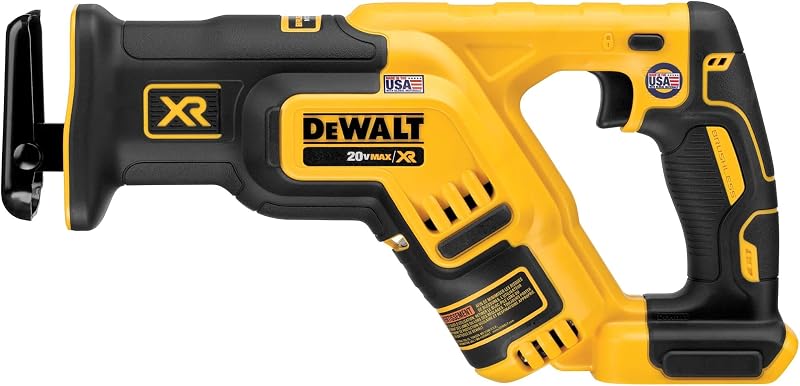
Reciprocating saws spend substantial time cutting in awkward orientations, making physical chassis dimensions and bare tool mass central to user control. The DeWalt DCS367 vs Makita XRJ05Z weight metric reveals a striking divergence between these two tools. DeWalt engineered the DCS367 to weigh just 5.0 pounds (listed at 5.4 pounds in specifications), packaged inside a compact 14.5-inch chassis. By mounting the brushless motor centrally in an angled configuration rather than inline behind the handle, DeWalt pulled the overall center of mass closer to the user’s grip, greatly improving horizontal and overhead balance.
By contrast, the XRJ05Z follows a traditional elongated reciprocating saw architecture. It measures 17-1/4 inches in length and weighs 7.8 pounds as a bare tool, scaling to approximately 8.2 pounds once an 18V LXT battery pack is mounted to the base. This represents a substantial physical disparity of nearly three pounds between the bare tools. Holding an eight-pound demolition saw above shoulder height while trimming ceiling joists or cutting overhead plumbing stacks drains user stamina rapidly compared to holding the five-pound DCS367. For contractors working on elevated platforms who also balance compact cutting equipment like the dewalt dcs367 vs milwaukee 2720-20, tool weight directly determines jobsite fatigue levels.
When selecting the DeWalt DCS367 or Makita XRJ05Z for tight spaces, the dimensional difference is decisive. Standard residential wall studs are framed 16 inches on center, leaving roughly 14.5 inches of open space between the studs. The DCS367 can be inserted straight between framing members to cut pipes, vent lines, or blocking without requiring severe blade bending or awkward angular alignment. The 17-1/4-inch XRJ05Z cannot physically enter that 14.5-inch opening straight-on, forcing operators to cut at severe diagonals or alter their stance entirely.
Edge: DeWalt DCS367 because its 14.5-inch frame and 5.0-pound weight allow it to fit directly inside standard stud bays with significantly less user fatigue.
Blade Clamping Mechanism and Versatility
Reciprocating saw versatility hinges on how the blade mounts to the reciprocating shaft. The DCS367 features a keyless 4-position blade clamp that stands out as one of its defining mechanical highlights. This mechanism permits the operator to insert reciprocating blades facing upward, downward, to the left, or to the right without utilizing external hand tools. When executing flush cuts along floorboards, subfloors, ceiling joists, or interior studs, the ability to rotate the blade sideways allows the user to cut completely flush against adjacent surfaces without bending the blade steel or scratching the saw’s front housing.
The XRJ05Z utilizes a robust “tool-less” blade change system engineered for rapid insertion and ejection on high-intensity demolition jobs. Makita’s blade locking collar permits quick swaps even when wearing heavy work gloves, speeding up recovery when teeth dull or blades snap under heavy loads. However, the XRJ05Z clamp does not provide multi-directional horizontal mounting options. To flush-cut a sill plate or vertical stud with the Makita, users must physically twist the entire 17-inch tool body onto its side or flex the reciprocating blade against the material, which increases friction and blade wear.
Makita counters this clamping limitation by reinforcing the internal crank architecture. The XRJ05Z incorporates a refined crank mechanism design engineered specifically to minimize blade deflection and dampen vibration during aggressive push-pull cutting cycles. This makes the Makita saw exceptionally stable when running long demolition blades through thick timber. Nevertheless, for technicians cross-referencing equipment against designs like the dewalt dcs367 vs milwaukee 2821-20, the architectural freedom offered by DeWalt’s 4-position clamp provides distinct functional versatility in everyday renovation scenarios.
Edge: DeWalt DCS367 because its 4-position blade clamp enables seamless flush cuts in four directions without requiring users to rotate the entire tool body.
Motor Performance and Speed Control
Both manufacturers integrate proprietary brushless motor designs into these reciprocating saws, eliminating carbon brush replacement while extending motor life. The DCS367 features a 20V MAX XR brushless motor delivering up to 100 watts of cutting power, which DeWalt pairs with an intelligent variable speed trigger capable of dialing output smoothly from zero up to 2,900 SPM. DeWalt notes that this brushless drive system provides up to 2.5 times more runtime compared to legacy brushed platforms when slicing through 2×4 lumber using standard high-capacity battery packs.
Makita equips the XRJ05Z with an electronically controlled BL brushless motor delivering 72 watts of rated output, engineered to dynamically match motor torque and RPM to application demands. Unlike the single-range trigger of the DeWalt, the XRJ05Z incorporates a variable 2-speed selector switch on the body. This setup allows the operator to mechanically lock the high-end output into Low (0-2,300 SPM) or High (0-3,000 SPM), while still maintaining fine trigger feathering. The Low setting is especially beneficial when cutting structural steel, thick rebar, or cast iron pipes where high stroke speeds generate excessive heat that destroys blade teeth.
Having a dual-range electronic gearbox provides superior operational discipline across diverse materials. On the DCS367, maintaining an exact lower cutting speed during dense metal work relies purely on finger pressure against the variable speed trigger. On the XRJ05Z, switching the selector to Low caps the motor speed automatically, ensuring steady cutting control and prolonging blade longevity. For operators comparing cordless motor platforms across categories like the dewalt dcs570 vs makita xsh04z, Makita’s electronic speed management delivers exceptional control for tough industrial fabrication.
Edge: Makita XRJ05Z because its 2-speed brushless selector switch prevents blade-scorching overspeeding in metal cuts while delivering 3,000 SPM on demand.
Jobsite Ergonomics and Practical Features
When running tools across demanding framing, electrical, or plumbing jobs, small convenience features often dictate overall workflow efficiency. Both tools include forward-facing LED illumination to light up the cut line inside dim basements, crawlspaces, and enclosed wall cavities. The DCS367 incorporates a bright built-in LED that directs its beam directly past the pivoting shoe toward the cut line, while the XRJ05Z integrates an L.E.D. light placed to illuminate the blade contact point clearly.
Beyond cut-line visibility, the XRJ05Z integrates a large retractable tool hook mounted near the motor housing. This hook allows the operator to hang the saw safely over scaffolding, structural ceiling joists, ladder rungs, or pipe racks between cuts. Because reciprocating saws are bulky tools that can easily fall when set down on irregular work surfaces, this hanging hook is a major practical advantage for framers and commercial tradesmen. The DCS367 product listing does not specify a built-in rafter hook, requiring users to set the tool flat on floorboards or framing plates between tasks.
Balancing these features, the DCS367 features a pivoting head that rests against the work surface to stabilize the tool and maintain constant contact during deep cuts. Additionally, the compact length of the DeWalt makes it vastly easier to carry on tool rigs or store inside standard modular toolboxes. For trades evaluating complementary shop tools like the dewalt dcs391 vs makita xsh04z, tool handling and jobsite ergonomics depend heavily on whether you need hands-free staging or lightweight compact storage.
Edge: Makita XRJ05Z because its built-in retractable rafter hook provides immediate jobsite utility for staging the tool safely between framing cuts.
Pros and Cons
DeWalt DCS367
Pros
- Compact 14.5-inch chassis fits between studs
- Lightweight 5-pound bare tool minimizes fatigue
- Keyless 4-position blade clamp for flush cuts
- Up to 2.5x more runtime claim
Cons
- Shorter 1-1/8-inch stroke length
- Lower maximum speed at 2,900 SPM
- No integrated rafter hook listed
Makita XRJ05Z

Pros
- Long 1-1/4-inch stroke for fast cutting
- High 3,000 SPM maximum cutting speed
- 2-speed brushless selector switch
- Built-in retractable rafter hook included
Cons
- Longer 17-1/4-inch chassis limits tight access
- Heavier 7.8-pound bare tool weight
- No 4-position flush-mounting blade clamp
Who Should Buy Each One
Understanding which tool matches your specific workflow ensures you do not end up with an undersized saw during heavy tear-outs or an oversized tool that cannot access tight framework. Both tools represent high-grade professional engineering, but they serve distinct operational environments.
Choose the DeWalt DCS367 If
- You regularly work inside standard 16-inch on-center wall stud framing where a 14.5-inch tool fits easily.
- You require multi-directional 4-position blade clamping to perform clean flush cuts along walls and floors.
- You prioritize low tool weight to reduce muscle strain during overhead plumbing cuts or ceiling installations.
- You already use DeWalt 20V MAX battery packs and want a lightweight, balanced compact reciprocating saw.
Choose the Makita XRJ05Z If
- You handle heavy demolition projects requiring aggressive cutting speed and a long 1-1/4-inch stroke.
- You cut mixed metals and need a 2-speed selector to prevent excessive blade wear at high RPM.
- You work on ladders or staging where a retractable rafter hook is essential for safe tool storage.
- You are invested in the Makita 18V LXT cordless platform and demand maximum cutting power for rough lumber.
Final Verdict
Evaluating this head-to-head comparison shows that neither saw universally outclasses the other; rather, they excel in fundamentally different cutting applications. For the majority of remodeling contractors, plumbers, electricians, and finish carpenters, the DeWalt DCS367 emerges as the more practical day-to-day choice. Its compact 14.5-inch footprint, low 5.0-pound weight, and versatile 4-position blade clamp allow it to solve difficult cutting problems inside confined stud cavities where full-size demolition saws cannot physically function. Anyone asking is DeWalt DCS367 worth it will find that its exceptional maneuverability and balanced runtime deliver tremendous jobsite utility for remodeling and renovation.
Conversely, when deciding between the DeWalt DCS367 or Makita XRJ05Z for demolition, the Makita XRJ05Z takes the victory. With its full-size chassis, aggressive 1-1/4-inch stroke length, 3,000 SPM high-speed ceiling, 2-speed brushless motor, and integrated rafter hook, it is built to power through framing teardowns, exterior pruning, and heavy structural timber without bogging down. Shoppers reading a Makita XRJ05Z review to confirm its high-speed performance can be confident that for heavy-duty material processing, this saw offers unbeatable cutting throughput. In the broader scope of Makita XRJ05Z vs DeWalt DCS367, select DeWalt for compact reach and Makita for demolition speed.
FAQ
Which saw cuts faster between the DeWalt DCS367 and Makita XRJ05Z?
The Makita XRJ05Z cuts faster in thick lumber and wide framing materials because it pairs a longer 1-1/4-inch stroke length with a maximum motor speed of 3,000 strokes per minute. The DeWalt DCS367 delivers a 1-1/8-inch stroke length and reaches up to 2,900 strokes per minute, which yields slightly slower material removal during large-scale demolition cuts.
Can the DeWalt DCS367 fit between standard wall studs?
Yes, the DeWalt DCS367 has an overall length of 14.5 inches, specifically designed to fit inside standard residential 16-inch on-center stud spacing, which leaves approximately 14.5 inches of clear space between framing studs. The Makita XRJ05Z measures 17-1/4 inches long, making it too long to fit straight between standard studs.
Does the Makita XRJ05Z include a blade clamp that mounts in four positions?
No, the Makita XRJ05Z features a standard tool-less blade clamp system designed for rapid straight-line blade changes, but it does not support multi-position 90-degree sideways or inverted mounting. The DeWalt DCS367 features a keyless 4-position blade clamp that allows blades to be mounted facing up, down, left, or right for easy flush cutting.
What battery voltages do these reciprocating saws require?
The DeWalt DCS367 operates on the DeWalt 20V MAX lithium-ion battery system, while the Makita XRJ05Z runs on the Makita 18V LXT lithium-ion battery platform. Both tools are sold as bare tools, meaning batteries and charging stations must be purchased separately if you do not already own them.
Does either saw feature a built-in rafter hook?
The Makita XRJ05Z features a built-in retractable tool hook that allows users to hang the saw on ladder rungs, scaffolding, or framing rafters between cuts. The product specifications and listing details for the DeWalt DCS367 do not list an integrated rafter hook.
Which reciprocating saw causes less operator fatigue?
The DeWalt DCS367 causes significantly less operator fatigue during prolonged use because it weighs only 5.0 pounds (5.4 pounds spec weight) compared to the Makita XRJ05Z, which weighs 7.8 pounds as a bare tool and 8.2 pounds with an attached battery pack. The lighter weight and shorter length of the DeWalt make it far easier to operate overhead and in tight, awkward angles.


