The single fundamental difference that decides between these two espresso setups is the coffee preparation workflow: the Breville Barista Pro integrates an on-demand conical burr grinder and a high-speed ThermoJet heating system into an all-in-one workstation, whereas the De’Longhi Dedica is an ultra-slim, standalone manual brewer built strictly for pre-ground coffee or espresso pods.
Buyers who want complete bean-to-cup control with precise grind dosing, digital temperature regulation, and cafe-style milk texturing should pick the Breville Barista Pro. Anyone needing an ultra-compact footprint to conserve kitchen counter space while pulling quick shots from pre-ground beans or single-serve pods should choose the De’Longhi Dedica.
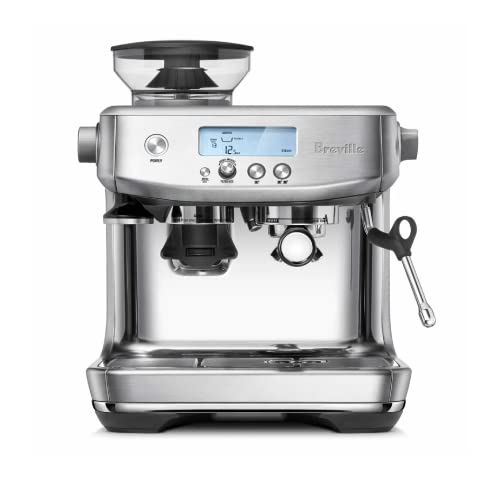

Breville Barista Pro vs De’Longhi Dedica at a Glance
| Feature | Breville Barista Pro | De’Longhi Dedica |
|---|---|---|
| Coffee Input | Whole bean, ground coffee | Ground coffee, espresso pods |
| Built-in Grinder | Integrated conical burr grinder with dose control | Not listed |
| Heating System | ThermoJet system (3-second heat-up) | High-performance Thermoblock |
| Temperature Regulation | Digital PID control (+/- 2°C) | Adjustable controls |
| Pump Pressure | Low-pressure pre-infusion | 15-bar pump |
| Water Reservoir Capacity | 67 oz (2.0 liters) | 34 oz (1.0 liter) |
| Cup Clearance | Not listed | Up to 5 inches |
| Dimensions (D x W x H) | 13 x 14 x 16 inches | 13 x 5.9 x 12 inches |
| Weight | 19.5 pounds | 9.3 pounds |
| Power / Wattage | 1680 watts (120V) | 1450 watts (110V) |
| Best For | Comprehensive bean-to-cup espresso crafting at home | Compact kitchens prioritizing pre-ground coffee or pods |
Grinding and Coffee Input Workflow
The coffee preparation workflow represents the sharpest operational contrast between these two manual espresso machines. Freshly ground coffee preserves delicate aromatic oils that rapidly evaporate after grinding, directly impacting espresso crema and flavor clarity. Having an integrated grinder changes the entire morning routine by keeping the entire bean-to-cup process confined to a single countertop appliance.
The Breville Barista Pro features an integrated precision conical burr grinder fed by a half-pound bean hopper. With single-touch dose grinding, the machine delivers the exact amount of ground coffee on demand directly into your portafilter. It offers adjustable grinding settings and includes both single-wall and dual-wall filter baskets to support both fresh whole beans and pre-ground coffee. In contrast, the De’Longhi Dedica includes no grinder whatsoever. It relies entirely on pre-ground coffee or E.S.E. espresso pods fed through its 3-in-1 filter holder. Those looking into a breville barista pro vs de’longhi magnifica comparison will note that the Barista Pro emphasizes hands-on grinding mechanics, while the Dedica strips grinding out of the equation entirely.
Relying on pre-ground coffee with the Dedica speeds up the immediate brewing process and eliminates grinder cleanup, but it restricts you from dialing in grind fineness to match specific roasts unless you purchase a separate standalone burr grinder. The Barista Pro built-in grinder gives you the full suite of bean-to-cup adjustments within one cohesive unit.
Edge: Breville Barista Pro because its integrated precision conical burr grinder provides complete control over fresh bean dosing and particle size directly in the machine.
Heating Technology and Temperature Stability
Water temperature stability directly governs how evenly soluble compounds are extracted from coffee grounds. If brew temperatures fluctuate excessively during a shot, espresso can taste unpleasantly sour or harsh. Furthermore, moving rapidly from brewing temperature to steam temperature determines how quickly you can assemble a complete milk beverage.
Engineering under the hood diverges significantly between these systems. The Breville Barista Pro uses an innovative ThermoJet heating system that achieves optimal extraction temperature in just 3 seconds, delivering instantaneous transitions from espresso extraction to steam generation. This rapid thermal circuit is paired with digital temperature regulation (PID) that maintains water temperature within +/- 2°C of target. The De’Longhi Dedica utilizes a high-performance thermoblock paired with 1450 watts of power and adjustable controls for personal preference, though the listing does not specify a digital PID algorithm or single-digit second startup time. Readers weighing a breville barista express vs barista pro upgrade will recognize that this 3-second ThermoJet system is a cornerstone improvement over older heating blocks.
In everyday use, the 3-second Breville Barista Pro heat up time virtually eliminates waiting between powering on the unit, pulling a shot, and texturing milk. The Dedica thermoblock provides capable home performance, but the Barista Pro delivers faster thermal agility and tighter digital temperature precision.
Edge: Breville Barista Pro thanks to its 3-second ThermoJet heat-up system and PID digital temperature regulation.
Countertop Footprint and Space Management
Kitchen real estate often dictates which appliances can reasonably live on a counter full-time. Espresso machines with integrated hoppers demand vertical clearance beneath upper cabinets and wide horizontal staging areas for portafilters and tamping mats.
This is where the De’Longhi Dedica compact espresso machine excels. Measuring only 5.9 inches wide, 13 inches deep, and 12 inches tall, the Dedica is an ultra-slim machine engineered specifically for narrow spaces. At 9.3 pounds, it is effortless to slide or relocate. The Breville Barista Pro measures 14 inches wide, 13 inches deep, and 16 inches tall, weighing in at 19.5 pounds. Its 16-inch height requires generous overhead space to load beans into the half-pound hopper without bumping wall cabinets. Those shopping a breville bambino plus vs de’longhi dedica matchup often prioritize this exact dimensional threshold.
If you are deciding between the Breville Barista Pro or De’Longhi Dedica for small spaces, the Dedica demands less than half the horizontal counter frontage of the Barista Pro. While the Barista Pro saves you the space of an external grinder, the Dedica remains the unmatched choice for ultra-tight apartment counters.
Edge: De’Longhi Dedica because its 5.9-inch width and lightweight chassis make it an exceptional space-saver.
Espresso Extraction and Pressure Dynamics
Delivering an authentic espresso extraction requires balancing pump pressure, pre-infusion, and dose consistency. Too much initial pressure can fracture the coffee puck and cause channeling, while inconsistent water volume produces watery or over-concentrated shots.
The Breville Barista Pro employs low-pressure pre-infusion that gradually ramps up water pressure at the start of extraction to draw out balanced flavors evenly across the coffee bed. It supports volumetric programming with dedicated 1-cup and 2-cup settings, alongside manual over-ride. The Barista Pro package also includes “The Razor” precision dose trimming tool to help level the puck. The De’Longhi Dedica operates on a 15-bar professional pressure pump and features an authentic manual barista experience that lets you control tamping and shot volume using its unique flow-stop button feature. The Dedica also incorporates a twin brewing cycle for pulling double shots and provides enough clearance to fit cups up to 5 inches high.
When assessing extraction quality in a De’Longhi Dedica review against a Breville Barista Pro review, the Barista Pro provides greater diagnostic repeatability. Its low-pressure pre-infusion and dose trimming accessories reduce shot variability, while the Dedica provides straightforward 15-bar pump delivery suitable for standard double shots or quick pods. Those evaluating a breville barista pro vs gaggia classic pro comparison will recognize the Barista Pro approach to controlled pre-infusion as a distinct advantage over unmoderated pump surges.
Edge: Breville Barista Pro due to its gradual low-pressure pre-infusion and dedicated dose trimming tools.
Milk Frothing and Texturing Performance
Creating silky microfoam for cappuccinos and lattes requires adequate steam velocity and a wand design that allows manual vortex control. Steaming milk is often where entry-level home machines show their mechanical limitations.
The Breville Barista Pro features a powerful manual steam wand designed specifically to texture milk into velvety microfoam suitable for latte art. Because of the instantaneous ThermoJet transition, the wand reaches steaming pressure immediately after pulling an espresso shot. Breville also includes a dedicated 480 ml stainless steel milk jug in the box, giving you the correct vessel shape out of the gate. The De’Longhi Dedica features a manual frother utilizing De’Longhi’s Advanced Cappuccino System. This wand produces rich, thick foam suitable for traditional cappuccinos with minimal effort, and its dial control allows manual steam modulation.
The practical difference lies in foam texture and flexibility. The Dedica creates generous, stiff cappuccino foam easily, making it accessible to novices who want a quick topping. The Barista Pro wand produces genuine fine-bubble microfoam required for intricate latte art, backed by the thermal steam power of its 1680-watt ThermoJet engine.
Edge: Breville Barista Pro because its steam wand generates true microfoam for latte art and includes a stainless milk jug.
Interface, Accessories, and Daily Usability
Daily satisfaction with an espresso maker comes down to how easy it is to operate, clean, and maintain over months of use. Display feedback and reservoir capacity heavily influence whether brewing feels like an effortless ritual or a chore.
The Breville Barista Pro is equipped with an intuitive LCD interface featuring illuminated buttons that display real-time grinding and extracting progress animations. It includes a large 67 oz (2-liter) water tank, a 2-year limited warranty, water filter, cleaning kit, and four filter baskets (single and dual wall for 1 and 2 cups). The De’Longhi Dedica uses a streamlined control panel with illuminated buttons and a rotary dial. It features a smaller 34 oz (1-liter) water tank, but excels in cleaning simplicity with dishwasher-safe parts, a removable drip tray, and an easily detachable water reservoir. Shoppers considering a breville barista express vs de’longhi dedica setup will find that the Dedica simplifies physical upkeep, even if it lacks digital screens.
The Dedica offers straightforward push-button operation with zero digital menus to navigate, while the Barista Pro provides informative visual feedback that actively guides the user through grind duration and shot timing. The Barista Pro also requires fewer water refills thanks to its double-sized 2-liter tank.
Edge: Breville Barista Pro for its animated LCD interface, extensive included accessories, and double the water reservoir capacity.
Pros and Cons
Breville Barista Pro

Pros
- Integrated precision conical burr grinder
- 3-second ThermoJet heat-up system
- Digital PID temperature control
- Manual steam wand creates microfoam
- Generous 67-ounce water tank capacity
Cons
- Substantial 14-inch wide counter footprint
- Heavy 19.5-pound chassis
View Breville Barista Pro on Amazon
De’Longhi Dedica

Pros
- Ultra-compact 5.9-inch wide body
- Compatible with ground coffee and pods
- 15-bar professional pressure pump
- Accommodates mugs up to 5 inches
Cons
- No integrated coffee bean grinder
- Smaller 34-ounce water reservoir
View De’Longhi Dedica on Amazon
Who Should Buy Each One
Choose the Breville Barista Pro If
- You want an integrated precision conical burr grinder that doses fresh whole beans on demand directly into your portafilter.
- You value a 3-second ThermoJet startup time with near-instant switching between espresso extraction and milk steaming.
- You want to learn hands-on latte art using a powerful manual microfoam steam wand and an included stainless milk jug.
- You prefer an animated LCD screen that displays grind times and extraction progress to dial in specialty roasts.
Choose the De’Longhi Dedica If
- Your kitchen counter space is severely restricted and requires a machine measuring under 6 inches wide.
- You prefer brewing with pre-ground espresso or mess-free E.S.E. espresso pods rather than grinding fresh whole beans.
- You want an ultra-lightweight 9.3-pound machine with dishwasher-safe removable parts for straightforward cleaning.
- You want to brew directly into taller travel mugs up to 5 inches high.
Final Verdict
The Breville Barista Pro is the superior machine for the vast majority of coffee lovers looking for an authentic cafe experience at home. By combining an on-demand conical burr grinder, rapid 3-second ThermoJet heating, digital PID temperature regulation, and a manual microfoam steam wand into a single chassis, it handles every stage of third-wave specialty coffee crafting. While it requires more counter space and dedicated user involvement, the resulting espresso extraction and milk texture offer unmatched precision.
The De’Longhi Dedica wins unequivocally on physical space management and casual convenience. When deciding if the De’Longhi Dedica is worth it, the answer is yes for anyone living in an apartment or working with cramped countertops who values a 5.9-inch wide profile. If you rely on pre-ground beans or single-serve espresso pods and want quick, traditional 15-bar coffee with simple push-button controls, the Dedica delivers solid espresso fundamentals without overwhelming your kitchen.
FAQ
Does the De’Longhi Dedica have a built-in grinder?
No, the De’Longhi Dedica does not include an integrated grinder. It is designed to brew using pre-ground coffee or E.S.E. espresso pods via its 3-in-1 filter holder. If you wish to use whole beans with the Dedica, you will need to purchase a standalone coffee grinder.
How fast is the Breville Barista Pro heat up time?
The Breville Barista Pro reaches optimal brewing extraction temperature in approximately 3 seconds thanks to its ThermoJet heating system. This system also allows for an instantaneous transition from pulling espresso shots to steaming milk.
Can the De’Longhi Dedica use espresso pods?
Yes, the De’Longhi Dedica is equipped with a 3-in-1 filter holder specifically designed to accommodate single shots, double shots, and Easy Serving Espresso (E.S.E.) pods, offering mess-free brewing options.
Which machine is better for small kitchens with limited space?
The De’Longhi Dedica is far better suited for tight spaces. Measuring only 5.9 inches wide and weighing 9.3 pounds, it takes up less than half the horizontal counter space of the Breville Barista Pro, which measures 14 inches wide and 16 inches tall.
Can you pour latte art with the Breville Barista Pro?
Yes, the Breville Barista Pro is equipped with a manual steam wand engineered to produce velvety microfoam. It also includes a 480 ml stainless steel milk frothing jug, providing the tools needed to create latte art at home.
What filter baskets come with the Breville Barista Pro?
The Breville Barista Pro includes both single-wall and dual-wall filter baskets in 1-cup and 2-cup capacities. Single-wall baskets are intended for dialing in freshly ground whole beans, while dual-wall pressurized baskets accommodate pre-ground coffee.
Is the Breville Barista Pro or De’Longhi Dedica better for complete beginners?
The De’Longhi Dedica is simpler for beginners who want quick espresso from pre-ground coffee or pods without dialing in grind size. However, for beginners eager to learn authentic home barista skills, the Breville Barista Pro provides an intuitive LCD interface with guided grinding and extraction animations that make learning straightforward.


