The defining difference between the Breville Barista Pro and the De’Longhi Magnifica is brewing philosophy: the Barista Pro is an involved semi-automatic espresso machine built around a traditional portafilter and a commercial-style steam wand, while the Magnifica Start is a fully automatic bean-to-cup machine that handles grinding, dosing, tamping, and brewing inside an automated chamber at the tap of a button.
Choose the Breville Barista Pro if you want hands-on control over your extraction parameters, custom dose adjustments, and cafe-style milk texturing for latte art. Choose the De’Longhi Magnifica if you value morning speed, push-button simplicity, and minimal daily clean-up without needing to learn barista techniques.
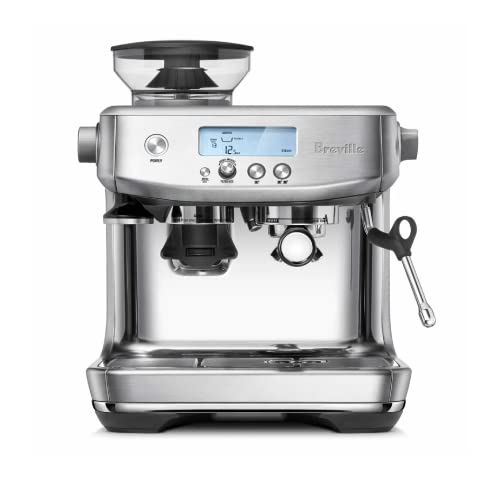

Breville Barista Pro vs De’Longhi Magnifica at a Glance
| Feature | Breville Barista Pro | De’Longhi Magnifica |
|---|---|---|
| Machine Classification | Manual / Semi-Automatic | Fully Automatic |
| Heating System | ThermoJet (3-second heat-up) | PID Temperature Control (1250W system) |
| Grinder Specification | Integrated conical burr grinder with dose control | Integrated conical burr grinder with 13 settings |
| Pump Pressure | Low-pressure pre-infusion (listing does not specify bar rating) | 15 Bar Pressure |
| Milk Frother | Manual microfoam steam wand | Traditional manual milk frother |
| Interface | LCD screen with animations and physical buttons | Touchscreen panel with 3 one-touch drink presets |
| Water Tank Capacity | 67 oz (2.0 L) | 60 fl oz |
| Bean Hopper Capacity | 1/2 lb | The listing does not specify |
| Exterior Build Material | Brushed Stainless Steel | Plastic (Painted Black finish) |
| Dimensions and Weight | 13″D x 14″W x 16″H; 19.5 lbs | 17″D x 9.25″W x 14″H; 19.6 lbs |
| Best For | Espresso enthusiasts seeking tactile brewing and silky microfoam | Coffee drinkers wanting quick bean-to-cup convenience with zero fuss |
Brewing Workflow and Daily Operation
Evaluating a semi automatic vs fully automatic espresso machine comes down to how much work you want to perform before drinking your morning coffee. The Barista Pro functions like a commercial cafe setup scaled down for domestic countertops. Preparing a drink requires you to lock the 54 mm portafilter into the grinding cradle, trigger the conical burr grinder, settle the grounds, tamp with level force, trim excess coffee using the included Razor precision tool, and lock the handle into the group head. You control shot volume using programmable 1-cup or 2-cup volumetric settings while monitoring extraction timing on the digital interface. This manual workflow offers deep personal satisfaction, but it demands your full attention, active technique, and physical engagement for every single shot.
In contrast, the Magnifica Start eliminates nearly every mechanical step from your routine. The machine utilizes an internal brew unit that automatically feeds beans from the hopper into the burrs, measures a fresh dose, compacts the coffee bed under internal mechanical pressure, and extracts the drink directly into your cup. Its touch-sensitive interface features three dedicated one-touch recipes for Espresso, Coffee, and Americano, alongside an intensity adjustment setting to alter brew strength without manually adjusting dose weights. If you are comparing the breville barista express vs de’longhi magnifica family of machines, the core appeal of the Magnifica platform is always this zero-effort morning workflow.
The practical trade-off between these two approaches centers on consistency versus customization. The automated brewing cycle on the Magnifica prevents human error such as uneven tamping, channeling, or sloppy distribution, making it exceptionally reliable for early mornings or busy households where multiple users want coffee quickly. However, the automated process prevents you from tweaking pre-infusion duration, changing basket geometry, or adjusting the coffee-to-water ratio on the fly. The Barista Pro lets you manipulate every variable to bring out subtle flavor notes in single-origin beans, making it far more rewarding for coffee hobbyists willing to practice.
Edge: De’Longhi Magnifica for effortless one-touch automated brewing that requires no manual tamping or portafilter handling.
Milk Texturing and Steam Performance
Milk frothing is a critical factor when deciding whether a Breville Barista Pro or De’Longhi Magnifica for lattes fits your household preferences. The Barista Pro features a dedicated, commercial-style manual steam wand engineered specifically to create smooth, hand-textured microfoam. Powered by Breville’s 1680-watt ThermoJet thermal block, the steam wand transitions instantly from brewing temperature to full steam pressure without the long delays typical of older single-boiler designs. The high-velocity steam output creates a rolling vortex in the included 480 ml stainless steel milk jug, breaking down milk proteins and sugars into silky foam dense enough to pour intricate latte art.
The Magnifica Start approaches milk drinks through a traditional manual milk frother wand attached to the front of the machine. De’Longhi designs this frother to aerate dairy and non-dairy alternatives, including oat, almond, and soy milk, to produce hot, aerated foam for cappuccinos and lattes. While functional and straightforward to use, traditional frothers of this style focus on generating fluffy, aerated foam rather than creating the ultra-fine microfoam texture required for delicate latte art patterns. Additionally, the listing indicates that the Magnifica operates at 1250 watts, giving it less raw heating power than the Breville system during continuous steaming cycles.
If your daily drink is a traditional dry cappuccino or a simple hot milk-and-coffee drink, the De’Longhi wand gets the job done without complication. But for anyone practicing milk-pouring techniques or seeking cafe-grade flat whites, the Barista Pro is in an entirely different class. Its powerful manual wand gives you total control over milk aeration, temperature, and texture, backed by an immediate steam transition that ensures your espresso crema does not dissipate while you wait for steam pressure to build. When evaluating the breville barista pro vs de’longhi dedica or other compact frothers, the Pro wand consistently sets the standard for consumer milk texturing.
Edge: Breville Barista Pro because its commercial-style steam wand produces dense, silky microfoam capable of pouring latte art.
Grinder Capabilities and Particle Control
Freshly ground coffee is essential for proper espresso extraction, and both machines integrate conical burr grinders to process whole beans immediately before extraction. However, comparing Breville Barista Pro grind settings vs Magnifica reveals two distinct philosophies regarding particle control and dose customization. The Magnifica Start features an integrated conical burr grinder with 13 distinct stepped settings adjusted via a dial inside the hopper. This stepped mechanism gives you a reliable, numbered framework to adjust extraction coarseness across varied roast profiles while allowing the machine to regulate internal dosing automatically.
The Barista Pro also features a hardened steel conical burr grinder, but it integrates an intuitive LCD screen with an animated dosing and grinding display that allows precise adjustments to your grinding duration. The Barista Pro system allows single-touch on-demand dosing directly into the 54 mm portafilter basket, providing the user with direct control over dose weight. To ensure extraction consistency, Breville supplies The Razor precision dose trimming tool, which manually levels and trims the coffee puck to the exact mechanical height needed for optimal head-space inside the group head.
For shoppers wondering is De’Longhi Magnifica worth it for bean management, its 13-setting grinder is remarkably user-friendly and prevents you from ever grinding coffee directly onto your countertop. It also accepts pre-ground coffee through a bypass chute for decaf drinkers. The Barista Pro grinder demands more patience during initial setup, as finding the right grind size requires adjusting both the internal burrs and the outer collar while weighing doses. Yet, that extra calibration potential allows you to dial in tricky light roasts that super-automatic machines often struggle to extract effectively. If you have researched the breville barista express vs barista pro, you know that the Pro’s digital interface makes tracking grind time increments straightforward.
Edge: Breville Barista Pro for its fine-tuned digital dosing control, direct-to-portafilter delivery, and included Razor leveling tool.
Heating Systems, Temperature Precision, and Extraction Speed
Thermal stability and heat-up speed directly influence how an espresso machine performs during early morning rushes. The Breville Barista Pro is powered by Breville’s ThermoJet heating system running at 1680 watts, which achieves optimal extraction temperature in an astounding 3 seconds. This rapid thermal block eliminates morning warm-up wait times entirely and allows near-instantaneous transitions between pulling an espresso shot and steaming milk. Furthermore, the Barista Pro features digital temperature regulation (PID) that keeps water temperatures stable within +/- 2°C throughout the entire extraction cycle, preventing scorched or sour shots.
The De’Longhi Magnifica Start utilizes a 1250-watt heating system equipped with its own PID temperature control module and a 15-bar high-pressure pump. While the Magnifica listing does not specify its exact warm-up time in seconds, standard super-automatic thermoblocks take notably longer to reach brew readiness than the 3-second ThermoJet system, and they require system rinse cycles before pulling a shot. Nevertheless, the Magnifica’s 15-bar pressure pump provides ample hydraulic force to push water through the internally tamped puck, ensuring a consistent layer of crema on its one-touch Espresso, Coffee, and Americano selections.
Another major extraction advantage on the Barista Pro is its low-pressure pre-infusion stage. Before full extraction pressure is applied, the machine gently introduces water at low pressure to expand the ground coffee puck evenly inside the basket. This pre-wetting process significantly reduces channeling and ensures balanced extraction across the entire bed of coffee. The Magnifica uses an automated internal pre-brewing infusion cycle, but you cannot alter its duration or flow profile. In head-to-head comparisons like the breville bambino plus vs de’longhi magnifica, Breville’s rapid ThermoJet heating architecture remains unmatched for consumer speed.
Edge: Breville Barista Pro for its 3-second ThermoJet warm-up speed, +/- 2°C PID accuracy, and low-pressure pre-infusion.
Build Quality, Design Footprint, and Materials
Physical construction and exterior styling differ dramatically between these two European-designed appliances. The Barista Pro features an exterior finished in brushed stainless steel, matching the aesthetic of professional commercial kitchen equipment. Weighing 19.5 pounds and measuring 13 inches deep, 14 inches wide, and 16 inches tall, it provides a solid, stable foundation that will not slide across the counter when you lock in the portafilter handle. Its top panel features an integrated cup warming tray, while the back houses a 67 oz (2.0-liter) removable water reservoir complete with a replaceable water filter.
The De’Longhi Magnifica Start features an exterior constructed from black molded plastic, giving it a modern, utilitarian aesthetic. It weighs virtually the same at 19.6 pounds, but its exterior dimensions measure 17 inches deep, 9.25 inches wide, and 14 inches tall. This long, narrow profile makes the Magnifica an excellent match for kitchens with limited horizontal counter width, although its 17-inch depth requires adequate clearance from the rear wall. Its water reservoir holds 60 fluid ounces, slightly less than the Breville, but still generous enough for several days of brewing without frequent refilling.
In terms of longevity and aesthetic appeal, the stainless steel casing of the Barista Pro provides superior resistance to daily scuffs, heat exposure, and cosmetic wear compared to the black plastic housing of the Magnifica. However, the plastic housing on the De’Longhi is easy to wipe down and does not show water spots or greasy fingerprints as readily as polished metal. Both machines utilize quality internal components, including durable conical burrs, but the tactile feel of the Barista Pro’s metal components conveys a more premium presence on the counter.
Edge: Breville Barista Pro for its brushed stainless steel chassis, larger 67 oz water reservoir, and classic kitchen aesthetic.
Cleaning, Maintenance, and Daily Hygiene
Cleaning an espresso machine is unavoidable, but the type of maintenance each machine demands varies widely. The De’Longhi Magnifica Start is designed with convenience-focused hygiene in mind. Because brewing takes place inside an enclosed chamber, spent coffee grounds are automatically knocked into an internal dump box after each extraction. The Magnifica features removable and dishwasher-safe components, including the drip tray and grounds container, making evening clean-up fast and painless. The central infuser unit can be removed from behind the water tank door and rinsed directly under the kitchen tap without chemical detergents.
The Barista Pro requires a more hands-on, routine cleaning process after every beverage. Once a shot is extracted, you must manually knock the spent coffee puck out of the portafilter into a knock box, rinse the metal basket, wipe the group head shower screen, and immediately purge and wipe down the steam wand with a damp cloth to prevent baked-on milk residue. Breville includes a comprehensive cleaning kit with cleaning tablets, a steam wand tip clearing tool, and water filters. An LCD alert prompts you when backflushing or descaling cycles are required.
When considering whether is Breville Barista Pro worth it from a lifestyle standpoint, you must decide if you mind the ritual of washing portafilters, wiping counters, and managing stray coffee grinds. For busy mornings, the Magnifica Start vs Barista Pro comparison leans heavily toward De’Longhi regarding maintenance. The Magnifica contains the mess completely inside the machine, features an automatic shut-off function, and allows you to toss its soiled parts straight into the dishwasher at the end of the week. Enthusiasts comparing the breville barista pro vs gaggia classic pro often embrace manual cleaning rituals, but for the average consumer, De’Longhi’s dishwasher-safe parts are an undeniable convenience.
Edge: De’Longhi Magnifica for its fully enclosed brewing chamber, automatic waste disposal, and dishwasher-safe components.
Pros and Cons
Breville Barista Pro

Pros
- Instant 3-second ThermoJet heat-up system
- Commercial manual microfoam steam wand
- Digital PID temperature regulation within 2°C
- Durable brushed stainless steel body
- Comprehensive accessories including Razor tool
Cons
- Demands hands-on grinding, tamping, and puck cleanup
- Parts are not dishwasher-safe
View Breville Barista Pro on Amazon
De’Longhi Magnifica

Pros
- One-touch automated bean-to-cup brewing
- Dishwasher-safe parts and internal dump box
- 13 adjustable conical burr grind settings
- Slim 9.25-inch wide countertop footprint
Cons
- Plastic exterior rather than stainless steel
- Traditional frother cannot produce latte art microfoam
- Fixed recipes limit manual extraction adjustments
View De’Longhi Magnifica on Amazon
Who Should Buy Each One
Choose the Breville Barista Pro If
- You want complete creative control over espresso extraction parameters, dosing, and manual tamping.
- You love silky, hand-textured microfoam and want to learn how to pour freehand latte art at home.
- You want zero wait time in the morning thanks to the instantaneous 3-second ThermoJet heating block.
- You prefer commercial-grade brushed stainless steel construction over an all-black plastic exterior.
Choose the De’Longhi Magnifica If
- You want freshly ground espresso, Americano, or coffee at the touch of a single button with no manual prep.
- You have a hectic morning schedule and want spent coffee grounds automatically discarded into an internal bin.
- You prefer low-maintenance ownership with removable parts that can be cleaned directly in the dishwasher.
- Your kitchen has narrow countertop space that benefits from a slim 9.25-inch wide appliance profile.
Final Verdict
Choosing between the De’Longhi Magnifica vs Breville Barista Pro comes down to whether you view making coffee as a creative hobby or a functional morning necessity. The Breville Barista Pro takes the overall win for coffee enthusiasts who prioritize cup quality, shot control, and true cafe-style beverages. With its 3-second ThermoJet heat-up time, commercial-grade steam wand, precision PID temperature control, and included Razor trimming tool, it offers all the hardware needed to master third-wave espresso and latte art in your own kitchen.
However, the De’Longhi Magnifica Start is the undeniable champion for everyday convenience and hassle-free operation. If the thought of grinding, tamping, wiping portafilters, and purging steam wands sounds like an unwelcome chore before your morning commute, the Magnifica delivers delicious bean-to-cup coffee with none of the friction. Its three one-touch recipes, 13 grind settings, enclosed brewing chamber, and dishwasher-safe components make it one of the easiest ways to enjoy fresh-ground espresso at home without lifting more than a single finger.
FAQ
Can you make regular drip-style coffee with both machines?
The De’Longhi Magnifica Start includes a dedicated one-touch “Coffee” recipe and an “Americano” button, which combines espresso with hot water automatically to simulate standard drip-style coffee. The Breville Barista Pro does not have a dedicated drip coffee setting, but you can easily create an Americano or long black by pulling an espresso shot and adding hot water through the dedicated hot water spout.
Which machine is better for beginners learning latte art?
The Breville Barista Pro is significantly better for latte art. It features a powerful manual steam wand that creates tight, velvety microfoam and includes a 480 ml stainless steel milk jug. The De’Longhi Magnifica features a traditional frother wand that creates airy foam suitable for cappuccinos, but it does not produce the fine milk texture needed for pouring latte art designs.
How do the grinder settings compare between the Barista Pro and Magnifica?
The De’Longhi Magnifica Start features 13 numbered, stepped grind settings adjusted via a mechanical dial inside the hopper. The Breville Barista Pro features adjustable conical burrs with digital grind time control managed in small increments via an intuitive LCD screen, giving you more granular control over your exact dose weight and particle size.
Can you use pre-ground coffee in these machines?
Yes, both machines accommodate pre-ground coffee. The Breville Barista Pro includes dual-wall (pressurized) filter baskets specifically designed to optimize extraction when using pre-ground supermarket coffee. The De’Longhi Magnifica features a dedicated bypass chute on top of the machine that allows you to brew single servings of pre-ground coffee, such as decaf, without emptying the whole bean hopper.
How fast does each machine take to heat up before brewing?
The Breville Barista Pro reaches extraction temperature in just 3 seconds thanks to its ThermoJet heating system. The De’Longhi Magnifica Start utilizes a traditional thermoblock system running at 1250 watts; while the listing does not specify exact warm-up seconds, it requires a short heating and automated rinse cycle before pulling your first beverage.
Are the parts on the Breville Barista Pro dishwasher-safe?
No, the portafilter, precision baskets, Razor tool, and water tank on the Breville Barista Pro must be hand washed to preserve their finish and seals. In contrast, the De’Longhi Magnifica features removable and dishwasher-safe parts, including the drip tray and internal grounds container, making daily sanitation noticeably faster.


