Deciding between the Shark NV501 and the Shark LA502 comes down to modern brushroll mechanics versus traditional raw motor draw: the LA502 features a dual-roller DuoClean PowerFins system with an engineered self-cleaning brushroll designed to eliminate hair wrap, whereas the NV501 relies on a single classic brushroll driven by a higher-amperage, 1200-watt motor.
Homeowners who want high raw electrical power for deep pile carpets should choose the NV501, while pet owners and mixed-surface households looking to end tangled brushroll maintenance should pick the LA502.
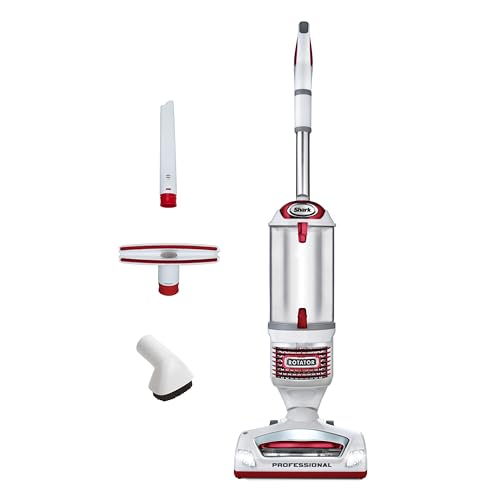

Shark NV501 vs Shark LA502 at a Glance
| Feature | Shark NV501 | Shark LA502 |
|---|---|---|
| Motor Wattage | 1200 watts | 890 watts |
| Amperage | 10 A | 7.42 A |
| Operating Voltage | 110120 volts | 120 volts |
| Brushroll System | Standard single brushroll | DuoClean PowerFins with self-cleaning brushroll |
| Cleaning Path Width | 9.5 inches | 9.5 inches |
| Dust Cup Capacity | 0.88 quarts | 0.89 quarts |
| Weight | Not listed (listed as lightweight) | 12.3 pounds |
| Filtration Type | Foam filter with HEPA and Complete Seal | Washable HEPA and foam filters with Complete Seal |
| Above-Floor Mechanism | Lift-Away push-button pod | Lift-Away pod with foot-release pedal |
| Sound Output | 80 db | Not listed |
| Best For | Carpet-heavy homes needing maximum motor draw | Homes with shedding pets and mixed hard floor surfaces |
Brushroll Technology and Hair Management
The primary architectural divide in this comparison rests directly inside the cleaning head. The Shark LA502 DuoClean PowerFins floorhead uses two distinct motorized rollers working in tandem. The front position holds a soft roller that maintains nonstop contact with the floor to pull in stuck-on dust and large particles, while the secondary roller features flexible silicone PowerFins. Crucially, the LA502 incorporates a self-cleaning brushroll engineered specifically to clear human and pet hair as you vacuum, directing strands straight into the suction stream rather than letting them bind tightly around the roller core. For pet owners who dread cutting long strands out of a roller with scissors, this system drastically reduces physical floorhead maintenance.
In contrast, the Shark NV501 uses a traditional upright single-roller nozzle configuration. This head relies on standard bristles to beat carpet fibers and agitate embedded soil up into the airflow path. While this classic approach generates aggressive mechanical carpet agitation, it does not include hair-clearing fins or an anti-wrap comb. Pet hair, sewing thread, and long strands will naturally wrap around the NV501 roller shaft over time, requiring manual inspection and periodic cutting to keep the roller spinning freely. Readers comparing older and newer upright designs in our shark nv501 vs nv752 breakdown will recognize this exact evolutionary jump in brushroll maintenance.
When assessing the Shark NV501 or LA502 for pet hair, the LA502 clearly targets the common frustration of roller clogs. The NV501 counters with brute-force agitation and an included wide upholstery tool designed to strip fur from furniture, but its primary floor nozzle requires far more active upkeep if you share your living space with heavily shedding animals.
Edge: Shark LA502, because its self-cleaning DuoClean PowerFins system actively prevents hair wrap while the NV501 requires manual cutting and roller detangling.
Motor Wattage and Electrical Specifications
Looking under the hood reveals an unexpected inversion between these two machines. The Shark NV501 wattage is rated at 1200 watts pulling a robust 10 amps on a standard 110120-volt circuit. In traditional vacuum engineering, higher wattage correlates to a heavy-duty motor capable of moving high volumes of air through restrictive carpet piles. The NV501 combines this 10-amp motor with two mechanical speed settings, giving you direct control over the roller rotation speed depending on whether you are working across delicate rugs or dense plush carpeting.
By comparison, the Shark LA502 operates on an 890-watt motor drawing 7.42 amps at 120 volts. At first glance, a drop of over 300 watts might suggest a reduction in performance, but modern vacuum architecture frequently downstages raw motor wattage in favor of sealed airflow dynamics and dual-roller mechanical efficiency. Because the LA502 relies on dual motorized rollers that seal directly against floor surfaces, it does not need to draw 1200 watts from your wall outlet to generate competitive debris extraction. The lower amperage also reduces thermal load and draws noticeably less total household electricity during extended cleaning sessions.
The trade-off comes down to how each machine attacks dirt. The NV501 uses raw motor suction power to pull dirt through a single-path nozzle, which can be advantageous when extracting fine sand buried deep in thick carpet backings. The LA502 relies on contact mechanics, using its dual rollers to scoop debris into the airflow channel before suction takes over. If you want to explore how wattage variations influence Shark uprights, our look at the shark nv501 vs la802 covers similar motor sizing dynamics.
Edge: Shark NV501, owing to its higher 1200-watt, 10-amp motor rating that produces substantial raw electrical draw for challenging carpet agitation.
Hard Floor and Multi-Surface Performance
Bare floor cleaning exposes the structural strengths and weaknesses of both vacuum styles. In any thorough Shark NV501 review, testers note that single-brushroll vacuums face a recurring physics challenge on bare wood and tile: stiff rotating bristles can cause larger debris, like dry cereal or cat litter, to scatter backward against baseboards. The NV501 manages this by offering two selectable brushroll speeds, allowing you to slow or disengage the aggressive roller action to minimize scatter while relying primarily on the machine’s 10-amp suction channel to collect loose crumbs.
The LA502 approaches bare floors from an entirely different mechanical angle through its front soft roller. Because this plush roller sits flush against the floor without a plastic front wall blocking it, the LA502 does not push larger debris forward like a snowplow. It directly pulls large particles under the head while simultaneously polishing away stuck-on micro-dust from polished hardwood, slate, or tile. Furthermore, the flexible silicone PowerFins maintain nonstop floor contact without leaving gaps, eliminating the scattering effect entirely.
For shoppers deciding between the Shark NV501 or LA502 for hardwood floors, this difference completely alters daily usability. On the NV501, transitioning from a hallway runner to a bare floor requires adjusting your speed switch to manage brushroll spin. On the LA502, the dual-roller head is permanently engineered for multi-surface transitions without requiring you to switch nozzles or worry about stiff bristles scratching sensitive floor finishes. Similar multi-floor comparisons can be found in our shark nv356e vs la502 guide.
Edge: Shark LA502, because its front soft roller and continuous-contact PowerFins directly engage bare floors to collect fine dust and large debris without scattering.
Lift-Away Portability and Detachable Pod Usability
Both models feature Shark’s signature Lift-Away architecture, which allows the main motor and dust canister pod to detach completely from the floor nozzle. This converts the upright machine into a portable canister for cleaning stairs, baseboards, window blinds, and vehicle interiors. However, the ergonomic execution of this feature differs between generations.
The Shark Rotator NV501 vs LA502 comparison reveals distinct handling mechanics. The NV501 uses a standard push-button release located on the pod body. You press the latch by hand, lift the pod away by its handle, and carry it with one hand while directing the wand with the other. The listing specifies that the NV501 ships with a dedicated accessory suite including a dusting brush, an upholstery tool, and a crevice tool. Its noise level is officially documented at 80 dB, giving buyers an exact acoustic benchmark for pod operation in confined spaces like stairwells.
The LA502 updates this workflow by introducing an easy-release foot pedal on the base of the unit. Rather than bending down to unlatch the pod by hand, you step on the pedal and pull the handle upward in one fluid motion. The LA502 listing explicitly documents the unit’s weight at 12.3 pounds with exterior dimensions of 10 inches long, 12 inches wide, and 46.5 inches high. While the NV501 is cataloged as lightweight and portable, its exact poundage is omitted from the official specifications. Those interested in how compact pod designs function in daily use can review our shark nv360 vs la502 breakdown for additional ergonomics data.
Edge: Shark LA502, thanks to its hands-free foot-pedal pod release mechanism and documented 12.3-pound overall operating weight.
Filtration Systems and Dust Containment
Air filtration is essential for households managing seasonal allergies or pet dander. Both vacuums excel in this category by providing a completely sealed system rather than just relying on an unsealed exhaust filter. Shark’s Anti-Allergen Complete Seal Technology ensures that air entering the machine cannot bypass the filtration media through unsealed seams or housing gaps. Once dirt enters the intake, 99.9% of dust and airborne particles remain trapped inside the unit rather than blowing back into the room.
Where these units diverge slightly is in filter composition and maintenance specifications. The NV501 listing specifies a foam filter arrangement paired with its HEPA filtration media, creating a multi-stage physical barrier for trapped debris. The LA502 listing explicitly specifies washable HEPA plus foam filters, allowing users to rinse and reuse both the primary and secondary filtration stages according to manufacturer instructions. Washable components reduce the ongoing friction of tracking down replacement media after heavy cleaning sessions.
Dust cup volume between the two is virtually identical. The NV501 provides an internal capacity of 0.88 quarts, while the LA502 provides 0.89 quarts. A difference of 0.01 quarts represents less than a tablespoon of physical volume, meaning neither vacuum holds an operational capacity advantage. Both machines hold enough debris for routine multi-room vacuuming before requiring a trip to the trash bin. To see how these filtration setups stack against larger upright platforms, take a look at our shark nv501 vs az2002 comparison.
Edge: Tie, as both vacuums feature Anti-Allergen Complete Seal technology, HEPA-grade containment, and virtually identical 0.88 to 0.89-quart dust cup volumes.
Pros and Cons
Shark NV501

Pros
- 1200-watt high-draw motor
- Two selectable speed settings
- Complete multi-surface tool kit included
- Anti-Allergen Complete Seal with HEPA
Cons
- Lacks anti-hair-wrap roller technology
- Single brushroll can scatter hard floor debris
- Exact weight omitted from product listing
Shark LA502

Pros
- DuoClean PowerFins dual-roller system
- Self-cleaning brushroll stops hair wrap
- Hands-free foot-pedal Lift-Away release
- Documented lightweight 12.3-pound body
- Washable HEPA and foam filter design
Cons
- Lower 890-watt motor rating
- Specific accessory attachments omitted from listing
Who Should Buy Each One
Choose the Shark NV501 If
- Your home contains mostly medium-to-thick carpeting where a 1200-watt, 10-amp motor is desired for heavy electrical draw.
- You prefer manual roller speed control with two selectable speeds for shifting between area rugs and carpet piles.
- You want a bundled accessory kit that specifically includes a crevice tool, dusting brush, and wide upholstery tool right out of the box.
- You do not have shedding pets with long fur that would wrap around a traditional bristle roller.
Choose the Shark LA502 If
- You have pets or household members with long hair and want an engineered self-cleaning brushroll that stops hair wrap.
- You have extensive hardwood, tile, or laminate flooring that benefits from the direct-contact polishing action of a front soft roller.
- You want a modern foot-pedal Lift-Away release to quickly detach the pod without bending over to unlatch it by hand.
- You prioritize energy efficiency and want an 890-watt system that uses dual motorized contact to clean effectively with less amperage.
Final Verdict
For the vast majority of households, the Shark LA502 represents the superior all-around cleaning machine. Its DuoClean PowerFins system solves the two most common complaints associated with classic upright vacuums: roller hair tangles and scattered bare-floor debris. By coupling a soft velvet roller with silicone PowerFins and an anti-wrap comb, the LA502 cleans bare floors, rugs, and furniture without requiring you to periodically slice tangled hair away from the axle. Add in the convenience of an easy-release foot pedal for Lift-Away mode and a manageable 12.3-pound chassis, and the LA502 justifies its modern engineering across daily multi-surface chores.
The Shark NV501 remains a viable pick for homeowners whose floor plans consist almost entirely of traditional carpeting. With its 1200-watt, 10-amp motor, the NV501 delivers substantial electrical power through a classic single-roller head, and its two-speed brushroll selector lets you adjust roller agitation across delicate rugs. However, because its standard brushroll lacks anti-tangle technology and its bare-floor cleaning relies on a single bristled roller, it requires more hands-on upkeep in homes with shedding animals and hard surfaces.
FAQ
Does the Shark LA502 prevent pet hair from wrapping around the roller?
Yes. The Shark LA502 features an engineered self-cleaning brushroll specifically designed to pick up pet hair with zero hair wrap compared to traditional Shark bristle nozzles. The roller directs strands straight into the suction stream to avoid tight tangles around the core.
What is the difference in motor wattage between the NV501 and LA502?
The Shark NV501 operates on a 1200-watt motor drawing 10 amps at 110120 volts, whereas the Shark LA502 uses an 890-watt motor drawing 7.42 amps at 120 volts. While the NV501 pulls more raw electrical power, the LA502 compensates mechanically with its dual motorized DuoClean rollers.
Can both vacuums clean hard floors safely?
Both vacuums are rated for hard floor use, but they handle bare surfaces differently. The NV501 uses a standard brushroll with two speed settings to minimize scatter, while the LA502 uses a specialized soft front roller that maintains direct contact with hard surfaces to polish away fine dust without scattering larger debris.
How do the dust cup capacities compare on the Shark NV501 and LA502?
The dust cup capacities are nearly identical. The NV501 holds 0.88 quarts, while the LA502 holds 0.89 quarts. This 0.01-quart variance is negligible in day-to-day cleaning, and both bins empty from the bottom using a bagless design.
Do both vacuums include HEPA filtration?
Yes. Both models feature HEPA filters alongside Shark’s Anti-Allergen Complete Seal Technology, which traps 99.9% of dust and allergens inside the vacuum body to prevent unsealed air leaks.
How does the Lift-Away pod detach on each model?
The NV501 uses a push-button release on the canister pod that you press by hand to lift the unit away. The LA502 incorporates an updated foot-release pedal on the base, allowing you to detach the portable pod by stepping on the pedal and lifting the handle without bending over.