The core distinction deciding between Traeger and Camp Chef comes down to how each brand generates heat and what style of cooking it prioritizes: Traeger concentrates on all-natural, wood-fired pellet fuel that infuses food with genuine hardwood smoke during low-and-slow cooking, while Camp Chef specializes in high-output propane burners engineered for instant, searing heat and modular field utility.
Choose Traeger if you want rich, authentic smoke rings and hands-off convective roasting for your backyard barbecue meats, or choose Camp Chef if you need an adaptable, high-BTU propane setup designed for remote outdoor cooking and rapid stovetop boiling.


Traeger vs Camp Chef at a Glance
| Feature | Traeger | Camp Chef |
|---|---|---|
| Primary Fuel Type | 100% All-Natural Hardwood Pellets | Liquefied Petroleum Gas (Propane) |
| Total Heat Output | Not listed in BTUs (Combustion based) | 60,000 BTUs total (30,000 BTUs per burner) |
| Burner Hardware | Internal firepot combustion system | Two cast-aluminum burners |
| Temperature Control Style | Automated pellet feed and moisture balance | Appliance-style dial knobs |
| Cooktop Dimensions | Enclosed barrel space (Not listed) | 14 in. x 32 in. cooking surface |
| Wind Protection | Fully enclosed steel lid | Three-sided windscreen |
| Portability Design | Stationary patio stance with hopper | Detachable steel legs and optional carry bag |
| Smoke Flavor Profile | Distinct hickory, maple, cherry, or apple smoke | Neutral propane combustion |
| Best For | Backyard smoking, roasting, and authentic wood flavor | Campsite boiling, high-heat searing, and multi-pan meals |
Fuel Source and Cooking Flavor Profile
The mechanism behind how fuel burns fundamentally shapes the taste of your food. When considering Traeger vs Camp Chef flavor, the two systems operate in completely different culinary realms. Traeger builds its identity around real wood combustion. Selecting premium fuel like Traeger Signature Blend wood pellets introduces a balanced combination of hickory, maple, and cherry hardwoods directly into the cooking chamber. Because Traeger hardwoods possess a compact cell structure and controlled moisture content, they ignite cleanly without chemical binders, delivering clean, full-bodied smoke across beef, poultry, pork, and seafood. For lighter profiles, burning Traeger Apple pellets infuses a subtle, fruity sweetness suited for pork chops and baked goods.
Camp Chef approaches outdoor heat generation through clean, pressurized liquefied petroleum gas. Propane combustion produces zero inherent wood smoke flavor. Instead, it yields a neutral, high-efficiency flame that lets the natural seasoning of your food and cookware take center stage. When assessing Traeger or Camp Chef for smoking, the propane flame simply cannot replicate the delicate wood rings and slow penetration delivered by American-milled hardwood pellets unless you run separate cast-iron smoke boxes or accessory diffusers. Readers weighing modular pellet options against dedicated gas systems often compare how wood heat compares to alternative setups, as explored in the camp chef woodwind 24 vs recteq rt-700 breakdown.
If your primary culinary objective is infusing deep smoke rings into brisket or pork butt, the wood pellet format is essential. Conversely, if you want unflavored heat that fries fish, browns pancakes, or boils gallons of water without coating your food in aromatic smoke, propane offers complete neutrality.
Edge: Traeger. Traeger uses all-natural, binder-free American hardwood pellets that produce genuine wood-fired smoke flavors that propane cannot match.
Heat Output and Cooking Temperature Control
Understanding heat delivery is essential when evaluating a Camp Chef burner vs Traeger pellet system. Propane burners deliver immediate thermal energy through direct flame impingement, making them masters of high-heat cooking techniques. The Camp Chef Explorer demonstrates this brute thermal strength by housing dual 30,000 BTU cast-aluminum burners that crank out a combined 60,000 BTUs of energy. This level of output allows you to heat heavy Dutch ovens, bring stockpots to a rapid boil, and sear cast-iron steaks within minutes. Appliance-style control knobs give you tactile, analog control over the flame size, allowing instant temperature drops whenever a pan starts smoking too quickly.
Pellet systems operate under an entirely different thermal philosophy. Rather than unleashing sudden bursts of open flame, Traeger pellets feed gradually into a combustion pot to maintain indirect, convective heat. The dense wood fibers and tight moisture tolerances engineered into Traeger pellets are designed to support steady low-temperature smoking, gentle roasting, and consistent baking. While a pellet grill maintains stable convective heat over ten-hour periods, it cannot replicate the intense localized searing or immediate boiling power of a 30,000 BTU open propane burner. The dynamics between high-heat outdoor cookers and modular burners are also evident when contrasting flat-top heat outputs in the blackstone vs camp chef analysis.
Controlling heat on the Camp Chef is manual and immediate: turn the dial to raise or lower the flame. On a pellet grill, temperature changes happen gradually as the burn rate of the wood pellets ramps up or slows down inside the firepot. For rapid heat changes and blistering searing power, Camp Chef dominates; for precise, steady thermal stability across long cooks, Traeger holds the line.
Edge: Camp Chef. The Explorer stove delivers 60,000 BTUs of raw, direct burner heat that boils water and sears foods faster than pellet combustion allows.
Portability and Outdoor Setup
Cooking outdoors presents distinct logistical challenges depending on whether you operate on a suburban back deck or deep in the backcountry. When asking whether to pack Traeger or Camp Chef for camping, portability features dictate which machine makes sense for the trip. The Camp Chef Explorer is specifically built for mobility, featuring detachable steel legs that break the frame down quickly for trunk transport. Its 34-inch long by 14-inch wide steel body weighs just 2.5 kg according to the manufacturer specifications, allowing quick setup at remote hunting camps, tailgates, or beachside outings. Equipping the stove with a heavy-duty, top-loading Camp Chef Carry Bag protects vehicle interiors while wrap-around handles make carrying the hardware straightforward.
Traeger systems, by contrast, are fundamentally backyard appliances. Traeger pellets arrive in 18-pound bags that must be kept completely dry to preserve their compact cell structure, as moisture causes natural wood pellets to disintegrate into useless sawdust. Furthermore, standard pellet smokers rely on electric augers and electronic induction fans, making them dependent on 120V household outlets or bulky external power generators when taken away from home. Comparing full-size backyard setups against versatile outdoor gear, such as in our pit boss pro series 1150 vs camp chef smokepro dlx comparison, illustrates how dedicated patio units sacrifice mobility for cooking volume.
The Camp Chef also features an integrated three-sided windscreen that shields the cast-aluminum burners from outdoor drafts, keeping flames active in rugged weather. Traeger equipment uses an enclosed barrel to defend its fire from wind, but the physical bulk and electrical requirements keep it anchored to home patios.
Edge: Camp Chef. Detachable steel legs, an available heavy-duty carry bag, and independent propane operation make the Camp Chef far superior for travel and field use.
Cooking Versatility and Cookware Compatibility
A major consideration in any Camp Chef vs Traeger outdoor cooking debate is how each system accommodates different styles of cookware and menu plans. Camp Chef builds its reputation around its 14-inch system compatibility. The 14 in. x 32 in. open cooking surface of the two-burner frame serves as a universal platform. You can place a cast-iron skillet on one burner while running a stockpot on the other, or mount customized Camp Chef 14-inch accessories like griddle plates, artisan pizza ovens, and grill boxes directly over the cast-aluminum burners. This modular design makes the stove versatile for preparing breakfast scrambles, deep-frying game, or boiling seafood boils simultaneously.
Traeger approaches versatility through whole-chamber convective cooking. Instead of accommodating various pots and pans over open flames, a pellet grill functions like an outdoor wood-fired convection oven. Using premium Traeger pellets allows you to smoke whole pork shoulders, roast poultry, bake artisan bread, and cook sheet-pan vegetables with equal ease. The uniform indirect heat prevents hot spots, meaning you do not have to shuffle pans around to prevent scorching. How convective barrel grills manage food versatility compared to larger dual-zone pits is highlighted in the pit boss austin xl vs camp chef woodwind 24 matchup.
Nevertheless, a pellet smoker cannot boil a pot of pasta or stir-fry vegetables in an open wok with the speed and responsiveness of a dedicated propane flame. If your cooking style requires diverse cookware types, high-volume boiling, and simultaneous dual-pot meals, Camp Chef provides an unmatched modular foundation.
Edge: Camp Chef. Its 14-inch system compatibility lets you run stockpots, skillets, and modular accessories simultaneously across two independently controlled burners.
Cleaning, Maintenance, and Field Durability
Regular maintenance dictates whether an outdoor cooker remains a pleasure to use or becomes a frustrating chore. A comprehensive Traeger review reveals that pellet fuel maintenance centers almost entirely on ash disposal. Because Traeger Signature Blend and Apple pellets are made from 100 percent natural hardwoods without artificial fillers or binders, they burn with exceptionally low ash output. However, that ash eventually settles in the bottom of the firepot and barrel, requiring periodic vacuuming to prevent combustion blockages and ensure proper airflow during subsequent sessions.
A standard Camp Chef review highlights an entirely different set of maintenance requirements. Because the Explorer burns clean propane gas, it produces zero wood ash, eliminating the need to vacuum out the cooking box. Its cast-aluminum burners resist corrosion from moisture and grease drippings, while the alloy steel chassis withstands harsh weather. The trade-off comes in grease management: running open fry pans, griddles, or boiling pots over the exposed burner box means cooking splatter lands directly onto the windscreen, frame, and burner heads, requiring manual wipedowns with degreasers after messy cooks. Similar maintenance differences between enclosed pellet grates and open cooking elements can be seen in our look at the pit boss pro series 1150 vs camp chef woodwind 24.
In the field, the Camp Chef requires practically no ongoing mechanical tuning beyond keeping burner ports clear of debris. Traeger pellets require vigilant dry storage to prevent moisture swelling, but when burned properly, they leave minimal residue inside the grill chamber.
Edge: Tie. Traeger creates low ash that requires vacuuming, while Camp Chef produces zero ash but demands regular manual degreasing across its open steel chassis.
Pros and Cons
Traeger
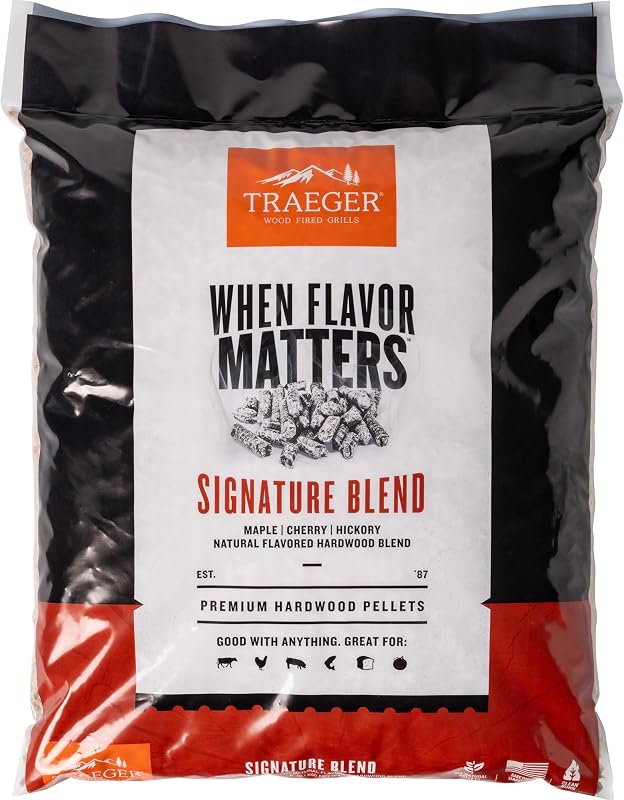
Pros
- 100 percent all-natural American hardwood
- No chemical binders or artificial fillers
- Engineered compact cell structure for low ash
- Versatile blends of hickory, maple, and cherry
Cons
- Requires electric pellet grill to burn
- Cannot deliver open-flame boiling power
- Must be kept completely dry during storage
View Traeger Grills Signature Blend 100% All-Natural on Amazon
Camp Chef

Pros
- Massive 60,000 BTU dual-burner output
- Detachable steel legs for quick field transport
- Three-sided windscreen blocks outdoor gusts
- Compatible with modular 14-inch cooktop accessories
Cons
- Produces no natural hardwood smoke flavor
- Requires hauling propane tanks and hoses
- Open frame requires manual grease degreasing
View Camp Chef Explorer Two Burner Stove on Amazon
Who Should Buy Each One
Choose the Traeger If
- You want genuine wood-fired smoke flavor using 100 percent hardwood pellets like hickory, maple, cherry, and apple.
- Your cooking routine focuses primarily on low-and-slow barbecue classics like brisket, ribs, pork shoulder, and roasted poultry.
- You do all your outdoor cooking in a backyard or patio setting with access to standard household electrical power.
- You appreciate clean-burning fuel that leaves low ash residue and requires minimal firebox sweeping.
Choose the Camp Chef If
- You need intense, instant heating power up to 60,000 BTUs for rapid water boiling, deep frying, and high-heat searing.
- You regularly cook at tailgates, campsites, or remote outdoor locations where detachable legs and carry bag mobility are essential.
- You want to use your existing pots, Dutch ovens, and cast-iron skillets across a generous 14 in. x 32 in. dual-burner surface.
- You cook in gusty weather conditions that demand a three-sided windscreen to shield active burner flames.
Final Verdict
When asking is Traeger worth it, the answer depends on your dedication to authentic barbecue flavor. Traeger has spent years mastering clean-burning, all-natural hardwood pellets that provide an unmistakable aroma and rich smoke profile that propane simply cannot duplicate. For the homeowner who wants set-it-and-forget-it temperature consistency for smoking ribs, roasting vegetables, or baking wood-fired breads on the back deck, Traeger remains the undisputed master of low-temperature flavor infusion.
On the other hand, is Camp Chef worth it for the mobile outdoor enthusiast? Absolutely. The Camp Chef Explorer delivers staggering heat output across its dual 30,000 BTU cast-aluminum burners, paired with rugged alloy steel construction and modular 14-inch accessory support. If your cooking demands rapid boiling, aggressive cast-iron frying, and dependable performance in windy campsites far away from electrical cords, Camp Chef is the clear, functional winner.
FAQ
Can you use Traeger pellets in a Camp Chef pellet grill?
Yes, Traeger 100 percent all-natural hardwood pellets can be burned in any standard pellet grill, including Camp Chef pellet models, provided the fuel is kept dry and free of moisture.
Does Camp Chef provide natural smoke flavor during cooking?
The Camp Chef Explorer stove burns propane gas, which provides clean, neutral heat without natural wood smoke flavor unless you place an auxiliary wood chip smoker box over the burner.
How does the heat output of Camp Chef compare to a pellet smoker?
The Camp Chef Explorer delivers 60,000 BTUs total across two cast-aluminum burners for rapid boiling and frying, whereas pellet grills rely on indirect convective heat designed for slow smoking and roasting rather than raw BTU open-flame cooking.
Are Traeger pellets manufactured with chemical fillers or binders?
No, Traeger pellets are made in American mills from 100 percent all-natural virgin hardwood with no artificial binders, fillers, or chemical additives, resulting in a clean burn with low ash production.
How portable is the Camp Chef two-burner stove for remote camping trips?
The Camp Chef Explorer is highly portable thanks to detachable steel legs, an overall frame weight of 2.5 kg according to the listing, and compatibility with custom-fit, weather-resistant carry bags designed for easy vehicle transport.
What foods pair best with Traeger Apple pellets versus the Signature Blend?
Traeger Apple pellets provide a sweet, subtle smoke profile ideal for chicken, pork, and baked goods, while the Signature Blend combines hickory, maple, and cherry hardwoods to tackle hearty beef cuts, wild game, and rich BBQ meats.


