Choosing between an electric vs gas pressure washer comes down to the fundamental trade-off between effortless plug-and-play convenience and raw, industrial-grade cleaning force. Electric pressure washers operate with quiet, zero-emission electric motors that plug directly into household outlets, requiring virtually zero mechanical upkeep, whereas gas pressure washers leverage combustion engines that produce higher water volume and stripping pressure with untethered mobility across wide properties.
Choose an electric pressure washer if you want an ultra-lightweight, low-maintenance machine for washing vehicles, cleaning patio furniture, and tackling light seasonal surface upkeep. Choose a gas pressure washer if you need to blast stubborn grime off sprawling concrete driveways, strip peeling paint, or work in areas far beyond the reach of an electrical wall outlet.




Electric vs Gas Pressure Washer at a Glance
| Feature | Electric Pressure Washer | Gas Pressure Washer |
|---|---|---|
| Power Source | Corded electric AC motor (13-Amp) | 4-stroke OHV gas engine (208cc to 212cc) |
| Maximum Pressure | 1,800 to 2,500 PSI | 3,300 to 3,400 PSI |
| Maximum Flow Rate | Up to 1.76 GPM (1.2 GPM rated) | 2.4 to 2.6 GPM |
| Machine Weight | 14.33 to 19 lbs | 63 to 64 lbs (28.6 kg) |
| Hose and Cord Reach | 20 to 25 ft hose with 35 ft GFCI cord | 25 ft abrasion-resistant hose (cord-free) |
| Detergent System | 13.53 oz foam bottle to 20 oz tank | 0.5 gallon tank or siphon tube |
| Pump Safety Mechanism | Total Stop System (TSS) trigger shutoff | Thermal relief valve |
| Best For | Cars, decks, patio furniture, siding | Large driveways, paint prep, heavy grease |
Cleaning Power and Pressure Output
Cleaning efficiency is determined by a combination of water pressure measured in pounds per square inch (PSI) and water volume measured in gallons per minute (GPM). Water pressure provides the mechanical force necessary to fracture dirt and lift embedded debris from a surface, while flow rate provides the volume needed to wash that loosened debris away. Multiplying PSI by GPM yields the overall cleaning units of a machine, which dictates how quickly and thoroughly an operator can finish a cleaning job.
When assessing gas vs electric pressure washer cleaning power, gas models consistently outclass electric alternatives across every primary output metric. Electric units, such as the Sun Joe SPX100-GO with its 13-amp motor producing 1,800 maximum PSI, or the higher-output Westinghouse ePX3500 delivering 2,500 max PSI (2,000 rated PSI) at 1.76 max GPM, are engineered for lighter residential duty. In contrast, heavy-duty gas units like the DeWalt DXPW3300-S with its 208cc engine generate 3,300 PSI at 2.4 GPM, and the Westinghouse WPX3400 pushes 3,400 PSI at 2.6 GPM via a 212cc 4-stroke engine. This fundamental power difference mirrors the performance gap seen when comparing a gas vs electric chainsaw, where internal combustion motors yield noticeably higher continuous output under heavy loads.
In real-world use, this discrepancy in electric vs gas pressure washer psi means a gas machine cuts through hardened mud, deep-set mildew, and oil stains on masonry in a fraction of the time. While an electric pressure washer review will rightly praise the ability of a 2,000-PSI machine to freshen a wooden fence or rinse a sidewalk, it lacks the scouring momentum to strip peeling paint or clean dense concrete quickly without requiring numerous repetitive passes.
Edge: Gas pressure washer, because its higher pressure and significantly greater water flow double the overall cleaning speed on tough exterior jobs.
Portability, Maneuverability, and Physical Weight
Portability encompasses two separate factors: how easily a machine rolls across various terrains during use, and how easily an operator can lift, transport, and store the hardware when the job is done. A machine that is effortless to roll across flat pavement may prove unwieldy when lifting it into a vehicle tailgate or carrying it up a flight of deck stairs.
Electric pressure washers hold an overwhelming advantage in overall physical weight and compact storage. The Sun Joe SPX100-GO weighs an exceptionally light 14.33 pounds in a compact 10 by 9.87 by 13.75-inch frame, making it easy to carry in one hand. The Westinghouse ePX3500 weighs just 19 pounds, standing 16.5 inches tall with a four-wheel steering system engineered with a low center of gravity to eliminate tipping during 360-degree turns. By contrast, gas models require sturdy steel frames and heavy engines: the DeWalt DXPW3300-S weighs 64 pounds, and the Westinghouse WPX3400 weighs 28.6 kilograms (roughly 63 pounds). Transporting these gas machines over turf or gravel demands large 10-inch pneumatic tires or 12-inch never-flat wheels.
However, gas pressure washers offer untethered operational freedom that electric units cannot match. An electric model requires a constant 120-volt connection, relying on a 35-foot power cord paired with a 20-foot or 25-foot high-pressure hose, strictly bounding your working diameter to the vicinity of an exterior outlet. A gas washer requires no electrical tether, functioning just like a cordless outdoor tool in the same vein as choosing a battery vs gas lawn mower for large acreage. You can pull a gas unit across a multi-acre property, along remote fence lines, or out to distant outbuildings without managing cord drag or voltage drop.
Edge: Tie, because electric models offer unmatched lightweight carrying ease for home storage, while gas models provide unlimited cord-free mobility across large properties.
Setup, Operation, and Ongoing Maintenance
The daily user experience of a pressure washer depends heavily on how quickly it can be prepped for a task and how much mechanical maintenance is required to keep it operating reliably. Routine tasks like checking fluid levels, winterizing pump components, and storing volatile fuel dictate long-term ownership effort.
Electric pressure washers provide an effortless push-button experience. With the Sun Joe SPX100-GO or Westinghouse ePX3500, setup involves connecting a garden hose, plugging the GFCI-protected power cord into an outlet, and flipping an electrical switch. Furthermore, both electric models feature a Total Stop System (TSS) that automatically shuts off the motor whenever the spray wand trigger is released. This conserves electricity, prevents unnecessary pump wear, and eliminates motor noise while moving hoses or repositioning ladders.
Gas pressure washers demand mechanical diligence. The 208cc engine on the DeWalt DXPW3300-S and the 212cc engine on the Westinghouse WPX3400 require fresh unleaded gasoline, periodic crankcase oil changes, spark plug checks, and air filter cleaning. Operators must pull a manual recoil cord to start the engine, manage choke settings, and ensure fuel is drained or treated before winter storage to prevent carburetor gumming. Gas pumps also rely on thermal relief valves instead of automatic trigger shutoffs; if an operator leaves the engine idling without spraying, the pump recirculates hot water until the valve purges it to prevent pump damage. The maintenance contrast mirrors the operational divide found in trimmers like the ego st1521s vs husqvarna 128ld, where electric simplicity replaces mechanical upkeep.
Edge: Electric pressure washer, because it starts with the flip of a switch, requires zero engine fluids, and incorporates automatic trigger-activated pump shutoff.
Vehicle Washing and Delicate Surface Safety
Washing vehicles, painted outdoor furniture, and delicate wooden decks requires controlled pressure and gentle chemical application rather than raw stripping force. Applying excessive pressure to automotive clear coats or composite decking risks peeling clear layers, loosening window trim seals, or etching deep grooves into wood grain.
When deciding on an electric or gas pressure washer for cars, electric units provide the ideal operational balance. The Sun Joe SPX100-GO operates at a safe 1,800 PSI and includes a dedicated 13.53-ounce foam bottle that distributes thick foaming detergent over body panels. The Westinghouse ePX3500 offers 2,000 rated PSI alongside a 20-ounce onboard soap tank and a pro-style wand with quick-connect nozzles (0°, 15°, 25°, turbo, and a low-pressure soap applicator). These lower operating pressures deliver ample cleaning muscle to lift road grime, brake dust, and mud without risking paint damage or forcing water past sensitive rubber window gaskets.
Gas pressure washers can wash vehicles, but they demand extreme caution and wider standoff distances. The 3,300 to 3,400 PSI produced by the DeWalt and Westinghouse gas models can instantly puncture tires, chip automotive paint, or strip decals if a tight nozzle tip is accidentally installed. While both the DeWalt DXPW3300-S and Westinghouse WPX3400 include low-pressure soap nozzles and dedicated chemical tanks, their sheer baseline output makes them far less forgiving for delicate chores. Anyone compiling an electric pressure washer review will note that controlled output is a safety benefit rather than a drawback for residential maintenance.
Edge: Electric pressure washer, because its moderate pressure range and integrated foaming attachments protect automotive paint and soft surfaces from accidental damage.
Driveway, Sidewalk, and Flatwork Efficiency
Cleaning horizontal flatwork like poured concrete, aggregate driveways, and paver walkways represents one of the most demanding tasks for any outdoor power tool. Porous concrete absorbs automotive fluids, atmospheric grime, and moss spores, locking dirt deep inside microscopic crevices that require sustained hydraulic force to extract.
For homeowners evaluating an electric or gas pressure washer for driveway cleaning, water volume (GPM) is just as critical as pressure (PSI). A gas model like the Westinghouse WPX3400 moves 2.6 gallons of water per minute at 3,400 PSI, while the DeWalt DXPW3300-S moves 2.4 GPM at 3,300 PSI. This massive volume rapidly pushes heavy slurry, moss residue, and dislodged sand across the driveway toward drainage channels. Furthermore, these high flow rates allow gas units to effectively drive rotating surface cleaner attachments using standard M22 fittings, cleaning wide circular swaths rather than thin pencil lines.
By comparison, an electric model like the Westinghouse ePX3500 pushes 1.2 GPM at rated pressure, and smaller units move even less. Trying to clean a multi-car driveway with a narrow 25-degree nozzle on an electric unit requires tiny, overlapping sweeping motions that can consume an entire afternoon. In large outdoor clearing tasks, volume and flow dominate performance, much like the airflow advantage seen when testing high-output commercial blowers in the echo pb-580t vs worx wg520 matchup. On expansive horizontal masonry, gas power saves significant labor hours.
Edge: Gas pressure washer, because its higher flow rate and 3,300+ PSI allow the use of wide surface cleaners to wash driveways in a fraction of the time.
Noise, Emissions, and Indoor or Garage Storage
Where and how a pressure washer is stored and operated impacts household safety and neighborhood comfort. Factors such as exhaust fumes, decibel output, and fuel storage restrictions dictate whether a tool belongs inside a home or strictly out in a detached shed.
Electric pressure washers emit zero fumes and operate at remarkably low noise levels. Because the motor halts completely via the Total Stop System whenever the trigger is released, the unit sits in total silence between cleaning passes. This makes electric washers pleasant to use in enclosed suburban patios, carports, and even inside open garage bays. Because they contain no fuel or crankcase oil, compact models like the Sun Joe SPX100-GO and Westinghouse ePX3500 can be stored safely in basements, utility closets, or under workbenches without lingering petroleum odors or fire hazards.
Gas pressure washers run continuous internal combustion engines that emit exhaust fumes and generate loud decibel levels. They must never be operated indoors, inside garages, or near open home windows due to carbon monoxide hazards. Storing a gas pressure washer like the DeWalt DXPW3300-S or Westinghouse WPX3400 requires dedicated, well-ventilated space in an outdoor shed or garage. Residual fuel odors are standard, and fuel levels must be monitored-such as keeping the fuel level a half-inch below the filler neck as noted by DeWalt-to prevent spillage during transport. The choice of fuel infrastructure presents real environmental trade-offs, akin to deciding between outdoor cooking fuels when contrasting a pellet grill vs gas grill.
Edge: Electric pressure washer, because it operates cleanly with zero emissions, low sound levels, and safe indoor storage capability.
Pros and Cons
Electric Pressure Washer
Pros
- Lightweight compact frames under 20 pounds
- Push-button starting with zero engine maintenance
- Total Stop System shuts motor when trigger releases
- Safe moderate pressure for washing vehicles
- Zero emissions allow quiet indoor garage storage
Cons
- Lower water volume extends flatwork cleaning times
- Tethered to power outlets and extension cords
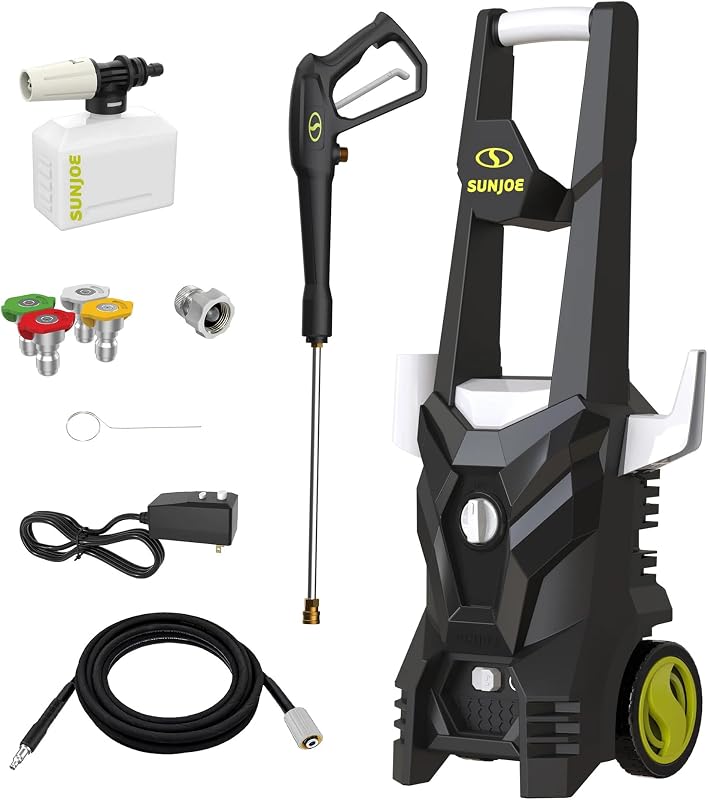
View Sun Joe SPX100-GO Electric Pressure Washer on Amazon
Gas Pressure Washer

Pros
- Heavy stripping power up to 3400 PSI
- High water flow up to 2.6 GPM
- Cordless mobility across large outdoor acreage
- Compatible with high-efficiency wide surface cleaners
- Durable steel frames with large rolling wheels
Cons
- Heavier frames weighing over 60 pounds
- Requires engine oil fuel management and winterizing
- Loud exhaust fumes prevent indoor garage operation
View DeWalt 3300 PSI Gas Pressure Washer on Amazon
Who Should Buy Each One
Choose the Electric Pressure Washer If
- You primarily clean vehicles, bicycles, patio furniture, composite decking, and exterior home siding.
- You want a lightweight machine weighing under 20 pounds that is effortless to carry up steps or store in a closet.
- You prefer instant push-button starting with zero oil changes, fuel stabilizers, or spark plug maintenance.
- You live in a quiet residential neighborhood and want an ultra-quiet tool with an automatic motor shutoff.
Choose the Gas Pressure Washer If
- You have long concrete driveways, extensive brick walkways, or large retaining walls covered in heavy mildew.
- You need to strip peeling exterior paint, blast cured oil stains, or prepare wood surfaces for deep staining.
- You maintain large acreage, rural properties, or commercial sites where electrical outlets are unavailable.
- You plan to use professional-style surface cleaners that require high water volume between 2.4 and 2.6 GPM.
Final Verdict
For the majority of suburban homeowners asking which electric or gas pressure washer for home use fits their routine, an electric pressure washer is the more practical investment. Units like the Westinghouse ePX3500 and Sun Joe SPX100-GO deliver sufficient scouring force for routine domestic chores-such as vehicle detailing, siding maintenance, and deck cleaning-without the burden of mixing fuel, changing engine oil, or tolerating heavy exhaust. The lightweight frames and compact storage footprints make them far more convenient to deploy for quick, impromptu cleaning tasks.
However, when tackling neglected concrete, broad driveways, and severe exterior staining, asking is a gas pressure washer worth it yields a resounding yes. The elevated output of models like the DeWalt DXPW3300-S and Westinghouse WPX3400 cuts cleaning times in half by supplying the high water flow and 3,300+ PSI necessary to strip stubborn grime rapidly. If your properties demand serious deep cleaning and cord-free mobility across wide footprints, the heavy-duty capabilities of a gas machine remain unmatched.
FAQ
Which is better for home use, an electric or gas pressure washer?
For standard residential upkeep, an electric model is generally superior due to its quiet operation, compact size, zero emissions, and lack of engine maintenance. It safely handles cars, outdoor furniture, and siding without risking surface damage. A gas model is better only if your property features extensive concrete flatwork or needs heavy-duty paint stripping.
Can an electric pressure washer clean a concrete driveway?
Yes, an electric pressure washer can clean concrete, but it takes significantly longer than a gas model. Because electric units typically deliver 1.2 to 1.76 GPM compared to 2.4 to 2.6 GPM on gas machines, you must use narrower spray nozzles and move the wand much more slowly across the surface to lift deep stains.
Can you damage a car with a gas pressure washer?
Yes. The high pressure generated by gas washers-often 3,300 to 3,400 PSI-can easily chip automotive clear coats, peel decorative decals, or damage rubber window seals if held too close or paired with a narrow 0-degree or 15-degree nozzle tip. Electric washers running under 2,000 rated PSI are much safer for vehicle detailing.
What does a Total Stop System do on an electric pressure washer?
A Total Stop System (TSS) is an automated sensor mechanism that shuts off the electric motor completely whenever the spray trigger is released. This prevents the pump from running dry or overheating, lowers energy consumption, reduces mechanical wear, and silences the machine when you are not actively spraying.
Why does water flow rate matter as much as PSI?
While PSI provides the shearing force that breaks dirt loose from a hard surface, gallons per minute (GPM) provides the volume required to carry that loosened mud, grit, and moss away. Higher GPM allows operators to clean broader paths in a single pass and run large spinning surface cleaners efficiently.
Can I use an extension cord with an electric pressure washer?
Most manufacturers recommend plugging the pressure washer’s built-in 35-foot GFCI power cord directly into a wall receptacle. If an extension cord must be used, it must be a heavy-duty, outdoor-rated cord sized appropriately (typically 12-gauge or 14-gauge depending on run length) to prevent voltage drop, motor overheating, and tripped circuit breakers.
Is an electric pressure washer worth it if I have heavy grime?
An electric pressure washer is worth it if you value low maintenance and primarily clean decks, vehicles, and light household siding. However, if you regularly deal with commercial grease, embedded automotive fluids, or peeling paint across extensive masonry, a gas model is necessary to avoid tedious, repetitive cleaning sessions.


