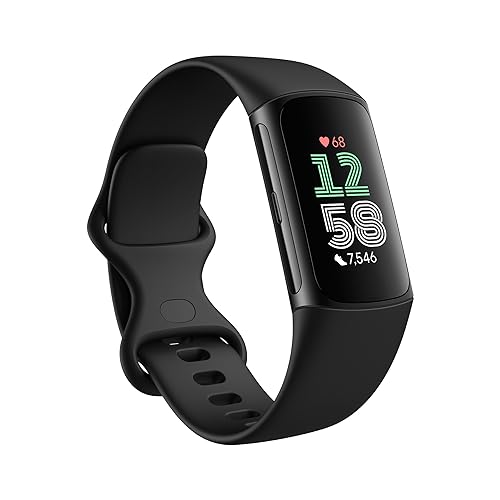
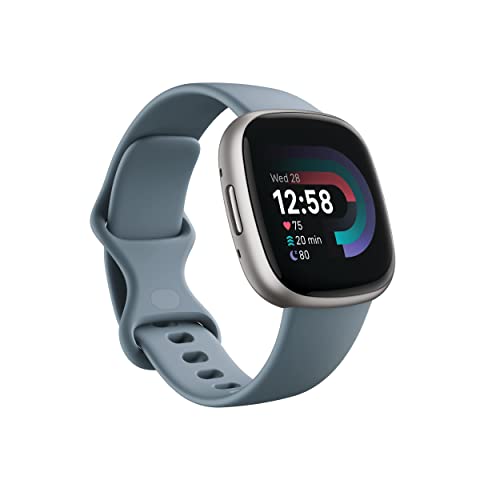
The fundamental difference separating the Fitbit Charge 6 and the Fitbit Versa 4 comes down to form factor and communication: the Charge 6 packages focused athletic tracking, gym machine connectivity, and an ECG sensor into a slender wristband, whereas the Versa 4 uses a broad, square smartwatch case to deliver on-wrist Bluetooth phone calls and Amazon Alexa voice control.
Dedicated athletes and runners who prioritize a minimal profile and direct exercise equipment integration should choose the Charge 6, while daily smartwatch wearers who want to take calls directly from their wrist and read stats on a larger display should choose the Versa 4.
Fitbit Charge 6 vs Fitbit Versa 4 at a Glance
| Feature | Fitbit Charge 6 | Fitbit Versa 4 |
|---|---|---|
| Device Category | Fitness Tracker | Smartwatch |
| Case Shape | Rectangular | Square |
| Case Material | Stainless Steel or Metal | Stainless Steel |
| On-Wrist Bluetooth Calls | Not listed | Yes |
| Voice Assistant | Not listed | Amazon Alexa built-in |
| Exercise Machine Heart Rate Linking | Yes (treadmills, ellipticals) | Not listed |
| ECG Functionality | Yes | Not listed |
| Built-In Satellite Navigation | Built-in GPS | Built-in GPS |
| Water Resistance | 50 meters | 50 meters |
| Stated Battery Life | Not listed | 6+ days |
| Included Premium Membership | 3-month trial | 6-month trial |
| Best For | Gym integration, ECG monitoring, and small wrists | On-wrist calls, voice commands, and large-screen visibility |
Display and Wrist Presence
Physical footprint dictates how comfortable a wearable feels over days of continuous use, particularly when tracking sleep patterns or moving through rigorous gym sessions. The Charge 6 adopts a narrow rectangular silhouette that sits flush against the wrist. Its slender tracker profile prevents the casing from digging into the back of your hand during push-ups, planks, or weight training, making the device exceptionally unobtrusive. When comparing the fitbit charge 6 vs inspire 3 or looking at the broader tracker space, this streamlined geometry ensures minimal bulk for 24/7 wear.
In contrast, the Versa 4 employs a modern square smartwatch chassis that commands significantly more wrist real estate. The primary advantage here is legibility: the larger touchscreen allows workout metrics, incoming text previews, and turn-by-turn navigation alerts to be viewed at a casual glance without squinting. However, that expansive display comes with a broader footprint that may feel cumbersome on smaller forearms. Buyers assessing the Fitbit Charge 6 vs Versa 4 screen size will find that while the Versa 4 provides far superior visual clarity mid-stride, those weighing the Fitbit Charge 6 or Versa 4 for small wrists will appreciate how the Charge 6 blends seamlessly into everyday outfits without dominating the forearm.
Material construction is dependable across both options, as both wearables feature stainless steel casing components paired with interchangeable silicone bands. Both units also utilize ambient light sensors to automatically modulate brightness depending on indoor lighting or direct outdoor sun. The ultimate physical trade-off is clear: the Charge 6 disappears under a dress shirt or workout sleeve, whereas the Versa 4 offers an expansive visual canvas designed to be read effortlessly during rapid movement.
Edge: Fitbit Charge 6 wins on ergonomic convenience and unobtrusive daily wear, particularly for small wrists and overnight sleep tracking, though the Versa 4 remains preferable for readers who prioritize glanceable display real estate.
Smartwatch Capabilities and Wrist Communication
The communication barrier between these two wearables represents one of the starkest functional contrasts in this comparison. The Versa 4 serves as a functional extension of your mobile device, featuring on-wrist Bluetooth calls alongside speaker and microphone hardware. This hardware arrangement lets you answer incoming phone calls directly from your wrist, manage text message alerts, and issue hands-free voice commands using built-in Amazon Alexa. For users debating the Fitbit Versa 4 vs Charge 6 for active work environments, the ability to accept a quick call while your smartphone sits across the room adds substantial utility.
The Charge 6 scales back these interactive communication tools in favor of a leaner notification workflow. While it displays incoming smartphone alerts, the product listing does not specify a microphone, built-in speaker, or the ability to conduct voice calls on the wrist. When evaluating this against traditional smartwatches like the fitbit charge 6 vs apple watch se, the Charge 6 clearly leans toward fitness tracking first. It does, however, incorporate helpful Google integrations, including Google Wallet for contactless tap-to-pay payments and Google Maps for wrist-based navigation.
Where the Charge 6 manages to counter is with media management, offering dedicated YouTube Music controls to skip, pause, or start audio directly from the tracker during training sessions. The Versa 4 matches Google Wallet and Google Maps functionality, while also listing Fitbit Pay support. Readers asking is Fitbit Versa 4 worth it for daily communication will find that the addition of Amazon Alexa voice prompts and wrist-based phone calling gives the Versa 4 an overwhelming advantage in everyday smartwatch duties.
Edge: Fitbit Versa 4 takes this category comfortably by providing true on-wrist Bluetooth calling, text responses, and Amazon Alexa voice assistance.
Workout Tracking, GPS, and Gym Integration
Both models arrive fully equipped for cross-training, each providing over 40 distinct exercise modes alongside automatic exercise tracking that logs sessions even if you forget to start a workout manually. Built-in GPS is present on both devices, which means you can accurately record outdoor route geometry, pace, and distance without carrying your phone along. Runners comparing the Fitbit Charge 6 or Versa 4 for running will appreciate that both track Active Zone Minutes to ensure training efforts hit targeted aerobic thresholds.
Despite their shared outdoor foundations, the Charge 6 pulls ahead in indoor fitness environments thanks to its ability to stream real-time heart rate data directly to compatible gym equipment. By linking the Charge 6 to compatible treadmills, ellipticals, stationary bikes, and rowing machines, you can view your biometric effort right on the gym console screen without gripping metallic handlebar sensors. Comparing athletic options like the fitbit charge 6 vs garmin venu 3 demonstrates how valuable this gym broadcast feature is for cross-training enthusiasts who frequent commercial fitness clubs.
The Versa 4 counters with a post-workout workout intensity map, allowing you to visualize how your cardiovascular effort shifted across different sections of your outdoor path. However, its listing makes no mention of broadcasting live heart rate metrics to third-party gym machinery. Shoppers examining Fitbit Charge 6 vs Versa 4 heart rate accuracy in gym settings will find that the Charge 6 offers far tighter hardware synergy with indoor fitness equipment.
Edge: Fitbit Charge 6 earns the advantage for dedicated gym-goers and fitness enthusiasts thanks to live heart rate streaming to compatible exercise machines and YouTube Music playback control.
Battery Life and Hardware Durability
Wearable longevity between charges dictates how consistently a device can monitor baseline biometrics, skin temperature variations, and overnight sleep cycles without interruption. The Versa 4 explicitly documents a battery runtime of 6+ days on a single charge. This multi-day endurance makes it easy to travel for nearly a full week without packing a proprietary charging cable, even while running continuous 24/7 heart rate monitoring, background notifications, and occasional GPS-tracked walks.
The Charge 6 product specifications do not explicitly state a runtime duration in days. Readers examining previous generational match-ups like the fitbit charge 5 vs versa 4 know that slim trackers traditionally hold solid charge windows, but based strictly on listing documentation, only the Versa 4 confirms a 6+ day benchmark. Those evaluating Fitbit Charge 6 vs Versa 4 battery life must rely on the Versa 4 as the only model with a manufacturer-verified runtime standard in its product specifications.
On the durability front, both models feature robust water resistance rated down to 50 meters, making either device completely safe for pool laps, rainy runs, or post-workout showers. The Versa 4 listing further outlines an operating temperature range spanning -14° to 113°F and a maximum operating altitude reaching 28,000 feet. While both units utilize rugged stainless steel case components and resilient silicone straps, the Versa 4 provides greater specification transparency regarding environmental extremes and continuous operational longevity.
Edge: Fitbit Versa 4 wins due to its explicitly stated 6+ day battery life and documented extreme altitude and temperature ratings.
Health Metrics, Sleep Analytics, and Coaching
Both devices function as comprehensive biometric hubs, tracking 24/7 heart rate, blood oxygen saturation via an SpO2 sensor, skin temperature variations, and movement via onboard accelerometers and gyroscopes. Each wearable translates these biological signals into a Daily Readiness Score, giving you actionable feedback on whether your body is primed for intense exertion or requires active recovery. Nightly sleep tracking is equally comprehensive on both units, detailing sleep stages, calculating a personalized Sleep Score, and utilizing a Smart Wake alarm to vibrate gently during lighter sleep phases.
However, when looking closely at health diagnostic sensors, the Charge 6 listing specifies an ECG (electrocardiogram) capability, an advanced tool used to assess heart rhythms directly from the wrist. The Versa 4 listing does not specify an ECG sensor, focusing instead on holistic tracking elements like reflection logging, guided breathing sessions, menstrual health tracking, and mindfulness content within its health metrics dashboard. Readers exploring compact health bands such as the fitbit charge 5 vs inspire 3 will recognize that the inclusion of an ECG sensor elevates the Charge 6 into deeper health assessment territory.
Software ecosystems and coaching trials present another divergence. The Charge 6 includes a 3-month trial to Google Health Premium, which introduces adaptive coaching built with Gemini that tailors recommendations to your routine. The Versa 4, on the other hand, bundles a longer 6-month trial to Fitbit Premium, unlocking personalized Sleep Profiles and deep historical metric trends. In any comprehensive Fitbit Charge 6 review or Fitbit Versa 4 review, buyers asking is Fitbit Charge 6 worth it for health monitoring will appreciate that its hardware includes dedicated ECG sensing, giving it a tangible edge in clinical wellness detection.
Edge: Fitbit Charge 6 holds the edge for clinical wellness tracking by including ECG monitoring on its specification sheet alongside adaptive Gemini-driven coaching.
Pros and Cons
Fitbit Charge 6

Pros
- Compatible exercise machine heart rate pairing
- Built-in ECG sensor for cardiac tracking
- Slim rectangular tracker for small wrists
- Dedicated YouTube Music playback controls
- Built-in GPS with turn-by-turn Google Maps
Cons
- No on-wrist Bluetooth phone calls
- Listing does not specify battery runtime
View Fitbit Charge 6 on Amazon
Fitbit Versa 4

Pros
- On-wrist Bluetooth phone call support
- Verified 6+ day battery life
- Large square screen for easy viewing
- Amazon Alexa voice assistant built-in
- Generous 6-month Premium trial included
Cons
- Wider casing feels bulkier on small wrists
- Lacks gym machine heart rate broadcasting
Who Should Buy Each One
Choose the Fitbit Charge 6 If
- You frequent the gym and want your live heart rate beamed directly to treadmills, stationary bikes, and ellipticals.
- You have small wrists or prefer a low-profile, rectangular fitness band that remains unobtrusive during sleep.
- You want advanced cardiac rhythm tracking enabled by an onboard ECG sensor.
- You rely on YouTube Music to power your training routines and want wrist-based playback control.
Choose the Fitbit Versa 4 If
- You want to answer Bluetooth phone calls directly from your wrist without fetching your mobile device.
- You prefer a broad, square smartwatch screen that makes pace, distance, and notifications instantly readable.
- You use Amazon Alexa to set timers, manage daily reminders, and control smart equipment with voice commands.
- You need guaranteed 6+ day battery life verified directly by the manufacturer’s technical specifications.
Final Verdict
For the majority of buyers focused primarily on physical conditioning and overall well-being, the Charge 6 is the superior choice. It packages essential Google navigation and payment tools into an ultra-streamlined rectangular chassis, includes a dedicated ECG sensor, and links directly to commercial exercise equipment for seamless cardio workouts. Unless you specifically require the wrist-calling functions of a traditional smartwatch, the Charge 6 offers the most focused, distraction-free health tracking package.
The Versa 4 proves its value for shoppers seeking a true smartwatch experience rather than a basic fitness band. Its integrated speaker, microphone, on-wrist Bluetooth call answering, Amazon Alexa support, and large square touchscreen provide everyday communication conveniences that the Charge 6 simply cannot match. If you want verified 6+ day battery endurance paired with a clear, readable display for daily office and fitness wear, the Versa 4 remains the right model to strap on.
FAQ
Does the Fitbit Charge 6 support on-wrist phone calls like the Versa 4?
No. The Charge 6 listing does not include a microphone, speaker, or Bluetooth calling functionality. If you need to answer incoming phone calls directly from your wrist, the Versa 4 is the only model between the two that includes on-wrist Bluetooth call support.
Which device is better for small wrists, the Charge 6 or Versa 4?
The Charge 6 is far better suited for slender wrists. It features a narrow, rectangular tracker profile that conforms naturally to smaller forearms, whereas the Versa 4 uses a wider, square smartwatch casing that may look and feel bulky on compact wrists.
Can both devices track outdoor runs without carrying a phone?
Yes. Both the Charge 6 and the Versa 4 feature built-in GPS functionality. This enables either wearable to map outdoor running or cycling routes, record real-time pace, and calculate distance independently of a paired mobile phone.
How do the Charge 6 and Versa 4 handle gym equipment connectivity?
The Charge 6 is designed to connect directly to compatible exercise machines such as treadmills, ellipticals, and stationary bikes, streaming your heart rate in real time to the machine display. The Versa 4 listing does not advertise exercise machine heart rate broadcast capabilities.
Do both devices provide turn-by-turn navigation and mobile payments?
Yes. Both wearables support turn-by-turn navigation via Google Maps and enable contactless tap-and-pay transactions using Google Wallet. The Versa 4 also supports Fitbit Pay according to its technical listing.
Which wearable features an ECG sensor?
The Charge 6 includes an ECG sensor listed under its additional specifications for monitoring heart rhythm patterns. The Versa 4 listing highlights 24/7 heart rate monitoring and an SpO2 sensor, but does not list an ECG sensor.


