The choice between the Honeywell HPA304 and the Dyson TP07 comes down to whether your indoor space demands raw, high-volume allergen air exchanges or a dual-purpose cooling tower equipped with intelligent air quality sensing.
Buyers battling severe seasonal triggers in spacious layouts should choose the Honeywell HPA304 for its rapid room turnover, while those seeking an oscillating cooling fan with automated air-purifying sensors will find the Dyson TP07 better tailored to their living spaces.


Honeywell HPA304 vs Dyson TP07 at a Glance
| Feature | Honeywell HPA304 | Dyson TP07 |
|---|---|---|
| Filtration Standard | Honeywell HEPA Filter (99.97% at 0.3 microns) | Fully sealed to HEPA H13 standard |
| Coverage Rating | 465 sq. ft. (4.8 ACH) / up to 2,250 sq. ft. (1 ACH) | Listing does not specify maximum square footage |
| Primary Air Mover Design | High-volume internal intake blower | Air Multiplier oscillating tower fan |
| Automated Air Quality Sensing | Not listed | Intelligent sensing (automatically senses and traps) |
| Built-In Controls & Timers | Touch controls, 2/4/8 hour timer, dimmer | Listing does not specify manual interface details |
| Product Dimensions | 20.08 x 10.83 x 22.32 inches | 7.7 x 8 x 41 inches |
| Unit Weight | 17 pounds | 8 pounds |
| Manufacturer Warranty | 5-year warranty | Listing does not specify warranty term |
| Best For | Dedicated large-room allergen and smoke clearing | Targeted personal cooling and smart air maintenance |
Room Coverage and Air Exchange Rates
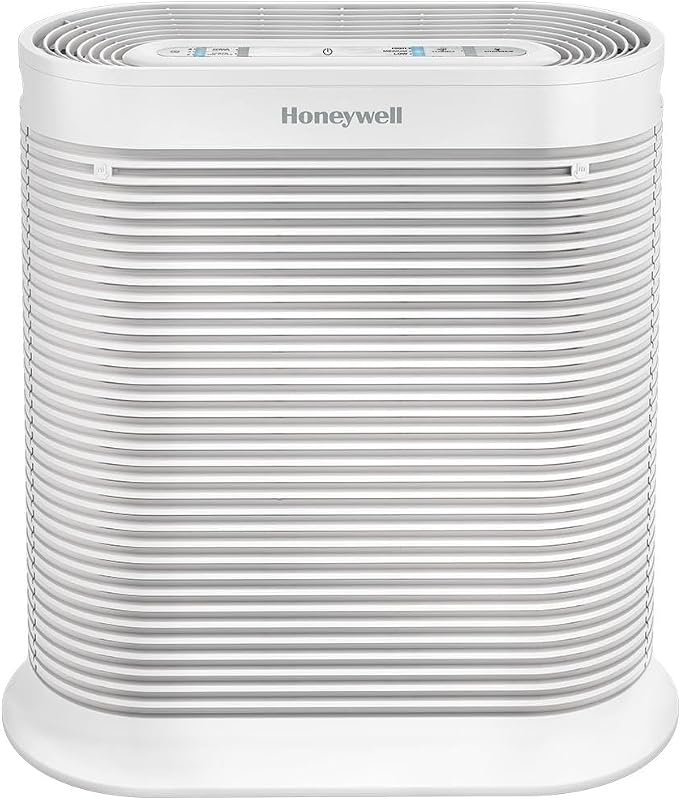
The rate at which an air purifier moves cubic feet of air through its filter dictates how quickly it can clear suspended particulate matter like dust, pollen, and pet dander. When evaluating the Honeywell HPA304 coverage, the manufacturer specifies high-capacity clearing designed for extra-large spaces. Specifically, the HPA304 circulates air up to 4.8 times an hour in rooms up to 465 square feet, and it can filter rooms up to 2,250 square feet within a single hour. While the technical product listing does not state a numerical Honeywell HPA304 CADR figure, these explicit air exchange figures confirm that the internal blower is configured to exchange massive volumes of air inside closed quarters. Shoppers comparing high-output console designs often weigh this against similar box purifiers, as explored in our coway airmega 400 vs honeywell hpa304 matchup.
The Dyson TP07 takes a different approach to spatial airflow. Dyson listing specifications describe the unit as purifying the whole room using proprietary Air Multiplier technology to project air across a space, but the listing does not specify concrete square footage coverage numbers or hourly air change benchmarks. Rather than pulling massive volumes through a wide box cabinet, the TP07 focuses on circulating purified air outward to reach occupants across the room while simultaneously cooling them. When choosing between the Honeywell HPA304 or Dyson TP07 for large rooms, the sheer cubic-volume capacity of the Honeywell console makes it far more suited to processing high volumes of stale air quickly.
This fundamental difference changes how each device impacts your indoor environment. The Honeywell HPA304 functions as a brute-force air scrubber that aggressively purifies high-volume spaces to reduce airborne contaminants before they settle onto surfaces. The TP07 works progressively, relying on continuous circulation to filter room air while doubling as a dedicated household fan. Readers seeking maximum volume turnover in shared living areas or expansive basements will see faster measurable reductions from Honeywell’s heavy-duty blower configuration.
Edge: Honeywell HPA304, thanks to clearly stated coverage capabilities up to 2,250 square feet in one hour and 4.8 air changes per hour in 465-square-foot rooms.
Filtration Efficiency and Allergen Capture
Air filtration performance relies heavily on filter density, mechanical sealing, and structural integrity under airflow pressure. For individuals weighing the Honeywell HPA304 or Dyson TP07 for allergies, examining how each machine secures its filter media is paramount. The Honeywell HPA304 relies on genuine Honeywell HEPA filtration engineered to capture up to 99.97% of airborne particles down to 0.3 microns. Its primary focus is trapping heavy biological loads, including pollen, pet dander, dust mite debris, smoke, and household dust. Because this unit relies on thick mechanical filter packs designed to process high air loads, it provides exceptional throughput for family spaces with pets or persistent allergen sources. Similar high-throughput mechanical systems are examined in our winix 5500-2 vs honeywell hpa304 comparison.
The Dyson TP07 approaches particle management by emphasizing full chassis containment. Dyson’s listing specifies an advanced, fully sealed filtration system re-engineered to meet the HEPA H13 standard. This design guarantees that what goes inside stays inside, preventing unfiltered air from bypassing the filter perimeter through unsealed chassis gaps. Dyson incorporates a two-phase purification setup that traps 99.97% of microscopic particles as small as 0.3 microns while ensuring the entire machine, not just the filter media, prevents fugitive emissions. This sealed standard offers peace of mind for sensitive environments where fine smoke or ultra-fine particulate escape must be minimized.
In practice, the Honeywell HPA304 captures enormous physical quantities of airborne debris over time, making it an exceptional workhorse for pet dander and pollen fallout. However, Dyson’s fully sealed HEPA H13 design prevents microscopic leakage, which gives it an advantage in containment precision. If your primary goal in a Dyson TP07 vs Honeywell air purifier comparison is absolute chassis sealing, the TP07 holds the technical advantage, while the Honeywell offers greater overall filter surface exposure to handle heavy domestic debris.
Edge: Dyson TP07, due to its fully sealed engineering meeting the rigorous HEPA H13 standard.
Air Circulation and Cooling Capabilities
Air movement defines how these two machines interact with the physical comfort of a room’s occupants. The Dyson TP07 cooling performance is built directly around Dyson’s Air Multiplier technology, which channels filtered air through an upright tower aperture. This produces an uninterrupted stream of high-velocity airflow that actively purifies the whole room and cools you simultaneously. Rather than functioning solely as an ambient air cleaner tucked into a corner, the TP07 serves as an active room fan designed to provide direct thermal relief during warmer weather.
The Honeywell HPA304 is strictly a dedicated mechanical air cleaner. Its internal motor pulls ambient air into the broad front and side intake grilles, pushes it through the HEPA filter packs, and expels it upward through an overhead exhaust grill. While this top-discharge vent creates noticeable air circulation in its immediate vicinity, it is not engineered to act as a directional cooling fan. The listing makes no claims regarding cooling utility, focusing exclusively on air cleaning and allergen reduction.
For buyers trying to decide if the Dyson TP07 is worth it, this dual functionality is often the deciding factor. The TP07 eliminates the clutter of operating both an oscillating tower fan and a standalone air purifier in the same room. Conversely, if you already have dedicated cooling or run central HVAC, the HPA304 avoids blowing direct drafts onto seating areas while maintaining a continuous vertical circulation pattern.
Edge: Dyson TP07, because its Air Multiplier architecture delivers genuine personal cooling alongside whole-room purification.
Controls, Automation, and User Convenience
Day-to-day usability often hinges on whether an air cleaner requires continuous hands-on adjustments or adapts autonomously to its environment. The Dyson TP07 review data highlights intelligent sensing capabilities. The listing states that the device automatically senses, captures, and traps pollutants on its own. By dynamically responding to fluctuating airborne contaminants, the TP07 can increase its purification intensity when air quality drops and throttle back down once ambient levels stabilize, minimizing manual oversight.
In contrast, this Honeywell HPA304 review highlights a more traditional, tactile control interface. The HPA304 features an easy-to-use touch control panel located directly on top of the cabinet. It includes an automatic shut-off timer with 2, 4, or 8-hour intervals, a control panel dimmer for light-sensitive rooms, and a dedicated filter change indicator with an integrated reset function. While simple and reliable, the HPA304 listing does not specify integrated particle sensors or automatic speed adjustments, requiring users to manually select their desired fan speed. Other automated alternatives in this performance tier are evaluated in our levoit core 400s vs honeywell hpa304 analysis.
The convenience trade-off is clear. The Dyson TP07 functions as a set-it-and-forget-it automated device that continuously monitors your air. The Honeywell HPA304 provides predictable, uninterrupted mechanical operation where the user dictates the airflow rate via physical touch controls. For light sleepers, the HPA304 does provide useful utility with its display dimmer, but it lacks the responsive environmental automation found on the TP07.
Edge: Dyson TP07, for its built-in intelligent sensing that automatically detects and traps airborne pollutants.
Footprint, Form Factor, and Placement Flexibility
Physical proportions determine where an appliance can reside without obstructing foot traffic or aesthetic sightlines. The Honeywell HPA304 measures 20.08 inches long, 10.83 inches wide, and 22.32 inches tall, weighing in at a substantial 17 pounds. Its broad, low-profile console shape requires a dedicated footprint along a perimeter wall where its intake grilles remain unobstructed. While stable and sturdy, its bulky cabinet design makes it a prominent fixture inside modest living spaces. Those interested in compact floor designs often cross-shop this model against smaller alternatives, such as in our coway airmega 200m vs honeywell hpa304 breakdown.
The Dyson TP07 adopts an ultra-slim, vertical tower silhouette measuring 7.7 inches wide, 8 inches deep, and 41 inches tall. At just 8 pounds, it weighs less than half of the Honeywell console despite standing nearly double its height. The narrow vertical footprint allows the TP07 to slide into narrow gaps between furniture, into tight bedroom corners, or alongside desks without consuming precious floor real estate. Its lightweight build also makes it easy to carry from room to room as daily occupancy shifts.
Placement practicality diverges based on these forms. The Honeywell HPA304 is best situated in large, open zones where its boxy 17-pound chassis cannot be easily tipped over. The Dyson TP07 fits gracefully into compact areas and bedroom layouts, maximizing vertical air delivery without dominating the floor. For smaller rooms or minimalist aesthetics, the Dyson form factor is distinctly more versatile.
Edge: Dyson TP07, due to its compact 7.7 by 8-inch base footprint and lightweight 8-pound frame.
Reliability, Maintenance, and Warranty Support
Long-term satisfaction with any purification hardware requires evaluating ongoing upkeep and manufacturer backing. The Honeywell HPA304 features an integrated filter change indicator that notifies owners precisely when the filter media needs replacement, supported by a manual reset button. Honeywell explicitly specifies that buyers should always purchase genuine Honeywell replacement air purifier filters, as compatible third-party filters are not guaranteed to offer identical performance or efficiency. Backing the entire unit is an extensive 5-year manufacturer warranty from Kaz, reflecting long-term confidence in the mechanical durability of its motor and housing. Similar longevity considerations are covered in our levoit vital 200s vs honeywell hpa304 guide.
The Dyson TP07 features an enclosed, two-phase filtration system engineered to capture and lock pollutants inside the chassis. While its sealed assembly simplifies filter exchanges, the listing does not specify the exact manufacturer warranty term or specific filter replacement intervals. Dyson hardware relies on internal microprocessors and sensor arrays to maintain its automated routines, which introduces more technical complexity than the simple electromechanical setup found inside the Honeywell.
When measuring expected operational longevity against hardware simplicity, the Honeywell HPA304 provides clear reassurance through its stated 5-year warranty. Its straightforward touch controls, heavy-duty chassis, and reliable filter-life indicator ensure minimal points of electronic failure over years of continuous air scrubbing.
Edge: Honeywell HPA304, backed by a generous 5-year manufacturer warranty and a dedicated filter-reset tracking system.
Pros and Cons
Honeywell HPA304
Pros
- Filters 2250 sq ft spaces in one hour
- 8 air changes hourly in 465 sq ft
- Generous 5-year manufacturer warranty
- Control panel dimmer and shut-off timer
Cons
- Heavy 17-pound bulky box chassis
- Lacks automated air quality sensing
- Does not provide directional personal cooling
View Honeywell HPA304 on Amazon
Dyson TP07

Pros
- Fully sealed to HEPA H13 standard
- Air Multiplier purifies and cools simultaneously
- Intelligent sensors automate pollutant capture
- Slim vertical footprint weighs only 8 pounds
Cons
- Listing does not specify square foot coverage
- Listing does not specify warranty length
Who Should Buy Each One
Choose the Honeywell HPA304 If
- You need rapid, high-volume air turnover across expansive rooms up to 2,250 square feet in an hour.
- Your household deals with heavy pet dander, dense pollen, or smoke that requires thick HEPA media.
- You prefer a straightforward, mechanical appliance backed by a 5-year manufacturer warranty.
- You want simple touch controls with an integrated display dimmer and physical shut-off timers.
Choose the Dyson TP07 If
- You want a single appliance that purifies room air while providing active, whole-room personal cooling.
- You prefer an automated device with intelligent sensing that detects and captures pollutants autonomously.
- You require a fully sealed HEPA H13 filtration system that prevents microscopic air bypass.
- You have limited floor space and need a slim, lightweight 8-pound tower design.
Final Verdict
The Honeywell HPA304 is the superior choice for homeowners whose primary priority is high-output, continuous air purification. By processing 465 square feet at 4.8 air changes per hour and circulating up to 2,250 square feet in 60 minutes, it acts as an unapologetic, heavy-duty mechanical filter. Backed by a 5-year warranty, a low-profile 17-pound chassis, and genuine HEPA media targeting microscopic allergens, the HPA304 delivers maximum cubic air turnover for allergy-prone households.
However, the Dyson TP07 wins the decision for buyers looking for modern convenience, intelligent automation, and multi-season utility. Its fully sealed HEPA H13 system ensures exceptional particle retention, while its Air Multiplier tower simultaneously cools occupants and projects clean air across the room. If you value automated operation, sleek aesthetic integration, and two-in-one cooling functionality, the TP07 is well worth the investment.
FAQ
What is the primary difference between the Honeywell HPA304 and the Dyson TP07?
The Honeywell HPA304 is a heavy-duty, high-capacity console air purifier focused purely on rapid air exchanges and allergen capture, whereas the Dyson TP07 is an oscillating smart tower fan that combines fully sealed HEPA H13 air filtration with personal cooling.
Can the Dyson TP07 completely replace a standard household fan?
Yes. The Dyson TP07 utilizes Air Multiplier technology engineered specifically to project air across the room and cool occupants while purifying, functioning as both an active tower fan and a whole-room air cleaner.
Does the Honeywell HPA304 feature automatic air quality sensing?
No. The listing does not specify automatic air quality sensors for the HPA304. It utilizes manual touch controls, an auto shut-off timer (2, 4, or 8 hours), and a control panel dimmer rather than autonomous speed adjustments.
How do the filter standards compare between both models?
The Honeywell HPA304 uses genuine Honeywell HEPA filters capturing up to 99.97% of particles down to 0.3 microns. The Dyson TP07 also captures 99.97% of particles at 0.3 microns, but its entire chassis is engineered and fully sealed to meet the HEPA H13 standard.
Which unit is easier to move between different rooms?
The Dyson TP07 is noticeably easier to relocate. It weighs only 8 pounds with a slim 7.7 x 8-inch base, compared to the Honeywell HPA304, which weighs 17 pounds and features a bulkier box console frame.
What room size is the Honeywell HPA304 rated to handle?
According to its listing, the Honeywell HPA304 is recommended for extra-large spaces, circulating air 4.8 times an hour in rooms up to 465 square feet and filtering rooms up to 2,250 square feet within one hour.