When deciding between the ASRock AMD RX 6700 XT and the PowerColor AMD RX 6950 XT, the single deciding difference comes down to the divide between high-end memory capacity and power scaling: the flagship tier card pairs 16GB of GDDR6 memory across a wide 256-bit bus with substantial compute resources, whereas the mid-tier option offers 12GB of GDDR6 memory on a 192-bit bus inside a compact, power-friendly envelope.
Choose the RX 6700 XT if your setup relies on a standard desktop chassis and a modest power supply where dual-fan efficiency is essential. Choose the RX 6950 XT if you possess an unconstrained gaming enclosure and a high-wattage power delivery system capable of supporting enthusiast-grade graphics hardware.

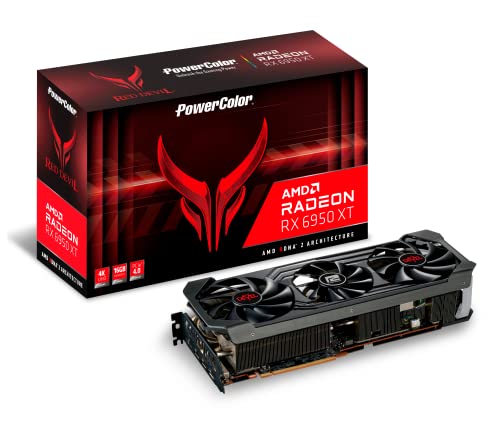
AMD RX 6700 XT vs AMD RX 6950 XT at a Glance
| Attribute | ASRock AMD RX 6700 XT | PowerColor AMD RX 6950 XT |
|---|---|---|
| Memory Capacity & Type | 12GB GDDR6 | 16GB GDDR6 |
| Memory Bus Width | 192-bit | 256-bit |
| Compute Units / Stream Processors | 54 Compute Units | 5120 Stream Processors |
| Boost Clock Speed | Up to 2584 MHz | Up to 2435 MHz (OC) / 2324 MHz (Silent) |
| Game Clock Speed | 2226 MHz | 2226 MHz (OC) / 2116 MHz (Silent) |
| Memory Clock | 18000 MHz (2584 MHz listing spec) | 18.0 Gbps (18000 MHz) |
| Cooling Hardware | Dual Fan Design with 0dB Silent Cooling | Triple Fan Design |
| Power Connectors | 2 x 8-pin | 3 x 8-pin |
| Minimum System Power | Not listed | 950W |
| Dimensions (L x W) | 10.5″ L x 5.1″ W | 13.07″ L x 6.42″ W |
| Best For | Standard cases and efficient 1440p gaming | Unconstrained 4K setups and enthusiast builds |
Memory Bandwidth and VRAM Capacity
VRAM capacity and bus width dictate how effectively a graphics card handles high-resolution texture packs, volumetric effects, and complex scene geometry without stuttering. In the debate between the RX 6700 XT 12GB vs RX 6950 XT 16GB configurations, the physical memory buffer represents a fundamental dividing line. As modern games scale up asset streaming demands, the physical bandwidth between the memory chips and the GPU core determines whether a card maintains consistent frame pacing or suffers from frame drops during intense rendered sequences.
Looking at the technical specifications, the PowerColor card carries 16GB of GDDR6 memory operating across a wide 256-bit interface with an 18.0 Gbps memory speed. The ASRock card features 12GB of GDDR6 memory across a narrower 192-bit memory bus, supported by 48MB of AMD Infinity Cache to offset latency and enhance high-resolution throughput. Builders evaluating intermediate steps often analyze the amd rx 6700 xt vs 6800 xt to see how wider memory buses impact data flow, but here the 256-bit bus of the flagship card provides a clear hardware advantage for high-volume data streaming.
The practical result of this disparity is felt when running demanding titles at higher rendering targets. While 12GB remains adequate for modern titles at 1440p, pushing intensive ray tracing accelerators or uncompressed texture packs can quickly saturate that buffer. The 16GB pool and 256-bit bus on the RX 6950 XT provide substantial headroom, ensuring that texture thrashing does not limit performance when gaming beyond standard resolutions. The RX 6700 XT balances its 12GB capacity well with Infinity Cache, but it cannot match the total data throughput provided by the flagship tier memory array.
Edge: AMD RX 6950 XT delivers a superior 16GB memory footprint and a wider 256-bit bus that protects against heavy texture saturation.
Compute Architecture and Gaming Resolution
The underlying compute engine determines raw rendering throughput, shading capabilities, and frame rate stability under intense geometric complexity. For gamers asking whether to choose the RX 6700 XT or RX 6950 XT for 4k gaming, core density is the primary performance factor. The sheer volume of parallel processing cores dictates how many pixels a graphics card can rasterize simultaneously, defining the tier boundary between high-refresh 1440p play and uncompromising 4K output.
The PowerColor RX 6950 XT features an expansive compute layout containing 5120 stream processors. It includes a hardware dual-BIOS toggle that allows users to switch between an OC Mode featuring a 2435 MHz boost clock and 2226 MHz game clock, and a Silent Mode operating at a 2324 MHz boost clock and 2116 MHz game clock. In contrast, the ASRock Challenger model utilizes 54 Compute Units with dedicated RT and AI accelerators, reaching a boost clock up to 2584 MHz and a game clock of 2226 MHz. Those comparing intermediate upgrades often look at the amd rx 6750 xt vs 6950 xt to see how clock frequencies correlate with processing core scaling across tiers.
When running games in the RX 6700 XT vs RX 6950 XT 1440p bracket, the higher boost frequency of the RX 6700 XT keeps gameplay fast and responsive. However, as resolution climbs toward the maximum supported display limit of 7680×4320 pixels, the 5120 stream processors of the RX 6950 XT showcase decisive rendering power. The 54 Compute Units of the RX 6700 XT must work substantially harder per clock cycle to render heavy workloads, making the PowerColor card the definitive choice for uncompromised graphical fidelity at demanding resolutions.
Edge: AMD RX 6950 XT takes the performance advantage through its massive array of 5120 stream processors for high-resolution rendering.
Power Consumption and System Requirements
Power delivery determines not only system stability but also the overall thermal output and electrical demands placed on your computer. An evaluation of the RX 6950 XT power consumption vs 6700 XT requirements shows that these two cards occupy entirely separate tiers of system planning. High-end computing hardware requires dedicated electrical pathways, robust voltage regulation, and significant power supply capacity to handle transient load spikes during intense gaming sessions.
The PowerColor card is an enthusiast component that requires three 8-pin PCI Express power connectors and demands a minimum system power supply of 950W. The ASRock Challenger utilizes a more accessible dual 8-pin auxiliary power configuration. While its specific minimum wattage is not listed in the specifications, dual 8-pin setups are standard across mainstream power supplies. Shoppers considering power demands across this hardware bracket often check the amd rx 6800 xt vs 6950 xt to determine where power consumption transitions from manageable to heavy-duty.
For PC builders questioning is RX 6950 XT worth it, the 950W power threshold represents a significant consideration. Running three dedicated 8-pin power cables often requires replacing an existing power supply unit, increasing overall system complexity and heat generation inside the case. The RX 6700 XT, requiring only two 8-pin connectors, integrates seamlessly into existing desktop power supplies without demanding hardware revisions or heavy electrical infrastructure.
Edge: AMD RX 6700 XT wins on power efficiency and practical compatibility with its simpler dual 8-pin power requirement.
Cooling Architecture and Acoustic Performance
Thermal management directly impacts sustained clock speeds, operational lifespan, and acoustic output. Any thorough AMD RX 6700 XT review will highlight the importance of balancing fan noise against thermal dissipation in mid-range systems, while an AMD RX 6950 XT review must assess how a cooler manages the substantial thermal load generated by a flagship GPU core. Both manufacturers have deployed custom cooling assemblies to handle these workloads.
The ASRock Challenger utilizes a Dual Fan Design equipped with Striped Ring Fans and Ultra-fit Heatpipe technology, paired with a durable metal backplate that aids in heat dissipation and structural rigidity. It incorporates 0dB Silent Cooling technology, which completely halts the fans during light workloads or idle states for silent desktop operation. The PowerColor Red Devil counterbalances its high thermal profile with a massive triple-fan cooling system and a dual BIOS switch, allowing users to prioritize quieter operation via the Silent profile or maximize airflow with the OC profile.
In practice, the dual-fan ASRock cooler delivers outstanding acoustics for compact workstations, remaining completely silent when browsing or watching video thanks to its 0dB mode. The PowerColor triple-fan assembly moves significantly more air across a larger heatsink fin array, which is necessary to cool its 5120 stream processors under full load. Those evaluating step-up dual-fan options frequently browse the amd rx 6700 xt vs 6750 xt to study thermal thresholds, but between these two specific cards, each cooling solution is engineered appropriately for its power class.
Edge: Tie, as the PowerColor offers a massive triple-fan system with dual BIOS modes, while the ASRock delivers 0dB silent idle technology in an efficient dual-fan build.
Physical Dimensions and Case Clearance
Physical size and slot footprint dictate whether a graphics card will fit into a given PC enclosure without obstructing storage drive bays, front-mounted liquid cooling radiators, or motherboard headers. In the PowerColor RX 6950 XT vs RX 6700 XT comparison, physical dimensions represent an immediate installation consideration. A card that cannot clear the front chassis panel or motherboard ports requires substantial case modifications or an enclosure replacement.
The ASRock Challenger features dimensions of 10.5 inches in length, 5.1 inches in width, and 2.0 inches in thickness (266 x 130 x 51 mm), providing a compact form factor that fits into virtually any standard ATX or Micro-ATX chassis. In comparison, the PowerColor Red Devil is a massive graphics card measuring 13.07 inches in length and 6.42 inches in width. Gamers looking to transition from smaller hardware often explore the amd rx 6650 xt vs 6700 xt to see how card length expands across tiers before attempting to accommodate a 13-inch unit.
The 13.07-inch length of the RX 6950 XT requires an enthusiast full-tower or an unconstrained mid-tower case, and builders must verify that front-mounted fans or liquid cooling radiators do not collide with the shroud. The ASRock RX 6700 XT offers effortless installation, dropping easily into standard desktop chassis while leaving ample room for clean cable routing and unrestricted front-to-back chassis airflow.
Edge: AMD RX 6700 XT wins for case clearance due to its versatile 10.5-inch length that fits standard desktop enclosures.
Pros and Cons
AMD RX 6700 XT

Pros
- Compact 10.5-inch dual-fan form factor
- 0dB silent cooling at idle
- Modern DisplayPort 2.1 connectivity
- Requires only dual 8-pin power connectors
Cons
- Narrower 192-bit memory interface
- Smaller 12GB GDDR6 memory capacity
AMD RX 6950 XT

Pros
- Massive 16GB GDDR6 memory capacity
- Wide 256-bit memory bus
- 5120 stream processors for high resolutions
- Dual BIOS with OC and Silent modes
Cons
- Demands 950W minimum system power
- Requires three 8-pin PCIe power cables
- Large 13.07-inch card length
Who Should Buy Each One
Choose the AMD RX 6700 XT If
- You own a standard mid-tower or compact chassis that cannot fit graphics cards longer than 11 inches.
- Your desktop power supply features only two 8-pin PCIe power connectors and standard wattage ratings.
- You focus primarily on 1440p gaming and prioritize silent 0dB operation during desktop tasks.
- You need modern display connectivity including DisplayPort 2.1 and HDMI 2.1 without restructuring your PC.
Choose the AMD RX 6950 XT If
- You operate an enthusiast-class gaming PC equipped with a 950W or higher power supply.
- Your power supply unit includes three dedicated 8-pin PCIe power cables for high-draw hardware.
- You target 4K gaming and demand 16GB of GDDR6 memory on a wide 256-bit bus for high-resolution texture streaming.
- Your chassis provides more than 13.1 inches of interior clearance to house a heavy triple-fan cooling system.
Final Verdict
For the majority of PC builders and mainstream gamers, the ASRock AMD RX 6700 XT is the more practical and adaptable graphics card. Its restrained 10.5-inch length, standard dual 8-pin power configuration, and 12GB GDDR6 memory buffer allow it to drop seamlessly into existing systems without necessitating a power supply replacement or a larger computer chassis. The inclusion of 0dB silent fan technology, a durable metal backplate, and DisplayPort 2.1 outputs makes it an exceptionally balanced hardware choice for high-refresh 1440p gaming.
Conversely, the PowerColor AMD RX 6950 XT is an uncompromising flagship component built for enthusiast rigs where power delivery and physical space are unconstrained. When your computer case can accommodate its 13.07-inch footprint and your power supply satisfies the 950W requirement across three 8-pin connectors, its 5120 stream processors and 16GB memory buffer on a 256-bit bus deliver outstanding parallel compute performance. In the final assessment of the AMD RX 6950 XT vs 6700 XT, the RX 6950 XT stands as the definitive choice for extreme 4K resolution targets, while the RX 6700 XT remains the ideal pick for balanced, efficient daily gaming.
FAQ
Can my power supply run the AMD RX 6950 XT?
The PowerColor RX 6950 XT requires a minimum system power supply of 950W and demands three 8-pin PCI Express power connectors. If your power supply unit is rated below 950W or lacks three separate 8-pin cables, you must upgrade your power supply to run this card safely.
Does the AMD RX 6700 XT have enough VRAM for modern games?
The ASRock RX 6700 XT is equipped with 12GB of GDDR6 memory on a 192-bit bus, paired with 48MB of AMD Infinity Cache. This configuration provides ample buffer capacity for modern titles running at 1080p and 1440p resolutions without running into memory bottlenecks.
What display outputs do these two graphics cards provide?
The ASRock RX 6700 XT features three DisplayPort 2.1 outputs and one HDMI 2.1 port, supporting ultra-high refresh rates and displays up to 7680×4320. The PowerColor RX 6950 XT provides standard DisplayPort and HDMI video output interfaces supporting a maximum resolution of 7680×4320 pixels.
How much larger is the PowerColor RX 6950 XT than the ASRock RX 6700 XT?
The PowerColor RX 6950 XT measures 13.07 inches long and 6.42 inches wide with a triple-fan cooling system. The ASRock RX 6700 XT measures 10.5 inches long, 5.1 inches wide, and 2.0 inches thick with a dual-fan assembly, making the ASRock card over 2.5 inches shorter and much easier to fit in standard PC enclosures.
Do both cards feature silent fan modes?
The ASRock RX 6700 XT includes 0dB Silent Cooling technology that stops the fans completely during low-temperature and idle states for noiseless operation. The PowerColor RX 6950 XT features a hardware dual BIOS switch that includes a dedicated Silent Mode to lower fan speeds and acoustic output during operation.
Which graphics card is better suited for 4K gaming?
The PowerColor RX 6950 XT is significantly better suited for 4K gaming due to its 16GB GDDR6 memory capacity, wide 256-bit bus, and 5120 stream processors. While the ASRock RX 6700 XT supports display resolutions up to 7680×4320, its 54 Compute Units and 12GB memory buffer are primarily optimized for high-refresh 1440p gameplay.


