The core decision between the AMD Ryzen 7 9800X3D and the AMD Ryzen 9 9950X comes down to a choice between specialized gaming latency optimization and massive multi-threaded compute density. While both desktop processors share AMD’s underlying Zen 5 microarchitecture and fit into the Socket AM5 infrastructure, the Ryzen 7 9800X3D implements 96MB of L3 Next Gen 3D V-Cache across an 8-core silicon die, whereas the Ryzen 9 9950X deploys 16 full processing cores and 32 threads with higher peak clock speeds.
Gamers seeking the highest possible frame rates and lowest frame-time variance should choose the Ryzen 7 9800X3D. Creators, software engineers, and production professionals who rely on intensive rendering or parallel computation should choose the Ryzen 9 9950X.
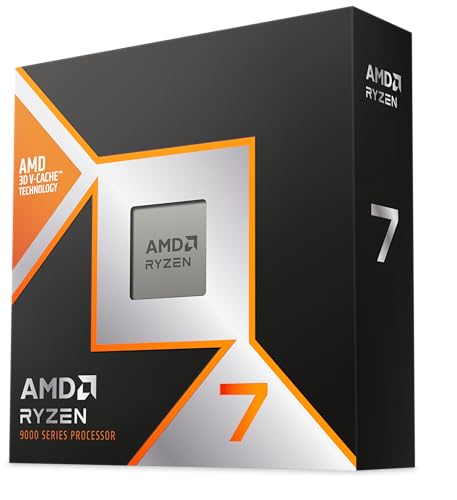

AMD Ryzen 7 9800X3D vs AMD Ryzen 9 9950X at a Glance
| Feature | AMD Ryzen 7 9800X3D | AMD Ryzen 9 9950X |
|---|---|---|
| Processor Series | Ryzen 7 | Ryzen 9 |
| Core Architecture | Zen 5 | Zen 5 |
| Core Count | 8 Cores | 16 Cores |
| Thread Count | 16 Concurrent Threads | 32 Concurrent Threads |
| Base Clock Speed | 4.7 GHz | 4.3 GHz |
| Max Boost Clock | Up to 5.2 GHz | Up to 5.7 GHz |
| L3 / Total Cache | 96MB L3 Cache | 80MB Total Cache |
| Secondary Cache | 8 MB | 16 MB |
| Thermal Rating (TDP) | 140 Watts | 170 Watts |
| Cooling Requirement | External Cooler Required | External Cooler Required (Liquid Cooler Recommended) |
| Supported Platform | Socket AM5 / Windows 11 | Socket AM5 / Windows 11 |
| Best For | High-FPS Competitive Gaming | Heavy Multi-Thread Workstations and Content Creation |
Gaming Performance and 3D V-Cache Architecture
Modern gaming engines place heavy demands on memory subsystems, making cache latency a critical factor in maintaining consistent frame delivery. The Ryzen 7 9800X3D addresses this demand directly through its 96MB L3 Next Gen 3D V-Cache, which keeps massive instruction sets and assets on the processor die rather than forcing frequent trips to system memory. This physical stacked-cache arrangement delivers approximately a 16 percent IPC uplift alongside improved thermal performance compared to prior generations, allowing the 8-core die to sustain boost clocks up to 5.2 GHz during intensive play.
The Ryzen 9 9950X approaches gaming with brute execution power, offering 16 cores, 32 threads, and a higher maximum boost clock of 5.7 GHz. AMD indicates that the 9950X easily delivers ultra-fast 100+ FPS performance in the world’s most popular games. However, when evaluating the amd ryzen 5 9600x vs ryzen 7 9800x3d or looking at the broader product tier, raw clock speed cannot completely offset the latency advantages provided by stacked cache. Games that constantly access physics calculations, complex artificial intelligence, and sprawling draw calls run with higher minimum frame rates when large amounts of cache memory are immediately accessible.
Evaluating the 9800X3D 3D V-Cache vs 9950X for real-world gameplay shows that extra cores beyond eight offer diminishing returns in almost all gaming titles. The Ryzen 9 9950X distributes its 80MB total cache across dual core complexes, which can introduce inter-die latency when game threads migrate. The Ryzen 7 9800X3D confines its 8 cores and 96MB L3 cache to a unified space, eliminating cross-communication penalties and maximizing frame pacing.
Edge: AMD Ryzen 7 9800X3D provides a unified 96MB 3D V-Cache structure that maximizes frame rates and minimizes frame-time drops in gaming.
Multi-Threaded Workloads and Productivity Throughput
In multithreaded productivity software, sheer core count and execution width dictate completion times. The Ryzen 9 9950X dominates this area by providing 16 physical Zen 5 cores and 32 concurrent threads, supported by 16 MB of secondary cache. Workloads such as offline video encoding, batch image transformation, structural simulation, and large-scale code compilation scale linearly with available processing threads. In 9950X vs 9800X3D productivity tasks, the flagship processor operates with double the execution units of its gaming-focused sibling.
The Ryzen 7 9800X3D remains capable for everyday productivity with its 8 cores and 16 threads, but it is constrained by hardware limits when tackling dense computational loads. While its 4.7 GHz base clock is higher than the 4.3 GHz base of the 9950X, having half the thread count creates an unavoidable bottleneck during heavy multitasking. Users comparing the amd ryzen 7 9700x vs ryzen 9 9950x will note that AMD reserves its dual-CCD configurations specifically for tasks where sustained thread throughput matters most.
For users running 9800X3D vs 9950X rendering jobs in ray-tracing engines or CAD modeling platforms, the difference in processing capacity is striking. The Ryzen 9 9950X completes background compute tasks in roughly half the time required by an 8-core CPU, freeing system resources for other operations. The 16MB secondary cache on the 9950X also ensures that data pipelines remain fully fed during sustained calculations.
Edge: AMD Ryzen 9 9950X easily outperforms with 16 cores, 32 threads, and double the multi-threaded compute density.
Clock Speeds and Single-Core Responsiveness
Single-threaded responsiveness affects desktop interactivity, basic operating system navigation, and legacy application performance. The Ryzen 9 9950X takes the lead in peak frequency, offering an unlocked multiplier that enables boost clocks up to 5.7 GHz. This top-end clock ceiling benefits lightly threaded design tools and photo editing software where algorithms execute linearly across one or two cores rather than spanning multiple threads.
The Ryzen 7 9800X3D balances clock speeds differently, operating with a higher base clock of 4.7 GHz and a maximum boost frequency of 5.2 GHz. In previous product cycles, stacked cache forced significant thermal penalties that kept boost frequencies lower. With Zen 5, AMD improved thermal performance on the 9800X3D, allowing higher clock headroom than older designs. As observed in any standard ryzen 7 9800x3d benchmark, the chip holds high frequencies consistently across all 8 cores without aggressive throttling under gaming loads.
When measuring single-core responsiveness across the pair, the 9950X holds a raw frequency advantage of up to 500 MHz. Readers considering alternatives such as the intel core ultra 7 265k vs amd ryzen 7 9800x3d will find that modern Zen 5 instructions per clock (IPC) make both processors exceptionally quick, but the unlocked 5.7 GHz boost on the 9950X delivers maximum headroom for single-core tasks.
Edge: AMD Ryzen 9 9950X reaches a 5.7 GHz maximum boost clock, delivering higher peak single-core speeds.
Power Consumption and Thermal Requirements
Operating efficiency and thermal management directly shape total system setup, power supply selection, and cooler requirements. In evaluating amd 9800x3d vs 9950x power consumption, the two chips sit in separate thermal categories. The Ryzen 7 9800X3D carries a 140-watt rating, reflecting its single-CCD configuration and efficiency optimizations tailored for continuous high-framerate gaming without overwhelming system cooling.
The Ryzen 9 9950X is rated at 170 watts to drive its 16 cores and 32 threads at sustained high clocks. Because of this higher thermal density, AMD specifically notes on the listing that a liquid cooler is recommended for the 9950X, while both processors ship without bundled cooling hardware. Squeezing 16 high-frequency cores into an AM5 package produces dense heat that demands robust radiator surface area and high static-pressure fans to maintain peak boost behavior under load.
Systems built around the 9800X3D are noticeably simpler to integrate into small form factor enclosures or air-cooled chassis. While buyers exploring an amd ryzen 7 9800x3d vs ryzen 9 9900x build also encounter varied wattage ratings, the 9800X3D operates cleanly inside standard mid-tower setups with modest airflow, whereas the 170W draw of the 9950X demands serious thermal planning.
Edge: AMD Ryzen 7 9800X3D operates within a lower 140W thermal rating that is easier to cool.
Platform Compatibility and Memory Support
Both the Ryzen 7 9800X3D and the Ryzen 9 9950X utilize AMD’s Socket AM5 infrastructure, ensuring widespread motherboard compatibility across modern chipsets. Both chips are designed for Windows 11 and use Zen 5 architecture. The Ryzen 9 9950X listing highlights native DDR5-5600 memory support as well as PCIe 5.0 expansion lanes on select motherboards, allowing users to pair the processor with next-generation storage drives and graphics cards.
The 9800X3D shares the drop-in ready AM5 design, offering the same interface flexibility. The primary functional distinction lies in how the memory subsystem interacts with each processor’s cache. Because the 9800X3D features 96MB of L3 cache directly adjacent to its cores, system memory latency has a smaller negative impact on gaming frame rates than it does on standard desktop processors. On the 9950X, high-bandwidth DDR5 memory is critical to feed data into its 80MB total cache and 16 cores.
When considering platform life cycles, such as the comparisons outlined in amd ryzen 9 9950x vs 9950x3d, Socket AM5 provides a unified upgrade path for both models. Neither processor includes a cooler, meaning motherboard choice and power delivery must be tailored to the respective 140W or 170W draw.
Edge: Tie. Both processors provide drop-in Socket AM5 integration, Windows 11 platform support, and modern memory features.
Pros and Cons
AMD Ryzen 7 9800X3D

Pros
- 96MB L3 Next Gen 3D V-Cache
- Higher 4.7 GHz base clock speed
- Lower 140W thermal power rating
- Up to 16% IPC architectural uplift
Cons
- Limited to 8 cores and 16 threads
- Lower 5.2 GHz maximum boost speed
- No bundled CPU cooling solution
View AMD Ryzen 7 9800X3D on Amazon
AMD Ryzen 9 9950X

Pros
- 16 cores and 32 processing threads
- High 5.7 GHz maximum boost clock
- Unlocked multiplier for user overclocking
- Native DDR5-5600 memory speed support
Cons
- Higher 170W thermal power requirement
- Liquid cooler recommended by listing
- Lower 4.3 GHz base clock speed
View AMD Ryzen 9 9950X on Amazon
Who Should Buy Each One
Choose the AMD Ryzen 7 9800X3D If
- Your primary desktop objective is competitive or high-refresh gaming where 96MB L3 3D V-Cache maximizes frames.
- You prefer a lower 140-watt power ceiling that remains manageable with standard cooling solutions.
- You want a high 4.7 GHz base clock across 8 cores dedicated entirely to active runtime execution.
- You want high-tier gaming capability without the heat output of a 16-core workstation chip.
Choose the AMD Ryzen 9 9950X If
- Your daily computer use centers on 3D rendering, video encoding, code compiling, or intensive multitasking.
- You need 16 cores and 32 processing threads to reduce project render times.
- You require a maximum boost clock of 5.7 GHz with an unlocked multiplier for overclocking flexibility.
- You have a dedicated liquid cooling setup capable of handling a 170-watt thermal rating.
Final Verdict
Choosing between the Ryzen 7 9800X3D and the Ryzen 9 9950X requires identifying whether your system exists primarily for play or professional production. The Ryzen 7 9800X3D is purpose-built to maximize gaming throughput. Its 96MB of Next Gen 3D V-Cache, combined with an elevated 4.7 GHz base speed and 140-watt operating target, provides low latency and outstanding frame-rate stability. For users who primarily play games and run standard background applications, the 9800X3D delivers the most refined gaming architecture available on Socket AM5, as highlighted throughout our amd ryzen 7 9800x3d review analysis.
Conversely, the Ryzen 9 9950X stands as the definitive choice when time spent waiting on rendering bars, code builds, or video exports impacts productivity. While asking if the ryzen 9 9950x is worth it depends on your workload, users running heavy production pipelines will immediately benefit from 16 Zen 5 cores, 32 threads, and a 5.7 GHz max boost clock. If your workstation generates income through compute-heavy applications, the 9950X is the superior investment; if your PC is built for gaming performance, select the 9800X3D. For prospective buyers weighing future multi-die cache options, evaluating the amd ryzen 7 9800x3d vs ryzen 9 9950x3d comparison provides additional perspective.
FAQ
Which CPU is better: Ryzen 7 9800X3D or Ryzen 9 9950X for gaming?
The Ryzen 7 9800X3D is the superior processor for gaming. Its 96MB L3 Next Gen 3D V-Cache sits directly on the core die, drastically reducing latency and providing higher average and 1% low frame rates in modern titles compared to standard core layouts.
Is the Ryzen 9 9950X worth it for non-gaming workloads?
Yes, the Ryzen 9 9950X is worth it for creators, engineers, and power users who execute intensive multi-threaded workloads. With 16 cores and 32 threads running up to 5.7 GHz, it halves completion times in heavy rendering, compression, and compilation tasks compared to 8-core alternatives.
Does either processor include a CPU cooler in the box?
Neither processor includes a CPU cooler. The Ryzen 7 9800X3D requires an external cooler suited for its 140-watt rating, while the Ryzen 9 9950X specifically recommends a liquid cooler on its product listing to handle its 170-watt output.
What socket do the 9800X3D and 9950X use?
Both processors use AMD Socket AM5. They are drop-in compatible with AM5 motherboards and run on the Windows 11 platform.
Can the Ryzen 9 9950X and Ryzen 7 9800X3D be overclocked?
The Ryzen 9 9950X listing explicitly confirms it is unlocked for overclocking, reaching boost frequencies up to 5.7 GHz. The 9800X3D features next-generation cache thermal improvements that allow clock speeds up to 5.2 GHz.
How do the cache configurations differ between the two chips?
The Ryzen 7 9800X3D features 96MB of L3 cache leveraging Next Gen 3D V-Cache along with 8MB of secondary cache. The Ryzen 9 9950X features 80MB of total cache alongside 16MB of secondary cache distributed across its 16 cores.