Selecting the right power supply hinges on calculating your hardware’s total continuous draw against sudden component spikes, and the decisive primary divider between these two units is total wattage output. While both power supplies share identical ATX 3.1 standards, Cybenetics Gold efficiency, and modular styling, the 250-watt gap determines whether your rig has baseline stability or substantial headroom for next-generation hardware.
Mainstream builders operating modern mid-range hardware should select the Corsair RM750x for its lighter frame and well-balanced power envelope. High-performance enthusiasts powering top-tier graphics cards with heavy transient loads should invest in the Corsair RM1000x to guarantee peak system stability.
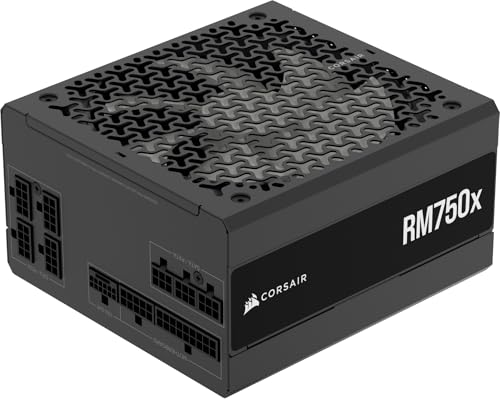

Corsair RM750x vs RM1000x at a Glance
| Feature | Corsair RM750x | Corsair RM1000x |
|---|---|---|
| Continuous Output Wattage | 750 Watts | 1000 Watts |
| ATX Specification | ATX 3.1 Compliant | ATX 3.1 Compliant |
| PCIe Standard | PCIe 5.1 Support | PCIe 5.1 Support |
| Efficiency Rating | Cybenetics Gold (Up to 91%) | Cybenetics Gold (Up to 91%) |
| Dedicated GPU Connector | Native 12V-2×6 Connector | Native 12V-2×6 Connector |
| Internal Capacitors | 100% Japanese 105°C Electrolytic | 100% Japanese 105°C Electrolytic |
| Cooling Hardware | 140mm FDB Fan | 140mm FDB Fan |
| Input Voltage Range | 110V – 264V AC | 120V AC |
| Unit Weight | 3.9 lbs | 6.9 lbs |
| Best For | Mainstream and upper mid-tier gaming PCs | Enthusiast builds with high-draw GPUs |
Continuous Output Wattage and Transient Load Headroom
A power supply must not only satisfy the steady-state electrical draw of a processor and graphics card, but also absorb the sudden power spikes common in modern gaming architectures. In an evaluation of RM750x vs RM1000x wattage capabilities, the fundamental difference comes down to 750 watts versus 1000 watts of continuous delivery. Both units are ATX 3.1 compliant, meaning they are engineered to resist transient power spikes per Intel specifications, but their absolute thresholds differ dramatically under extreme load conditions.
When assembling high-end gaming hardware, modern components can double their nominal draw for microsecond bursts. The RM750x delivers reliable performance when matched with standard desktop processors and upper-tier single GPUs, but it leaves limited overhead for intensive workstation tasks or multi-rail expansions. In contrast, running the larger capacity model mirrors the advantages seen when contrasting the corsair rm850x vs rm1000x, where an extra buffer keeps total system consumption sitting comfortably below the unit’s maximum ceiling.
Deciding if an upgrade is necessary depends on your exact component configuration. When considering whether is RM1000x worth it, builders pairing top-tier processors with high-draw graphics cards will appreciate having an extra 250 watts of ceiling. Operating closer to the halfway point of an internal wattage limit promotes cooler operation and leaves room for hardware upgrades down the road without triggering over-power protections.
Edge: Corsair RM1000x provides 250 additional watts of sustained power delivery and significantly higher transient spike absorption headroom.
Power Conversion Efficiency and Capacitor Quality
Efficiency standards govern how effectively an internal power supply converts alternating wall current into smooth direct current for sensitive silicone components. Both of these RMx series models hold Cybenetics Gold certification, guaranteeing up to 91% operational efficiency under typical loads. Higher efficiency directly translates into reduced waste heat, minimized overall power consumption, and lower acoustic turbulence within your chassis.
Any thorough Corsair RM750x review must highlight that Corsair equips this platform with 100% Japanese 105°C-rated electrolytic capacitors. These premium components ensure tight voltage regulation and clean ripple suppression even when ambient case temperatures rise during prolonged gaming marathons. The identical capacitor standard is mirrored in the Corsair RM1000x review specs, providing the exact same electrical durability and ten-year operational lifespan across both output tiers.
While the conversion efficiency percentage is technically identical at up to 91%, how a PC interacts with the efficiency curve changes with total capacity. A mid-range PC pulling 450 watts draws roughly 60% of the RM750x capacity, placing it squarely in an optimal efficiency window. That exact same 450-watt load draws less than half of the RM1000x output, matching the conversion characteristics seen in class leaders like the corsair rm1000x vs seasonic vertex gx-1000. Nevertheless, on pure electrical specifications and manufacturing components, neither model holds an architectural advantage over the other.
Edge: Tie. Both models utilize identical 100% Japanese 105°C electrolytic capacitors and achieve identical Cybenetics Gold efficiency up to 91%.
Acoustic Output and Thermal Regulation
Operating sound is a critical consideration for enthusiast PC builders, and comparing the RM750x vs RM1000x noise level reveals how component headroom directly influences fan behavior. Both units feature a single 140mm fluid dynamic bearing (FDB) cooling fan designed for low-noise performance and long service life. The FDB design reduces mechanical friction inside the motor assembly, preventing the grinding or ticking sounds that can develop over time in lower-tier sleeve-bearing alternatives.
Thermal management relies on air cooling directed across internal heat sinks, and the workload demanded of the cooling fan correlates with how hard the internal circuitry is pushed. When asking whether to pick the Corsair RM750x or RM1000x for gaming, thermal dissipation becomes an operational factor. Under an identical 500-watt gaming load, the RM750x works at two-thirds of its rated output, dissipating heat through continuous airflow similar to what users experience when comparing the corsair rm750x vs seasonic focus gx-750.
The RM1000x handles that exact same 500-watt draw at precisely half of its rated limit. Because the internal components experience less relative strain, the 140mm fan can rotate at lower speeds while maintaining target temperatures within the casing. For users who prioritize silent desktop operation while gaming, the higher-capacity unit maintains a quieter thermal profile simply because it operates further below its maximum thermal threshold.
Edge: Corsair RM1000x runs cooler and quieter under identical gaming workloads due to operating at a lower total percentage of its capacity.
Cabling Integration and Native PCIe 5.1 Connectivity
Managing power delivery cables inside a modern chassis can be challenging, but both power supplies utilize a fully modular layout. Modular design allows you to connect only the specific cables your build requires, eliminating unused harnesses that would otherwise obstruct internal airflow. Both models come supplied with Corsair’s embossed cabling package paired with low-profile cable combs, making routing neat and visually striking.
Modern graphics cards demand robust power interfaces, and the presence of a native 12V-2×6 connector on both models is a critical feature. This PCIe 5.1 compliant connector provides a direct, uninterrupted cable line from the power supply directly into the graphics card without needing clunky multi-plug splitters or third-party adapters. In comparisons such as the corsair rm1000x vs be quiet! pure power 12 m 850w, having this native high-power terminal built into the main backplane streamlines assembly significantly.
When checking connectivity options between the Corsair RM1000x vs RM750x, the general physical interface remains standard ATX. The RM750x listing specifies a connector quantity of 2, while the RM1000x listing does not specify its exact terminal count. However, both units provide the full complement of modular leads necessary to drive modern motherboards, storage arrays, and high-performance PCIe peripherals using identical high-flexibility embossed wiring.
Edge: Tie. Both power supplies feature identical fully modular layouts, native 12V-2×6 connectors, and flexible embossed cables with low-profile combs.
Dimensions, Build Weight, and Input Voltage
Chassis integration and electrical compatibility represent notable variations between these two hardware options. Examining the Corsair RM750x vs RM1000x specs, both units share identical external dimensions according to the manufacturer data, measuring 2.3 x 3.39 x 5.91 inches in standard ATX form factor. This compact footprint ensures effortless clearance inside standard mid-tower and full-tower PC cases without encroaching on drive cages or lower cable management channels.
Despite their identical external shell measurements, there is a pronounced RM750x vs RM1000x difference in total physical mass. The RM750x weighs in at a modest 3.9 pounds, making it easier to handle during installation and ideal for builders who frequently move their systems, matching the lightweight appeal explored in our corsair rm1000x vs sf750 analysis. The RM1000x scales significantly heavier at 6.9 pounds, reflecting the denser internal heatsinks, heavier copper traces, and beefier electrical transformers required to sustain 1000 watts.
Input voltage specifications also show clear divergence in the published product listings. The RM750x supports a wide-range input tolerance from 110 volts up to 264 volts of alternating current, allowing it to adapt effortlessly to varying wall voltages and international power grids. The RM1000x listing specifies input strictly at 120 volts AC. For builders needing a lighter unit with documented wide-range AC flexibility, the smaller unit takes the lead.
Edge: Corsair RM750x provides a three-pound lighter frame and documented wide-voltage support ranging from 110V to 264V AC.
Pros and Cons
Corsair RM750x

Pros
- Lightweight 3.9 lb chassis
- Full ATX 3.1 and PCIe 5.1 compliance
- Native 12V-2×6 connector included
- Cybenetics Gold efficiency up to 91%
- Wide 110V to 264V AC input support
Cons
- 750W limit leaves less headroom for flagship GPUs
- Listing specifies only 2 connectors
Corsair RM1000x

Pros
- 1000W continuous output capacity
- ATX 3.1 transient spike resistance
- Native direct 12V-2×6 connection
- Cybenetics Gold up to 91% efficiency
- 100% Japanese 105°C-rated capacitors
Cons
- Heavier 6.9 lb chassis weight
- Listing specifies only 120V AC input voltage
View Corsair RM1000x on Amazon
Who Should Buy Each One
Choose the Corsair RM750x If
- You are assembling a mid-tier to high-end PC with a single mainstream graphics card.
- You plan to install the unit in a system that requires a lighter 3.9-pound overall mass.
- You need wide input voltage flexibility rated across 110V to 264V AC lines.
- Your estimated peak hardware power draw remains comfortably beneath 600 watts.
Choose the Corsair RM1000x If
- You are running a flagship graphics card prone to sharp, aggressive transient power spikes.
- You want a power supply that operates in lower, quieter fan speed bands during intense gaming.
- You want 1000 watts of sustained continuous output to ensure future component upgrade headroom.
- You run heavy multi-threaded workstation processing loads alongside gaming tasks.
Final Verdict
For the vast majority of PC builders assembling standard single-GPU gaming systems, the Corsair RM750x is the most practical choice. It delivers the complete modern feature set including ATX 3.1 transient resistance, PCIe 5.1 support, a native 12V-2×6 connector, Cybenetics Gold efficiency, and Japanese 105°C capacitors. With a lighter 3.9-pound frame and wide-range 110V to 264V AC input support, it covers every essential requirement for mainstream rigs with dependable stability.
The Corsair RM1000x becomes the clear winner when your hardware configuration pushes into enthusiast territory. If you are pairing high-wattage desktop processors with top-tier GPUs that demand substantial continuous power and generate violent transient spikes, the additional 250-watt overhead is essential. The heavier internal hardware of the RM1000x ensures your components operate with pristine stability and lower relative acoustic noise when running at high capacities.
FAQ
Can the Corsair RM750x handle transient power spikes from high-end graphics cards?
Yes. The Corsair RM750x is fully compliant with the ATX 3.1 power standard from Intel. This specification mandates strict compliance with PCIe 5.1 requirements, ensuring the unit is internally engineered to absorb sharp microsecond transient spikes without tripping shutdown protections.
Is the Corsair RM1000x worth it for a standard gaming build?
The RM1000x provides valuable overhead if you plan to upgrade to top-tier components later or want the power supply to operate at lower fan speeds under load. However, for standard single-GPU systems that draw 400 to 500 watts, the 750-watt model provides ample capacity without excess unused headroom.
Do both power supplies include a native 12V-2×6 GPU cable?
Yes. Both the RM750x and RM1000x include a native 12V-2×6 connector on their modular backplanes. This enables a direct connection from the power supply to modern graphics cards, eliminating the need for bulky multi-connector adapters.
How does the RM750x vs RM1000x noise level compare under normal desktop loads?
Both power supplies utilize a 140mm fluid dynamic bearing (FDB) fan engineered for quiet operation. However, because the RM1000x has a higher total capacity, a mid-range system load represents a smaller percentage of its maximum output, allowing it to maintain lower fan speeds and quieter acoustics under sustained loads.
What is the primary RM750x vs RM1000x difference in daily operation?
The primary divider is continuous output capacity: 750 watts on the RM750x versus 1000 watts on the RM1000x. While both feature Cybenetics Gold efficiency and modular embossed cabling, the 1000W model provides an extra 250 watts of headroom for demanding components and weighs three pounds more.
Can the RM1000x operate on international voltage standards above 120V?
The product listing for the RM1000x specifically lists its minimum and maximum input voltage at 120 volts AC. In contrast, the RM750x listing explicitly confirms a wide-range input capability spanning from 110 volts up to 264 volts AC.
Are both models covered by the same manufacturer warranty?
Yes. According to the manufacturer descriptions, both the Corsair RM750x and the Corsair RM1000x are backed by a ten-year warranty, reflecting the durability of their 100% Japanese 105°C-rated electrolytic capacitors and Cybenetics Gold electrical designs.


