When selecting a power supply for a high-performance computer, deciding between an 850-watt unit and a 1000-watt unit hinges almost entirely on total system wattage capacity and transient headroom. While both units share modern platform architecture including Cybenetics Gold efficiency, full modularity, and native 12V-2×6 PCIe 5.1 cabling, the rm850x vs rm1000x wattage difference determines how comfortably your system handles simultaneous CPU and GPU loads during demanding workloads.
Choose the Corsair RM850x if you are powering a mainstream to upper-tier gaming rig running a single graphics card and prefer a lighter, versatile power supply. Choose the Corsair RM1000x if you are assembling an elite gaming or workstation PC with sustained high power requirements, overclocked processors, or multi-component configurations that demand massive electrical headroom.
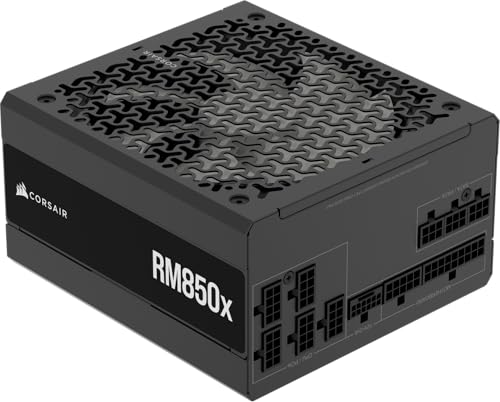

Corsair RM850x vs Corsair RM1000x at a Glance
| Specification | Corsair RM850x | Corsair RM1000x |
|---|---|---|
| Continuous Output Wattage | 850 watts | 1000 watts |
| Efficiency Rating | Cybenetics Gold (up to 91%) | Cybenetics Gold (up to 91%) |
| Power Standard Compliance | ATX 3.1 and PCIe 5.1 | ATX 3.1 and PCIe 5.1 |
| GPU Power Connector | Native 12V-2×6 connector | Native 12V-2×6 connector |
| Capacitor Specifications | 100% Japanese 105°C-rated electrolytic | 100% Japanese 105°C-rated electrolytic |
| Cooling Fan Size and Type | 140mm Fluid Dynamic Bearing (FDB) | 140mm Fluid Dynamic Bearing (FDB) |
| Cable Construction | Fully modular embossed cables with low-profile combs | Fully modular embossed cables with low-profile combs |
| Listed Input Voltage | 100V to 240V AC | 120V AC |
| Chassis Listed Weight | 3.9 pounds | 6.9 pounds |
| Chassis Listed Dimensions | 2.3 x 3.39 x 5.91 inches | 2.3 x 3.39 x 5.91 inches |
| Best For | Single-GPU enthusiast gaming setups | Heavily loaded or overclocked flagship rigs |
Wattage Capacity and System Headroom
Total continuous wattage is the primary technical distinction in this comparison, dictating the maximum sustained power the unit can deliver safely without triggering overload protections. A power supply operating at 850 watts satisfies the operational envelope of the vast majority of gaming hardware, accommodating modern performance processors alongside mid-to-high-tier discrete graphics cards. However, running power-hungry hardware under full computational load pulls a notable percentage of an 850-watt ceiling, leaving less buffer for sudden transient spikes or future hardware expansions. If you have weighed smaller configurations, such as in our corsair rm750x vs rm1000x analysis, you already know that moving up the wattage scale is fundamentally about headroom.
The RM1000x raises total continuous output to 1000 watts, providing a 150-watt buffer over the RM850x. In any direct corsair rm1000x vs rm850x comparison, this extra headroom provides meaningful security when pairing high-TDP components like flagship desktop processors with top-tier GPUs. Power supplies also deliver their highest electrical efficiency and lowest relative heat output when loaded near 50 percent of their rated capacity. Because the 1000W model places that sweet spot at 500 watts compared to 425 watts on the 850W model, systems that consistently draw between 450 and 600 watts during intensive gaming will operate much closer to optimal thermal and electrical operating points on the larger unit.
Choosing between these capacities is therefore a balance between exact requirements and anticipated expansion. Builders looking to assemble a balanced gaming PC without pushing component power limits find ample capability in the 850-watt tier. Conversely, power users running sustained multi-threaded rendering tasks, extensive storage arrays, or demanding open-loop liquid cooling setups benefit directly from the reserve capacity offered by the 1000-watt variant.
Edge: Corsair RM1000x, because its 1000-watt continuous output provides a larger 150-watt power ceiling for demanding components and future upgrades.
GPU Compatibility and High-End Transient Handling
Modern graphics cards introduce massive, instantaneous power spikes known as transient excursions that can momentarily double normal board power draw. Both the RM850x and RM1000x are built to Intel’s ATX 3.1 standard and support PCIe 5.1, meaning both units are engineered specifically to absorb these rapid spikes without shutting down. Furthermore, each unit includes a dedicated native 12V-2×6 connector, allowing a direct connection from the power supply directly to modern GPUs without the need for bulky adapter splitters. This simplifies cable routing and prevents poor pin contacts that plagued older 12VHPWR adapters.
When considering rm850x or rm1000x for rtx 4090 builds, overall power draw becomes the deciding factor rather than connector availability. While an 850W power supply satisfies basic manufacturer recommendations for stock RTX 4090 configurations running alongside standard consumer CPUs, pairing that card with an unlocked, high-wattage desktop processor pushes the total draw very close to the 850W limit under simultaneous synthetic stress tests. The RM1000x eliminates this anxiety entirely, accommodating sustained 450W to 600W GPU power limits while effortlessly providing the remaining 400W to 550W for the rest of the build. Readers weighing flagship capacities often evaluate the corsair rm850x vs seasonic vertex gx-1000 when balancing brand ecosystems against peak capacity.
The difference between the two models in GPU support is therefore not connector compatibility-since both share the identical native 12V-2×6 standard-but the electrical reserve available to sustain flagship graphics cards under heavy sustained workloads. The RM850x handles cards up to the RTX 4080 Super class with plenty of room to spare, while the RM1000x is the definitive choice for unconstrained top-tier cards and heavily overclocked hardware.
Edge: Corsair RM1000x, because its higher capacity absorbs the extreme sustained power draw and transient loads of flagship GPUs with greater stability.
Acoustic Profile and Fan Operation
Operational noise in modern power supplies is intimately linked to electrical efficiency and internal component temperatures. When evaluating corsair rm850x vs rm1000x noise, both models rely on an identical internal cooling design featuring a 140mm Fluid Dynamic Bearing (FDB) fan. Fluid dynamic bearings minimize mechanical friction, ensuring quiet operation and a long operational lifespan. Both units also utilize 100% Japanese 105°C-rated electrolytic capacitors, which withstand substantial thermal stress without degrading electrical performance, allowing the fan curves to prioritize quiet operation during low to moderate workloads.
Because fan curves in the RMx series scale according to load percentage and internal temperatures, the corsair rm1000x vs rm850x acoustic experience diverges under real-world loads. In an identical system drawing 450 watts during a demanding game, the RM850x operates at approximately 53 percent load, whereas the RM1000x operates at just 45 percent load. Consequently, the RM1000x maintains a slower fan RPM profile under equivalent medium-to-high wattage conditions because it is working further away from its maximum rated capacity. Those looking at compact alternatives might check our corsair rm1000x vs sf750 breakdown to see how fan size dictates sound profiles, but between these two ATX units, larger capacity translates to quieter operation at identical wattages.
For general computing tasks, media streaming, and low-intensity gaming, both power supplies operate virtually silently. However, if your setup regularly pulls between 400W and 600W and low system acoustics are your top priority, the higher capacity of the RM1000x keeps the cooling fan spinning at lower, less perceptible speeds during intensive computing sessions.
Edge: Corsair RM1000x, because running identical system loads at a lower relative percentage allows its 140mm fan to operate at lower RPMs.
Efficiency Ratings and Power Consumption
Energy efficiency determines how much wall power a unit draws to deliver a given amount of wattage to internal components, with unutilized energy dissipating as waste heat. In this corsair rm850x vs rm1000x specs matchup, both power supplies earn Cybenetics Gold certification, reaching up to 91% electrical efficiency. This high efficiency standard ensures that rm850x vs rm1000x power consumption remains tightly controlled across various operating environments, keeping operating temperatures low while protecting internal circuitry from thermal degradation.
Because both power supplies share the Cybenetics Gold standard and identical premium component architecture, neither unit has an inherent architectural advantage in conversion efficiency. When running identical low-load tasks-such as web browsing or desktop idling where system draw is under 100 watts-the RM850x will technically operate slightly closer to its optimal efficiency band because 80 watts represents nearly 10 percent of its total load compared to just 8 percent on the 1000-watt model. Efficiency curves typically dip when load drops below 10 percent, giving the 850W model a slight edge in idle efficiency.
Conversely, during peak gaming or rendering sessions where total system consumption climbs toward 500 or 600 watts, the RM1000x settles comfortably into its peak 50 percent efficiency sweet spot. This makes the question of is corsair rm1000x worth it depend primarily on your daily usage profile: workstations running heavy sustained compute tasks maximize efficiency on the 1000-watt model, while typical gaming rigs that spend significant hours idling or doing light desktop work gain slight advantages with the 850-watt unit.
Edge: Tie, because both models share Cybenetics Gold certification delivering up to 91% efficiency, trading minor efficiency advantages at low versus high loads.
Electrical Input and Regional Compatibility
Power supply specifications also dictate the electrical input characteristics each unit can accept from wall outlets, which impacts regional flexibility. The Corsair RM850x is rated for an input voltage range of 100V to 240V alternating current (AC). This universal full-range input allows the RM850x to function seamlessly on standard 120V North American power grids as well as 230V European and international power mains without requiring external voltage transformers or specialized wiring.
In contrast, the product specifications for the Corsair RM1000x list an input voltage of 120V AC, with both minimum and maximum input ratings documented at 120 volts. For users operating on standard North American residential circuits, this specification aligns directly with household outlet standards. However, international users or builders who relocate between countries with varying mains voltages face a distinct limitation according to the listed specifications, as the RM850x officially documents compatibility across the wider 100V to 240V spectrum.
For builders operating strictly on 120V circuits, this technical difference will not impact daily operation. However, in terms of sheer hardware versatility and electrical flexibility across various global electrical grids, the broader voltage specification of the RM850x makes it an easier choice for international applications or fluctuating utility mains. Other models like those in our corsair rm1000x vs seasonic focus gx-750 review also highlight input versatility as an important baseline spec.
Edge: Corsair RM850x, because its documented 100V to 240V input range provides broader electrical compatibility than the 120V-only listing of the RM1000x.
Weight, Form Factor, and Cable Management
Chassis dimensions and cable construction dictate how smoothly a power supply fits inside a PC case and how easily cables can be routed behind the motherboard tray. According to their technical specifications, both models share identical listed dimensions of 2.3 x 3.39 x 5.91 inches and standard ATX form factor classifications. Furthermore, both units utilize fully modular designs equipped with Corsair’s embossed cables featuring low-profile combs. These embossed cables are flexible and eliminate unnecessary clutter, ensuring you only install the exact leads your configuration requires.
Where the two units diverge considerably is physical weight. The RM850x weighs 3.9 pounds, whereas the RM1000x weighs in at 6.9 pounds according to the product specifications. A 3-pound difference represents substantial internal mass variations, reflecting larger internal heat sinks, heavier magnetics, or denser electrical component shielding required to support sustained 1000-watt throughput. In compact mid-tower builds or portable desktop enclosures, shaving three pounds off the total system weight simplifies transport and handling.
While cable management remains identical across both models thanks to the flexible embossed cables and integrated low-profile combs, the lighter chassis of the 850W model offers an ergonomic advantage during installation. Handling and securing a 3.9-pound unit inside a cramped chassis requires less physical maneuvering than securing a 6.9-pound unit. For builders interested in how other 850W platforms compare, our corsair rm1000x vs be quiet! pure power 12 m 850w article provides further context on physical footprints.
Edge: Corsair RM850x, because it delivers identical modular cabling and compact dimensions with a significantly lighter 3.9-pound chassis.
Pros and Cons
Corsair RM850x

Pros
- 850W continuous power output
- Cybenetics Gold efficiency up to 91%
- Lighter 3.9-pound chassis
- Universal 100V to 240V input range
- Native 12V-2×6 ATX 3.1 connector
Cons
- Lower headroom for extreme GPU spikes
- Higher fan RPM under heavy loads
Corsair RM1000x

Pros
- 1000W massive continuous output
- Exceptional headroom for flagship GPUs
- Cybenetics Gold efficiency up to 91%
- Native 12V-2×6 ATX 3.1 connector
- 100% Japanese 105°C capacitors
Cons
- Heavier 6.9-pound chassis weight
- Narrower 120V-only listed input voltage
View Corsair RM1000x on Amazon
Who Should Buy Each One
Choose the Corsair RM850x If
- You are running a mainstream enthusiast gaming build centered on graphics cards up to the RTX 4080 class.
- You require a wide 100V to 240V AC input voltage range for international mains or fluctuating electrical grids.
- You prefer a lighter power supply that keeps total system weight low for easier transport and assembly.
- You want high Cybenetics Gold efficiency optimized for typical gaming and desktop idle loads.
Choose the Corsair RM1000x If
- You are building a high-end system with top-tier components like an RTX 4090 or power-hungry workstation CPUs.
- You plan to overclock your processor and GPU, necessitating extra electrical headroom above 850 watts.
- You want lower fan noise under sustained 400W to 600W loads by running the power supply near its 50 percent sweet spot.
- You operate on standard 120V AC household power and require maximum continuous output capacity.
Final Verdict
For the majority of PC builders and dedicated gamers, the Corsair RM850x is the most practical choice. It provides 850 watts of clean continuous power, ATX 3.1 transient resistance, a native 12V-2×6 connector for modern graphics cards, and premium Japanese 105°C capacitors. Backed by Cybenetics Gold efficiency and flexible embossed cables, it effortlessly powers modern single-GPU rigs while maintaining a lighter chassis weight and versatile 100V to 240V input compatibility. In any practical corsair rm850x review assessment, 850 watts remains the ideal balance of capacity and usability for contemporary gaming hardware.
The Corsair RM1000x takes the lead when assembling extreme setups where power consumption regularly surges into enthusiast territory. If you are pairing high-draw flagship graphics cards with unlocked multi-core CPUs, running extensive liquid cooling hardware, or seeking whisper-quiet operation during 500-watt gaming loads, the additional 150 watts of continuous capacity is indispensable. A thorough corsair rm1000x review shows that while it carries a heavier chassis and a narrower listed voltage specification, its massive headroom and thermal stability make it the premier choice for uncompromising powerhouse PCs.
FAQ
Do both power supplies include a native 12V-2×6 connector?
Yes, both the Corsair RM850x and Corsair RM1000x feature native 12V-2×6 connectors on the power supply, compliant with ATX 3.1 and PCIe 5.1 standards. This allows you to connect modern high-end graphics cards directly using a single cable without relying on third-party adapters or multiple 8-pin splitters.
Can the Corsair RM850x comfortably power an RTX 4090?
The RM850x can power an RTX 4090 in standard gaming configurations when paired with a typical consumer processor operating at stock power limits. However, if you run unlocked power limits, heavy CPU workloads simultaneously, or plan on extreme overclocking, stepping up to the RM1000x provides safer operating headroom to absorb large transient power spikes.
What is the difference in cable quality between these two models?
There is no difference in cable design between the two units. Both models come equipped with Corsair’s fully modular embossed cables featuring low-profile combs, designed to offer high flexibility, clean cable routing, and simplified installation inside standard PC cases.
Are both units certified for Cybenetics Gold efficiency?
Yes, both the RM850x and RM1000x hold Cybenetics Gold certifications. This rating indicates up to 91% electrical efficiency under standard operating conditions, which minimizes energy waste, reduces heat generation inside the chassis, and keeps operational noise low.
What cooling fan is installed in each unit?
Both models use a 140mm Fluid Dynamic Bearing (FDB) cooling fan designed for low-noise performance and long mechanical life. The fan speed curve is thermally controlled, operating at lower RPMs during light to moderate system utilization.
Why does the Corsair RM1000x weigh more than the RM850x?
The RM1000x weighs 6.9 pounds compared to the 3.9-pound weight of the RM850x according to the product specifications. The heavier weight of the 1000W model is due to the larger internal heat sinks, heavier magnetic transformers, and denser electrical components required to safely deliver continuous 1000-watt loads.
What warranty coverage does Corsair provide for these power supplies?
Corsair provides a ten-year warranty for both the RM850x and the RM1000x. Both units feature 100% Japanese 105°C-rated electrolytic capacitors engineered for extended reliability and stable long-term power delivery.


