The choice between the Asus ROG Swift PG32UQX and the Samsung Odyssey Neo G7 32 hinges on panel design, screen geometry, and hardware processing: the Asus delivers a distortion-free flat IPS display backed by a dedicated NVIDIA G-SYNC Ultimate hardware module and factory color calibration, while the Samsung offers an aggressive 1000R curved display built around a 165Hz refresh rate, 1ms response time, and deep contrast.
Choose the Asus ROG Swift PG32UQX if you demand reference-grade color fidelity, flat geometry for professional editing workflows, and hardware-level synchronization. Choose the Samsung Odyssey Neo G7 32 if you want wraparound gaming immersion, a higher refresh rate, and deep black levels for fast-paced action.


Asus ROG Swift PG32UQX vs Samsung Odyssey Neo G7 32 at a Glance
| Feature | Asus ROG Swift PG32UQX | Samsung Odyssey Neo G7 32 |
|---|---|---|
| Screen Size and Curvature | 32 inches, Flat | 32 inches, 1000R Curved |
| Native Resolution | 4K UHD (3840 x 2160) | 4K UHD (3840 x 2160) |
| Display and Backlight Tech | Mini-LED IPS, Quantum Dot | Quantum Matrix, Quantum Mini-LED LCD |
| Refresh Rate | 144 Hz | 165 Hz |
| Pixel Response Time | The listing does not specify | 1ms (GTG) |
| Local Dimming Zones | 1,152 FALD zones | 1,196 zones |
| Peak Brightness & HDR | 1400 nits, DisplayHDR 1400 | 2000 nits, Quantum HDR 2000 |
| Variable Refresh Sync | NVIDIA G-SYNC ULTIMATE | NVIDIA G-Sync Compatible, AMD FreeSync Premium Pro |
| Color Accuracy & Depth | DCI-P3 98%, True 10-bit, Calibration report | 12-bit black levels (Gamut not listed) |
| Physical Extras | LiveDash OLED front deco bar, pouch, tripod screw | CoreSync lighting, Ultrawide Game View (21:9) |
| Best For | Color grading, visual fidelity, flat HDR gaming | High-speed competitive play, curved immersion |
Panel Architecture and Screen Curvature
The structural design of the display panel represents the most immediate functional difference between these two flagship monitors. The PG32UQX utilizes a flat IPS panel that preserves exact geometric straightness across its entire 32-inch surface. In creative production, 3D modeling, photo retouching, and architectural rendering, straight horizontal and vertical lines must render true without optical distortion. The flat layout ensures that visual elements maintain predictable proportions from edge to edge, which is essential for creative tasks and general desktop productivity.
By comparison, the Odyssey Neo G7 features an intense 1000R curved panel intended to match the natural peripheral arc of human vision. This deep radius pulls the outer edges of the 32-inch screen closer to your eyes, creating a panoramic wraparound effect that enhances spatial immersion in flight simulators, racing titles, and open-world adventures. When assessing the samsung odyssey neo g7 32 vs lg 27up850, screen curvature fundamentally shifts the monitor’s intended environment from static precision to sensory enclosure. While both panels claim wide 178-degree viewing angles, the 1000R curve bends straight gridlines, which can prove distracting during spreadsheet work or digital design.
Surface treatments also diverge in the specification sheets. Asus equips the PG32UQX with a matte anti-glare finish designed to diffuse ambient room lighting without muting colors. Samsung lists a glossy screen finish in its specification table, while simultaneously noting in its feature description that the matte display absorbs external light to minimize reflections. For users who cannot tolerate the distortion of straight lines in creative software, the flat profile of the Asus remains paramount.
Edge: Asus ROG Swift PG32UQX for maintaining a distortion-free flat plane that serves both precision creative workloads and visual fidelity.
Refresh Rate and Motion Clarity
Motion fluidity directly dictates how effectively a monitor tracks rapid movement during high-stakes PC gaming. In the Asus PG32UQX vs Samsung Neo G7 refresh rate matchup, the Odyssey Neo G7 establishes a measurable lead by operating at a native 165Hz. Rendering up to 165 frames per second at 3840 x 2160 resolution gives the Odyssey Neo G7 an advantage in perceived smoothness, camera tracking, and input latency, providing competitive players with an immediate edge when panning across complex scenes.
The PG32UQX caps its native refresh rate at 144Hz. While 144Hz at 4K resolution provides substantial fluidity compared to standard 60Hz panels, it trails the Samsung in fast-action scenarios. Furthermore, regarding the PG32UQX vs Neo G7 response time metrics, the Odyssey Neo G7 features a certified 1ms gray-to-gray (GTG) response time designed to eliminate ghosting and motion smear. By contrast, the PG32UQX listing does not specify a GTG response time number, and IPS Mini-LED implementations with dedicated G-SYNC modules historically focus on image processing rather than ultra-low pixel transition speed. Readers examining the samsung odyssey g7 27 vs acer nitro xv272u will recognize that dedicated high-refresh engineering plays a pivotal role in maintaining clarity during frantic gameplay.
For fast-paced esports, first-person shooters, and high-velocity action games, the combination of 165Hz and 1ms GTG response makes the Odyssey Neo G7 the faster, sharper gaming display under heavy camera movement. The PG32UQX handles cinematic games effortlessly, but its 144Hz ceiling and unlisted pixel response rate cannot match the snappy motion performance of the Samsung panel.
Edge: Samsung Odyssey Neo G7 32 for its faster 165Hz refresh rate and certified 1ms GTG response time that reduces motion blur.
HDR Performance and Local Dimming Backlight
High Dynamic Range performance relies heavily on backlight density, local dimming control, and peak luminance capability. In the PG32UQX vs Odyssey Neo G7 local dimming breakdown, both monitors stand among the elite tier of consumer displays by incorporating full-array Mini-LED backlights. The PG32UQX features 1,152 independent local dimming zones driven by Full Array Local Dimming (FALD) technology, paired with official VESA DisplayHDR 1400 certification and a peak brightness rating of 1400 nits. This hardware configuration produces specular highlights with realistic brilliance while preserving shadow details.
Samsung counters with its Quantum Matrix Technology, outfitting the Odyssey Neo G7 with 1,196 local dimming zones and Quantum HDR 2000. The Neo G7 reaches an astonishing peak brightness of 2000 nits alongside a dynamic contrast ratio of 1,000,000:1. Furthermore, Samsung specifies 12-bit black levels that allow the panel to produce deeper dark regions than typical LCDs. Evaluating the asus rog swift pg32uqx vs lg 27up850 highlights just how far these thousand-zone backlights surpass standard edge-lit monitors in maintaining contrast without washing out the entire image.
When deciding between the Asus PG32UQX or Neo G7 32 for HDR gaming, the Samsung delivers higher maximum burst luminance and slightly deeper static contrast due to its panel architecture. However, the PG32UQX offers an exceptionally stable 1400-nit HDR output certified under rigorous VESA DisplayHDR 1400 standards, preventing aggressive brightness throttling. Nevertheless, with 1,196 zones and 2000 nits of peak output, Samsung pushes dynamic range boundaries slightly further for high-impact explosions, daylight landscapes, and dark dungeon exploration.
Edge: Samsung Odyssey Neo G7 32 for achieving higher 2000-nit peak luminance and incorporating 1,196 dimming zones with 12-bit black levels.
Color Accuracy and Professional Workflows
Color fidelity establishes a significant divide between these two 32-inch displays. The PG32UQX is engineered to function as a professional creative tool as well as an enthusiast gaming screen. It incorporates quantum-dot technology delivering true 10-bit color depth capable of rendering over one billion colors. Crucially, Asus specifies 98% coverage of the cinema-grade DCI-P3 color space, includes a physical color calibration report in the retail packaging, and bundles a complimentary 3-month Adobe Creative Cloud membership.
The Odyssey Neo G7 focuses its specification sheet primarily on gaming dynamics. While it leverages Quantum Mini LEDs and Quantum Matrix Technology to produce vivid imagery, the listing does not specify its exact DCI-P3 or sRGB gamut coverage percentages, nor does it supply a factory color calibration report. For content creators seeking an authoritative Asus ROG Swift PG32UQX review, the presence of verified gamut metrics and factory calibration guarantees that colors viewed on screen correspond directly to international digital printing and broadcast standards.
Creative professionals editing commercial video, mastering HDR content, or retouching high-resolution photographs cannot rely on unverified color metrics. The PG32UQX provides documented color reliability out of the box, making it an indispensable hybrid tool for users who divide their desk time between professional design suites and after-hours gaming.
Edge: Asus ROG Swift PG32UQX for documented 98% DCI-P3 color coverage, factory calibration certification, and bundled Adobe Creative Cloud access.
Variable Refresh Rate and Hardware Processing
Smooth frame delivery requires seamless synchronization between the graphics card and the monitor’s internal scaler. The PG32UQX distinguishes itself by integrating a dedicated NVIDIA G-SYNC ULTIMATE hardware processor. Unlike monitors that rely strictly on software protocol handshakes, G-SYNC Ultimate incorporates specialized physical hardware inside the chassis to manage variable refresh rates, ultra-low latency, and advanced HDR tone mapping across the entire refresh frequency spectrum.
The Odyssey Neo G7 utilizes NVIDIA G-Sync Compatible certification alongside AMD FreeSync Premium Pro. Rather than using proprietary internal hardware, Samsung relies on open adaptive-sync protocols processed through standard scalar architecture. As shown in modern display comparisons like the samsung odyssey oled g8 vs msi mpg 321urx, software-based adaptive sync provides outstanding flexibility across diverse graphics hardware, enabling tear-free gaming on both NVIDIA GeForce and AMD Radeon graphics cards without limitation.
While the Odyssey Neo G7 delivers broad compatibility through AMD FreeSync Premium Pro and G-Sync Compatible modes, the PG32UQX provides the prestige stability of NVIDIA’s top-tier G-SYNC Ultimate module. The dedicated processor ensures that variable overdrive and HDR tone mapping operate with zero tearing or stutter, providing consistent frame pacing even during severe frame-rate fluctuations.
Edge: Asus ROG Swift PG32UQX for its dedicated NVIDIA G-SYNC Ultimate processor delivering hardware-level HDR synchronization.
Ergonomics, Physical Design, and Built-In Features
Chassis engineering and functional hardware extras complete the user experience. The PG32UQX introduces a unique LiveDash OLED display integrated directly into the front deco bar. This secondary screen displays customized user icons or live system telemetry, such as real-time CPU temperatures, GPU frequencies, and fan speeds. Asus also includes an extensive accessory bundle in the box, providing a color calibration report, an ROG pouch, replaceable LED light covers, wall mount screws, and a dedicated tripod thread screw atop the stand for mounting webcams or streaming lights. However, the PG32UQX is physically substantial, weighing 24 pounds.
The Odyssey Neo G7 counters with dedicated gaming ergonomics and aesthetic lighting. Its stand features full mechanical adjustability, allowing users to swivel, tilt, pivot, and adjust the display height to establish an ideal ergonomic posture. Samsung also integrates CoreSync lighting, an ambient rear illumination feature that analyzes on-screen game colors and projects matching light onto the rear wall. Another software utility, Ultrawide Game View, allows players to crop the 16:9 screen into an ultra-wide 21:9 aspect ratio to spot off-screen opponents. Comparing wide formats such as the samsung odyssey g9 49 vs viewfinity s9 shows how effectively wide aspect ratios expand peripheral awareness.
In terms of ports, the PG32UQX provides DisplayPort 1.4 DSC, three HDMI 2.0 ports, two USB 3.1 ports, and a USB 2.0 port. The Odyssey Neo G7 provides DisplayPort, HDMI, USB, and lists wired and wireless connectivity options in its hardware specifications. Weighing 19 pounds, the Samsung display is five pounds lighter than the Asus and offers pivot rotation that the rigid PG32UQX mount lacks.
Edge: Samsung Odyssey Neo G7 32 for its lighter weight, pivot-capable ergonomic stand, CoreSync ambient lighting, and Ultrawide Game View mode.
Pros and Cons
Asus ROG Swift PG32UQX
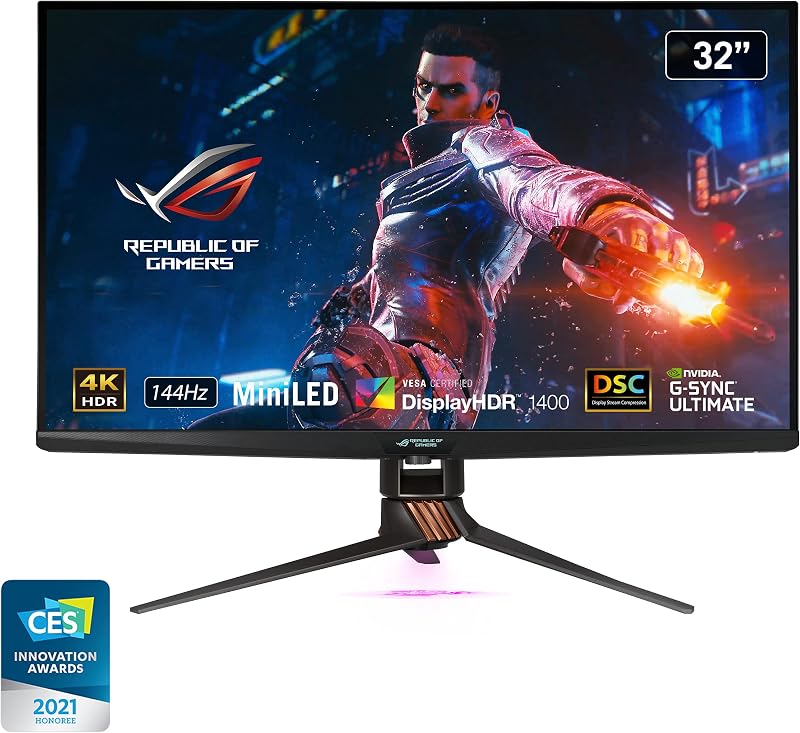
Pros
- 1152-zone Mini-LED FALD backlight
- Factory-calibrated 98% DCI-P3 color gamut
- Dedicated NVIDIA G-SYNC Ultimate processor
- Front LiveDash OLED system telemetry display
- Distortion-free flat IPS panel
Cons
- 144Hz refresh rate trails 165Hz rivals
- Heavier 24-pound chassis
- Listing does not specify GTG response time
View Asus ROG Swift PG32UQX on Amazon
Samsung Odyssey Neo G7 32

Pros
- 165Hz refresh rate with 1ms GTG
- Quantum HDR 2000 with 2000 nits peak
- 1196 local dimming zones
- Immersive 1000R curved field of view
- Full ergonomics with tilt, swivel, pivot, height
Cons
- 1000R curve distorts straight graphic lines
- Listing does not specify color gamut percentage
- Lacks dedicated G-SYNC hardware module
View Samsung Odyssey Neo G7 32 on Amazon
Who Should Buy Each One
Choose the Asus ROG Swift PG32UQX If
- You need a completely flat 32-inch 4K panel that preserves geometric accuracy for CAD, graphic design, and video editing.
- You require documented 98% DCI-P3 color gamut coverage backed by an included factory calibration report and true 10-bit depth.
- You prioritize hardware-driven variable refresh synchronization via a dedicated NVIDIA G-SYNC Ultimate processor.
- You want front-facing system monitoring via the built-in LiveDash OLED display alongside webcam tripod mounting hardware.
Choose the Samsung Odyssey Neo G7 32 If
- You want complete gaming immersion powered by an aggressive 1000R wraparound curvature filling your field of view.
- You play fast-paced action titles and competitive shooters that benefit from a 165Hz refresh rate and 1ms GTG response time.
- You want maximum peak HDR brightness up to 2000 nits driven by 1,196 Quantum Mini-LED local dimming zones.
- You need versatile stand ergonomics that include height adjustment, tilt, swivel, and full pivot rotation.
Final Verdict
When weighing the Asus ROG Swift PG32UQX vs Samsung Odyssey Neo G7, the Samsung Odyssey Neo G7 32 emerges as the superior choice for dedicated PC gamers. By pairing a rapid 165Hz refresh rate and certified 1ms GTG response time with 1,196 Quantum Mini-LED zones reaching 2000 nits, the Neo G7 delivers breathtaking HDR impact and fluid motion tracking. Its 1000R curved profile pulls the player directly into virtual environments, while its lighter chassis and fully articulating stand make desk integration straightforward for gaming battlestations.
Conversely, the Asus ROG Swift PG32UQX remains the definitive pick for creative professionals and visual purists who require reference-grade precision. Its flat 32-inch IPS panel eliminates curved geometric warping, while its verified 98% DCI-P3 color space, factory calibration report, true 10-bit color, and dedicated NVIDIA G-SYNC Ultimate hardware processor provide uncompromising color fidelity and tear-free performance. If your daily workflow blends commercial creative production with premium 4K HDR gaming, the PG32UQX justifies its position as a high-precision visual workstation.
FAQ
Is Asus ROG Swift PG32UQX worth it for professional content creation?
Yes, the Asus PG32UQX is exceptionally well-suited for professional content creation. It features a flat IPS panel that avoids optical distortion, covers 98% of the DCI-P3 color gamut with true 10-bit color depth, includes a factory calibration report in the box, and comes with a 3-month Adobe Creative Cloud membership.
Is Samsung Odyssey Neo G7 32 worth it for office productivity and spreadsheets?
The Samsung Odyssey Neo G7 can handle office tasks thanks to its sharp 4K resolution, but its aggressive 1000R curvature bends straight lines, grids, and spreadsheets. Users who work extensively with architectural drawings, financial sheets, or photo editing may find the curved geometry less practical than a traditional flat screen.
Asus PG32UQX or Neo G7 32 for HDR gaming: which offers better visual impact?
Both monitors provide top-tier HDR visuals due to their thousand-plus local dimming zones. The Samsung Odyssey Neo G7 achieves a higher peak brightness of 2000 nits with Quantum HDR 2000 and 1,196 zones, delivering intense contrast bursts. The Asus PG32UQX delivers 1400 nits backed by official VESA DisplayHDR 1400 certification and quantum-dot color richness. Gamers seeking raw brightness and deep immersion will favor the Samsung, while those desiring color stability and flat geometry will prefer the Asus.
How does PG32UQX vs Odyssey Neo G7 local dimming compare in dark environments?
The PG32UQX features 1,152 FALD zones across an IPS panel, while the Odyssey Neo G7 features 1,196 local dimming zones utilizing Quantum Matrix Technology with 12-bit black levels. Both control backlight blooming significantly better than standard displays, but the Samsung’s panel architecture and higher zone count allow it to produce deeper black levels in dark room settings.
Does the Asus PG32UQX vs Samsung Neo G7 refresh rate make a difference in competitive play?
Yes, the Samsung Odyssey Neo G7 provides a noticeable advantage in fast-paced games due to its 165Hz refresh rate and certified 1ms GTG response time. The Asus PG32UQX operates at 144Hz and does not specify a GTG response time, making the Samsung noticeably smoother and sharper during fast camera sweeps.
What is the PG32UQX vs Neo G7 response time difference?
The Samsung Odyssey Neo G7 lists an elite 1ms (GTG) pixel response time designed to eliminate ghosting and motion smearing. The Asus ROG Swift PG32UQX product listing does not specify a GTG response time number, as its engineering prioritizes color accuracy, FALD brightness, and G-SYNC Ultimate processing over ultra-fast esports pixel transitions.
Can the Asus PG32UQX monitor system performance during gameplay?
Yes, the PG32UQX includes an integrated LiveDash OLED display on its front deco bar. Users can configure this screen to display customized graphical icons or real-time PC hardware metrics, including CPU temperatures and GPU performance statistics.


