The single difference that determines whether a bagged vacuum or a bagless vacuum belongs in your home is how each machine isolates, stores, and expels dirt. Bagged cleaners seal household debris inside multi-layer, self-closing filter bags that you discard without touching grime, whereas bagless designs pull debris into a reusable plastic canister that you unlatch, dump out, and periodically wash.
Choose a bagged vacuum if anyone in your home suffers from respiratory sensitivities or if you despise the dust clouds that billow during bin emptying. Choose a bagless vacuum if you want zero ongoing filter bag purchases and prefer the convenience of emptying a clear canister straight into the trash whenever you finish cleaning.


Bagged Vacuum vs Bagless Vacuum at a Glance
| Feature | Bagged Vacuum | Bagless Vacuum |
|---|---|---|
| Dirt Containment | Enclosed, self-sealing fabric or paper bags | Clear plastic dust canister with cyclonic separation |
| Filtration System | Completely sealed HEPA systems trapping 99.97% of particles | Washable cloth or washable HEPA filters with cup baffles |
| Disposal Experience | Hands-free, no-touch ejection with zero dust clouds | Push-button bottom drop prone to airborne dust kickback |
| Debris Capacity | 3.0 liters (e.g., Kenmore Intuition series) | 1.7 to 2.5 liters (e.g., Amazon Basics and Eureka Whirlwind) |
| Recurring Expenses | Ongoing purchase of replacement dust bags | Zero bag purchases; reusable washable components |
| Motor Wattage | 120W to 200W specialized dual-motor systems (8A) | 720W to 960W high-draw single suction motors (8A) |
| Machine Weight Range | Approximately 14 pounds | Approximately 8.15 to 8.4 pounds |
| Noise Output | Around 75 dB | Around 82 dB |
| Best For | Allergy sufferers, wall-to-wall carpets, and pet owners | Quick cleaning, multi-surface hard floors, and zero maintenance overhead |
Filtration Quality and Allergen Containment
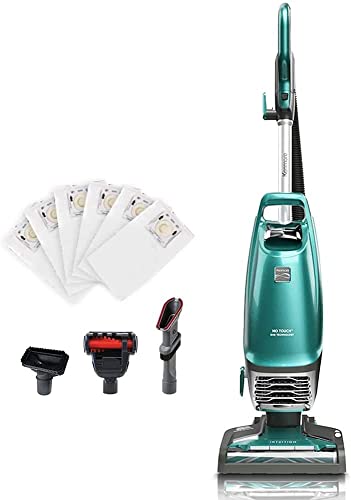
The primary battleground between these two vacuum styles is air hygiene. When you push a vacuum across a floor, it ingests fine mineral dust, pet dander, mold spores, and pollen before venting that exhaust back into your living room. A bagged vacuum handles this air stream by passing it directly through the walls of an enclosed pouch. High-end bagged platforms like the Kenmore Intuition Bagged Upright Vacuum Lift-Up Carpet Cleaner utilize a completely sealed system paired with certified HEPA filtration to trap 99.97% of particles down to microscopic sizes. Because the bag itself acts as the first, thickest stage of filtration, dust is locked inside a dense matrix that prevents fine silt from escaping into the motor housing or re-entering indoor air.
Bagless cleaners take an entirely different path, using cyclonic chambers to spin coarse dirt out of the airflow before pushing the remaining exhaust through a pre-motor filter and an exhaust screen. While machines like the Eureka Whirlwind Bagless Canister Cleaner NEN110A include HEPA filtration stages to purify vented air, the weak point in the allergen chain occurs during trash day. When you hit the one-touch release on a bagless dust cup, fine particles inevitably form a dust cloud as the debris falls into your wastebasket. If you are comparing a cordless vs corded vacuum or trying to decide on the best bagged or bagless vacuum for allergies, this dust puff can trigger sneezing, watery eyes, and respiratory flare-ups.
Bagged models feature self-sealing collars that snap shut the moment you pull the bag from the chamber. The Kenmore No Touch Bag Technology lets you eject the entire loaded 3-liter pouch straight into the bin with a single push button, meaning your skin never contacts collected dander and zero dust escapes. In contrast, bagless chambers frequently suffer from static cling, where hair and fine soot stick to the plastic sidewalls and central shroud, requiring you to reach inside or shake the bin vigorously. For true medical-grade allergen defense, sealed bagged machines remain unmatched.
Edge: Bagged vacuum. Completely sealed HEPA enclosures and self-closing bags keep microscopic allergens contained both during vacuuming and at disposal.
Maintenance Demands and Ongoing Upkeep
Evaluating long-term maintenance reveals the major trade-off between labor and recurring consumable purchases. A bagless vacuum cleaner eliminates the frustration of running out of bags right before company arrives. When shoppers ask is a bagless vacuum worth it, the answer usually centers on eliminating ongoing consumable orders. Platforms like the Amazon Basics Upright Bagless Vacuum Cleaner rely on washable cloth filters that you simply rinse under a cold tap. Similarly, the Eureka Whirlwind highlights washable filters and a zero-maintenance-cost design, meaning you do not have to purchase replacements under normal operating conditions.
However, zero ongoing purchases does not mean zero effort. Washable bagless filters must be thoroughly rinsed every few weeks to prevent fine dust from clogging the porous fabric. Crucially, a washed filter requires 24 to 48 hours of air-drying before you can reinstall it; inserting a damp filter back into a high-speed electric vacuum can ruin the motor and cause foul mildew growth. Dust canisters also accumulate oily grime, pet hair buildup, and electrostatic films that require washing the canister itself in a sink. Much like modern stick vacuums discussed in our dyson v8 vs v11 comparison, keeping a bagless dust pathway clean demands constant user vigilance.
Bagged cleaners shift the burden from manual labor to consumable replenishment. With a 3-liter capacity, a bagged upright can hold weeks or even months of dry dirt before you need a replacement. Every time you insert a fresh bag, you essentially install a brand-new primary filter, keeping the interior chamber sanitary and ensuring the secondary HEPA filter stays clean for extended periods. While the Kenmore Intuition Bagged Upright Vacuum with Hair Eliminator Brushroll comes packaged with four HEPA dust bags to get you started, you will inevitably have to buy more bags over the lifetime of the appliance. If you prefer paying for convenience over washing grimy plastic parts in your sink, bagged models are far less tedious.
Edge: Bagless vacuum. Washable filters and reusable dust cups eliminate the ongoing expense of replacement bags.
Suction Power and Airflow Consistency
When analyzing bagged vs bagless vacuum suction power, you must look at both motor strength and how airflow behaves as the dust compartment fills. Traditional bagless units draw high electrical wattage to spin cyclonic air funnels. The Eureka Whirlwind pulls 960 watts from its 8-amp motor, while the Amazon Basics Upright employs a 720-watt motor generating 12 kilopascals of suction. The core theoretical advantage of cyclonic bagless technology is that heavy debris spins away from the filter, keeping the primary airflow path clear so suction remains consistent whether the bin is empty or half full.
In practice, fine silt eventually cakes the internal mesh shroud and pleated pre-motor filter on bagless machines. Once those pores clog, airflow drops noticeably until the filters are washed. By contrast, older bagged designs had a reputation for losing suction as dirt packed against the paper walls. Modern bagged systems overcome this with specialized engineering. Kenmore integrates a PowerFlow Bag Chamber with double-wall technology in both the Intuition Lift-Up and the Hair Eliminator models. This structural chamber maintains dedicated air channels around the perimeter of the bag, allowing 120W to 200W dual-motor systems to pull steady airflow through the top and sides of the bag even as the 3-liter interior fills with debris.
Bagless machines deliver raw, high-wattage airflow right out of the box, making them punchy cleaners on bare floors and low-pile rugs. However, they require prompt emptying when dirt reaches the maximum fill line to avoid choking the cyclone. Bagged systems offer a more gradual, predictable airflow curve, supported by specialized bag chambers that preserve working suction until the bag is packed tight. If you neglect maintenance, both will suffer, but bagless designs lose their edge more abruptly when fine dust bypasses the cyclone shroud.
Edge: Tie. Bagless models offer high initial wattage and raw airflow, while modern double-wall bagged designs preserve steady suction across full bag cycles.
Carpet Cleaning and Pet Hair Management
Removing stubborn animal fur and embedded grit from pile carpet requires aggressive mechanical agitation combined with dedicated airflow. When choosing a bagged or bagless vacuum for carpet, the brushroll design and motor setup dictate how deeply the machine cleans. Upright bagged models like the Kenmore Intuition utilize dual motors: one motor generates suction while a second dedicated motor drives the motorized brushroll. Furthermore, the Kenmore BU4050 includes a specialized Hair Eliminator nozzle that continuously clears wrapped strands from the roller, preventing long hair and animal fur from choking the brush mechanism.
For dedicated pet owners, animal dander and shedding fur introduce distinct challenges. In any bagged or bagless vacuum for pet hair evaluation, odor containment is just as vital as pickup performance. Storing pet fur inside a bagless dust cup can cause stale pet odors to escape every time the motor runs, and pulling tangled hair clumps out of a narrow canister opening can be messy. Bagged vacuums encapsulate dander, fleas, and hair inside thick multi-ply HEPA material, locking odors away. Both Kenmore models complement this with specialized tools, such as the Pet HandiMate attachment, which uses an agitated turbine to pull fur off upholstery and stair treads.
Bagless models like the Amazon Basics Upright provide capable carpet cleaning through straight suction and a standard brushroll, supplemented by an upholstery tool and crevice tool. The Eureka Whirlwind canister relies on an integrated airflow control on the handle and a multi-surface floor nozzle with 960 watts of draw, making it adept at switching between area rugs and hard flooring. However, for deep plush carpets that trap heavy sand and thick pet hair, the heavier motor assemblies and specialized anti-tangle brushrolls found on dedicated bagged uprights pull more embedded debris from deep pile.
Edge: Bagged vacuum. Dual-motor carpet agitation, anti-tangle brushrolls, and sealed dander containment make bagged models superior for heavy carpets and shedding pets.
Maneuverability, Weight, and Usability
Usability during daily chores often comes down to physical weight and how easy the machine is to steer around furniture. On this metric, bagless cleaners hold a distinct physical advantage. The Amazon Basics Upright weighs only 8.4 pounds, while the Eureka Whirlwind canister comes in at just 8.15 pounds. This featherlight construction makes carrying the vacuum up steep staircases or moving it from room to room virtually effortless. The Eureka Whirlwind further enhances usability with a compact three-wheel base, a metal telescoping wand, and an automatic cord rewind that retracts the power cord at the touch of a button.
Bagged uprights are inherently heavier due to their insulated motor housings, sealed chamber walls, and dual-motor drive systems. Both Kenmore Intuition units weigh approximately 14 pounds. While 14 pounds is relatively lightweight for a full-sized sealed upright, it is nearly 70% heavier than the compact bagless options. To offset this heft, Kenmore equips the Intuition with smooth swivel steering and four-wheel stability, allowing the floor head to pivot cleanly around chair legs. Additionally, both Intuition models feature a Lift-Up canister design that detaches the motor and bag chamber from the floor nozzle with the push of a button, converting the upright into a handheld pod for stair cleaning and above-floor dusting.
Maneuvering a vacuum also involves hose reach and cord management. The Amazon Basics upright provides a 25-foot power cord and a detachable handle for elevated reach, while the Kenmore Intuition includes a 7-foot flexible hose and bright LED headlights that illuminate hidden dirt beneath furniture. If your cleaning style favors quick, lightweight passes across multiple rooms-similar to the agile handling highlighted in our dyson v10 vs v11 and dyson v10 vs outsize guides-an ultra-light bagless machine demands noticeably less physical effort.
Edge: Bagless vacuum. Sub-9-pound weights, automatic cord rewinds, and compact canister profiles make bagless machines easier to carry and maneuver.
Capacity and Operating Volume
The frequency with which you must stop cleaning depends entirely on internal capacity. The representative bagged vacuums feature generous 3-liter bag capacities. Because the dirt is compressed into the bag chamber under steady negative pressure, a 3-liter pouch holds an immense volume of compacted dust, hair, and grit. In typical single-family households, a single bag can last anywhere from one to three months before needing replacement, enabling continuous, uninterrupted cleaning sessions across an entire home.
Bagless vacuums have smaller collection volumes that require frequent clearing. The Amazon Basics upright offers a 1.7-liter dust cup, while the Eureka Whirlwind canister provides a 2.5-liter bin. However, you cannot fill a bagless dust cup to the brim without choking the internal cyclone. Most manufacturers designate a maximum fill line located well below the total volume of the cup-often around halfway up the chamber-meaning the usable capacity is significantly smaller than the exterior dimensions suggest. You will find yourself emptying a bagless canister after every one or two cleaning sessions, which interrupts workflow during large deep-cleaning projects, an issue also noted when comparing high-capacity bins in our dyson v8 vs outsize analysis.
Acoustics also separate the two formats. The high-speed cyclonic separation, open plastic canisters, and 720W to 960W motors in the Amazon Basics and Eureka bagless units generate a noise level of roughly 82 decibels. Bagged vacuums, by contrast, benefit from acoustic dampening: the thick fabric bag and sealed outer chamber absorb motor whine and rushing air noise. As a result, the Kenmore Intuition models operate at a quieter 75 decibels, creating a noticeably less abrasive hum during extended use.
Edge: Bagged vacuum. Larger 3-liter capacity allows weeks of uninterrupted cleaning, while insulated chambers produce lower operating noise.
Pros and Cons
Bagged Vacuum

Pros
- Completely sealed HEPA system traps 99.97% of allergens
- Hands-free no-touch bag disposal prevents dust clouds
- PowerFlow double-wall chambers sustain suction as bags fill
- Generous 3-liter capacity lasts weeks between changes
- Dual-motor brushroll agitation excels on carpets
Cons
- Requires ongoing purchases of replacement bags
- Heavier overall weight at roughly 14 pounds
View Kenmore Intuition Bagged Upright Vacuum Lift-Up on Amazon
Bagless Vacuum

Pros
- Washable filters eliminate ongoing bag purchase expenses
- Featherlight design weighs only 8.15 to 8.4 pounds
- Transparent dust cup shows fill level at a glance
- Available automatic cord rewind simplifies storage
Cons
- Releases dust plumes during canister emptying
- Requires frequent filter washing and 24-hour dry times
- Smaller capacity requires frequent emptying
View Amazon Basics Upright Bagless Vacuum Cleaner on Amazon
Who Should Buy Each One
Choose the Bagged Vacuum If:
- Someone in your home suffers from asthma, seasonal allergies, or sensitivity to airborne dust plumes.
- You have wall-to-wall carpeting and shedding pets that require dual-motor brushroll agitation and specialized hair-removal tools.
- You prefer a hygienic disposal process where a self-sealing pouch drops into the trash without releasing dust into the air.
- You want a quiet, insulated cleaning appliance with a large 3-liter capacity that only requires attention once every few weeks.
Choose the Bagless Vacuum If:
- You refuse to spend money on ongoing replacement bags or risk running out of supplies mid-cleaning.
- You need a featherlight cleaner weighing under 9 pounds that is effortless to carry up and down stairs.
- Your home features primarily hard floors, tile, and low-pile area rugs that benefit from quick-dump canisters.
- You value modern convenience features like an automatic cord rewind and a clear bin that shows exactly what was picked up.
Final Verdict
For most households seeking the cleanest indoor air and deepest carpet performance, the bagged vacuum remains the superior choice. While it requires buying replacement bags periodically, the hygienic advantages of a completely sealed HEPA system, hands-free no-touch disposal, and dual-motor brush agitation outweigh the ongoing cost of bags. Units like the Kenmore Intuition series demonstrate that modern bagged cleaners can offer lift-up versatility, anti-tangle brushrolls, and steady suction without the messy dust clouds that plague clear plastic canisters.
However, the bagless vacuum wins convincingly on convenience, physical weight, and zero-dollar operating upkeep. If you live in a multi-story home, have mostly hardwood or tile flooring, and hate the idea of buying consumables, models like the Eureka Whirlwind and Amazon Basics Upright deliver strong cleaning performance at almost half the weight of an upright bagged machine. As long as you do not mind washing filters in the sink and emptying the dust bin outside, a bagless vacuum delivers straightforward, grab-and-go cleaning.
FAQ
Do bagless vacuums lose suction faster than bagged vacuums?
Yes, bagless vacuums can experience sudden suction drops if their fine mesh screens and pre-motor filters become coated in fine dust, which restricts airflow through the cyclonic assembly. Bagged vacuums equipped with double-wall airflow chambers maintain consistent suction longer because air circulates around the outer perimeter of the bag even as it fills with debris.
Is a bagged vacuum better for pet hair and odor?
A bagged vacuum is generally better for pet-heavy households because the multi-layer bag traps animal dander, hair, and associated odors inside a sealed HEPA structure. In a bagless vacuum, pet hair trapped in the plastic cup can emit odors during operation, and fur often wraps around the central cyclone shroud, requiring manual removal.
How often do you need to empty or replace the dust compartment on each type?
A bagless dust cup typically requires emptying after every cleaning session or two, as dirt must not rise above the maximum fill line to avoid choking the cyclone. A bagged vacuum with a 3-liter capacity can often go anywhere from one to three months between bag replacements under normal household conditions.
Can you wash the filters on a bagged vacuum?
Most bagged vacuums use disposable primary dust bags that you discard rather than wash. While some models include a secondary motor exhaust filter that can be replaced or lightly tapped clean, the primary HEPA bag is strictly single-use to ensure optimal filtration and structural integrity.
Do bagless vacuums create a mess when you empty them?
Yes, opening the bottom flap of a bagless dust cup usually releases a cloud of fine airborne dust back into the room. To minimize allergen exposure, many bagless owners empty their canisters directly inside an outdoor trash can rather than inside the home kitchen or utility room.
Are bagged vacuums significantly heavier than bagless models?
Generally, yes. Full-sized bagged upright vacuums often weigh around 14 pounds due to their sealed double-wall housings and secondary brushroll motors. Compact bagless uprights and canisters frequently weigh between 8 and 9 pounds, making them noticeably easier to carry up stairs and maneuver into tight spaces.