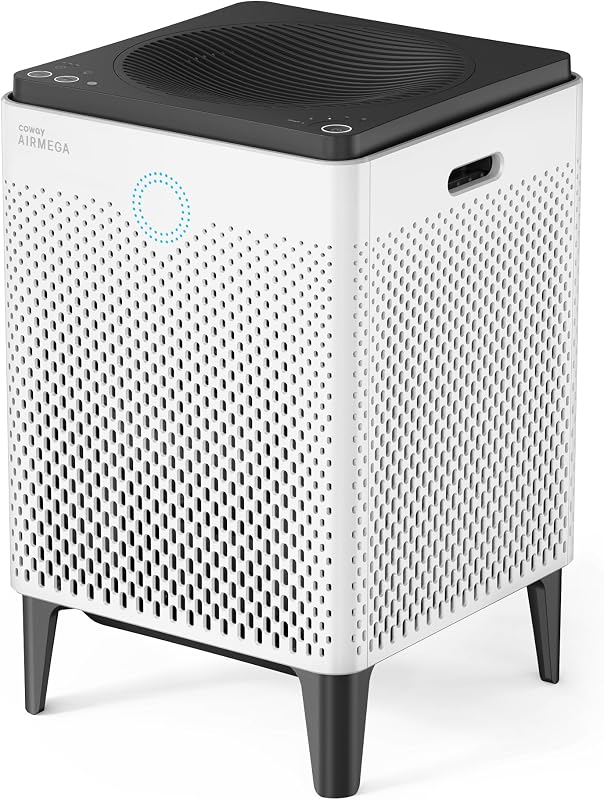
The single deciding factor between the Levoit Eleva 300X and the Coway Airmega 200M is the trade-off between particle-detection precision in dedicated personal quarters and brute airflow circulation across expansive communal spaces. While one machine specializes in identifying microscopic airborne contaminants down to fine particulate bands, the other is engineered to pull air through large floor plans and shut its motor down when conditions stabilize.
Choose the Levoit Eleva 300X if you want multi-channel particle monitoring and independent filter replacement in a compact bedroom footprint. Choose the Coway Airmega 200M if you need to circulate air across open-concept layouts up to 1,748 square feet and prefer an automated system that halts fan draw once rooms are clean.


Levoit Eleva 300X vs Coway Airmega 200M at a Glance
| Feature | Levoit Eleva 300X | Coway Airmega 200M |
|---|---|---|
| Floor Coverage | Not listed (optimized for bedrooms) | 874 sq. ft. (30 min) / 1,748 sq. ft. (60 min) |
| Sensor Technology | 3-Channel Laser (PM1, PM2.5, PM10) | Particle Air Quality Monitor |
| Filtration Stages | 3-stage System-Level Sealed HEPA | HyperCaptive (Pre-filter, Deodorization, HEPA) |
| Filter Service Life | Up to 2 years (DuoShield modular) | Filter Life Indicator (duration not listed) |
| Energy Management | Not listed | Eco Mode (auto fan shutoff after 30 min) |
| Operational Noise Level | Not listed | 24.4 dB minimum |
| Power Consumption | Not listed | 82 watts |
| Control Hardware | Touch interface | Touch controls and remote control |
| Dimensions and Weight | 9.4 x 9.4 x 15.1 in; 7.7 lbs | 10.0 x 17.0 x 18.0 in; 12.3 lbs |
| Best For | Targeted bedroom allergy monitoring | Large-room turnover and energy conservation |
Coverage Area and Airflow Output
Air purifier effectiveness depends heavily on fan capacity and exchange rates relative to total cubic volume. An air purifier engineered for an enclosed bedroom operates under completely different pressure dynamics than one assigned to an open floor plan. When choosing between the Levoit Eleva 300X or Coway Airmega 200M for large room installations, the rate at which the blower processes ambient air dictates how rapidly indoor pollutants drop.
The Coway Airmega 200M coverage area is officially rated to treat spaces up to 874 square feet in 30 minutes, or reach up to 1,748 square feet in 60 minutes. This wide reach makes the Airmega 200M a viable single-unit solution for sprawling basements, open kitchens, and living rooms with high ceilings. By contrast, the Eleva 300X listing does not specify a maximum square-footage threshold, describing the unit specifically as a bedroom air purifier designed for personal sleeping quarters. Readers assessing high-capacity alternatives can review our levoit core 400s vs coway airmega 200m comparison to see how other high-output platforms compete with this fan profile.
Placing an under-sized purifier in an oversized room forces the fan to run continuously at peak velocity, raising ambient sound levels without achieving thorough room-wide turnover. The Airmega 200M delivers the intake surface area and duct sizing required to move significant air volumes through shared living spaces. The Eleva 300X concentrates its intake geometry for localized airflow boundaries rather than whole-house air exchanges.
Edge: Coway Airmega 200M provides clearly documented coverage metrics reaching up to 1,748 square feet, whereas the Eleva 300X is bounded by compact bedroom design.
Particulate Detection and Sensor Capabilities
A reactive air purifier relies entirely on the precision of its optical or laser sensors. Basic sensors detect broad particulate mass increases, but modern precision units break down pollution into specific particulate bands so users understand whether they are facing heavy dust, volatile aerosols, or microscopic smoke residues. Diagnostic granularity allows the internal logic of an automatic cleaner to modulate blower speeds with minimal latency.
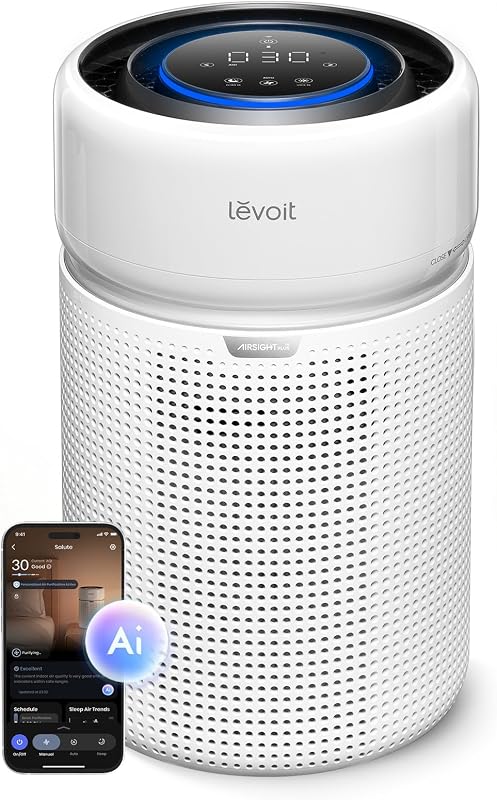
The Levoit Eleva 300X PM sensor package represents a marked step forward by introducing a 3-channel optical detection array that tracks PM1, PM2.5, and PM10 independently. This multi-band approach lets the Eleva 300X register coarse dust and pollen (PM10), common combustion particles (PM2.5), and ultra-fine atmospheric aerosols (PM1) separately. The Coway Airmega 200M uses an integrated real-time air quality monitor that changes status based on detected pollution, but the manufacturer listing does not specify multi-channel particle classification or independent PM size tracking. For a broader look at how Levoit integrates smart monitoring into higher-tier models, see our analysis of the levoit eleva 300x vs levoit core 400s.
For occupants tracking specific respiratory triggers, the granular feedback on the Eleva 300X eliminates guesswork. A user can tell immediately whether a spike stems from larger biological allergens or microscopic outdoor smoke penetrating the room envelope. The Airmega 200M alerts users to generalized air quality degradation, but lacks the specialized diagnostic telemetry built into Levoit’s platform.
Edge: Levoit Eleva 300X leads decisively with its 3-channel PM1, PM2.5, and PM10 particulate monitoring array.
Filtration Engineering and Allergen Capture
The internal arrangement of filter media dictates how effectively an air cleaner traps airborne irritants without leaking bypassed air back into the room. True HEPA standards require 99.97% removal efficiency down to 0.3 microns, but certified system sealing and specialized chemical adsorbents separate basic cleaners from dedicated clinical defenses. Deciding on the Levoit Eleva 300X or Coway Airmega 200M for allergies requires examining test methodologies and media layering.
Levoit equips the Eleva 300X with System-Level Sealed HEPA filtration tested under the ASTM F3150-18 standard to ensure that captured particles cannot escape through seams or internal housing gaps. Its 3-stage filtration includes DuoShield technology, pairing specialized carbon filters with its HEPA barrier. The Airmega 200M deploys Coway’s HyperCaptive filtration system, which combines a washable pre-filter, a deodorization carbon stage, and a HEPA element rated for 99.97% retention at 0.3 microns alongside 99% reduction of volatile organic compounds and odors. Coway’s assembly has also been tested by Korea Conformity Laboratories (KCL) against SPS-KACA 002-132:2022 standards down to 0.01-micron ultra-fine particles, SGS under IEST-RP-CC007 conditions, and JEM 1467:2015 conditions for acetic acid.
Coway’s washable pre-filter serves as an external mechanical shield that collects pet hair and coarse lint before it strikes the primary media, preserving HEPA efficiency. Levoit relies on an enclosed system seal that prioritizes containment integrity. Those interested in larger dual-filter setups can explore the levoit eleva 300x vs coway airmega 400 comparison, but between these two, Coway provides a deeper suite of third-party lab certifications across volatile compounds and micro-fine particles.
Edge: Coway Airmega 200M wins due to its multi-tier HyperCaptive filtration, washable physical pre-filter, and extensive KCL/SGS test validations down to 0.01 microns.
Filter Maintenance and Replacement Architecture
Filter maintenance logistics dictate both long-term operational convenience and ongoing ownership routines. Traditional all-in-one cylindrical cartridges force users to discard intact particulate media simply because the odor-adsorbing carbon layer has reached saturation. Modular systems and washable stages alter the maintenance rhythm considerably over years of operation.
The Levoit Eleva 300X filter life is rated for up to two years, verified against the GB/T18801 standard to a 50% decline in clean air delivery rate under 12-hour daily operation at maximum fan speed. Furthermore, Levoit’s DuoShield design allows the HEPA filter and the activated carbon filter to be uncoupled and replaced independently. The listing for the Coway Airmega 200M features a built-in filter life indicator light to signal replacement intervals, but does not provide an explicit multi-year longevity claim. However, Coway includes a washable pre-filter that can be rinsed indefinitely under tap water, preventing large debris from prematurely clogging the downstream stages.
The modular separation on the Eleva 300X provides operational flexibility: heavy smoke or pet odors can be addressed by swapping only the carbon element without replacing an otherwise pristine HEPA core. While Coway’s washable screen limits dust loading, Levoit’s documented 2-year operational rating on the primary core provides a predictable multi-year replacement schedule. Readers comparing modular upkeep versus high-capacity washable stages can reference our levoit vital 200s vs coway airmega 200m guide.
Edge: Levoit Eleva 300X takes the category with its documented 2-year lifespan rating and separate modular carbon replacement design.
Energy Consumption and Operating Modes
Continuous air purification can drive up monthly utility consumption if fan motors remain engaged when ambient air is already clean. Modern automated modes address this through dynamic RPM throttling or complete mechanical disconnection of the drive assembly when sensor readings remain in clean zones. When running an air cleaner year-round, operating logic matters as much as raw mechanical wattage.
The Coway Airmega 200M eco mode provides an aggressive energy-conservation profile: if the internal sensor registers clean air for 30 consecutive minutes, the fan shuts down entirely. The motor remains dormant until the optical monitor detects rising particulate counts, at which point it restarts automatically. The Airmega 200M is rated at 82 watts on peak draw, holds official CARB certification, and offers three manual fan speeds, smart auto adjustment, and a dedicated remote control. The Levoit Eleva 300X listing confirms automated bedroom protection via its 3-channel sensor, but the manufacturer documentation omits exact operating wattage, standby draw, and fan-kill conservation modes.
Coway’s complete fan shutoff cycle in Eco Mode avoids running an idling motor across empty rooms during clean spells. Units that merely drop to a baseline low speed continue drawing current 24 hours a day. The inclusion of a remote control alongside touch interfaces gives Coway another layer of operational control that Levoit’s compact listing does not match.
Edge: Coway Airmega 200M wins with its automated Eco Mode fan-cutoff feature, remote controller, and certified 82-watt peak rating.
Form Factor, Acoustics, and Bedroom Suitability
Placement options depend directly on the physical enclosure of the purifier. A machine intended for a nightstand, dresser, or tight corner needs a narrow footprint and minimal weight for easy room transfers. Conversely, a floor-standing cabinet model requires dedicated floor space away from walls and curtains to pull air effectively.
The Levoit Eleva 300X is explicitly tailored for sleeping quarters, measuring 9.4 inches deep, 9.4 inches wide, and 15.1 inches tall, with an overall weight of 7.7 pounds. Its compact cylindrical tower profile fits easily onto bedroom surfaces or tight bedside clearances without obstructing movement. The Coway Airmega 200M is a wider, square floor console measuring 10 inches deep, 17 inches wide, and 18 inches tall, weighing 12.3 pounds. The Airmega 200M lists an ultra-low minimum noise rating of 24.4 dB, ideal for light sleepers, though its wider chassis occupies substantial floor space.
For shoppers with constrained bedroom footprints, moving a 12.3-pound floor unit around furniture can be cumbersome. The Eleva 300X weighs roughly 37 percent less than the Coway and requires a fraction of the tabletop footprint. While Coway offers quiet 24.4 dB operation at low speeds, Levoit’s compact geometry is substantially easier to place in bedrooms.
Edge: Levoit Eleva 300X provides superior portability and a significantly smaller spatial footprint for bedroom living.
Pros and Cons
Levoit Eleva 300X
Pros
- 3-channel PM1, PM2.5, PM10 sensor
- Up to 2-year filter life
- DuoShield independent carbon replacement
- Lightweight 7.7-pound bedroom footprint
Cons
- Coverage area not specified
- Lacks washable physical pre-filter
View Levoit Eleva 300X on Amazon
Coway Airmega 200M

Pros
- Cleans up to 1,748 square feet
- Automated fan-off Eco Mode
- Washable pre-filter saves HEPA media
- Quiet 24.4 dB minimum noise rating
- Includes dedicated remote control
Cons
- Bulky 12.3-pound cabinet body
- Lacks multi-channel PM size readout
View Coway Airmega 200M on Amazon
Who Should Buy Each One
Choose the Levoit Eleva 300X If
- You need real-time data distinguishing coarse dust (PM10), fine particulate (PM2.5), and ultra-fine aerosols (PM1).
- You want a compact, lightweight 7.7-pound unit tailored specifically for bedroom end tables or nightstands.
- You prefer independent modular filter maintenance so you can replace carbon and HEPA stages separately.
- You desire a documented filter endurance curve tested up to two years under heavy daily operation.
Choose the Coway Airmega 200M If
- You must clean wide-open rooms, apartments, or finished basements reaching up to 1,748 square feet.
- You want an Eco Mode that powers down the fan completely when ambient air has been clean for 30 minutes.
- You value a washable physical pre-filter to catch pet hair and lint before it hits delicate internal media.
- You prefer having a dedicated physical remote control in addition to top-mounted touch buttons.
Final Verdict
The overall choice between these two purifiers hinges entirely on your room layout and your reliance on particle feedback. In a head-to-head Coway Airmega 200M vs Levoit Eleva 300X matchup, the Coway Airmega 200M emerges as the stronger all-around choice for primary living areas, common spaces, and apartments. Its documented 1,748 square foot maximum reach, third-party lab testing against 0.01-micron contaminants, washable external pre-filter, and fan-stopping Eco Mode make it a powerhouse for general domestic air circulation.
The Levoit Eleva 300X wins convincingly when your priority shifts to strict bedroom placement and fine-tuned allergy management. With its advanced 3-channel optical PM sensor, compact 7.7-pound tower body, ASTM F3150-18 sealed filtration, and independent DuoShield carbon replacement, the Eleva 300X gives allergy sufferers unprecedented diagnostic visibility. If your goal is broad-room turnover, pick Coway; if your goal is personal respiratory defense in your sleeping quarters, pick Levoit.
FAQ
Is Coway Airmega 200M worth it for open-concept floor plans?
Yes. The Coway Airmega 200M is specifically engineered to handle up to 874 square feet in 30 minutes and 1,748 square feet in 60 minutes. Its wide front intake panel and 82-watt motor allow it to pull air across open areas far more effectively than small bedroom-specific purifiers.
How does the Levoit Eleva 300X PM sensor differentiate particle sizes?
The Eleva 300X uses a 3-channel optical detection array that splits particulate readings into PM1, PM2.5, and PM10 categories. Instead of providing a single generalized air quality reading, it informs the user whether airborne contamination is driven by coarse debris like pollen and dust (PM10) or fine combustion particles and aerosols (PM2.5 and PM1).
What does the Levoit Eleva 300X review data say about filter replacement intervals?
According to manufacturer testing based on the GB/T18801 standard, the Eleva 300X filter retains performance for up to two years before reaching a 50% CADR decline, assuming 12 hours of daily operation on maximum speed. Its DuoShield construction also allows you to replace the activated carbon stage separately from the HEPA filter.
How does Coway Airmega 200M Eco mode save electricity?
When operating in Eco Mode, the Airmega 200M monitors ambient air continuously. If the air quality remains clean for 30 consecutive minutes, the unit shuts off the fan motor completely to eliminate energy waste, then restarts automatically when its internal sensor detects returning airborne pollutants.
Which purifier is better for pet dander and seasonal allergies?
Both models target allergens, but they excel in different ways. The Airmega 200M features a washable pre-filter that traps floating pet hair and coarse dander before it reaches the HEPA media, making it ideal for multi-pet households. The Eleva 300X offers System-Level Sealed HEPA certified to ASTM F3150-18 standards and tracks PM10 pollen spikes directly on its display.
Can the Coway Airmega 200M run continuously without manual intervention?
Yes. By engaging Coway’s Smart Auto Mode, the internal particle sensor adjusts fan speeds between low, medium, and high in real time based on surrounding air quality. If left in Eco Mode, it handles both speed increases and complete fan shutoffs automatically without user interaction.