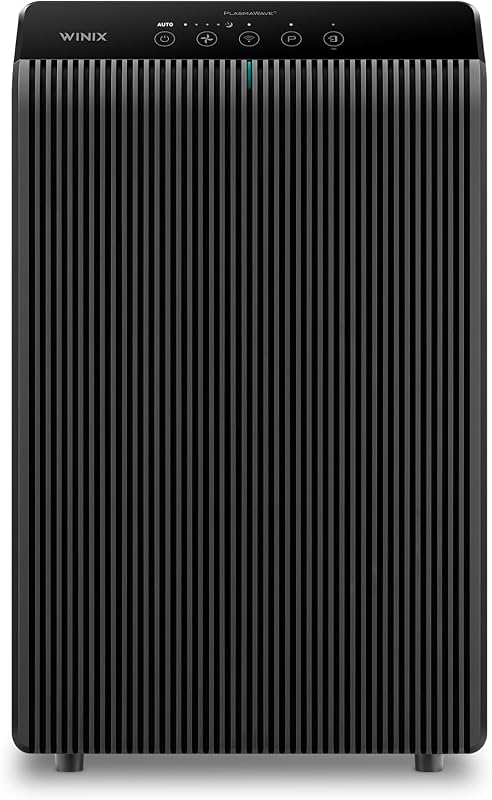
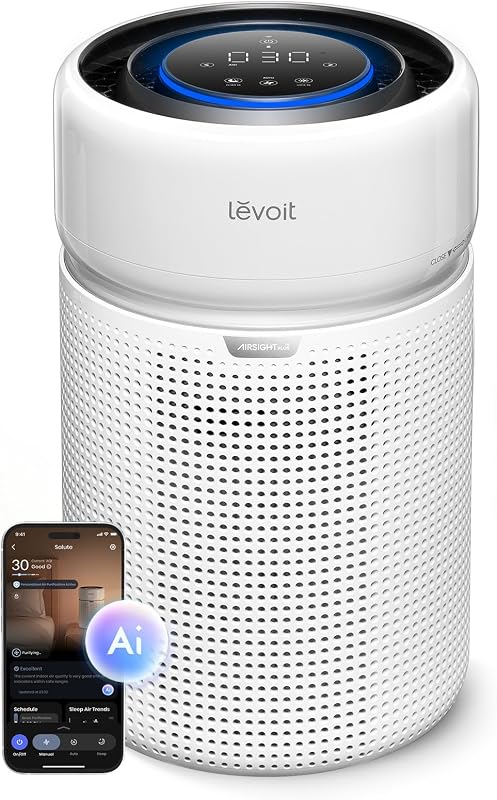
The core distinction between the Levoit Core 400S and the Coway Airmega 200M comes down to operational management: Levoit prioritizes automated particle sensing via its AirSight Plus system and cylindrical 360-degree circulation, while Coway delivers an energy-conserving Eco Mode paired with a separate washable pre-filter.
Select the Levoit Core 400S if you want continuous air monitoring that dynamically scans for airborne debris down to 0.3 microns across expansive floor plans. Choose the Coway Airmega 200M if you want a machine that automatically turns its fan off once the air is clean to conserve electricity and utilizes an easy-to-clean pre-filter screen to preserve the life of internal stages.


Levoit Core 400S vs Coway Airmega 200M at a Glance
| Feature | Levoit Core 400S | Coway Airmega 200M |
|---|---|---|
| Maximum Rated Coverage | 1,733 sq ft per hour | 1,748 sq ft per hour (874 sq ft in 30 min) |
| Filtration Stages | 360° intake, Efficient Middle Filter, Carbon | Washable Pre-Filter, Deodorization, HEPA |
| Particle Retention Threshold | 99.97% at 0.3 microns | 99.97% at 0.3 microns (tested to 0.01 microns) |
| Noise Level Minimum | 24 dB | 24.4 dB |
| Fan Speeds and Modes | Automatic sensing mode | 3-stage manual, Auto Mode, Eco Mode |
| Air Quality Monitoring | AirSight Plus real-time particle sensor | Built-in Air Quality Monitor indicator |
| Power Consumption | Not listed | 82 watts |
| Dimensions and Weight | 10.79 x 10.79 x 20.43 inches; 12.79 lbs | 10.0 x 17.0 x 18.0 inches; 12.3 lbs |
| Certifications | Not listed | CARB Certified |
| Best For | Continuous smart sensing in large rooms | Energy-conscious owners wanting washable pre-filters |
Room Coverage and Airflow Delivery
Air purification capacity determines how rapidly an appliance turns over stale indoor air to scrub out pollen, dust, and particulate matter. In any head-to-head assessment of the coway airmega 200m vs levoit core 400s, overall output numbers appear remarkably close on paper. The Core 400S specifies room processing capacity up to 1,733 square feet in a single hour. This matches the needs of open-concept living quarters, connected hallways, and primary bedroom suites where stagnant air tends to accumulate.
Coway measures the Airmega 200M by explicit timeframes: it purifies spaces up to 874 square feet every 30 minutes, or 1,748 square feet in 60 minutes. The resulting air exchange rate between the two devices is nearly identical across a standard 60-minute window. Readers evaluating a broader brand lineup through our levoit vs coway overview will find that both manufacturers engineer these specific models for mid-to-large residential zones. The structural delivery differs primarily through intake geometry: Levoit relies on a cylindrical 360-degree perimeter intake that draws air from every compass point, while Coway utilizes a directional front-facing intake panel.
When deploying the levoit core 400s vs coway airmega 200m for large room setups, the 360-degree intake of the Core 400S allows placement closer to central open areas to pull from all directions simultaneously. The Airmega 200M pulls dirty air through its front perforation grid and exhausts it upward through the top grille, making it well-suited for placement along peripheral walls. Both move sufficient air volume to refresh substantial household square footage once per hour.
Edge: Tie. Both units provide virtually identical room turnover metrics, reaching approximately 1,740 square feet per hour.
Filtration System and Maintenance Demands
The internal arrangement of filter media defines how well a purifier traps allergens and how frequently the user must purchase replacement media. When deciding between the levoit core 400s or coway airmega 200m for allergies, examining the mechanical layers is essential. The Levoit Core 400S uses an all-in-one cylindrical filter cartridge featuring an Efficient Middle Filter alongside an activated carbon layer to capture 99.97% of airborne particles down to 0.3 microns, including pollen, pet dander, and fine dust.
Coway equips the Airmega 200M with its HyperCaptive Filtration System, which combines three discrete barriers: a coway airmega 200m washable pre filter, an activated carbon deodorization filter, and an internal HEPA filter. The listing notes that Coway’s system reduces 99.97% of 0.3-micron particles and was laboratory tested by KCL to capture ultra-fine particles down to 0.01 microns. Furthermore, the carbon filter has dedicated chamber test data confirming the reduction of volatile organic compounds and acetic acid odors within 30 to 60 minutes.
The critical maintenance divergence lies in the first stage of defense. The Coway Airmega 200M features a detachable, rinse-clean mesh pre-filter designed to capture coarse debris, hair, and dust clusters before they reach the high-efficiency media. By washing this screen regularly under a tap, users protect the HEPA pleated core from early clogging. The Core 400S relies on an integrated cylindrical replacement assembly where the pre-filter mesh is permanently affixed to the outer perimeter of the cartridge, requiring vacuuming rather than simple rinsing.
Edge: Coway Airmega 200M. Its separate washable pre-filter screen preserves the inner HEPA media, backed by laboratory testing down to 0.01-micron particles.
Smart Controls and Real-Time Monitoring
Operational feedback gives homeowners visibility into their indoor air quality without requiring external sensors. The Levoit Core 400S integrates proprietary AirSight Plus technology, which continuously scans ambient air conditions for micro-particles as small as 0.3 microns. Based on these real-time environmental inputs, the Core 400S automatically adjusts its internal fan speeds to clear sudden spikes in contamination, such as kitchen smoke or kicked-up dust.
The Coway Airmega 200M approaches automated adjustment through an onboard Air Quality Monitor and an integrated particle sensor. The system communicates pollution levels via a color-shifting display ring on the top console and automatically shifts through its three manual fan stages when set to Auto Mode. The listing also notes that the Coway includes a remote control and physical touch buttons, offering tactile command over the unit’s functions without needing to handle the main chassis directly.
For shoppers interested in deep operational analysis, reading a thorough levoit core 400s vs coway airmega 400 comparison highlights how sensor suites change across higher-tier chassis. The Levoit Core 400S Smart Air Purifier platform focuses on reactive home air monitoring, using high-precision laser-based particle tracking. While the Airmega 200M provides reliable localized color ring monitoring and remote management, Levoit’s AirSight Plus sensor offers continuous readings that immediately register minute changes in fine particle density.
Edge: Levoit Core 400S. The AirSight Plus system provides continuous particle tracking at the 0.3-micron threshold to trigger automatic fan response.
Energy Efficiency and Eco Automation
Operating an air purifier continuously throughout the day impacts long-term household utility bills. In this domain, coway airmega 200m eco mode functions as a standout operational feature that directly influences power conservation. In standard Auto Mode, most purifiers run their fans indefinitely on low speed even after air quality clears. Coway’s Eco Mode alters this behavior: when the onboard monitor detects that the air has remained clean for 30 consecutive minutes, the fan powers completely down to stop drawing high current.
If the Airmega 200M detects an influx of pollutants while sleeping, the fan automatically wakes up and resumes air cleaning. According to manufacturer specifications, the Coway Airmega 200M draws 82 watts at peak operation. The inclusion of Eco Mode allows owners to mitigate that draw across quiet daytime hours or while away at work. For additional perspective on Coway’s energy profiles against other designs, consider browsing the levoit vital 200s vs coway airmega 200m breakdown.
The Levoit Core 400S listing does not state its maximum or minimum operational wattage figures. While the unit maintains an intelligent automatic setting that decreases fan speed to maintain air quality, it lacks a feature that shuts down fan rotation entirely during prolonged clean states. The Core 400S continues circulating air constantly. For prospective buyers asking is coway airmega 200m worth it for energy management, this specialized cycling mechanism provides an efficiency safeguard that prevents continuous power consumption when the room requires no active cleaning.
Edge: Coway Airmega 200M. The 30-minute shutoff Eco Mode prevents wasted electricity by pausing fan operation once room air is clean.
Acoustic Output and Sound Levels
Purifiers placed in bedrooms or home offices must run quietly to avoid disrupting sleep or phone conversations. A direct coway 200m vs levoit 400s noise level comparison reveals that both appliances are engineered specifically to eliminate acoustic intrusion on low settings. Levoit states that its internal structure was custom-designed by engineers to keep operational noise down to a baseline of 24 dB, resembling a quiet whisper or rustling leaves.
The Coway Airmega 200M records a baseline noise level of 24.4 dB at its lowest fan setting. At under half a decibel of difference, human ears cannot distinguish any meaningful volume gap between the two units at their lowest settings. Both models operate quietly enough on their baseline speeds to sit beside a nightstand without disturbing light sleepers. Similar quiet thresholds are evaluated when contrasting other compact purifiers, such as in the levoit eleva 300x vs coway airmega 200m review.
Acoustic performance diverges when fans ramp up to higher tiers. The Coway Airmega 200M features three manual fan settings (low, medium, high), alongside its automated modes. The highest speed moves substantial air to counter smoke or intense odors, but produces noticeable wind rush through the upper outlet. Levoit’s internal geometry is optimized to balance airflow against acoustic backpressure, but running either unit at top capacity produces audible air movement typical of any machine pushing hundreds of cubic feet of air per minute.
Edge: Tie. With baseline sound ratings of 24 dB for Levoit and 24.4 dB for Coway, neither unit holds an audible acoustic advantage during standard low-speed operation.
Form Factor and Placement Flexibility
Physical footprint and structural dimensions determine where an air purifier can reasonably fit inside a room. The Levoit Core 400S features a cylindrical column design measuring 10.79 inches deep, 10.79 inches wide, and 20.43 inches tall, with an overall weight of 12.79 pounds. Its round, vertical shape draws air from the entire lower perimeter, meaning it cannot be pushed flush against a flat wall or tucked behind a couch without choking off part of its filtration intake.
The Coway Airmega 200M uses a boxy, squarish cabinet footprint measuring 10.0 inches deep, 17.0 inches wide, and 18.0 inches high, weighing in at 12.3 pounds. Because its intake occurs strictly through the front faceplate and exhaust expels straight through the top, it occupies a different visual profile. It is shorter by over two inches than the Core 400S, though wider by more than six inches across its front face. Readers looking at rectangular models can also compare the levoit core 400s vs vital 200s to see how Levoit handles box-style chassis.
The lighter weight of the Airmega 200M (12.3 pounds vs 12.79 pounds) and its squarish profile make it easy to slide against baseboards or tuck beneath end tables, provided the front intake remains clear. The Core 400S requires clearance around its entire cylinder to maximize the utility of its 360-degree filtration system, which can complicate placement in tight rooms or narrow corridors.
Edge: Coway Airmega 200M. The shorter cabinet design and front-facing intake make it easier to place against walls without blocking intake vents.
Pros and Cons
Levoit Core 400S

Pros
- Covers up to 1733 square feet hourly
- AirSight Plus laser particle detection
- Low 24 dB quiet operational profile
- 360-degree all-around intake design
Cons
- No dedicated washable pre-filter layer
- Wattage consumption not listed
View Levoit Core 400S on Amazon
Coway Airmega 200M

Pros
- Energy-saving automated Eco Mode
- Permanent washable pre-filter screen
- Verified 0.01 micron allergen capture
- Includes remote control operation
Cons
- Higher 82-watt maximum power draw
- Directional front air intake intake grille
View Coway Airmega 200M on Amazon
Who Should Buy Each One
Choose the Levoit Core 400S If
- You want 360-degree air intake to draw airborne dust from all corners of an open living room.
- You value precise AirSight Plus particle sensing that continually samples air for 0.3-micron particles.
- You prefer a slender, circular upright footprint over a wider rectangular floor unit.
- You need an automatic system that dynamically scales fan speed to maintain clean air across 1,733 square feet.
Choose the Coway Airmega 200M If
- You want an Eco Mode that turns off the fan after 30 minutes of clean air to lower energy usage.
- You prefer a separate washable pre-filter screen that rinses under a tap to catch pet hair and lint.
- You need verified particle capture down to 0.01 microns and lab-tested volatile organic compound reduction.
- You want convenient setting adjustments using an included remote control alongside top-panel touch keys.
Final Verdict
For most shoppers prioritizing continuous indoor air monitoring across open-concept layouts, the Core 400S delivers a balanced package. Its 360-degree intake system pulls airborne contaminants from every angle, while the AirSight Plus laser-guided sensor provides continuous tracking of 0.3-micron pollutants. Operating down at a whisper-quiet 24 dB, it cleans up to 1,733 square feet per hour with minimal user intervention, making it a capable everyday solution for busy households.
The Coway Airmega 200M wins for homeowners focused on low maintenance costs and operational efficiency. Its HyperCaptive system includes a permanent washable pre-filter screen that protects the inner HEPA filter from premature dust loading, while the automated Eco Mode eliminates wasted power by stopping the fan once indoor air remains clean for half an hour. If you value energy conservation, tested 0.01-micron allergen capture, and simple screen washing, the Airmega 200M is the superior choice.
FAQ
What is the difference in room coverage between these two purifiers?
The Core 400S is rated to clean spaces up to 1,733 square feet in one hour, while the Airmega 200M cleans up to 1,748 square feet in 60 minutes (or 874 square feet in 30 minutes). Both manage comparable square footage across an hour of operation.
Can I wash the pre-filter on the Coway Airmega 200M?
Yes. The Coway Airmega 200M includes a dedicated washable pre-filter screen that can be removed and rinsed with water to clear away pet fur, hair, and coarse dust before it reaches the carbon and HEPA stages.
How quiet is the Coway Airmega 200M compared to the Levoit Core 400S?
The Levoit Core 400S operates down to 24 dB on its lowest setting, while the Coway Airmega 200M operates down to 24.4 dB. Both noise levels match the volume of a soft whisper and are virtually silent in bedroom environments.
How does Eco Mode work on the Coway Airmega 200M?
In Eco Mode, the Airmega 200M monitors air quality continuously. If the air remains purified for 30 minutes or more, the internal fan automatically turns off to save electricity. The fan kicks back on only when the sensor detects incoming pollution.
What size particles do these air purifiers capture?
Both purifiers capture 99.97% of airborne particles down to 0.3 microns. The Coway Airmega 200M listing also cites KCL testing demonstrating capture of ultra-fine particles down to 0.01 microns.
Does the Coway Airmega 200M include a remote control?
Yes. The Coway Airmega 200M listing specifies remote control capability alongside touch controls on the chassis, allowing you to change fan speeds and modes from across the room.