The single deciding factor between the Corsair RM850x and the Corsair SF750 comes down to physical chassis dimensions: the RM850x is a full-sized ATX unit delivering 850 watts of power, whereas the SF750 is a compact SFX power supply engineered specifically for small-form-factor systems at 750 watts.
Choose the RM850x if you are building inside a standard mid-tower or full-tower desktop that accommodates standard ATX hardware and requires extra overhead for high-draw graphics cards. Choose the SF750 if you are designing a compact, space-constrained enclosure that strictly requires an SFX power supply or benefits from the smaller footprint.
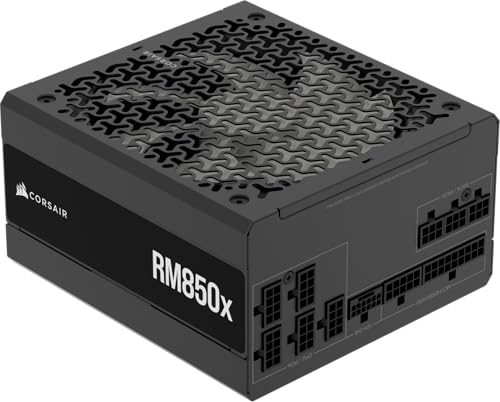

Corsair RM850x vs SF750 at a Glance
| Feature | Corsair RM850x | Corsair SF750 |
|---|---|---|
| Form Factor | ATX | SFX |
| Continuous Wattage | 850 Watts | 750 Watts |
| Efficiency Certification | Cybenetics Gold (Up to 91%) | 80 PLUS Platinum |
| Power Standard | ATX 3.1 / PCIe 5.1 | ATX 3.1 / PCIe 5.1 |
| 12V GPU Connection | Native 12V-2×6 Connector | PCIe 5.1 Ready (Modular) |
| Cooling Fan | 140mm FDB Fan | 92mm PWM FDB Fan |
| Zero RPM Fan Mode | The listing does not specify | Yes |
| Modular Cabling Type | Embossed with low-profile combs | Type-5 Micro-Fit connectors |
| Chassis Adapter Included | The listing does not specify | SFX-to-ATX bracket included |
| Warranty Coverage | 10 Years | 7 Years |
| Best For | Standard ATX desktop cases | Small-form-factor (SFF) cases |
Form Factor and Case Compatibility
Physical casing dimensions dictate where these power supplies can physically operate. The RM850x conforms to the standard ATX form factor, measuring 2.3 x 3.39 x 5.91 inches according to its technical listing, designed to mount directly into mid-tower and full-tower PC enclosures without brackets. Standard ATX cases provide the necessary clearance for its chassis and cable routing paths, ensuring proper airflow around the casing. Attempting to fit an ATX supply into a compact SFF chassis is usually impossible due to clearance limitations around internal brackets and graphics card mounts.
In contrast, the SF750 is built entirely around the ultra-compact SFX standard, occupying a fraction of the interior volume of an ATX model. The Corsair SF750 vs RM850x physical dimension gap enables the SF750 to fit into dedicated Mini-ITX cases like shoebox, sandwich, or console-style layouts where internal space is at a premium. Furthermore, the SF750 listing specifies an included SFX-to-ATX bracket, which allows this diminutive supply to be mounted inside full-sized cases to free up extra clearance for liquid cooling radiators, custom loops, or lengthy storage arrays. Builders deciding on corsair rm750x vs sf750 models face this exact spatial trade-off.
Evaluating the RM850x vs SF750 form factor demonstrates that physical volume fundamentally dictates your chassis selection. Installing the RM850x in standard layouts provides a snug, straightforward installation with ample room for standard cable harnesses. Installing the SF750 provides unmatched adaptability across both mini-ITX chambers and larger enclosures, whereas the RM850x cannot cross over into compact SFF territories under any circumstance.
Edge: Corsair SF750, because its native SFX footprint fits tight mini-ITX enclosures while its included SFX-to-ATX adapter bracket allows installation in standard desktop cases as well.
Wattage and Power Delivery
The total capacity ceiling separates how much raw electrical current each unit can distribute to modern, high-draw PC components. The RM850x delivers 850 watts of continuous power, providing 100 additional watts over its smaller counterpart. Both units comply with Intel’s ATX 3.1 standard and support PCIe 5.1 hardware, meaning both internal architectures are engineered to absorb transient power spikes without triggering emergency shutoffs. However, the higher ceiling on the RM850x gives multi-rail components and high-wattage graphics cards extra operating headroom, particularly when paired with overclocked processors.
The Corsair SF750 wattage ceiling is 750 watts, which is remarkably high for an SFX chassis but naturally lower than the ATX model. For compact gaming rigs, 750 watts handles modern performance GPUs with ease, supported by the unit’s transient spike resistance. High-stress computing and intensive render tasks operate smoothly on both designs thanks to their reliance on 100% Japanese 105°C-rated electrolytic capacitors, which ensure clean, unwavering power delivery under maximum electrical strain. For systems that run closer to the upper edge of power consumption, readers comparing higher capacities like the corsair rm850x vs rm1000x understand how overhead prevents component throttling.
When selecting between the Corsair RM850x or SF750 for gaming, the 850-watt rating of the RM850x provides greater stability for top-tier graphics cards with higher factory power limits. While the SF750 manages flagship hardware remarkably well within its 750-watt boundary, the extra 100 watts of the RM850x provides a safer buffer against sustained heavy loads and future hardware upgrades.
Edge: Corsair RM850x, because its 850-watt continuous output provides 100 watts of additional headroom for demanding hardware configurations.
Efficiency and Thermal Design
Electrical efficiency ratings dictate how much power from the wall socket is converted into heat versus usable direct current. The RM850x features Cybenetics Gold certification, reaching up to 91% electrical efficiency. Cybenetics testing evaluates efficiency across various operating loads, noise levels, and environmental conditions, confirming that the RM850x operates with minimal wasted energy and reduced thermal output inside desktop cases. This efficiency level keeps the internals cooler and limits wasted power draw during extended productivity and gaming sessions.
The SF750 takes electrical efficiency a step further with an official 80 PLUS Platinum certification. Because small-form-factor cases feature limited internal air volume, reducing heat generation at the power supply level is critical. The Platinum rating ensures that less energy is lost as ambient heat, preventing the internal components of the SF750 from saturating the surrounding chassis air. Builders evaluating compact efficiency against competing ATX units like the corsair sf750 vs be quiet! pure power 12 m 850w often prioritize this elevated Platinum tier.
Both units use 105°C-rated Japanese capacitors to sustain longevity in warm environments, but the SF750 achieves a superior efficiency standard. The higher conversion efficiency directly compensates for its tighter internal component layout by emitting less heat into restricted mini-ITX enclosures, whereas the RM850x relies on its Cybenetics Gold profile inside larger spaces with more unrestricted ventilation.
Edge: Corsair SF750, because its 80 PLUS Platinum certification delivers higher electrical efficiency, translating directly to lower waste heat inside compact environments.
Cooling and Noise Performance
Thermal management approaches vary significantly between these two models due to their physical fan diameters. The RM850x houses a large 140mm fluid dynamic bearing (FDB) fan. The wider surface area of a 140mm fan allows it to move a substantial volume of air at relatively low rotational speeds. This larger fan diameter distributes airflow over the internal heat sinks evenly, keeping operating noise low even when the system is under substantial electrical loading.
The SF750 utilizes a 92mm PWM-controlled cooling fan equipped with a fluid dynamic bearing. Because the chassis is small, a 92mm fan must spin faster to move an equivalent volume of air compared to a 140mm unit. However, the SF750 integrates a dedicated Zero RPM Mode, which completely halts the fan during low-load computing tasks. In this mode, the power supply produces zero acoustic noise, relying strictly on passive dissipation until load or thermal thresholds require the fan to spin. The RM850x product specifications do not state whether a Zero RPM mode is present on this specific listing.
Under heavy, sustained loads, the 140mm fan on the RM850x can maintain low acoustics due to its physical size, whereas the 92mm fan on the SF750 must ramp up its PWM curve more aggressively under peak power draws. However, for everyday light loads, the confirmed Zero RPM mode on the SF750 delivers true silence that the RM850x listing does not guarantee. Readers assessing cooling profiles across high-end desktop hardware can review the corsair rm850x vs seasonic focus gx-750 to see similar acoustic comparisons.
Edge: Tie. The RM850x benefits from a larger, quieter 140mm fan under heavy loads, while the SF750 explicitly guarantees absolute silence at low loads via its Zero RPM mode.
Cables and Connector Standards
Both models feature fully modular layouts, allowing builders to attach only the specific cables necessary for their component configuration. The Corsair RM850x ATX 3.1 unit includes embossed, ultra-flexible cables fitted with low-profile combs. These combs keep multi-wire runs aligned neatly, simplifying cable management behind the motherboard tray in mid-tower cases. Additionally, the RM850x features a native 12V-2×6 connector, providing a direct connection to modern PCIe 5.1 graphics cards without requiring cumbersome multi-plug adapters.
The SF750 uses Corsair’s Type-5 Micro-Fit modular connectors. These high-density connectors feature smaller terminal housings at the power supply interface, freeing up valuable space on the rear panel of the unit. The flexible, compact cables bend easily around tight internal clearances, which is essential when routing cables past graphics card backplates and motherboard heatsinks in SFF cases. The listing also highlights ATX 3.1 compliance and PCIe 5.1 support for modern hardware compatibility. Comparing ultra-dense cabling against desktop units, as seen in the corsair rm1000x vs sf750 match-up, emphasizes how much Micro-Fit connectors simplify small chassis assembly.
While the RM850x excels in presentation with its pre-installed cable combs and direct native 12V-2×6 cable, the SF750 optimizes every square millimeter of space with its Type-5 Micro-Fit system. If you are assembling a desktop case with large glass side panels, the embossed cables on the RM850x look clean and structured. If you are building inside tight quarters, the smaller Type-5 connectors on the SF750 prevent cable clutter from choking chassis intake fans.
Edge: Corsair RM850x, because its embossed cables with low-profile combs and native 12V-2×6 GPU connector provide a cleaner, more complete wiring setup for modern high-performance builds.
Warranty and Long-Term Reliability
Long-term reliability is anchored by internal component quality and manufacturer backing. Both the RM850x and SF750 use 100% Japanese 105°C-rated electrolytic capacitors. Japanese capacitors are widely recognized across PC power supply engineering for maintaining stable voltage ripple suppression and resisting degradation caused by heat and prolonged electrical stress. Both units are compliant with the ATX 3.1 specification, ensuring enhanced resilience against transient spikes.
Where these two models diverge is in their factory warranty coverage. Corsair backs the RM850x with a 10-year warranty, reflecting confidence in its thermal dissipation, large 140mm fan, and spacious component spacing. The SF750 comes with a 7-year warranty. While a 7-year warranty remains extensive for any power supply-especially an ultra-dense SFX unit operating in hotter, compact environments-it still falls three years short of the ATX model.
The extra three years of coverage on the RM850x provide added peace of mind for builders who maintain their core power supplies across multiple computer upgrade cycles. While the SF750 is built with top-tier components, the tighter physical thermal envelope of SFX units likely explains why the manufacturer caps its warranty at seven years.
Edge: Corsair RM850x, because its 10-year warranty provides three additional years of guaranteed protection over the SF750.
Pros and Cons
Corsair RM850x

Pros
- 850 watts of continuous power
- Native 12V-2×6 GPU connector
- Large 140mm FDB cooling fan
- Ten-year manufacturer warranty
- Embossed cables with combs
Cons
- ATX size incompatible with SFF cases
- Cybenetics Gold rather than Platinum
Corsair SF750

Pros
- Compact SFX form factor
- 80 PLUS Platinum efficiency
- Zero RPM mode at low loads
- Type-5 Micro-Fit flexible cabling
- SFX-to-ATX bracket included
Cons
- Lower 750-watt power ceiling
- Shorter seven-year warranty
Who Should Buy Each One
Choose the Corsair RM850x If
- You are assembling a system in a mid-tower or full-tower ATX case with standard mounting points.
- You are running high-draw graphics cards that benefit from 850 watts of continuous output and a native 12V-2×6 connector.
- You prioritize long-term investment protection backed by a 10-year manufacturer warranty.
- You want embossed cables with low-profile combs for neat routing behind standard motherboard trays.
Choose the Corsair SF750 If
- You are building a small-form-factor (SFF) or Mini-ITX PC that strictly demands an SFX power supply.
- You want maximum electrical efficiency backed by an 80 PLUS Platinum certification to minimize heat buildup.
- You need completely silent operation during low-load productivity via a dedicated Zero RPM fan mode.
- You want compact Type-5 Micro-Fit cabling or need the flexibility of the included SFX-to-ATX adapter bracket.
Final Verdict
For most desktop builders constructing a PC in a conventional tower chassis, the RM850x is the definitive choice. Its 850-watt continuous output, native 12V-2×6 GPU connection, large 140mm fluid dynamic bearing fan, and superior 10-year warranty make it an outstanding foundation for high-performance computing. Anyone questioning is Corsair RM850x worth it will find that its generous wattage headroom and robust ATX 3.1 transient spike resistance provide exceptional reliability for modern gaming hardware.
However, the SF750 stands as the premier option whenever spatial volume and efficiency take priority. If you are questioning is Corsair SF750 worth it for a compact chassis, its 80 PLUS Platinum efficiency, Zero RPM mode, space-saving Type-5 Micro-Fit cables, and included SFX-to-ATX bracket deliver unmatched versatility. For builders tackling small-form-factor enclosures where standard ATX units cannot fit, the SF750 remains the undisputed champion.
FAQ
Can the Corsair SF750 fit into a standard ATX computer case?
Yes. The SF750 includes an SFX-to-ATX bracket in the package, which adapts its compact SFX mounting pattern to match the standard ATX power supply cutouts found on mid-tower and full-tower cases.
Can I use the Corsair RM850x in a small-form-factor case?
No. When deciding between the Corsair RM850x or SF750 for SFF builds, the RM850x is an ATX form factor unit and cannot fit into Mini-ITX or small-form-factor enclosures that require native SFX power supplies.
Does the Corsair RM850x feature native support for modern PCIe 5.1 graphics cards?
Yes. The RM850x complies with the ATX 3.1 standard and includes a native 12V-2×6 power connector, allowing direct connection to compatible modern GPUs without requiring an external multi-connector adapter.
What is the primary difference in efficiency between these two power supplies?
The RM850x is Cybenetics Gold-certified, delivering efficiency ratings up to 91%. The SF750 holds an 80 PLUS Platinum certification, providing higher overall energy conversion efficiency to reduce waste heat in compact builds.
What cable types are included with the Corsair SF750?
The SF750 comes equipped with fully modular Type-5 Micro-Fit cables. These connectors feature smaller terminal housings that save physical space and route easily through tight chassis corridors.
How long is the manufacturer warranty on both power supplies?
The Corsair RM850x includes a 10-year warranty, while the Corsair SF750 includes a 7-year warranty. Both units utilize 100% Japanese 105°C-rated capacitors for dependable long-term operation.


