The single difference that decides the choice for most buyers comes down to extreme bandwidth and weather protection versus dedicated hardware-level encryption. The Crucial X10 Pro doubles theoretical throughput up to 2,100 MB/s over a 20 Gbps interface and adds an IP55 ingress protection rating for field work, whereas the WD My Passport SSD prioritizes data privacy with built-in 256-bit AES hardware encryption over a standard 10 Gbps connection.
Choose the Crucial X10 Pro if you are a content creator or filmmaker who needs the fastest transfer times and outdoor element resistance for on-location editing. Choose the WD My Passport SSD if you are an enterprise professional, student, or general user who handles sensitive records and values transparent, hardware-managed security on standard USB connections.

Crucial X10 Pro vs WD My Passport SSD at a Glance
| Feature | Crucial X10 Pro | WD My Passport SSD |
|---|---|---|
| Peak Read Speed | Up to 2,100 MB/s | Up to 1,050 MB/s |
| Peak Write Speed | Up to 2,000 MB/s | Up to 1,000 MB/s |
| Interface & Bandwidth | USB 3.2 Gen 2×2 (20 Gbps) | USB 3.2 Gen 2 (10 Gbps) |
| Ingress Protection | IP55 water and dust resistant | Not listed |
| Drop Resistance | Up to 7.5 ft (2 m) | Up to 6.5 ft (1.98 m) |
| Data Security | Password protection | 256-bit AES hardware encryption |
| Chassis Construction | Anodized aluminum with lanyard loop | Metal shock and vibration resistant |
| Form Factor Weight | Not listed | 46 g |
| Included Software | Mylio Photos+ (3 months), Acronis True Image | Not listed |
| Best For | High-bandwidth video editing and outdoor workflows | Encrypted office backups and everyday travel storage |
Read and Write Transfer Speeds
Sustained transfer speeds determine how quickly massive video folders, system backups, and game installations move between your internal drive and external media. When evaluating the Crucial X10 Pro transfer speed, the specifications highlight a theoretical ceiling of up to 2,100 MB/s read and 2,000 MB/s write. These numbers rely on a 20 Gbps connection protocol, allowing modern workstations equipped with USB 3.2 Gen 2×2 to move data at double the speed of older USB generations. For creative editors offloading hundreds of gigabytes of raw production footage, reaching past two gigabytes per second dramatically reduces idle rendering and copy times.
By comparison, the WD My Passport SSD read write speed tops out at 1,050 MB/s read and 1,000 MB/s write using internal NVMe architecture over a USB 3.2 Gen 2 interface. While this provides snappy responsiveness that outclasses mechanical hard drives and standard SATA external drives, it operates at half the sequential ceiling offered by the Crucial drive. If you are comparing modern portable drives across our comprehensive tests, such as in our samsung t9 vs crucial x10 pro analysis, peak throughput remains closely linked to host-controller compatibility.
The operational catch lies in your host machine’s hardware capabilities. To extract the full 2,100 MB/s from the Crucial X10 Pro, your computer must feature a dedicated USB 3.2 Gen 2×2 port. Standard USB-C ports found on many mainstream laptops and older desktops cap out at 10 Gbps, which levels the Crucial unit down to roughly the same speeds as the WD model. However, on compatible hardware, Crucial holds an undeniable bandwidth advantage for raw ingestion and active workspace duties.
Edge: Crucial X10 Pro delivers double the potential sequential read and write speeds over its 20 Gbps interface.
Outdoor Durability and Rugged Build Quality
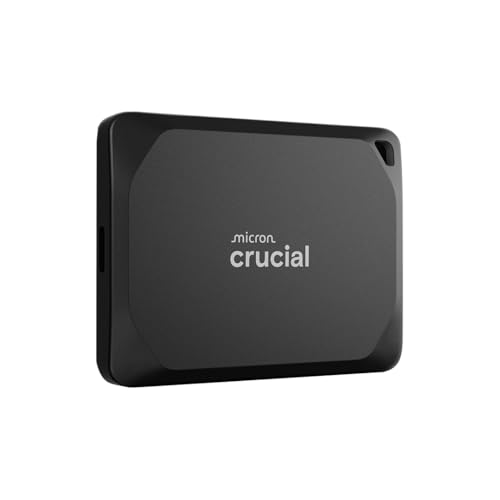
A portable drive taken into the field must endure drops, dust, spills, and vibration without losing structural integrity or corrupting stored data. The Crucial X10 Pro IP55 rating certifies that the enclosure can withstand exposure to dust deposits and low-pressure water jets from any direction. Furthermore, Crucial rates the drive for drop protection from heights up to 7.5 feet (2 meters) onto carpeted concrete floors. The exterior is crafted from anodized aluminum, featuring an integrated lanyard loop and a discrete activity light to visually confirm active read/write operations before disconnection.
The WD My Passport SSD features a sleek, compact metal shell engineered to resist shock and vibration, with drop resistance rated up to 6.5 feet (1.98 meters). At a featherweight 46 grams, it slips effortlessly into a shirt pocket or laptop sleeve without adding bulk. However, the manufacturer listing does not specify any official IP ingress protection rating against water sprays or airborne particulate matter. Similar environmental distinctions often decide field viability when weighing pro-grade drives, as explored in our sandisk extreme pro portable vs crucial x10 pro breakdown.
For users operating strictly in corporate offices, home studios, or university lecture halls, the physical protection offered by the WD drive is more than sufficient to handle accidental desk drops and commute jostling. For travel photographers, documentary crews, and field engineers who operate outside controlled indoor environments, Crucial provides the added peace of mind that a splash of rain or trail dust will not compromise critical files.
Edge: Crucial X10 Pro offers a certified IP55 water and dust resistance rating alongside a higher 7.5-foot drop tolerance.
Data Security and Encryption Architecture
Protecting commercial assets, client deliverables, and personal records against unauthorized access requires a dependable security implementation. The WD My Passport SSD distinguishes itself by integrating password-enabled 256-bit AES hardware encryption directly on the controller. Because the encryption process is executed on the drive’s dedicated silicon rather than relying on the host computer’s operating system, cryptographic protection remains seamless, non-intrusive, and computationally isolated from the host machine’s processor.
The Crucial X10 Pro listing specifies password protection to safeguard user data on the move, but it lacks dedicated hardware-level 256-bit AES encryption silicon. While software password tools and OS-level file encryption utilities can restrict unauthorized access, they consume host processing resources during active read and write operations. When managing confidential legal contracts, proprietary client drafts, or sensitive accounting spreadsheets, hardware-based authentication eliminates reliance on external software suites.
For high-security corporate environments where IT departments enforce strict compliance policies, hardware encryption is often an uncompromised prerequisite. In this WD My Passport SSD review comparison, Western Digital takes the clear lead by baking defense-grade cryptographic silicon straight into the controller without requiring external encryption tools.
Edge: WD My Passport SSD provides built-in 256-bit AES hardware encryption for superior data privacy.
Video Editing and Sustained Creator Workflows
When deciding between the Crucial X10 Pro or WD My Passport SSD for video editing, sustained throughput and buffer stability take center stage. Video editors working with multi-stream 4K or 8K ProRes timelines require an external drive that functions as an active scratch disk without dropping frames or stuttering during playback. The Crucial X10 Pro is engineered specifically for creative professionals, offering read speeds up to 2,100 MB/s that let you scrub complex timelines and composite motion graphics directly from the external volume.
The WD My Passport SSD, with read speeds reaching 1,050 MB/s, handles single-stream 4K video editing, proxy workflows, and high-resolution photo catalogs with reliable fluidity. However, when handling multi-camera edits or high-bitrate uncompressed footage, its 10 Gbps connection acts as a data pipeline ceiling. Those who analyze professional mobile editing gear in comparisons like our sandisk extreme pro portable vs wd my passport ssd guide know that video timelines demand maximum continuous throughput.
Crucial further supports professional media workflows by bundling three months of Mylio Photos+ and Acronis True Image upon registration. These tools simplify media organization and drive cloning, whereas the WD listing does not detail supplementary media software. The combination of 20 Gbps bandwidth and tailored creator features establishes the Crucial X10 Pro as the superior workstation companion for demanding media production.
Edge: Crucial X10 Pro provides the continuous bandwidth required for uncompressed multi-stream video editing and includes creative management software.
Device Compatibility and Everyday Portability
Device versatility ensures that an external SSD integrates friction-free across your entire hardware ecosystem. The Crucial X10 Pro offers extensive out-of-the-box compatibility, connecting via USB-C and USB-A to Windows, Mac, iPad Pro, Chromebooks, Android devices, Linux workstations, PS4, PS5, Xbox, and even legacy devices like the Sony PlayStation Vita. This broad hardware support makes the drive a flexible asset for users who constantly transition between desktop rendering rigs, tablets on location, and gaming setups.
The WD My Passport SSD provides cross-compatible operation with USB 3.2 Gen 2 and USB-C connections, supporting modern Mac and PC machines straight out of the box, with USB-A compatibility for legacy systems. Measuring exceptionally compact and weighing only 46 grams, the My Passport SSD is remarkably easy to carry in everyday commuter gear. For builders upgrading storage setups across internal and external media, checking cross-platform component reviews such as our wd blue sn580 vs crucial p310 evaluation shows how modern storage interfaces streamline workflows across platforms.
Both drives offer plug-and-play simplicity for modern computers, yet Crucial documents broader native hardware profiles across consoles and mobile devices. Crucial also incorporates a physical lanyard hole directly into its aluminum housing, giving creators an easy way to tether the drive to a camera cage, field bag, or belt loop during transit.
Edge: Crucial X10 Pro edges ahead with broader documented device compatibility and an integrated lanyard loop.
Pros and Cons
Crucial X10 Pro
Pros
- Up to 2100MB/s read and 2000MB/s write speeds
- IP55 water and dust resistance rating
- Superior 7.5-foot drop protection
- High-bandwidth 20Gbps data transfer rate
Cons
- Requires 20Gbps port for peak transfer speeds
- Lacks stated 256-bit AES hardware encryption
View Crucial X10 Pro on Amazon
WD My Passport SSD
Pros
- Built-in 256-bit AES hardware encryption
- Ultra-lightweight portable build at 46 grams
- Shock and vibration resistant metal design
Cons
- Slower read speeds capped at 1050MB/s
- No official IP water or dust resistance rating
- Lower 6.5-foot drop resistance
View WD My Passport SSD on Amazon
Who Should Buy Each One
Choose the Crucial X10 Pro If

- You own a workstation or laptop with USB 3.2 Gen 2×2 ports and want read speeds reaching 2,100 MB/s.
- You shoot video and photos outdoors and require certified IP55 water and dust resistance.
- You edit multi-stream 4K or 8K media directly off the external SSD without rendering local proxies.
- You need broad cross-device functionality spanning consoles, iPads, Android devices, and multiple operating systems.
Choose the WD My Passport SSD If

- You handle confidential business, legal, or personal data requiring 256-bit AES hardware encryption.
- Your computers feature standard 10 Gbps USB 3.2 Gen 2 or USB-A ports where higher bandwidth SSDs are throttled.
- You prefer an ultralight 46-gram metal chassis tailored for business travel and daily briefcase transport.
- You need a dependable plug-and-play drive for general system backups, document archives, and photo libraries.
Final Verdict
For most creative professionals, tech enthusiasts, and performance-minded users, the Crucial X10 Pro emerges as the stronger investment. In this head-to-head Crucial X10 Pro vs My Passport SSD matchup, the X10 Pro separates itself through raw performance metrics, providing up to 2,100 MB/s read and 2,000 MB/s write speeds alongside rigorous IP55 environmental protection and 7.5-foot drop durability. If you work in demanding environments or handle large video timelines, the answer to whether is Crucial X10 Pro worth it is an unequivocal yes.
Conversely, the WD My Passport SSD wins when data privacy and office practicality take precedence over peak throughput. If your host devices do not support 20 Gbps USB 3.2 Gen 2×2, the extra theoretical bandwidth of the Crucial drive remains dormant, making the WD drive’s 1,050 MB/s transfer rate fully competitive. When combined with dedicated 256-bit AES hardware encryption and a svelte 46-gram enclosure, buyers looking for corporate security will find that is WD My Passport SSD worth it for peace of mind.
FAQ
Which drive is faster between the Crucial X10 Pro and WD My Passport SSD?
The Crucial X10 Pro is substantially faster, offering read speeds up to 2,100 MB/s and write speeds up to 2,000 MB/s over a USB 3.2 Gen 2×2 (20 Gbps) interface. The WD My Passport SSD delivers speeds up to 1,050 MB/s read and 1,000 MB/s write over a USB 3.2 Gen 2 (10 Gbps) connection.
Can I edit 4K video directly off the Crucial X10 Pro and WD My Passport SSD?
Yes, both drives can handle 4K video editing, but the Crucial X10 Pro provides far more headroom for heavy multi-stream timelines and high-bitrate uncompressed codecs due to its 2,000 MB/s write capabilities. The WD My Passport SSD is best suited for compressed 4K footage or proxy-based editing workflows.
Does the WD My Passport SSD require special software for encryption?
The WD My Passport SSD utilizes built-in 256-bit AES hardware encryption managed via password protection. Because cryptographic scrambling is handled by hardware inside the drive rather than software on the host CPU, security runs efficiently without taxing your system resources.
Is the Crucial X10 Pro waterproof?
The Crucial X10 Pro carries an official IP55 rating, which means it is resistant to dust deposits and low-pressure water sprays from any angle. While it is built to survive outdoor rain and spills, it is not rated for full underwater submersion.
Can both drives connect to gaming consoles like the PS5 and Xbox?
The Crucial X10 Pro explicitly lists compatibility with PS5, PS4, Xbox, and older hardware like the PlayStation Vita. The WD My Passport SSD functions as an external USB storage volume for consoles using standard USB-C and USB-A connections, though it is primarily marketed for PC and Mac desktop use.
Why does the Crucial X10 Pro require a specific USB port to reach maximum speed?
The Crucial X10 Pro uses the USB 3.2 Gen 2×2 protocol, which bonds two 10 Gbps data lanes together to reach 20 Gbps. If plugged into a standard USB 3.2 Gen 2 (10 Gbps) or USB 3.0 port, the drive will automatically downshift to match the host port’s lower speed ceiling.