The deciding factor between these two Enduro Series lawn tractors comes down to powertrain architecture and cutting deck width: the Cub Cadet XT1 LT42 pairs a compact 42-inch cutting deck with a single-cylinder Kohler 5400 Series engine generating between 17 and 19.5 horsepower, whereas the Cub Cadet XT1 LT46 upgrades to a 46-inch cutting deck powered by a Kohler 7000 Series twin-cylinder engine delivering between 20 and 26 horsepower. This structural divergence directly affects mowing duration, fuel management, engine smoothness, and gate clearance across residential properties.
Homeowners managing standard residential lots under an acre with perimeter fencing and tight garden gates should choose the XT1 LT42 for its nimble handling and simplified maintenance. Property owners caring for open ground exceeding one acre or contending with thick, overgrown turf should select the XT1 LT46 for its increased mowing swath and robust twin-cylinder torque reserve.


Cub Cadet XT1 LT42 vs Cub Cadet XT1 LT46 at a Glance
| Feature | Cub Cadet XT1 LT42 | Cub Cadet XT1 LT46 |
|---|---|---|
| Cutting Deck Width | 42 inches | 46 inches |
| Engine Series | Kohler 5400 Series | Kohler 7000 Series |
| Engine Architecture | Single cylinder | Twin cylinder |
| Horsepower Rating | 17 HP to 19.5 HP | 20 HP to 26 HP |
| Engine Compatibility | Kohler KS530, KS540, KS590, KS595 | Kohler KT715, KT725, KT730, KT735, KT740, KT745 |
| Spark Plug Setup | 1 Spark Plug (14 132 11-S) | 2 Spark Plugs (25 132 23-S) |
| Engine Oil Supply | Not listed | Two 32 oz bottles (64 oz total SAE 10W-30) |
| Air Filtration System | Filter 22 083 01-S / Pre-cleaner 22 083 04-S | Filter 32 083 10-S / Pre-cleaner 32 083 10-S |
| Turning Radius | Not listed | Not listed |
| Best For | Residential lawns under 1 acre with tight clearances | Large acreage over 1 acre and demanding cutting conditions |
Engine Architecture and Power Delivery
The operational core of any lawn tractor is its powertrain, and examining the Cub Cadet XT1 single vs twin cylinder layout reveals significant practical differences in vibration, operating sound, and cutting stamina. The XT1 LT42 is powered by a single-cylinder Kohler 5400 Series engine, covering power bands from 17 HP up to 19.5 HP across engine variations such as the KS530, KS540, KS590, and KS595. A single-cylinder engine concentrates its power stroke into a single piston, creating a mechanical rhythm that is direct, mechanically basic, and highly efficient for steady grass trimming. However, single-piston operation produces natural vibrational harmonics that transfer through the chassis during extended cutting sessions.
Conversely, the Cub Cadet XT1 LT46 engine specs highlight the Kohler 7000 Series V-twin engine platform, spanning models from the KT715 to the KT745 with power output rated between 20 HP and 26 HP. The twin-cylinder configuration divides the combustion load across two opposed cylinders firing in balanced sequence. This configuration substantially dampens operating vibrations, delivering smoother power delivery and significantly higher torque under sudden heavy load. When tackling dense patches of clover, damp turf, or tall field weeds, the twin-cylinder architecture maintains blade tip speed where a single-cylinder motor might experience RPM drop. Shoppers comparing mid-range riding platforms often evaluate the cub cadet xt1 lt42 vs husqvarna yth18542 to see how single-cylinder engines stack up against alternative brands, but within the XT1 family, the displacement and cylinder upgrade of the LT46 represents a major performance jump.
Choosing between these two engine configurations requires balancing property demands against operating costs. The single-cylinder motor on the LT42 consumes less fuel during standard cutting cycles and operates with straightforward mechanical simplicity. The twin-cylinder powerhouse on the LT46 consumes more fuel per hour but generates the continuous muscle necessary to power through heavy mowing without bogging down the transmission or slowing forward momentum.
Edge: Cub Cadet XT1 LT46 delivers superior torque, smoother running balance, and higher maximum horsepower for demanding turf.
Cutting Deck Size and Acreage Productivity
The physical footprint of the mower deck dictates how quickly an operator can process wide expanses of grass. The Cub Cadet XT1 deck size difference represents a four-inch gap in cutting path between the 42-inch deck of the LT42 and the 46-inch deck of the LT46. While four inches might seem modest on paper, across an expansive residential property that difference multiplies with every back-and-forth pass. A 46-inch deck sweeps roughly ten percent more surface area per rotation, compoundingly shrinking total operating time on properties with broad, unbroken stretches of lawn.
When deciding on the Cub Cadet XT1 LT42 or LT46 for 1 acre, mowing efficiency becomes a primary consideration. A one-acre lot typically features around 35,000 to 40,000 square feet of actual cuttable grass once structures and driveways are subtracted. Utilizing the LT42 requires more total turns and overlapping passes to achieve clean, uniform coverage. The LT46, with its broader swath, reduces the number of directional transitions required, saving valuable seat time and mechanical runtime on the engine and belts. Readers assessing productivity on open acreages often study the cub cadet xt1 lt46 vs toro timecutter 42 to contrast traditional tractor deck sizing against zero-turn alternatives.
However, deck width introduces a physical trade-off when negotiating property contours. Wider decks are more prone to scalping sudden high spots or mounds in undulating yards if the terrain changes abruptly beneath the cutting shell. The 42-inch deck of the LT42 follows subtle ground undulations with less risk of scraping the turf crown on uneven ground. For flat, sprawling acreage, the 46-inch platform remains the indisputable efficiency leader.
Edge: Cub Cadet XT1 LT46 finishes large open lawns faster due to its wider 46-inch cutting path.
Maneuverability and Property Navigation
Lawn navigation involves more than straight-line speed; it requires negotiating flower beds, garden boundaries, retaining walls, and perimeter fences. While the manufacturer specifications do not list an exact numeric turning radius for either machine in the provided listing data, the overall physical geometry of the tractor frames and cutting decks dictates how easily each machine maneuvers in constrained environments. The Cub Cadet LT42 vs LT46 turning radius discussion is shaped fundamentally by the physical overhang of their respective decks relative to the tractor chassis.
The XT1 LT42 possesses a narrow profile that excels in tight suburban configurations. Standard residential backyard gates often measure between 46 and 48 inches in width. A 42-inch cutting deck slides through standard four-foot gates with adequate clearance for the discharge chute, eliminating the need to take down fence sections or keep a secondary push mower on hand for enclosed backyards. Exploring comparisons like the john husqvarna ts 120 vs cub cadet xt1 lt42 highlights how compact residential platforms simplify navigation through dense suburban obstacle courses.
In contrast, the XT1 LT46 features a broader housing that often measures well past 48 inches when the grass discharge deflector is factored into the equation. Navigating this wider profile requires wider clearance around mature trees, brick edging, and narrow side yards. If an operator attempts to navigate tight garden corners with the 46-inch deck, they must leave wider buffers to avoid scraping obstacles. For landscapes defined by intricate gardens, tight gates, and numerous tree rings, the smaller platform proves significantly easier to steer and park.
Edge: Cub Cadet XT1 LT42 easily maneuvers around tight obstacles and fits through standard residential fence gates.
Routine Maintenance and Operating Complexity
Ongoing equipment ownership is defined by routine seasonal servicing, and the specifications from replacement maintenance packages illustrate distinct mechanical requirements between these two models. A comprehensive Cub Cadet XT1 LT42 review must emphasize the simplicity of its single-cylinder layout. The Hipa maintenance kit for the LT42 Kohler 5400 Series contains a single spark plug (part 14 132 11-S), an air filter (part 22 083 01-S / 22 883 01-S1) paired with pre-cleaner 22 083 04-S, an engine oil filter (part 12 050 01-S), and a standard fuel filter (part 25 050 22-S). Performing an annual tune-up on this engine takes minimal time because the technician only needs to gap and thread one spark plug and monitor a modest oil reservoir.
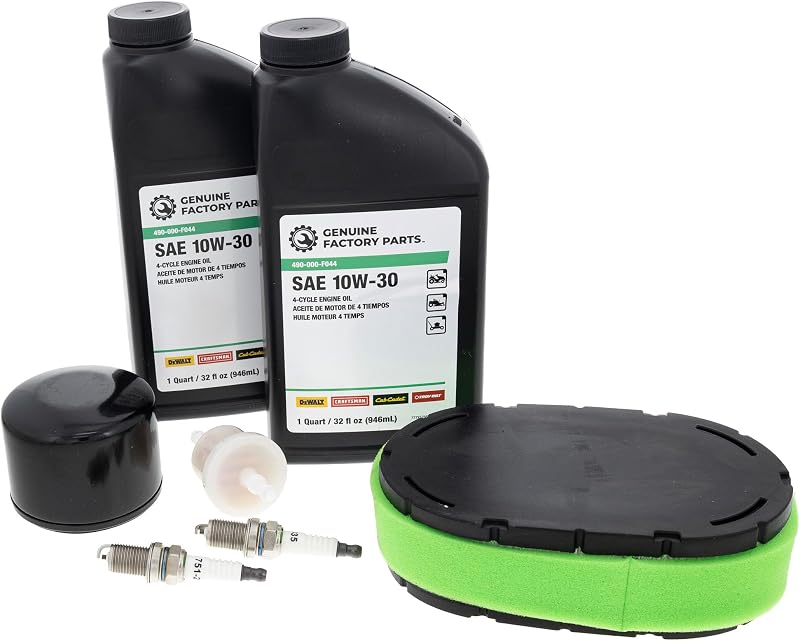
By comparison, servicing the XT1 LT46 involves additional components and higher consumable volumes, as revealed in the Cub Cadet genuine OEM maintenance kit (part 490-950-F051). Because the Kohler 7000 Series is a V-twin engine, it requires two spark plugs (part 25 132 23-S) and a larger air filtration assembly (air filter 32 083 10-S with matching pre-filter). Furthermore, the factory kit for the LT46 includes two full 32-ounce bottles of SAE 10W-30 motor oil (64 ounces total), reflecting the greater lubrication capacity demanded by the dual-cylinder crankcase. While both models utilize the identical 12 050 01-S oil filter and 25 050 22-S fuel filter, the twin-cylinder platform inherently doubles ignition maintenance and requires more lubricant volume per service interval. Shoppers exploring compact platforms frequently reference the cub cadet xt1 lt42 vs toro timecutter 42 to see how single-cylinder maintenance routines compare across different brand offerings.
This servicing difference translates directly into ownership labor. Changing plugs on a single-cylinder tractor is an accessible five-minute task located on one side of the engine block. The LT46 requires accessing plug ports on both cylinder banks of the Kohler 7000 V-twin. While neither maintenance routine is prohibitively complex, the LT42 offers an undeniable advantage in service speed and lower fluid requirements over its operational life.
Edge: Cub Cadet XT1 LT42 requires fewer service components, utilizing only one spark plug and less oil volume.
Heavy-Duty Capability and Durability Under Load
Evaluating long-term tractor value requires analyzing how each machine handles harsh operating conditions, thick turf growth, and hot summer temperatures. When asking is Cub Cadet XT1 LT46 worth it, one must consider the structural resilience of its twin-cylinder Kohler 7000 Series powerplant. Twin-cylinder engines dissipate heat more effectively across two separate cylinder jugs than a high-displacement single-cylinder engine that generates all its combustion heat within a single cylinder wall. This thermal advantage allows the LT46 to maintain peak power output during mid-summer heatwaves without entering thermal stress or losing operating efficiency.
A detailed Cub Cadet XT1 LT46 review reveals that the engine’s power band (20 HP to 26 HP) provides vital overhead when cutting thick, moisture-rich spring grasses. When an operator drives a tractor into overgrown fescue or rye, blade resistance places instant mechanical load on the engine spindle. The higher displacement Kohler KT715 through KT745 series engines absorb this load seamlessly, maintaining high blade tip speeds that produce clean, un-ragged grass tips and prevent deck clogging. Comparisons such as the cub cadet xt1 lt46 vs husqvarna yth18542 highlight how dual-cylinder power reserves protect equipment life when tackling demanding properties.
The LT42, while capable of pristine cuts on maintained turf, operates closer to its maximum mechanical threshold when encountering heavy, overgrown growth. Its 17 to 19.5 HP single-cylinder Kohler 5400 engine must work harder under tall turf, which can elevate engine operating temperatures and increase component wear if forced to cut dense brush or overgrown pasture grass on a regular basis. For challenging mowing conditions, the LT46 provides the heavy-duty stamina required for multi-season durability.
Edge: Cub Cadet XT1 LT46 offers greater thermal dissipation and heavy-duty power overhead to prevent strain in thick grass.
Pros and Cons
Cub Cadet XT1 LT42

Pros
- Kohler 5400 single-cylinder simplicity
- Single spark plug seasonal servicing
- Compact 42-inch deck fits standard gates
- Agile navigation around garden beds
Cons
- Lower maximum horsepower ceiling
- Requires more passes on large lawns
View Cub Cadet XT1 LT42 on Amazon
Cub Cadet XT1 LT46
Pros
- Kohler 7000 series twin-cylinder engine
- Higher power rating reaching 26 HP
- Wider 46-inch deck reduces mowing passes
- Smooth balanced dual-cylinder operation
Cons
- Requires two spark plugs and dual oil bottles
- Wider deck clearance restricts gate passage
View Cub Cadet XT1 LT46 on Amazon
Who Should Buy Each One
Choose the Cub Cadet XT1 LT42 If
- Your property measures under one acre and features standard lawn grass with regular mowing schedules.
- You need to navigate through narrow backyard fence gates that cannot accommodate decks wider than 42 inches.
- You prefer simple maintenance routines that require only one spark plug and lower oil capacity during seasonal tune-ups.
- Your yard contains numerous decorative garden beds, tight tree clusters, and complex borders demanding a compact mowing footprint.
Choose the Cub Cadet XT1 LT46 If
- Your lawn exceeds one acre of open ground where a wider 46-inch cutting deck substantially cuts down total mowing time.
- You frequently contend with heavy, damp, or overgrown grass that requires the robust torque of a 20 HP to 26 HP twin-cylinder engine.
- You prefer the smooth, low-vibration operating experience of a balanced V-twin Kohler 7000 Series platform.
- Your storage shed and boundary gates provide ample width to house a 46-inch cutting deck without clearance issues.
Final Verdict
For most homeowners managing suburban acreage between one and two acres, the Cub Cadet XT1 LT46 emerges as the superior long-term investment. The pairing of a wider 46-inch cutting platform with the smooth, high-output Kohler 7000 Series twin-cylinder engine transforms routine mowing into a faster, less fatiguing chore. The additional horsepower overhead ensures the machine cuts cleanly through thick springtime growth without bogging down, while the dual-cylinder design runs cooler and smoother during long mid-summer cuts. Shoppers evaluating broad cutting decks against competing residential tractors often review comparisons like the john husqvarna ts 120 vs cub cadet xt1 lt46 before finalizing their decision, but within the Enduro line, the LT46 offers exceptional cutting capability.
However, the Cub Cadet XT1 LT42 remains the definitive choice for properties defined by spatial constraints rather than open acreage. If your property features a standard four-foot perimeter gate, dense ornamental landscaping, or limited garage storage space, the 46-inch deck becomes a frustrating liability. The LT42 provides dependable Kohler 5400 power, an agile 42-inch deck profile, and rock-solid single-cylinder mechanical simplicity that reduces seasonal tune-up costs. When evaluating the Cub Cadet XT1 LT46 vs LT42, choose the LT42 for tight suburban yards and the LT46 for sprawling, demanding lawns.
FAQ
Is the Cub Cadet XT1 LT46 worth it over the LT42?
The XT1 LT46 is well worth the upgrade if your property exceeds one acre or features dense, fast-growing turf. The step up from a single-cylinder engine to a Kohler 7000 Series twin-cylinder motor provides significantly smoother operation, reduced vibration, and 20 HP to 26 HP of cutting power, which prevents deck clogging and reduces mowing passes on larger lawns.
Can the Cub Cadet XT1 LT42 handle a 1-acre property?
Yes, the XT1 LT42 can manage a one-acre property, but it will require more time and additional mowing passes compared to the LT46. Its 42-inch deck and 17 to 19.5 HP Kohler 5400 engine are fully capable of maintaining typical turf, though operators will spend roughly ten to fifteen percent more time in the seat compared to using a 46-inch deck.
What is the difference between the Kohler 5400 and Kohler 7000 engines?
The primary difference lies in cylinder architecture and power output. The Kohler 5400 Series used in the LT42 is a single-cylinder engine producing between 17 HP and 19.5 HP, utilizing one spark plug. The Kohler 7000 Series on the LT46 is a V-twin engine producing between 20 HP and 26 HP, utilizing dual spark plugs and two quarts of oil for smoother operation and higher torque.
What are the turning radius specifications for the LT42 and LT46?
The manufacturer listing data does not specify the exact numeric turning radius for either the LT42 or the LT46. However, the physical width of the deck affects maneuvering agility; the LT42 features a narrower cutting housing that navigates tighter spaces and corners more easily than the wider 46-inch deck of the LT46.
Do both models use the same oil filter and fuel filter?
Yes, according to the official maintenance kits, both the Kohler 5400 Series on the LT42 and the Kohler 7000 Series on the LT46 utilize the same 12 050 01-S engine oil filter and 25 050 22-S fuel filter. However, their air filters, pre-cleaners, spark plug models, and total oil capacities differ significantly.
Will the Cub Cadet XT1 LT46 fit through a standard yard gate?
Most standard residential backyard gates measure 48 inches wide. While the cutting deck itself measures 46 inches, the protruding discharge chute and bracket assembly often expand the tractor’s overall width past 48 inches. Consequently, the LT46 generally requires a 52-inch or wider gate opening, whereas the 42-inch LT42 can easily clear standard four-foot gates.


