The single deciding factor between the DeWalt DCD801 and the DeWalt DCD800 is active bind-up safety versus compact chassis clearance: the DCD801 incorporates an electronic Anti-Rotation shutoff mechanism designed to protect your wrists when boring high-torque holes, while the DCD800 utilizes an ultra-short 6.37-inch profile built specifically to fit between tight framing members and cramped mechanical bays.
Choose the DeWalt DCD801 if your daily workload demands high-demand hole-making where catching a hidden knot or metal strike could violently jerk the tool out of your grip. Choose the DeWalt DCD800 if you primarily navigate cramped corners, awkward joist cavities, and tight interior cabinetry where every fraction of an inch of clearance dictates whether a drill fits.
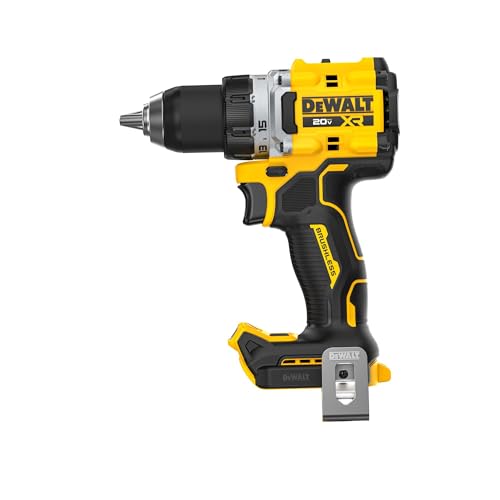

DeWalt DCD801 vs DeWalt DCD800 at a Glance
| Feature | DeWalt DCD801 | DeWalt DCD800 |
|---|---|---|
| Anti-Rotation Safety Shutoff | Yes (with red LED alert indicator) | Not listed |
| Tool Dimensions (L x W x H) | 9.0 x 3.5 x 7.1 inches | 6.37 x 2.5 x 8.14 inches |
| No-Load Speed Settings | 2 speeds (0-650 / 0-2,000 RPM) | 2 speeds (0-650 / 0-2,000 RPM) |
| Chuck Size and Construction | 1/2-inch metal ratcheting | 1/2-inch metal ratcheting |
| Work Light Illumination | 3-position LED (70 lumens with auto-shutoff) | 3-position LED (70 lumens with 20-minute spotlight) |
| Asset Tracking Integration | Tool Connect Chip Ready | Tool Connect Chip pocket (DCE042 compatible) |
| Listed Power Output | Up to 109% more powerful rating | 300 watts / 1400 ft-lb listed torque |
| Rated Drilling Capacity (Wood / Metal) | 0.5 inches / 0.5 inches | 0.5 inches / 0.5 inches |
| Package Configuration | Bare tool (belt hook included) | Kit (two 2Ah batteries, charger, bag, hook) |
| Best For | Heavy hole drilling with kickback safety | Tight-space framing, plumbing, and electrical rough-ins |
Kickback Safety and Anti-Rotation Protection
Kickback in a cordless drill occurs whenever a large spade bit, hole saw, or self-feed bit binds against dense timber or struck hardware, suddenly reversing the rotational torque directly into the operator’s hands, wrists, and elbows. In professional trades, this sudden violent twist is one of the most common causes of workplace sprains and dropped tools on elevated platforms. Having an active sensor system mitigates this risk by shutting off the motor before the drill can rotate out of control.
This critical division stands at the core of any DeWalt DCD800 vs DCD801 comparison. The DCD801 is specifically engineered with DeWalt’s dedicated Anti-Rotation System, an electronic gyroscopic sensor that measures rotational movement and immediately halts motor drive when severe, uncontrolled tool rotation occurs. In addition to cutting power, the tool illuminates a bright red diagnostic LED on the foot to visibly alert you that the anti-rotation clutch was engaged. In contrast, the DCD800 listing does not specify any anti-kickback or bind-up detection hardware, relying solely on its mechanical friction clutch and manual trigger feathering to prevent over-torque situations.
The safety advantage offered by the DCD801 pays massive dividends on rough jobsites where operators work off extension ladders or reach into awkward, unbraced overhead angles. If you frequently bore large holes with aggressive feed rates, you can explore similar heavy-duty platforms in our dewalt dcd801 vs dcd805 analysis. For users routinely pushing high-capacity bits, the electronic safety shield of the DCD801 transforms high-torque drilling from a wrist-straining hazard into a controlled, predictable task.
Edge: DeWalt DCD801 wins decisively here by providing an intelligent electronic anti-rotation shutoff system that prevents violent tool spin during sudden bit bind-ups.
Chassis Dimensions and Tight-Space Maneuverability
When running conduit, plumbing drains, or structured cabling through finished framing, drill head length determines whether you can drill straight between standard 16-inch-on-center studs or if you need an unwieldy right-angle attachment. A tool with an elongated front-to-back profile forces users to drill at an off-axis angle, which increases friction, stalls motor speeds, and results in misaligned penetrations.
Examining the DCD800 head length vs DCD801 reveals a stark structural divergence. The DCD800 features an ultra-compact chassis measuring just 6.37 inches long, which is a full half-inch shorter than preceding workhorses like the DCD791. Its slender 2.5-inch width allows it to slide cleanly between closely spaced pipes and under-sink framing. By comparison, the DCD801 specification sheet lists total item dimensions at 9 inches long by 3.5 inches wide, producing a substantially bulkier profile that demands extra working clearance.
If you are trying to decide between the DCD801 or DCD800 for tight spaces, the DCD800 is the clear physical winner. Contractors upgrading from older entry-level models often evaluate options like the dewalt dcd771 vs dcd800 precisely because the shorter nose on the DCD800 eliminates the frustrating clearance headaches common in cramped remodel projects. The DCD801 requires noticeably more room to operate, making it better suited for open-bench fabrication or unobstructed wall studs.
Edge: DeWalt DCD800 takes the clearance category thanks to its stubby 6.37-inch chassis that slips effortlessly into cramped framing cavities.
Motor Power, Speed, and Workload Productivity
Motor efficiency dictates how rapidly a tool completes repetitive cuts and whether it maintains operational speed under dense load. A high-efficiency brushless motor delivers prolonged runtimes and ensures that battery energy transfers cleanly into chuck rotation rather than wasting energy as heat. This metric directly impacts your daily output when drilling dozens of holes in structural lumber or electrical enclosures.
Looking at the DeWalt DCD801 vs DCD800 specs, both drills feature two mechanical speed gears delivering identical no-load speeds of 0 to 650 RPM in low gear and 0 to 2,000 RPM in high gear, managed by sensitive variable-speed triggers. Both listings also publish a 0.5-inch drilling capacity rating in wood and 0.5-inch in metal. However, the internal motor tuning differs according to product documentation. The DCD801 is designated by DeWalt as their most powerful 20V MAX 2-speed drill/driver, engineered to deliver up to 109% more power than previous baselines, capable of churning out up to 175 holes per battery charge while claiming a 25% power advantage over select competitive platforms.
Meanwhile, the DCD800 listing highlights a maximum power rating of 300 watts alongside a listed 1400 ft-lb torque specification, providing aggressive driving force in an XR compact footprint. While the DCD800 offers ample driving muscle for general carpentry and mechanical assembly, those requiring raw, sustained drilling throughput can inspect larger hammer drill configurations in our dewalt dcd801 vs dcd996 overview. In this specific pair, the DCD801 carries the factory designation for top-tier power output and high-volume hole completion.
Edge: DeWalt DCD801 takes the motor category based on documented manufacturer ratings indicating up to 109% increased power output and heavy-duty 175-hole cycle endurance.
Work Light Functionality and Jobsite Visibility
Drill-mounted LED lights are critical when roughing in basement utility rooms, unpowered attics, crawlspaces, or deep under-counter cabinetry. Beyond sheer brightness, the placement of the emitter and the flexibility of its timer settings dictate whether the work light genuinely replaces a handheld flashlight or simply casts annoying shadows behind your drill bit.
Both the DCD801 and the DCD800 incorporate high-output foot-mounted 3-position pivoting LEDs that produce up to 70 lumens of illumination. Positioned on the battery base rather than directly under the chuck, both lights angle their beam upward to illuminate the exact contact point of the fastener without creating a dark barrel shadow. However, their internal firmware settings introduce a practical operational difference.
The DCD800 listing highlights three distinct light modes, most notably an extended 20-minute spotlight shutoff mode. This extended timer allows the DCD800 to stand upright on its battery and act as a stationary area floodlight while you organize fittings, pull wire, or inspect breaker panels in total darkness. The DCD801 documentation specifies an adjustable 3-position 70-lumen light with auto-shutoff, but does not indicate the dedicated 20-minute spotlight profile found on the DCD800. For deeper insight into how DeWalt structures lighting across different generations, check our dewalt dcd800 vs dcd996 breakdown. The DCD800 provides superior auxiliary task utility when ambient illumination is absent.
Edge: DeWalt DCD800 earns the edge with its 3-mode lighting module that includes an extended 20-minute continuous spotlight mode for dark jobsite areas.
Kit Packaging, Tool Tracking, and Deployment Value
The total value proposition of any cordless tool depends heavily on what comes inside the packaging versus what accessories you must source separately. For tradespeople building a new tool collection, a bare tool requires immediate auxiliary investment in batteries, chargers, and storage bags, whereas established tradespeople with stacks of existing batteries often favor bare tools to avoid paying for surplus power packs.
The DCD801 covered here is listed under model code DCD801B as a bare tool only, shipping solely with the drill and a reversible belt hook. It does not include a battery pack, charger, or carrying case. Conversely, the DCD800 configuration detailed in the listing (DCD800D2) ships as a turnkey jobsite kit complete with two DCB203 20V MAX 2Ah lithium-ion compact batteries, a compatible system charger, a belt clip, and a durable contractor bag. If you are debating whether is DCD800 worth it, receiving two functional battery packs and a dedicated charger straight out of the box makes it an immediate working asset without extra orders.
Regarding digital inventory control, both models feature integrated asset management readiness. The DCD801 is designated as Tool Connect Chip Ready, while the DCD800 features an internal pocket designed to house the DCE042 Tool Connect Chip (sold separately). Both connect with DeWalt’s Site Manager app to monitor tool location and inventory status across multiple worksites. For trades managing broader fleets of premium equipment, comparing these tools against higher-voltage models like the dewalt dcd800 vs dcd998 can help map long-term investments. For out-of-the-box utility, the DCD800 kit package provides complete operational readiness on day one.
Edge: DeWalt DCD800 takes the value category by supplying a complete kit with two 2Ah batteries, a dedicated charger, and a contractor storage bag.
Chuck Construction and Fastener Retention
The chuck is the primary mechanical interface between a drill’s motor output and the accessory bit. High-torque applications place severe rotational and radial stress across the chuck jaws. Plastic-sleeved chucks frequently slip, score round shanks, or crack when bumped against framing timber. Professional trades routinely demand all-metal ratcheting mechanisms with carbide-infused jaws that bite deeply into bits to prevent slippage during tough drilling cycles.
Both the DeWalt DCD801 and DeWalt DCD800 are equipped with premium 1/2-inch all-metal ratcheting chucks. These heavy-duty assemblies allow operators to lock down bits using single-handed manual twists, producing audible clicks that confirm the internal ratcheting teeth have fully engaged the accessory shank. Both chucks accept standard cylindrical and hex-shank bits up to 0.5 inches in diameter, ensuring broad cross-compatibility across twist drills, masonry bits, step bits, and hole saws.
In practice, neither drill surrenders any advantage regarding chuck longevity or grip security. Both units handle intensive resistance without releasing their grip on standard bit shanks, minimizing the downtime caused by loose bits spinning inside chuck jaws during deep framing cuts. Because both tools feature identical 1/2-inch metal chuck construction, bit retention performance is functionally identical across both platforms.
Edge: Tie, as both drills share an identical heavy-duty 1/2-inch all-metal ratcheting chuck that delivers maximum bit gripping force.
Pros and Cons
DeWalt DCD801

Pros
- Electronic Anti-Rotation kickback shutoff protection
- Red LED indicator confirms safety engagement
- Motor rated up to 109% more powerful
- High endurance up to 175 holes per charge
- Durable 1/2-inch metal ratcheting chuck
Cons
- Longer 9-inch chassis limits tight-space access
- Bare tool listing excludes batteries and charger
DeWalt DCD800

Pros
- Ultra-compact 6.37-inch head length
- 3-position LED with 20-minute spotlight mode
- Complete kit includes two 2Ah batteries and charger
- 1/2-inch heavy-duty metal ratcheting chuck
- Tool Connect chip pocket for asset tracking
Cons
- Lacks electronic anti-rotation kickback protection
- Taller physical profile at 8.14 inches
Who Should Buy Each One
Choose the DeWalt DCD801 If
- You frequently use large-diameter hole saws or auger bits and need electronic anti-rotation protection against violent wrist-twisting bind-ups.
- You perform heavy drilling from elevated ladders, staging, or awkward overhead stances where unexpected tool spin creates a falling or injury hazard.
- You already own a robust supply of DeWalt 20V MAX batteries and prefer buying an ultra-powerful bare tool to avoid redundant chargers.
- You demand DeWalt’s highest-output 2-speed motor engineering rated for up to 175 holes per charge cycle.
Choose the DeWalt DCD800 If
- You regularly work inside tight residential stud bays, subfloor joists, or electrical panels where the compact 6.37-inch chassis length is essential.
- You need a complete ready-to-work kit that includes two 2Ah batteries, a matching charger, and a heavy-duty contractor carrying bag.
- You need an integrated 20-minute continuous LED spotlight mode to illuminate unpowered workspaces without packing an auxiliary task light.
- You want a lightweight, maneuverable primary drill/driver for high-volume cabinet installation, trim carpentry, and general fastening.
Final Verdict
Evaluating this DeWalt DCD800 vs DCD801 matchup reveals two highly focused tools tailored for distinct jobsite priorities. If your work leans toward structural rough-ins, heavy timber boring, and high-demand commercial tasks, the DeWalt DCD801 is the superior choice. Its integrated electronic Anti-Rotation System serves as a vital safety barrier, arresting sudden rotational kickback before it can injure your wrists or throw you off balance. Combined with a motor rated up to 109% more powerful than standard benchmarks, the DCD801 establishes itself as a formidable hole-making powerhouse.
On the other hand, if your daily reality involves squeezing between narrow 16-inch-on-center studs, working underneath cabinetry, or navigating tight ductwork runs, the DeWalt DCD800 is the tool that will get the job done without endless frustration. Its compact 6.37-inch head length provides exceptional clearance that the longer DCD801 simply cannot match. Backed by a full kit featuring two 2Ah batteries and a versatile 20-minute spotlight LED, the DCD800 offers unparalleled maneuverability and complete out-of-the-box readiness for general contractors and finish specialists alike.
FAQ
What is the main difference between the DeWalt DCD801 and DCD800?
The primary difference is that the DeWalt DCD801 includes an electronic Anti-Rotation System that shuts down the motor if it detects dangerous rotational twisting during a bind-up, whereas the DeWalt DCD800 features an ultra-compact 6.37-inch head length designed for superior clearance inside cramped spaces.
How does the anti-rotation feature work on the DeWalt DCD801?
The anti-rotation system uses internal gyroscopic motion sensors to detect sudden, uncontrolled spinning of the drill chassis. If the bit binds and the tool begins to twist violently in the user’s hands, the electronic controller cuts power to the motor in a fraction of a second and illuminates a red LED on the foot of the tool to indicate that safety shutoff occurred.
Does the DeWalt DCD800 have an anti-kickback safety feature?
The manufacturer listing for the DeWalt DCD800 does not specify an electronic anti-kickback or anti-rotation safety system. It relies on its standard mechanical torque clutch settings and operator trigger control to manage excessive resistance.
Which drill is better suited for tight spaces?
The DeWalt DCD800 is significantly better for tight spaces because its head length measures only 6.37 inches from front chuck face to rear motor housing. In contrast, the DeWalt DCD801 has listed dimensions of 9 inches in length, requiring much more clearance to operate squarely between studs.
Can both drills use DeWalt Tool Connect chips?
Yes. Both models feature integrated Tool Connect Chip compatibility. The DCD801 is listed as Tool Connect Chip Ready, and the DCD800 features a dedicated chip pocket that accepts the DCE042 chip (sold separately) to track tool inventory via the DeWalt Site Manager application.
Is the DCD801 worth it over the DCD800 for general DIY work?
For standard household fastening, drywall anchors, and light carpentry, the DCD800 or its complete kit is generally the more practical purchase due to its compact size, included batteries, and easier maneuverability. The DCD801 is primarily worth the investment if you frequently tackle heavy drilling with large spade bits or hole saws where kickback injury is a genuine hazard.
Do both drills feature all-metal chucks?
Yes. Both the DeWalt DCD801 and the DeWalt DCD800 are equipped with heavy-duty 1/2-inch all-metal ratcheting keyless chucks that deliver secure bit retention during demanding wood and metal drilling operations.


