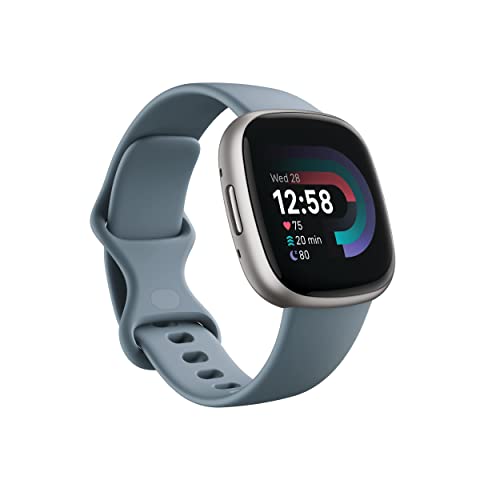
Choosing between the Fitbit Versa 4 and the Apple Watch Series 10 comes down to a fundamental trade-off between platform-agnostic battery endurance and high-powered wearable computing. The defining difference centers on how you interact with your device: one is an endurance-first fitness companion that runs for nearly a week between charges across both major smartphone platforms, while the other is an advanced extension of the Apple ecosystem offering rapid data processing, clinical-grade cardiac features, and interactive apps at the expense of frequent charging.
Buyers prioritizing uninterrupted health tracking, multi-day outdoor trips, and compatibility with either Android or iOS should look closely at the Fitbit Versa 4, whereas dedicated iPhone owners wanting standalone onboard storage, high-level emergency sensors, and deep app integration will get far more utility from the Apple Watch Series 10.
![Apple Watch Series 10 [GPS 46mm case] Smartwatch with Jet Black Aluminum Case with Black Sport Band - M/L. Fitness Tracker, ECG App, Always-On Retina Display, Water Resistant](https://m.media-amazon.com/images/I/31Cud2WnszL._SL500_.jpg "Apple Watch Series 10 [GPS 46mm case] Smartwatch with Jet Black Aluminum Case with Black Sport Band - M/L. Fitness Tracker, ECG App, Always-On Retina Display, Water Resistant")
Fitbit Versa 4 vs Apple Watch Series 10 at a Glance
| Feature | Fitbit Versa 4 | Apple Watch Series 10 |
|---|---|---|
| Operating System | Fitbit OS | watchOS |
| Phone Compatibility | Android OS 9 or higher, Apple iOS 15 or higher | Apple iPhone only |
| Stated Battery Life | 6+ days | Fast charging to 80 percent (runtime not listed) |
| Display Type | Touchscreen (size not listed) | Always-On Retina display (46mm, up to 30% more screen area) |
| Internal Storage | The listing does not specify | 64 GB |
| Water Resistance | 50 meters | 50 meters (with depth and water temperature sensors) |
| Heart Health Monitoring | 24/7 heart rate tracking | ECG app, high/low heart rate alerts, irregular rhythm notifications |
| Safety and Emergency Tools | The listing does not specify | Fall Detection, Crash Detection, Emergency SOS, Check In |
| Case Material | Stainless Steel | Jet Black Aluminum |
| Best For | Multi-day fitness tracking across Android and iOS | Advanced health metrics and seamless iOS integration |
Battery Life and Power Management
Battery longevity determines how seamlessly a smartwatch integrates into your daily life. When a watch requires daily maintenance, tracking consistency often suffers because users must find windows during morning routines or evening wind-downs to plug the device in. Extended battery life eliminates charging anxiety, allowing users to travel over a long weekend without packing proprietary cables or worrying about a dead device during an extended workout.
When comparing fitbit versa 4 vs apple watch series 10 battery life, the contrast is stark. The Versa 4 delivers a manufacturer-rated 6+ day battery life from a single charge, running continuous background health logging without demanding daily access to a wall outlet. In contrast, the Apple Watch Series 10 listing highlights fast charging capabilities that reach an 80 percent charge quickly, powered by a 46 milliamp-hour lithium-ion cell, but it does not specify a multi-day operational span. Apple Watch models historically require regular charging intervals to sustain their power-hungry processors and continuous screen demands.
For users who dislike the chore of tethering another electronic device to an outlet every morning or night, the Versa 4 provides unmatched freedom. The Apple Watch Series 10 counterbalances this by minimizing charging downtime with its rapid-charge architecture, making quick top-ups feasible while showering, but it cannot match the uninterrupted operational cycle of its competitor.
Edge: Fitbit Versa 4 provides genuine multi-day endurance with a 6+ day battery capacity that easily outlasts the daily charging routine required by the Series 10.
Smart Features and Platform Compatibility
Smart capabilities transform a wearable from a basic passive activity tracker into a productivity hub on your wrist. True smartwatch utility involves managing incoming communications, navigating routes, making contactless payments, and interacting with virtual voice assistants without reaching for your phone. However, the depth of these features often depends entirely on the smartphone operating system paired with the watch.
The fitbit sense 2 vs apple watch series 10 comparison shows similar dynamics to this matchup: the Apple Watch Series 10 is deeply entrenched in the Apple ecosystem. Running watchOS with 64 GB of onboard memory storage capacity, the Series 10 lets users send text messages, answer phone calls, stream music and podcasts directly, summon Siri, and process transactions through Apple Pay. It also adds exclusive ecosystem conveniences, such as unlocking an authenticated Mac computer automatically and employing Precision Finding to locate misplaced iPhones. However, it operates exclusively with Apple devices.
The Versa 4 takes an inclusive approach to smartphone operating systems, pairing with Apple iOS 15 or higher as well as Android OS 9 or higher. Its smart features cover essential daily tasks: handling on-wrist Bluetooth calls, displaying phone notifications, executing contactless purchases via Google Wallet or Fitbit Pay, and providing voice assistance via Amazon Alexa built-in. It also includes Google Maps, though the listing notes Maps navigation was launched for Android first with iOS support planned later. Despite these tools, the Versa 4 lacks onboard media storage for offline music, leaving the Series 10 far ahead in standalone smartwatch intelligence.
Edge: Apple Watch Series 10 delivers superior standalone smart functionality with 64 GB of storage, Siri voice commands, and deep system-level integration across Apple hardware.
Health Monitoring and Diagnostic Capabilities
Wearable health technology has evolved from simple step counts into sophisticated physiological surveillance. Modern wrist sensors can monitor peripheral blood oxygen levels, measure baseline wrist temperature, assess recovery trends, and identify potential cardiac irregularities. Choosing between these platforms involves balancing lifestyle well-being tools against clinical-oriented alert mechanisms.
In any rigorous fitbit versa 4 vs apple watch series 10 accuracy evaluation, the hardware sensor suites tell a distinct story. The Apple Watch Series 10 is built around proactive medical monitoring. It features an integrated ECG app capable of recording an electrocardiogram on demand, alongside automated notifications for high or low heart rates and irregular heart rhythms. For comprehensive wellness, the Series 10 introduces the Vitals app to monitor overnight respiratory rate and heart rate metrics, paired with cycle tracking that offers retrospective ovulation estimates derived from temperature monitoring.
The Versa 4 approaches health from a holistic conditioning perspective, tracking 24/7 heart rate, SpO2 blood oxygen saturation, skin temperature variations, and daily stress via a Stress Management Score and reflection logging. It calculates a Daily Readiness Score to signal whether your body is primed for strenuous exertion or requires rest. However, access to the full suite of advanced analytics, guided programs, and historical trends requires an ongoing Fitbit Premium membership, though a 6-month trial is included. While the Versa 4 tracks critical baseline numbers, it lacks an on-demand ECG app and irregular rhythm alerts.
Edge: Apple Watch Series 10 wins on diagnostics thanks to its regulated ECG app, irregular rhythm notifications, and retrospective ovulation tracking without paywalled health metrics.
Exercise Tracking and Workout Analysis
Dedicated fitness tracking requires responsive real-time metrics, robust satellite positioning, and software capable of translating raw physical output into actionable training metrics. Whether you are hitting local running trails or doing intervals in a gym, your device must log your strain accurately without tethering you to a phone.
When considering the fitbit versa 4 or apple watch series 10 for running, both devices bring capable standalone tracking to the table via built-in GPS. The Versa 4 is equipped with over 40 distinct exercise modes and automated exercise detection. During cardio workouts, it tracks Active Zone Minutes to ensure you reach target intensity thresholds, later generating a workout intensity map within the mobile companion app. Its operating temperature range spans from -14° to 113°F with an operational altitude ceiling of 28,000 feet, making it resilient in varied physical environments.
The Apple Watch Series 10 approaches fitness through its customizable Activity Rings and an upgraded Workout app that measures training load over time, helping athletes assess how workout intensity impacts physical conditioning over days and weeks. For aquatic athletes, the Series 10 supplements its 50-meter water resistance rating with specialized depth and water temperature sensors, giving it extra utility for surface water sports and recreational swimming that the Versa 4 does not match. Combined with its high-visibility Always-On Retina display, the Series 10 delivers a more dynamic exercise experience during high-intensity training.
Edge: Apple Watch Series 10 edges ahead with advanced training load analytics, specialized water temperature and depth sensors, and customizable Activity Rings.
Sleep Tracking and Recovery Insights
Nighttime health tracking requires a device comfortable enough to wear through the night and smart enough to interpret autonomic nervous system recovery. The value of sleep tracking hinges not only on tracking sleep duration, but also on identifying sleep architecture, disturbances, and nightly physiological stability.
Anyone assessing the fitbit versa 4 or apple watch series 10 for sleep tracking will find distinct methodologies on display. Sleep monitoring is where Fitbit established its wearable pedigree. The Versa 4 records nightly sleep stages (light, deep, and REM sleep) and compiles an overall Sleep Score each morning. Users with an active Fitbit Premium account receive a personalized Sleep Profile that analyzes long-term rest habits against animal archetypes. Practical sleep features include a smart wake alarm that vibrates during optimal light sleep phases within a designated window, alongside a standard Do Not Disturb mode.
The Apple Watch Series 10 tracks sleep health through the Vitals app, which aggregates overnight metrics like heart rate, respiratory rate, and sleep intervals to establish personal baselines and highlight nightly deviations. While the Series 10 offers high precision and a thinner, lighter physical footprint that feels less intrusive during sleep, its battery architecture remains an obstacle. To use the Series 10 for consistent sleep tracking, users must develop strict daytime charging habits. The Versa 4, by contrast, can be worn for nearly a week of consecutive nights without a single visit to the charging cradle.
Edge: Fitbit Versa 4 takes the lead for sleep tracking because its 6+ day battery life ensures effortless, continuous nighttime wear without the risk of an overnight dead battery.
Hardware, Display, and Physical Durability
A wrist-worn device experiences constant exposure to bumps, abrasions, moisture, and environmental debris. Materials, display protection, and case engineering determine whether a watch retains its structural integrity through intense workouts and outdoor chores.
The Apple Watch Series 10 introduces significant exterior upgrades, featuring a redesigned 46mm rectangular chassis crafted from Jet Black aluminum that is thinner and lighter than past iterations. Its Always-On Retina display provides up to 30 percent more usable screen area, dramatically improving text readability for messages, workout metrics, and system navigation. On the durability front, the Series 10 features a crack-resistant front crystal, IP6X dust resistance certification, and 50-meter water resistance, alongside a carbon-neutral manufacturing footprint when paired with select bands.
The Fitbit Versa 4 utilizes a modern square case constructed from stainless steel paired with a soft silicone band. It features a responsive touchscreen display and matches the Apple Watch with a 50-meter water resistance depth, making it suitable for pool workouts and showers. However, the listing does not specify official IP-rated dust resistance or the use of an always-on display panel. While the stainless steel case gives the Versa 4 a resilient housing, the Series 10 offers a more refined, larger display with superior screen space and verified dustproofing.
Edge: Apple Watch Series 10 wins with a 30 percent larger Always-On Retina display, IP6X-certified dust resistance, and crack-resistant glass construction.
Pros and Cons
Fitbit Versa 4

Pros
- 6+ day battery life
- Compatible with Android and iOS
- Built-in GPS with 40+ exercise modes
- Includes 6-month Fitbit Premium membership
- Durable stainless steel case construction
Cons
- Advanced readiness metrics require Premium subscription
- No internal storage for offline music
- Lacks ECG app and irregular rhythm alerts
Apple Watch Series 10

Pros
- ECG app and irregular rhythm notifications
- 64 GB internal storage capacity
- Always-On Retina display with 30% more area
- Fall Detection, Crash Detection, and Emergency SOS
- Depth and water temperature sensors
Cons
- Exclusive to iPhone users
- Requires frequent charging intervals
- Small 46 mAh listed battery capacity
View Apple Watch Series 10 on Amazon
Who Should Buy Each One
Choose the Fitbit Versa 4 If
- You want a fitness watch with 6+ days of continuous battery life that avoids daily charging sessions.
- You use an Android smartphone or want the flexibility to switch between Android and iOS without losing your fitness data.
- You prioritize automated sleep stage tracking, Sleep Scores, and wake-up alarms without battery anxiety.
- You want essential smart features like Amazon Alexa, on-wrist Bluetooth calls, and Google Wallet in a lightweight stainless steel design.
Choose the Apple Watch Series 10 If
- You are an iPhone user who wants seamless access to Siri, Apple Pay, phone calls, and interactive app notifications.
- You require clinical-style cardiac tracking, including an on-demand ECG app and irregular heart rhythm notifications.
- You want 64 GB of internal storage for music and podcast playback without carrying your phone during workouts.
- You value critical outdoor and personal safety sensors, including Fall Detection, Crash Detection, and Emergency SOS.
Final Verdict
When weighing the apple watch series 10 vs fitbit versa 4, the right model depends on whether your priority is wearable utility or tracking endurance. For iPhone owners who want the pinnacle of modern smartwatch engineering, asking is apple watch series 10 worth it results in a clear yes. Its expansive Always-On Retina display, 64 GB of media storage, advanced ECG monitoring, IP6X dust resistance, and safety protocols like Crash Detection provide an unrivaled computing experience on the wrist. If you are deeply invested in Apple hardware and do not mind brief daily charging sessions, the Series 10 is the superior smartwatch.
On the other hand, shoppers questioning is fitbit versa 4 worth it will find immense value if their primary goal is uninterrupted health logging across any smartphone platform. Any comprehensive fitbit versa 4 review highlights that a 6+ day battery life transforms the user experience, making sleep monitoring, Daily Readiness checks, and 24/7 heart rate tracking truly continuous. While an apple watch series 10 review will rightfully praise its computational prowess, the Versa 4 remains the smarter choice for multi-day endurance, cross-platform Android and iOS usability, and focused fitness tracking.
FAQ
Can the Fitbit Versa 4 work with an Apple iPhone?
Yes. The Fitbit Versa 4 listing confirms compatibility with Apple iOS version 15 or higher, as well as Android OS version 9 or higher, allowing iPhone owners to sync activity data, receive notifications, and log health metrics.
Can the Apple Watch Series 10 be paired with an Android phone?
No. The Apple Watch Series 10 requires an Apple iPhone for initial setup, cellular or Wi-Fi data synchronization, and general feature operation. It is not compatible with Android mobile devices.
Does the Fitbit Versa 4 require a paid subscription to use its fitness tracking features?
Basic fitness tracking, 24/7 heart rate monitoring, built-in GPS workout routes, and standard sleep metrics do not require a paid plan. However, advanced insights such as the Daily Readiness Score and personalized Sleep Profiles require a Fitbit Premium membership. A 6-month Premium trial membership is included with the purchase of the device.
What safety tools are included on the Apple Watch Series 10?
The Apple Watch Series 10 includes advanced safety features including Fall Detection, Crash Detection for severe automobile accidents, Emergency SOS calling via button press, and Check In, which automatically notifies loved ones when you reach your destination.
Can you store music directly on the Fitbit Versa 4 or Apple Watch Series 10?
The Apple Watch Series 10 includes 64 GB of internal memory storage capacity, allowing users to download music and podcasts directly to the watch for offline playback. The Fitbit Versa 4 listing does not specify internal media storage or offline music support.
Are both smartwatches safe to wear while swimming?
Yes. Both the Fitbit Versa 4 and the Apple Watch Series 10 feature a water resistance depth rating of 50 meters. The Series 10 also incorporates dedicated depth and water temperature sensors to track aquatic metrics during surface swimming and water sports.
How does the charging routine compare between both watches?
The Fitbit Versa 4 provides 6+ days of battery life on a single charge, requiring charging only once or twice a week. The Apple Watch Series 10 relies on faster charging technology capable of restoring 80 percent battery in a brief session, but requires regular charging intervals to sustain operation.

