The fundamental divide between the Fitbit Charge 6 and the Apple Watch Series 10 centers on product philosophy: one is a dedicated, streamlined fitness tracker designed to monitor wellness with minimal distraction, while the other is a full-scale wearable computer built for deep communication, expansive wrist-based computing, and advanced athletic tracking.
Choose the Fitbit Charge 6 if you want an unobtrusive band focused on 24/7 heart rate monitoring, Google essentials, and structured recovery metrics. Choose the Apple Watch Series 10 if you want an expansive Always-On Retina display, full phone call and texting independence, extensive third-party integration, and comprehensive emergency safety features.
![Apple Watch Series 10 [GPS 46mm case] Smartwatch with Jet Black Aluminum Case with Black Sport Band - M/L. Fitness Tracker, ECG App, Always-On Retina Display, Water Resistant](https://m.media-amazon.com/images/I/31Cud2WnszL._SL500_.jpg "Apple Watch Series 10 [GPS 46mm case] Smartwatch with Jet Black Aluminum Case with Black Sport Band - M/L. Fitness Tracker, ECG App, Always-On Retina Display, Water Resistant")
Fitbit Charge 6 vs Apple Watch Series 10 at a Glance
| Attribute | Fitbit Charge 6 | Apple Watch Series 10 |
|---|---|---|
| Device Type | Fitness tracker band | Full-featured smartwatch |
| Display Style | Rectangular touchscreen | 46mm Always-On Retina display |
| Operating System | Android Wear 1.0 | watchOS |
| Onboard Storage | Not listed | 64 GB |
| Durability & Water Resistance | 50 meters water resistant | 50 meters water resistant, IP6X dust resistant, crack resistant |
| Sensors | SpO2, ECG, optical heart rate, temperature, ambient light, accelerometer, gyroscope | ECG, optical heart rate, electrical heart sensor, depth sensor, water temperature sensor |
| Navigation | Built-in GPS, Google Maps turn-by-turn | Built-in GPS, Precision Finding |
| Smart Utilities | Google Wallet, YouTube Music controls | Phone calls, text messages, Siri, Apple Pay, Mac unlocking |
| Safety Features | Not listed | Fall Detection, Crash Detection, Emergency SOS, Check In |
| Best For | Unobtrusive health tracking and Google essentials | Comprehensive communication, rich app support, and Apple ecosystem users |
Hardware Design, Display, and Daily Wear Comfort
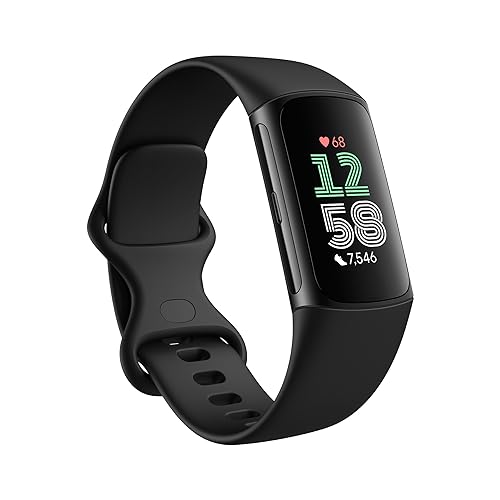
Physical footprint dictates how a wearable integrates into your day, especially during intense training or overnight rest. The Fitbit Charge 6 follows the traditional tracker design language, utilizing a compact rectangular module built into a silicone band with a stainless steel or metal case. Because of its narrow silhouette, the Charge 6 sits discreetly against the wrist, reducing the chance of catching on jacket sleeves or gym equipment. The touchscreen interface is tailored for quick upward and downward swipes, presenting essential metrics in a linear feed rather than demanding prolonged visual engagement.
The Apple Watch Series 10 takes a radically different visual and ergonomic path. Featuring a 46mm case crafted from Jet Black aluminum paired with a Black Sport Band, the Series 10 introduces a much larger, wide-angle viewing area. The listing specifies that this redesign delivers up to 30 percent more screen area on a thinner, lighter chassis that enhances all-day wrist comfort. The Always-On Retina display allows you to check workout pacing, incoming alerts, and time metrics without raising your arm or tapping the glass. While the larger footprint offers unmatched data legibility, it occupies substantially more wrist real estate than a slender tracker band.
Durability ratings also differentiate these two wearables for rigorous use. The Series 10 is certified IP6X dust resistant, crack resistant, and water resistant to 50 meters, giving it reinforced protection against outdoor elements and sand. The Charge 6 listing confirms 50-meter water resistance for pool sessions and showers, but it does not specify an IP dust certification. If you are reading this comparison while researching other compact options like our fitbit charge 6 vs apple watch se analysis, the balance between screen size and low-profile comfort remains a central deciding factor.
Edge: Apple Watch Series 10 for its larger Always-On Retina display, crack resistance, and IP6X dust protection.
Workout Tracking and Athletic Training Capabilities
Athletic monitoring requires precision, variety, and accessible data while moving. In an fitbit versa 4 vs apple watch series 10 comparison, screen space often shifts training preferences, and that dynamic is equally pronounced here. The Fitbit Charge 6 approaches exercise through structured efficiency, delivering more than 40 exercise modes alongside automatic exercise tracking. A standout utility for gym enthusiasts is its ability to broadcast heart rate data in real time to compatible exercise machines such as treadmills and ellipticals. Furthermore, Active Zone Minutes guide your exertion levels by tracking the time spent in fat burn, cardio, and peak heart rate zones.
When assessing the Apple Watch Series 10 vs Charge 6 fitness tracking experience, the Series 10 functions as an analytical athletic computer. Through the native Workout app, the Series 10 provides customizable views and advanced performance metrics across dozens of activities. A major addition to the Series 10 is training load tracking, which calculates how the intensity and duration of your workouts impact your body over time. For water sports and swimming, the Series 10 features dedicated depth and water temperature sensors, giving swimmers and snorkelers real-time environmental context that tracker bands cannot supply.
For outdoor cardio routines, both devices feature built-in GPS to record distance and route paths without carrying a phone. Deciding between the Fitbit Charge 6 or Apple Watch Series 10 for running comes down to how you digest pacing data. The Charge 6 provides simple, glanceable numbers on its slim screen, keeping your attention on the road. The Series 10 displays multi-metric workout views simultaneously, tracking heart rate zones, elevation, cadence, and split times on its 46mm screen while logging movement toward customizable Activity Rings.
Edge: Apple Watch Series 10 for its comprehensive training load analytics, customizable Activity Rings, and built-in depth and water temperature sensors.
Health Monitoring, Sleep Analysis, and Recovery Tools
Continuous wellness monitoring requires advanced biometric sensors and actionable recovery algorithms. In any comprehensive Fitbit Charge 6 review, recovery stands out as a core strength. The Charge 6 tracks 24/7 heart rate, blood oxygen saturation via an SpO2 sensor, skin temperature variations, and cardiac rhythm through an integrated ECG app. It turns these physiological signals into accessible scores: a Daily Readiness score indicates whether your body is primed for exertion, while a stress management score monitors physical responses to daily tension.
When choosing the Fitbit Charge 6 or Apple Watch Series 10 for sleep tracking, the Charge 6 offers deep overnight utility in a package that is remarkably easy to wear to bed. It generates a personalized nightly Sleep Score that grades sleep stages and restlessness, and it includes a Smart Wake alarm designed to vibrate during optimal, lighter sleep phases within a designated morning window. The Charge 6 also integrates with Google Health Premium, which provides personalized coaching built with Gemini that adapts to your daily routine, supported by an included 3-month trial before requiring a separate paid subscription.
The Apple Watch Series 10 approaches wellness through clinical-grade tracking and systemic health surveillance. It houses an ECG app for on-demand rhythm checks, alongside background notifications for high, low, or irregular heart rhythms. For overnight monitoring, the Series 10 uses the Vitals app to track metrics such as respiratory rate, overnight heart rate, and baseline physiological fluctuations. It also provides advanced menstrual cycle tracking with retrospective ovulation estimates. While the Series 10 collects vast health data, the Charge 6 packages daily readiness and sleep scores into simpler, everyday benchmarks, making it a compelling alternative for readers who have also weighed the fitbit sense 2 vs apple watch series 10 ecosystem.
Edge: Fitbit Charge 6 for its dedicated Sleep Score algorithms, Smart Wake vibrating alarm, and integrated Daily Readiness recovery scores.
Smart Features, Connectivity, and Communication
Smart capabilities separate simple fitness wearables from true wrist computers. The Fitbit Charge 6 incorporates essential Google utilities directly into its lightweight interface. Users can navigate outdoor routes using turn-by-turn directions from Google Maps directly on the wrist, process contactless checkout lines with tap-to-pay via Google Wallet, and control music playback through dedicated YouTube Music controls. However, the Charge 6 relies on connected audio control rather than broad independent media storage, and it does not support cellular connectivity, independent voice calling, or full keyboard messaging.
Examining an Apple Watch Series 10 review reveals an entirely different echelon of communication power. Running watchOS and packing 64 GB of onboard memory storage, the Series 10 functions as an independent extension of your digital life. You can take phone calls directly from the watch speaker and microphone, send text messages, activate Siri for voice control, and stream music or podcasts over Wi-Fi or Bluetooth. Seamless Apple ecosystem features allow you to automatically unlock your Mac, send money using Apple Pay, or use Precision Finding to locate a misplaced iPhone with directional cues.
Safety technology represents another stark divergence between these two devices. The Apple Watch Series 10 integrates Fall Detection and Crash Detection, which identify severe impacts and connect to emergency dispatchers automatically if you are unresponsive. An Emergency SOS trigger lets you summon assistance by holding the side button, while Check In alerts designated contacts when you reach a destination safely. The Charge 6 listing does not specify emergency impact detection or automated SOS calls, making the Series 10 far superior for users seeking personal safety safeguards.
Edge: Apple Watch Series 10 for its 64 GB internal storage, two-way calls, text messaging, Siri, and automated emergency safety systems.
Battery Management and Charging Efficiency
Battery performance determines wearable reliability and dictates how often you must remove the device from your wrist. When reviewing Fitbit Charge 6 battery life vs Apple Watch Series 10, the technical specifications supplied by the listings reveal fundamentally different power demands. The Fitbit Charge 6 is categorized as a tracker running Android Wear 1.0, engineered specifically for all-day activity tracking and 24/7 heart rate monitoring without the extreme power draw of an expansive, desktop-grade mobile operating system.
The Apple Watch Series 10 houses a 46 milliamp_hours lithium-ion battery cell that powers a high-resolution Always-On Retina display, continuous background safety sensors, and active wireless radios. Because watchOS executes complex computing tasks, the Series 10 requires regular charging intervals. To offset this demand, the Series 10 incorporates engineered faster charging capabilities, allowing the battery to replenish to 80 percent capacity quickly, making short charging top-offs during morning showers or evening wind-downs practical.
The operational trade-off is clear. The Charge 6 offers sustained metric logging across multiple days of continuous movement without frequent stops at a charging cable, much like the stamina profile explored in our fitbit inspire 3 vs apple watch series 10 comparison. The Series 10 trades multi-day endurance for an expansive display and desktop-level features, leaning on fast-charging hardware to keep daily downtime to a minimum. If you prioritize continuous overnight sleep data without managing daily charging cycles, the Charge 6 requires far less maintenance.
Edge: Fitbit Charge 6 for its streamlined power profile supporting continuous, uninterrupted 24/7 metric tracking.
Ecosystem Compatibility and Subscriptions
A wearable must fit into your existing smartphone ecosystem, or it becomes an expensive paperweight. The Apple Watch Series 10 requires an iPhone to pair and function. It operates as an integral component of the broader Apple ecosystem, linking directly with Apple Health, Apple Fitness, Apple Pay, and macOS devices. Its watchOS platform supports thousands of native wearable applications, and its construction is carbon neutral when configured with select bands, supporting specific environmental standards outlined by Apple.
The Fitbit Charge 6 offers broader platform flexibility. The listing notes that the Charge 6 uses an iOS controller profile while running Android Wear 1.0, enabling it to communicate with both major mobile operating systems. Its software suite is deeply integrated with Google services, making Google Maps, Google Wallet, and YouTube Music accessible from the wrist without requiring an exclusive hardware brand lock-in. For users transitioning from earlier models, such as those weighing a fitbit charge 5 vs apple watch series 10 upgrade, this cross-platform adaptability is a distinct operational advantage.
Software services also require consideration when evaluating ongoing utility. The Fitbit Charge 6 includes a 3-month trial of Google Health Premium, which unlocks Gemini-powered personalized fitness and wellness coaching; continued access requires an ongoing subscription. The Apple Watch Series 10 provides its core biometric analytics, Vitals app tracking, training load calculations, and cycle tracking without a mandatory subscription paywall. When asking is Apple Watch Series 10 worth it, the absence of a subscription fee for core biometric analysis balances its broader initial commitment.
Edge: Apple Watch Series 10 for its complete lack of subscription paywalls on core metrics and seamless watchOS synchronization.
Pros and Cons
Fitbit Charge 6

Pros
- 40+ exercise modes with Active Zone Minutes
- Real-time heart rate broadcast to gym machines
- Google Maps and Google Wallet integration
- Dedicated Sleep Score with Smart Wake alarm
- Built-in GPS with SpO2 and ECG sensors
Cons
- Requires Google Health Premium for Gemini coaching
- Display smaller than 46mm smartwatch screen
- Controls music rather than storing offline tracks
View Fitbit Charge 6 on Amazon
Apple Watch Series 10

Pros
- Expansive Always-On Retina display with 46mm case
- 64 GB onboard storage for apps and media
- Integrated Fall Detection and Crash Detection safety suite
- Full voice calling, texting, and Siri integration
- Built-in depth and water temperature sensors
Cons
- Requires an iPhone for pairing and functionality
- Larger 46mm case occupies more wrist area
- Requires frequent fast charging to maintain battery
View Apple Watch Series 10 on Amazon
Who Should Buy Each One
Choose the Fitbit Charge 6 If
- You prefer a slender, low-profile band that remains unobtrusive during sleep and weightlifting.
- You want turn-by-turn Google Maps directions and Google Wallet payments without wearing a bulky smartwatch.
- You train frequently on gym equipment and want to broadcast your real-time heart rate to compatible treadmills and ellipticals.
- You want structured recovery scores, Smart Wake morning alarms, and continuous 24/7 activity monitoring without daily charging demands.
Choose the Apple Watch Series 10 If
- You own an iPhone and want an expansive 46mm Always-On Retina display with up to 30 percent more screen area.
- You need standalone communication tools, including voice calls, direct text replies, and Siri voice commands.
- You prioritize advanced personal safety features like Fall Detection, Crash Detection, and Check In arrival notifications.
- You want 64 GB of onboard storage for media alongside aquatic depth and water temperature sensors for swimming.
Final Verdict
When comparing the Apple Watch Series 10 vs Fitbit Charge 6, the optimal choice depends entirely on whether you want a focused biometric tracker or an expansive daily smartwatch. The Apple Watch Series 10 is the superior overall wearable for iPhone users who want comprehensive wrist computing. Its 46mm Always-On Retina display, 64 GB onboard storage, full communication capabilities, and automated safety detection systems provide an unmatched smart experience that a fitness band cannot replicate.
However, when asking is Fitbit Charge 6 worth it, the answer is an emphatic yes for users whose priorities center purely on fitness and rest. The Charge 6 excels with its slim rectangular design, continuous 24/7 heart rate monitoring, Google Maps directions, and gym machine connectivity, all while delivering detailed sleep and recovery scores without demanding daily battery top-offs. If your goal is to track your workouts and sleep without wearing a mini-computer on your wrist, the Charge 6 is the smarter, more focused companion.
FAQ
Can the Fitbit Charge 6 make phone calls or send text messages?
The Fitbit Charge 6 does not support standalone voice calling or direct text composition. While it can display incoming alerts and notifications from your connected phone, it lacks the microphone, speaker, and voice input tools found on the Apple Watch Series 10.
Can you use the Apple Watch Series 10 with an Android phone?
No. The Apple Watch Series 10 runs watchOS and requires an iPhone to set up, sync data, and access its core features. In contrast, the Fitbit Charge 6 supports both major smartphone operating systems through its mobile application integration.
Does the Fitbit Charge 6 require a paid subscription for basic health metrics?
No. The Charge 6 tracks standard metrics including heart rate, 40+ exercise modes, Sleep Scores, and Active Zone Minutes out of the box. However, advanced Gemini-powered coaching through Google Health Premium requires a separate subscription following an included 3-month trial.
How do the safety features compare between the Charge 6 and Series 10?
The Apple Watch Series 10 includes advanced hardware and software safety tools, including Fall Detection, Crash Detection, Emergency SOS, and Check In arrival alerts. The Fitbit Charge 6 listing does not specify automated crash or fall detection capabilities.
Which device is better suited for swimming and water tracking?
Both devices feature 50-meter water resistance suitable for swimming. However, the Apple Watch Series 10 includes dedicated depth and water temperature sensors that deliver real-time aquatic data, making it more capable for active water sports.
Can the Fitbit Charge 6 store music directly on the device?
The Fitbit Charge 6 features controls for YouTube Music, allowing you to control playback on your phone, but it does not list onboard storage for downloaded audio files. The Apple Watch Series 10 provides 64 GB of onboard memory storage to download and listen to music and podcasts directly.


