The decisive difference between the Frigidaire 50 Pint Dehumidifier and the Midea Cube 50 centers on water containment and drainage engineering. Frigidaire sticks to an upright, traditional tower housing a 2.7-gallon front-slide bucket and gravity drainage, whereas Midea deploys a modular lift-and-twist framework that holds an enormous 4.2-gallon reservoir alongside an internal vertical drain pump.
Choose the Frigidaire dehumidifier if you want an upright, conventional machine with a front-accessible bucket that slides out without lifting the mechanical motor assembly. Choose the Midea Cube 50 if you are managing persistent basement dampness and want to maximize time between emptying cycles or pump water upward through an included 16-foot hose into an elevated sink or window.

Frigidaire 50 Pint Dehumidifier vs Midea Cube 50 at a Glance
| Feature | Frigidaire 50 Pint Dehumidifier | Midea Cube 50 |
|---|---|---|
| Daily Moisture Removal | 50 pints per day | 50 pints per day |
| Coverage Rating | 4,500 square feet | 4,500 square feet |
| Internal Tank Volume | 2.7 gallons | 4.2 gallons |
| Integrated Water Pump | No (gravity continuous drain only) | Yes (vertical or horizontal, 16-foot hose included) |
| Power Consumption | 470 watts | 425 watts |
| Fan Speed Settings | 3 speeds | Up to 3 speeds |
| Air Flow Capacity | 235 CFM | 253 cubic centimeters per minute |
| Chassis Dimensions | 12.19″D x 24.25″W x 24.25″H | 14.45″D x 14.76″W x 14.57″H |
| Unit Weight | 44.5 pounds | 43 pounds |
| Best For | Living areas requiring quick front-bucket removal | Basements and unattended rooms requiring high tank volume or upward pumping |
Water Reservoir Capacity and Emptying Frequency
Internal bucket size dictates how often you must physically intervene when operating a high-capacity dehumidifier without a permanent drain line. Both appliances extract up to 50 pints of water from the air every 24 hours under standard rating conditions, meaning an undersized tank fills multiple times a day during heavy humidity spikes. When evaluating the frigidaire 50 pint dehumidifier vs homelabs 4500, water management is often the central operational hurdle, and that same challenge appears here.
The Frigidaire 50 Pint Dehumidifier includes a 2.7-gallon bucket. Because 50 pints equates to 6.25 gallons of daily moisture extraction, running the Frigidaire at maximum extraction requires emptying the reservoir roughly two to three times every 24 hours. The bucket is seated cleanly in the front lower cabinet, fitted with an integrated carrying handle and an internal splash guard to minimize sloshing when you walk it over to a sink or floor drain.
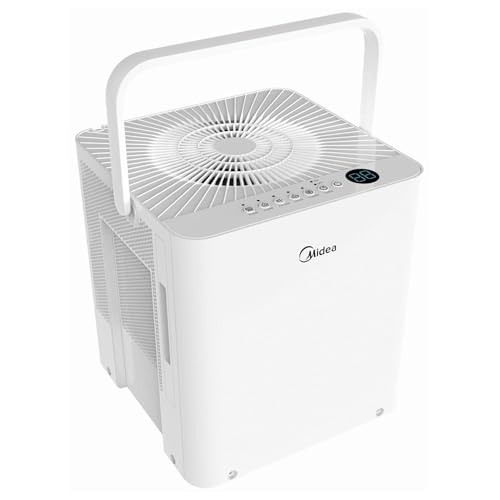
The Midea Cube 50 alters this daily routine through its expandable architecture. When extended into operational mode, the lower tub serves as the water basin, offering a substantial 4.2-gallon capacity. Looking at the midea cube 50 pint dehumidifier tank size, it holds over 55 percent more water than the Frigidaire tank. On days of peak humidity, the Midea Cube can operate for extended stretches before triggering an auto-shutoff full-tank alert. For spaces without dedicated plumbing drains, this extra capacity eliminates constant maintenance checks.
Edge: Midea Cube 50, because its 4.2-gallon reservoir holds significantly more water and reduces the daily frequency of manual dumping.
Drainage Systems and Continuous Pumping Capability
Active drainage determines whether a dehumidifier can operate entirely unattended in utility spaces, crawlspaces, or subterranean levels. Relying on manual reservoir dumping becomes impractical when drying out persistently damp foundations or handling seasonal moisture surges. Buyers exploring the midea cube 50 vs frigidaire 50 pint dehumidifier matchup for below-grade applications must prioritize how each machine releases water when gravity works against them.
The Frigidaire unit supports continuous draining through a passive gravity connection port. When you hook up a standard garden hose, gravity pulls water out of the internal collection pan and directs it away. This arrangement functions reliably if you have an accessible floor drain or a sump pit lower than the outlet valve. However, the listing specifies no internal pump on this model. If your only drainage option is an elevated utility sink, an exterior window, or a wall-mounted waste line, gravity cannot push the water upward, limiting placement options unless you purchase an external condensate pump.
The Midea Cube 50 integrates an internal motorized water pump directly into its chassis. It comes packaged with a 16-foot continuous drain hose, enabling the machine to drive water vertically or horizontally out of a basement window or up into a laundry sink. Furthermore, Midea provides a bucketless operational mode where the active unit sits directly above a sink or floor drain to discharge moisture directly through the included tube. Examining the frigidaire 50 pint vs midea cube continuous drain setups reveals that Midea provides an out-of-the-box solution for complex drainage routes that the Frigidaire cannot handle on its own.
Edge: Midea Cube 50, thanks to its factory-integrated vertical water pump and included 16-foot drainage hose.
Chassis Design, Ergonomics, and Seasonal Storage
How a dehumidifier integrates into your living space affects everyday convenience, particularly when you must move the appliance between rooms or stow it during dry winter months. Form factor also dictates how comfortable the machine is to empty by hand when continuous lines are not connected. Comparing the frigidaire 50 pint dehumidifier vs vremi midea 22 pint illustrates how classic vertical layouts stack up against alternative body styles.
Frigidaire relies on a conventional upright console measuring 12.19 inches deep, 24.25 inches wide, and 24.25 inches tall, with a weight of 44.5 pounds. The front-loading bucket design allows you to pull the container out horizontally without disturbing the upper mechanical assembly. Because the reservoir holds 2.7 gallons, a full bucket weighs roughly 22.5 pounds in water weight. Combined with the splash guard and ergonomic handle, managing this weight remains well within comfortable physical limits for most homeowners during routine chores.
The Midea Cube 50 introduces an innovative lift-and-twist structure measuring 14.45 inches deep, 14.76 inches wide, and 14.57 inches tall at a weight of 43 pounds. To use the full reservoir, you lift the top dehumidifier engine out of the bucket, rotate it 90 degrees, and seat it across the top of the extended tank. While this engineering allows the unit to nest into half its size for compact off-season closet storage, manual emptying requires lifting the mechanical motor head off the water bucket to pour it out. Furthermore, a completely filled 4.2-gallon tank carries approximately 35 pounds of water alone, demanding noticeable lifting strength if you carry it manually.
Edge: Frigidaire 50 Pint Dehumidifier, because its front-slide bucket permits quick, single-handed removal without lifting the appliance’s upper mechanical components.
Moisture Control, Airflow, and Maintenance Access
Extracting airborne moisture efficiently requires steady internal air movement and accurate humidistat controls to maintain a balanced relative humidity level. Excessive moisture encourages mold growth, while overly dry air strains home woodwork and wastes energy. Any thorough frigidaire 50 pint dehumidifier review must assess how quickly the unit circulates ambient air through its refrigeration coils to capture suspended vapor.
The Frigidaire dehumidifier features Custom Humidity Control, allowing users to tailor specific moisture thresholds within residential rooms. It pushes air at a robust rate of 235 cubic feet per minute across three selectable fan speeds. To protect internal components from dust buildup, Frigidaire equips the model with an easy-to-clean washable filter. You can slide the screen out, rinse it under running water, dry it, and reinstall it to sustain maximum efficiency. In the frigidaire fhdd5034y1 vs midea cube 50 comparison, Frigidaire presents a dependable, low-effort maintenance profile suited for primary living spaces.
The Midea Cube 50 provides a multi-directional air intake system designed to pull damp air from various angles, accompanied by three operating fan speeds. Its humidity settings range from 35 percent to 85 percent relative humidity. To protect the cooling hardware in chillier ambient conditions, Midea includes an auto-defrost feature that stops frost from accumulating along the condenser coils, along with an auto-restart function that restores programmed parameters following power outages. Similar low-temperature mechanics are explored in our midea cube 50 vs ge 50-pint wifi smart dehumidifier analysis.
Edge: Tie. Both units provide three operational fan speeds, washable filtration, and granular humidity adjustments that adequately regulate household air moisture.
Power Consumption and Smart Connectivity
Because dehumidifiers in damp environments often cycle continuously for days, electrical efficiency and remote management capabilities significantly influence long-term ownership satisfaction. When readers ask is midea cube 50 worth it, energy efficiency and smartphone control play a major role in calculating that value.
The Frigidaire FHDD5034Y1 draws 470 watts of power at 115 volts. Its control interface supports programmable operation, automated moisture removal, and standard cycle modes. Frigidaire notes Wi-Fi capability on this listing, letting users interact with system parameters. However, the appliance remains fundamentally built around on-chassis electronic pad interactions and classic standard operation routines, drawing somewhat higher wattage during full-load dehumidification.
The Midea Cube 50 runs at 425 watts, making it noticeably leaner on electrical draw while matching the 50-pint moisture extraction threshold. The unit carries an Energy Star certification in its product specification profile. In terms of connected technology, Midea builds full smart functionality into the device via the SmartHome application for iOS and Android. Users can track ambient humidity metrics, monitor real-time bucket fill levels, and issue voice commands through Amazon Alexa or Google Assistant. Those weighing the homelabs 4500 vs midea cube 50 will recognize Midea’s connectivity suite as one of the most developed smart platforms in this appliance category.
Edge: Midea Cube 50, offering a lower 425-watt power consumption rating alongside comprehensive Alexa and Google Assistant integration.
Pros and Cons
Frigidaire 50 Pint Dehumidifier

Pros
- Front-loading bucket with splash guard
- Washable easy-to-clean dust filter
- Three fan speed settings
- Simple gravity drainage port
Cons
- Smaller 2.7-gallon water tank
- Lacks integrated vertical pump
- Higher 470-watt power draw
View Frigidaire 50 Pint Dehumidifier on Amazon
Midea Cube 50

Pros
- Massive 4.2-gallon water reservoir
- Built-in vertical pump with 16-foot hose
- Space-saving lift-and-twist nested design
- Energy Star certified 425-watt draw
- Alexa and Google Assistant smart controls
Cons
- Must lift motor unit to dump bucket
- Full 4.2-gallon tank weighs 35 pounds
Who Should Buy Each One
Choose the Frigidaire 50 Pint Dehumidifier If
- You empty your dehumidifier manually and want a front-loading bucket that slides out without lifting the heavy motor head.
- Your room features an existing floor drain or sump pit that allows passive gravity continuous drainage without an electric pump.
- You prefer a classic upright console design that remains stationary and ready to run year-round without lifting or twisting assemblies.
- You want simple, washable filter access to keep airborne dust from entering internal mechanical coils in living rooms or bedrooms.
Choose the Midea Cube 50 If
- You need an integrated vertical pump to discharge water upward through a 16-foot hose into an elevated utility sink or basement window.
- You plan to use manual collection but want a massive 4.2-gallon water reservoir to stretch the time between bucket emptying cycles.
- You want to monitor water levels, adjust relative humidity, and issue voice commands using Amazon Alexa or Google Assistant.
- You need a compact nested chassis that collapses to half its operational height for space-saving off-season closet storage.
Final Verdict
For most homeowners seeking high-capacity moisture control in subterranean spaces, the Midea Cube 50 stands out as the superior overall machine. Its combination of an expansive 4.2-gallon nested tank, lower 425-watt electrical draw, and factory-integrated vertical pump solves the most aggravating chore associated with high-humidity basements: carrying heavy water tanks up stairs or constantly checking shutoff indicators. Smart app integration and hands-free voice control further cement its dominance for spaces where the dehumidifier sits out of immediate sight.
The Frigidaire 50 Pint Dehumidifier remains the practical recommendation if your dehumidifier will live in a main-floor hallway, family room, or bedroom where manual bucket emptying is an unavoidable daily task. Pulling a 2.7-gallon bucket straight out from the front panel using a dedicated carry handle and splash guard is far less physically awkward than detaching and lifting the heavy motor unit of the Midea Cube to dump out 35 pounds of collected water. If you already have a floor drain or prioritize traditional upright ergonomics, Frigidaire delivers straightforward, reliable moisture extraction without the complex mechanics.
FAQ
Can the Frigidaire 50 Pint Dehumidifier pump water upward into a sink?
No, the Frigidaire 50 Pint Dehumidifier does not have an integrated pump. Its continuous drainage feature operates purely by gravity, meaning the drain hose must slope downward toward a floor drain, sump basin, or lower outlet. If you need to discharge water vertically into an elevated sink, you would have to attach an external aftermarket condensate pump.
How far can the Midea Cube 50 pump water?
The Midea Cube 50 includes a 16-foot drain hose designed to work with its built-in pump. This system has enough pressure to drive collected moisture vertically or horizontally out of a basement window, over a wall, or directly into an elevated utility sink, allowing the machine to run continuously without manual bucket emptying.
Can the Midea Cube run without using the water tank?
Yes, the Midea Cube 50 features a bucketless continuous drain option. You can uncouple the active dehumidifier unit from the lower tank reservoir and position it directly over a floor drain or sink using the provided drainage line, allowing it to remove moisture continuously without holding water in the base.
How does the lift-and-twist design on the Midea Cube work?
The Midea Cube is built in two primary sections: the upper mechanical unit and the lower bucket. For compact storage, the upper unit nests completely inside the bucket. To operate the dehumidifier at full water capacity, you lift the top unit upward out of the bucket, rotate it 90 degrees, and rest it across the top rim of the lower reservoir.
Does the Frigidaire 50 Pint Dehumidifier require replacement air filters?
No, the Frigidaire 50 Pint Dehumidifier includes an easy-to-clean washable filter. Instead of buying replacement cartridges, you slide the filter assembly out of the unit, rinse collected household dust and debris under clean water, allow it to dry thoroughly, and slide it back into the chassis.
Which model is better for an unheated basement?
The Midea Cube 50 is better equipped for unheated basements due to its built-in auto-defrost feature and integrated pump. Auto-defrost keeps the cooling coils clear of ice accumulation when ambient temperatures drop, while the pump eliminates the need to carry full buckets of water up basement stairs.


