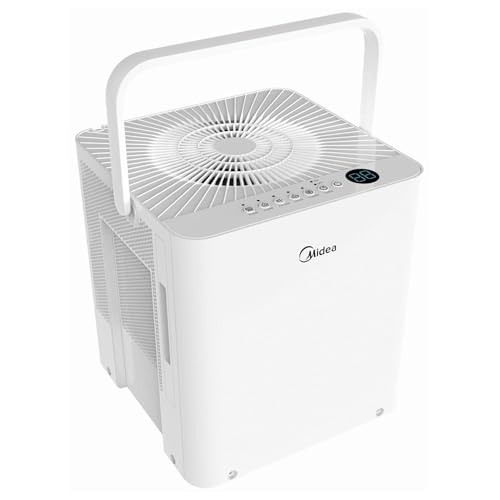
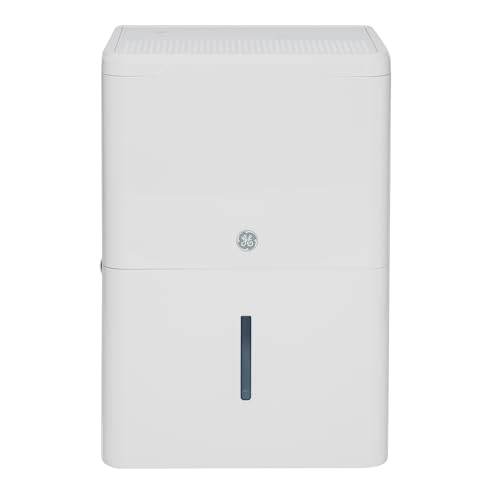
Choosing between these two high-capacity moisture extractors comes down to whether you require automated vertical drainage paired with a massive collection tank or prioritize living-space mobility and automated airflow regulation. The Midea Cube 50 introduces an unconventional nested bucket design that holds 4.2 gallons of water alongside an integrated upward pump, whereas the GE 50-Pint WiFi Smart Dehumidifier utilizes a traditional upright tower configuration equipped with caster wheels and humidity-sensing Smart Dry fan adjustments.
Homeowners tackling damp crawlspaces or deep basements where continuous upward drainage into a sink or window is necessary should invest in the Cube 50. In contrast, anyone seeking an appliance to roll between bedrooms, bathrooms, and living areas with hands-off fan optimization should select the GE 50-Pint WiFi Smart Dehumidifier.
Midea Cube 50 vs GE 50-Pint WiFi Smart Dehumidifier at a Glance
| Attribute | Midea Cube 50 | GE 50-Pint WiFi Smart Dehumidifier |
|---|---|---|
| Daily Moisture Removal | 50 pints per day | 50 pints per day |
| Manufacturer Coverage Rating | 4,500 sq ft | 5,000 sq ft |
| Water Tank Capacity | 4.2 gallons (approx. 33.6 pints) | 15 pints (approx. 1.875 gallons) |
| Drainage Methods | Built-in vertical pump, continuous gravity drain, manual tank | Continuous gravity drain connection, manual tank |
| Drain Hose Included | Yes (16-foot pump drain tube) | Not listed |
| Mobility Features | Lift-and-twist nested chassis, built-in handles | 360-degree easy-roll wheels, pocket handles |
| Target Humidity Range | 35% to 85% | 30% to 70% |
| Fan Automation | 3 manual speeds | 3 speeds with automated Smart Dry regulation |
| Dimensions (D x W x H) | 14.45 x 14.76 x 14.57 inches | 11.4 x 14.4 x 24.1 inches |
| Unit Weight | 43 pounds | 41.1 pounds |
| Best For | Unattended basements and high-volume moisture removal | Multi-room residential use and energy-conscious living areas |
Water Tank Capacity and Drainage Capabilities
Water collection and disposal methods represent the most significant practical divergence when comparing the GE 50-Pint WiFi Smart Dehumidifier vs Midea Cube 50. Traditional dehumidifiers incorporate relatively small collection buckets that require emptying multiple times a day under heavy humidity loads. The Cube 50 fundamentally changes this experience through its lift-and-twist mechanics. By lifting the operating machinery from the base and rotating it into an extended position, the bottom vessel becomes an expansive reservoir. With a generous 4.2-gallon capacity-equivalent to roughly 33.6 pints-the Midea Cube 50 tank capacity holds more than double the water of standard residential dehumidifiers. This permits the machine to run continuously for extended periods without halting operation due to a full bucket.
Beyond tank capacity, active drainage sets these appliances apart. The Midea Cube 50 features an integrated vertical pump paired with an included 16-foot drain hose. This internal pump can discharge collected water upward into a utility sink, out an elevated basement window, or directly into overhead plumbing lines without relying on gravity. It also allows a no-bucket continuous drain mode where the upper unit sits directly over a floor drain. Conversely, the GE 50-Pint employs an internal 15-pint collection bucket and a passive gravity-drain connection. While it accommodates continuous operation via a standard garden hose connection, the draining line must slope strictly downward toward a floor drain or sump pit. The listing does not include a dedicated drain tube in the box, and the internal pump is absent, meaning any water removal to an elevated basin requires purchasing an external condensate pump.
For high-humidity installations where no floor drain exists, the internal pumping mechanism provides tremendous utility. Emptying a 15-pint bucket twice daily quickly becomes a tedious chore, while lifting a completely filled 4.2-gallon Midea bucket means hauling around 35 pounds of water. Thus, while the Midea provides an expansive reservoir, its true strength lies in the hands-off reliability made possible by its motorized upward discharge mechanism.
Edge: Midea Cube 50, due to its massive 4.2-gallon reservoir and integrated vertical pump with an included 16-foot drainage hose.
Form Factor, Storage, and Physical Mobility
Chassis engineering dictates how smoothly an appliance fits into your living quarters and how effortlessly you can transfer it between different zones. The GE 50-Pint follows the conventional upright tower blueprint, measuring 11.4 inches deep, 14.4 inches wide, and 24.1 inches tall, weighing in at 41.1 pounds. GE outfits this cabinet with integrated pocket handles and 360-degree easy-roll caster wheels. These rolling components allow users to smoothly navigate the machine across hardwood, tile, or flat carpets from the laundry room to the main hallway without straining their back or lifting heavy mechanical equipment.
The Cube 50 approaches physical footprint through a transformative, two-piece architecture. In its nested or storage configuration, the primary operating motor drops directly into the collection bucket, reducing its profile to 14.45 inches deep, 14.76 inches wide, and 14.57 inches tall. This halved vertical profile makes off-season closet storage exceptionally easy. When moisture levels rise, you lift the core unit out and rest it across the bucket rim in the extended position. However, moving this device while it contains water is considerably more demanding. The unit weighs 43 pounds completely dry, and the product data lists no rolling caster wheels. As explored in our homelabs 4500 vs midea cube 50 comparison, hauling a square, casterless machine across different household floors requires deliberate physical exertion.
Readers evaluating physical mobility must weigh seasonal compact storage against daily room-to-room transitions. If your objective is a static installation in a single utility area, the Cube 50 nested footprint proves tidy when dried out for winter. But if your daily routine involves relocating the machine across multiple living quarters, the upright tower design with caster mobility simplifies domestic logistics significantly.
Edge: GE 50-Pint WiFi Smart Dehumidifier, thanks to its integrated 360-degree caster wheels and upright tower form factor.
Fan Automation and Smart Drying Controls
Air circulation control and automated cycling directly affect indoor acoustic comfort and electrical consumption. The GE 50-Pint stands out in everyday living areas through its proprietary Smart Dry technology. Standard humidistats merely turn the refrigeration compressor on or off while maintaining whatever manual fan speed you selected. Smart Dry continuously evaluates real-time ambient moisture levels and dynamically adjusts the unit’s 3-speed fan accordingly. When ambient humidity spikes, the machine increases airflow to accelerate condensation; as room air nears your preset target, the fan shifts down to its lowest speed to minimize noise and save energy.
The Cube 50 features three distinct manual fan speeds paired with a multi-directional air intake configuration, drawing damp air efficiently through its chassis. However, it lacks an automated fan-modulating program comparable to Smart Dry. To adjust airflow on the Midea unit, you must select the fan level manually either through the physical top-panel buttons or via the SmartHome mobile application. Both units feature full wireless integration: the Midea connects through the SmartHome app while the GE syncs with the SmartHQ platform. Both platforms allow remote humidity monitoring, timer setups, and voice control using Amazon Alexa or Google Assistant. The Midea app also includes specialized water-level monitoring to track bucket fill status remotely.
When asking is GE 50-Pint WiFi Smart Dehumidifier worth it for finished spaces, automated fan regulation proves to be a standout capability. Instead of continually adjusting fan switches to eliminate background motor drone when you enter a living space or bedroom, the appliance modulates itself quietly without compromising air extraction performance.
Edge: GE 50-Pint WiFi Smart Dehumidifier, because Smart Dry automatically modulates fan speeds to balance humidity demand against energy use and noise.
Dehumidification Capacity and Coverage Area
Moisture extraction rates define baseline effectiveness for any environmental appliance. Both contenders remove up to 50 pints per day under standard testing parameters. This volume represents the top tier for portable residential appliances, capable of handling damp foundations, flooded basements, and humid summer basements alike. Comparing the Midea Cube 50 pints per day rating against the GE shows equal compressor performance, yet their manufacturer coverage ratings and humidity range parameters diverge slightly.
GE rates its appliance for high-humidity living zones and expansive basements up to 5,000 square feet, offering an adjustable target humidity range between 30% and 70%. In comparison, Midea rates the Cube 50 for coverage areas up to 4,500 square feet, but provides a broader target humidity spectrum ranging from 35% up to 85%. While 50 pints of moisture extraction remains identical on paper, the lower 30% threshold on the GE provides deeper drying capability for homeowners battling severe mold vulnerabilities or damp storage basements requiring ultra-dry ambient air.
When deciding on the Midea Cube 50 or GE 50-Pint WiFi Smart Dehumidifier for basement setups, square footage ratings within this tier are close enough that room geometry and air distribution matter more than the raw 500-square-foot spec difference. As detailed in our homelabs 4500 vs ge 50-pint wifi smart dehumidifier analysis, extracting 50 pints daily across an open-plan environment depends on consistent airflow circulation. Because both machines handle identical condensation volumes, overall drying output ends in parity.
Edge: Tie, as both units deliver matching 50-pint daily extraction rates with nearly identical large-space coverage boundaries.
Operating Safeguards and Maintenance Features
Long-term reliability and system preservation depend heavily on onboard safeguards, defrost automation, and routine maintenance systems. Because dehumidifiers draw air across cold refrigeration coils, low room temperatures can cause surface frost accumulation that restricts airflow and strains internal compressors. Both machines incorporate automated defrost sensors that pause compressor cycles while running the fan to melt frost buildup. This operational safeguard makes both units suitable for cooler spring and autumn operation in semi-conditioned spaces.
Both models also include auto-restart memory, ensuring that your customized settings, timer rules, and humidity targets resume immediately after utility outages. Where the units diverge is in operational alerts and filtration upkeep. The GE 50-Pint features a dedicated clean-filter reminder that alerts you when the washable, reusable air filter needs rinsing, preserving steady airflow over the heat exchanger. Additionally, the GE incorporates a 10-second full-bucket audible alarm alongside an integrated water-level control switch that shuts the system down if the reservoir overflows or is reseated incorrectly.
The Cube 50 features an air flow capacity of 253 cubic centimeters per minute and draws 425 watts at 115 volts, utilizing a continuous operation mode designed for round-the-clock moisture suppression. As we observed when comparing the midea cube 50 vs vremi midea 22 pint, Midea relies heavily on app notifications to convey operational alerts rather than persistent physical alarms. For homeowners wanting upfront appliance feedback, GE provides a dedicated filter maintenance monitor and a distinctive bucket-alert chime.
Edge: GE 50-Pint WiFi Smart Dehumidifier, owing to its integrated clean-filter notification and built-in full-bucket audible alarm.
Pros and Cons
Midea Cube 50

Pros
- Massive 4.2-gallon lift-and-twist tank
- Integrated vertical pump with 16-foot hose
- Nests to half size for storage
- Wide 35% to 85% humidity range
- Smart control via SmartHome app
Cons
- Lacks rolling caster wheels
- Heavy 43-pound dry chassis
- No automated fan speed adjustment
GE 50-Pint WiFi Smart Dehumidifier

Pros
- Automated Smart Dry fan regulation
- 360-degree easy-roll caster wheels
- Dries down to 30% relative humidity
- Washable filter with clean-filter alert
- Full-bucket 10-second audible alarm
Cons
- Small 15-pint collection bucket
- No built-in vertical water pump
- Drain hose not included in box
View GE 50-Pint WiFi Smart Dehumidifier on Amazon
Who Should Buy Each One
Choose the Midea Cube 50 If
- You need to pump water upward into an elevated utility basin or out a basement window using the included 16-foot drain hose.
- You rely on manual tank emptying but want to minimize daily maintenance by using an oversized 4.2-gallon water reservoir.
- You require a compact appliance that nests down to roughly half its operational height for neat off-season storage.
- You want a broad humidity target scale that reaches up to 85% for specialized environmental control.
Choose the GE 50-Pint WiFi Smart Dehumidifier If
- You plan to wheel the appliance between bedrooms, living areas, and laundry rooms on smooth 360-degree casters.
- You prefer set-and-forget airflow automation through Smart Dry technology that balances fan speed with real-time moisture.
- You need to target lower relative humidity levels down to 30% for aggressive drying in damp storage spaces.
- You want clear physical maintenance notifications, including a clean-filter light and an audible full-bucket alert.
Final Verdict
The choice between this Midea Cube 50 vs GE dehumidifier matchup hinges on installation geography and water handling. If your primary goal is curing persistent subterranean dampness in a basement lacking a gravity floor drain, the Cube 50 is the superior machine. Its built-in motorized pump eliminates the physical labor of lugging water upstairs, while its lift-and-twist 4.2-gallon tank delivers unrivaled collection volume when operating manually. Add in its unique nested storage form factor, and it remains an outstanding solution for dedicated utility spaces.
However, for general residential use across furnished living rooms, hallways, and active living quarters, the GE 50-Pint is the more sensible investment. Equipped with 360-degree rolling casters, an upright silhouette, a 10-second bucket alarm, and humidity-responsive Smart Dry fan regulation, it operates seamlessly within living environments without demanding constant physical adjustments. Unless your specific installation demands the upward lift of a motorized pump or the massive 4.2-gallon reservoir, the GE model delivers a more refined, mobile, and hands-off everyday domestic experience.
FAQ
Can the Midea Cube 50 pump water upward into a sink?
Yes. The Cube 50 features an integrated vertical pump that actively pushes drainage water upward through its included 16-foot tube, allowing you to route discharge lines up into an elevated utility sink, out a window, or into an overhead waste pipe.
Does the GE 50-Pint WiFi Smart Dehumidifier come with a built-in pump?
No, the product listing does not specify an internal pump for the GE 50-Pint. It features an internal 15-pint bucket and a built-in gravity-drain hose port, which requires a downward-sloping hose connection to move water away passively.
How does the lift-and-twist mechanism work on the Midea Cube 50?
The Cube 50 uses an extendable chassis that operates in two positions. In nested mode, the upper dehumidifier body rests entirely inside the base bucket for space-saving storage or direct over-drain use. In extended mode, you lift the top unit out, twist it 90 degrees, and set it on the bucket rim, expanding internal water storage to 4.2 gallons.
What does Smart Dry technology do on the GE dehumidifier?
Smart Dry technology monitors relative humidity in the room and automatically adjusts the 3-speed fan to match moisture demand. It operates on higher speeds when moisture is elevated and downshifts to lower speeds as the target humidity is achieved, reducing fan noise and electrical consumption.
Can both dehumidifiers restart automatically after a power outage?
Yes, both models feature an auto-restart function. If your home experiences an electrical blackout, both machines retain your chosen humidity targets, fan settings, and operational modes in memory, resuming normal operation as soon as power is restored.
Which unit is easier to move between different rooms?
The GE 50-Pint is significantly easier to transport between rooms because it includes integrated pocket handles and 360-degree easy-roll caster wheels. The Cube 50 weighs 43 pounds dry and does not include caster wheels in its product listing, requiring users to physically lift and carry the unit.