The core distinction between the GE 50-Pint WiFi Smart Dehumidifier and the Waykar 34 Pint comes down to high-capacity structural drying power versus compact, low-noise efficiency. The GE platform is built to pull substantial volumes of water from massive, persistently damp lower levels, while the Waykar focuses on quiet, energy-conserving moisture removal in everyday living areas.
Homeowners dealing with deep, unconditioned cellars or sprawling open layouts up to 5,000 square feet should choose the GE 50-Pint WiFi Smart Dehumidifier for its heavy-duty extraction and app control. Anyone needing an unobtrusive, whisper-quiet appliance for bedrooms, apartments, or finished rooms up to 2,000 square feet should opt for the Waykar 34 Pint.
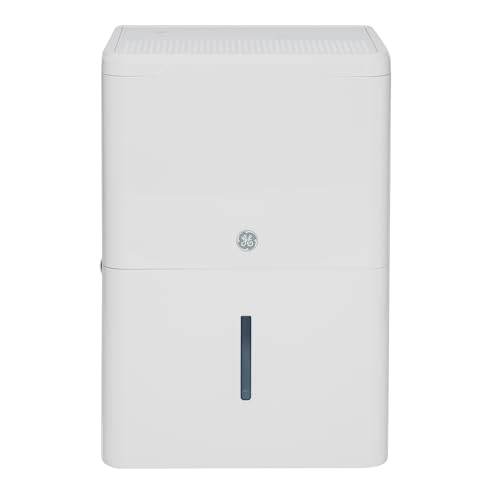

GE 50-Pint WiFi Smart Dehumidifier vs Waykar 34 Pint at a Glance
| Feature | GE 50-Pint WiFi Smart Dehumidifier | Waykar 34 Pint |
|---|---|---|
| Daily Moisture Removal | 50 pints per day | 34 pints per day (at 95°F, 90% RH) |
| Manufacturer Coverage Area | Up to 5,000 sq. ft. | Up to 2,000 sq. ft. |
| Water Tank Capacity | 15 pints (1.875 gallons) | 0.62 gallons (approx. 5 pints) |
| Fan Speeds | 3 speeds | 2 speeds |
| Operating Modes | Intermittent, Smart Dry | DEHU, DRY, Continuous (CONT.) |
| Smart Connectivity | Built-in Wi-Fi (SmartHQ app, Alexa, Google) | Not listed |
| Operational Sound Level | Not listed | 38 dB minimum |
| Energy Certifications & Power | 115 volts, Smart Dry efficiency | 190 watts, 2025 Energy Star Most Efficient, DOE, TUV |
| Dimensions & Weight | 11.4″D x 14.4″W x 24.1″H; 41.1 lbs | 10.87″D x 8.39″W x 19.3″H; 22.1 lbs |
| Drain Hose Included | No (connector built-in) | Yes (3.3-foot hose included) |
| Model Number | ADHE50WWF | PD160B-PRO |
| Best For | Large damp basements and automated home setups | Bedrooms, home offices, and medium-sized spaces |
Moisture Removal Capacity and Coverage Area
Dehumidifier performance is fundamentally defined by how many pints of water the compressor can condense within a 24-hour cycle and the total air volume it can treat. When evaluating the GE 50-Pint vs Waykar 34 Pint pint capacity, the mechanical scale differences become obvious immediately. The GE unit is rated to remove 50 pints of moisture every day, pushing dry air across footprints reaching up to 5,000 square feet. This high volume of airflow and moisture extraction makes it suitable for open floor plans, wide unpartitioned basements, and moisture-prone garages.
By comparison, the Waykar unit extracts up to 34 pints per day, tested under peak conditions of 95 degrees Fahrenheit and 90 percent relative humidity. Its specified operating coverage tops out at 2,000 square feet. In our review of the ge 50-pint wifi smart dehumidifier vs vremi midea 22 pint, we noted that high-capacity machines cycle less frequently when combating ambient humidity in large spaces. In the match between the GE ADHE50WWF vs Waykar PD160B-PRO, the GE model possesses nearly fifty percent more raw extraction capability, allowing it to bring saturated framing lumber and concrete slabs under control far faster than its smaller competitor.
If you are addressing severe moisture intrusion, standing dampness, or seasonal foundation condensation in a large layout, the GE 50-Pint vs Waykar 34 Pint coverage area metric reveals that the Waykar will quickly reach its physical boundaries. The 34-pint capacity handles single rooms, small apartments, and moderate humidity spikes with precision, but it cannot circulate the air volume needed for whole-house or multi-room subterranean moisture management.
Edge: GE 50-Pint WiFi Smart Dehumidifier because it delivers substantially higher daily moisture removal and more than double the structural coverage area.
Smart Controls and Automation Features
Modern dehumidifiers increasingly integrate automation to reduce user maintenance and prevent over-drying. In this category, the GE SmartHQ dehumidifier vs Waykar 34 Pint contrast is stark. The GE model features integrated Wi-Fi that links directly to the SmartHQ mobile application, alongside hands-free voice integrations through Amazon Alexa and Google Assistant. This setup allows users to view real-time ambient humidity, switch operating speeds, or set 24-hour schedules from their smartphones without entering a musty crawlspace or damp basement.
The GE unit also features proprietary Smart Dry technology. Rather than running continuously at full output, the internal sensors calculate the difference between the target relative humidity (adjustable between 30 and 70 percent) and the actual room humidity, adjusting the internal fan across three discrete speeds automatically. This intelligent control minimizes power consumption while maintaining a stable target atmosphere. When comparing high-end platforms such as the midea cube 50 vs ge 50-pint wifi smart dehumidifier, connected features like these prove essential for homeowners who travel or manage secondary properties.
The Waykar 34 Pint takes a purely localized approach to control. It features an onboard digital control panel that switches between three distinct pre-programmed functions: standard dehumidification (DEHU), clothing drying mode (DRY), and continuous operation (CONT.). It includes power outage memory to retain your settings after an interruption and an automatic defrost sensor, but the listing does not specify any Wi-Fi functionality or companion app integration. Adjustments must be executed manually at the machine.
Edge: GE 50-Pint WiFi Smart Dehumidifier because it features built-in Wi-Fi connectivity, SmartHQ app controls, voice assistant support, and adaptive Smart Dry logic.
Water Collection and Drainage Systems
The practical convenience of a dehumidifier depends heavily on how often you must empty its water bucket or how simply you can establish an uninterrupted passive drain. The GE ADHE50WWF is fitted with a generous 15-pint (1.875-gallon) collection bucket. This large reservoir allows the machine to pull water for extended periods before shutting down. When the bucket reaches capacity, a water level float activates an automatic shutoff mechanism alongside a 10-second audible alert, preventing accidental overflows if the bucket is unseated or brimming.
The Waykar 34 Pint employs a much more compact 0.62-gallon water reservoir (just under 5 pints). Because of this small internal volume, running the Waykar at maximum extraction in a very humid environment will fill the tank in a matter of hours, demanding frequent manual trips to empty it. However, Waykar addresses this design limitation by bundling a 3.3-foot flexible drain hose directly in the box, giving users everything required for continuous gravity drainage straight to a floor drain or sump pit without an auxiliary purchase.
The GE model also features a built-in continuous drain hose connection, but the listing does not include a hose in the package, requiring you to source a standard garden-style hose separately. For shoppers choosing between the frigidaire 50 pint dehumidifier vs ge 50-pint wifi smart dehumidifier or this Waykar unit, manual tank capacity remains a deciding daily factor. GE gives you three times the manual bucket volume, whereas Waykar is clearly engineered around continuous drainage via its included hose.
Edge: GE 50-Pint WiFi Smart Dehumidifier because its 15-pint internal tank drastically reduces manual emptying frequency compared to Waykar’s modest 0.62-gallon bucket.
Operating Sound Levels and Living Area Comfort
Dehumidifier noise is generated by both the internal refrigerant compressor and the high-velocity blower assembly. When placing an appliance in a bedroom, nursery, home office, or living room, decibel ratings dictate everyday livability. This is where the Waykar 34 Pint shines. Built around an upgraded rotary compressor and sound-dampening engineering, the Waykar records a quiet minimum sound output of only 38 dB on its low fan setting.
At 38 dB, the Waykar 34 Pint noise level is quieter than a standard conversational hum and sits noticeably lower than the 45 dB threshold typical of conventional portable units. The gentle hum makes it easy to position the unit beside a desk or near a bed without disturbing sleep or concentration. Furthermore, the unit features a dual-speed fan that lets you drop the airflow when quiet operation takes priority over rapid moisture clearance.
The GE 50-Pint listing does not specify an exact decibel output. However, heavy-duty 50-pint compressors paired with large-diameter fan wheels designed to process 5,000 square feet of air invariably produce more vibration and mechanical hum than a compact 34-pint compressor. While GE integrates three fan speeds to help modulate noise, its sheer mechanical throughput means it sounds more like a substantial utility appliance than a quiet domestic air purifier.
Edge: Waykar 34 Pint because its certified 38 dB low-noise output makes it dramatically better suited for occupied living spaces.
Energy Efficiency, Form Factor, and Portability
Physical footprint and electricity consumption dictate how easily an appliance integrates into residential spaces. The Waykar 34 Pint has earned the 2025 Energy Star Most Efficient recognition, backed by Department of Energy (DOE) and TUV efficiency certifications. Rated at an economical 190 watts, its internal copper coil construction and rotary compressor maximize thermodynamic exchange while keeping electrical consumption exceptionally low. When prospective buyers ask is Waykar 34 Pint worth it, the ongoing electrical efficiency provides a very compelling argument.
Physical handling also favors the Waykar design. Weighing just 22.1 pounds and measuring 10.87 inches deep, 8.39 inches wide, and 19.3 inches high, the unit can be lifted with one hand and set on an elevated shelf, laundry counter, or tucked neatly inside a bathroom without crowding floor space. Comparing compact alternatives like the homelabs 4,500 sq ft 32 pint vs waykar 34 pint reinforces how much easier a lightweight machine is to reposition across multiple floors.
The GE 50-Pint unit is a substantial appliance. It weighs 41.1 pounds-almost double the weight of the Waykar-and measures 11.4 inches deep, 14.4 inches wide, and 24.1 inches tall. GE mitigates this bulk by integrating 360-degree easy-roll caster wheels and molded pocket handles. Rolling the unit across level basements or smooth garage floors is seamless, but carrying it up and down stairwells requires considerable effort. Its electrical system runs on standard 115-volt residential power, assisted by Smart Dry programming to cut power waste, but it lacks the ultra-low 190-watt footprint of the Waykar.
Edge: Waykar 34 Pint because of its verified 2025 Energy Star Most Efficient status, low 190-watt draw, and featherweight 22.1-pound footprint.
Pros and Cons
GE 50-Pint WiFi Smart Dehumidifier

Pros
- Removes up to 50 pints daily
- Covers up to 5000 square feet
- SmartHQ app and voice controls
- Generous 15-pint collection bucket
- Three adjustable fan speeds
Cons
- Heavy 41.1-pound cabinet weight
- Drain hose not included in box
View GE 50-Pint WiFi Smart Dehumidifier on Amazon
Waykar 34 Pint

Pros
- Ultra-quiet 38 dB minimum sound
- Energy Star Most Efficient 2025 certified
- Includes 3.3-foot drain hose
- Lightweight 22.1-pound compact chassis
Cons
- Small 0.62-gallon internal water tank
- Lacks wireless app connectivity
Who Should Buy Each One
Choose the GE 50-Pint WiFi Smart Dehumidifier If
- You need to control persistent moisture across large basements, garages, or spaces up to 5,000 square feet.
- You want remote visibility to track relative humidity, set schedules, and adjust settings via smartphone or voice assistants.
- You plan to rely on an internal collection bucket and want 15 pints of capacity to avoid constant manual emptying.
- You prefer adaptive automation like Smart Dry to regulate three fan speeds according to ambient moisture shifts.
Choose the Waykar 34 Pint If
- You are placing the dehumidifier in a bedroom, nursery, or office where its 38 dB quiet operation won’t cause disruptions.
- You want top-tier energy conservation supported by 2025 Energy Star Most Efficient certification and a low 190-watt rating.
- You require a lightweight, 22.1-pound appliance that is easy to carry between floors, laundry rooms, or tight bathrooms.
- You plan to use continuous gravity drainage immediately with the included 3.3-foot drain hose.
Final Verdict
In any balanced Waykar 34 Pint vs GE 50-Pint WiFi Smart Dehumidifier comparison, the superior unit depends entirely on the environment you are treating. For the majority of homeowners managing unconditioned basements, chronic foundation dampness, or extensive open footprints, the GE 50-Pint WiFi Smart Dehumidifier is the definitive pick. Its commercial-grade 50-pint extraction rate, expansive 5,000 square foot rating, large 15-pint internal tank, and integrated SmartHQ Wi-Fi ecosystem deliver a set-it-and-forget-it moisture management experience that lighter machines cannot replicate.
Conversely, the Waykar 34 Pint emerges as the superior choice for finished living areas, bedrooms, home offices, and smaller apartments. With an exceptionally low sound output of 38 dB, an Energy Star Most Efficient rating running on just 190 watts, and an ultra-portable 22.1-pound frame, it provides quiet, localized drying without driving up energy use or cluttering your living space. If your target area is under 2,000 square feet and low noise is your priority, the Waykar delivers remarkable utility.
FAQ
Can the GE 50-Pint WiFi Smart Dehumidifier or Waykar 34 Pint for basement use operate in cold temperatures?
Yes, both models feature integrated automatic defrost functionality. When ambient temperatures drop in cooler basements or garages, frost can accumulate on the internal cooling coils. The sensors in both the GE and Waykar units detect frost development, cycling off the compressor while running the fan to melt frost before resuming active dehumidification.
How do the internal water tanks compare for manual emptying?
The GE model features a 15-pint (1.875-gallon) bucket, allowing for extended runtimes before shutting off on a full bucket alert. The Waykar features a much smaller 0.62-gallon (approximately 4.96-pint) tank. In high-humidity conditions, the Waykar bucket will fill up several times faster than the GE bucket, making the Waykar better suited for use with its included continuous drain hose.
Does the Waykar 34 Pint require a smart plug for scheduling?
Because the Waykar 34 Pint listing does not specify built-in Wi-Fi or app connectivity, you cannot adjust its humidity targets or change modes from your phone. However, it does feature internal power outage memory, meaning it will automatically resume its prior operating mode when powered on, making it compatible with basic external timers or smart wall outlets.
Can I use voice commands to control the GE 50-Pint dehumidifier?
Yes, the GE unit integrates with the SmartHQ platform, which supports voice control through Amazon Alexa and Google Assistant. Once linked to your home network, you can adjust fan speeds, turn the machine on or off, and query current settings hands-free.
Does either dehumidifier include an air filter that needs replacement?
Neither unit requires purchasing disposable replacement filters under normal operating conditions. The GE unit features a washable, reusable filter supported by an automatic clean filter alert on the control panel. The Waykar unit also includes a detachable, washable mesh filter that slides out for regular cleaning under running water.
What happens when the water bucket gets full on these units?
Both models feature built-in overflow protection. The GE unit uses a water level control switch that automatically shuts down operation when the bucket is full or misaligned, accompanied by a 10-second audible alarm. The Waykar model similarly features an automatic shutoff mechanism that engages as soon as the 0.62-gallon tank reaches capacity to prevent spills.
Ultimately, matching your square footage and humidity severity dictates whether the heavy-duty GE or the compact Waykar serves your home better. If your moisture challenges fall outside these two extremes, exploring curated Dehumidifier Picks can help pinpoint models tailored for crawl spaces or extreme temperatures. Selecting the right capacity prevents energy waste while keeping indoor humidity consistently below target thresholds.