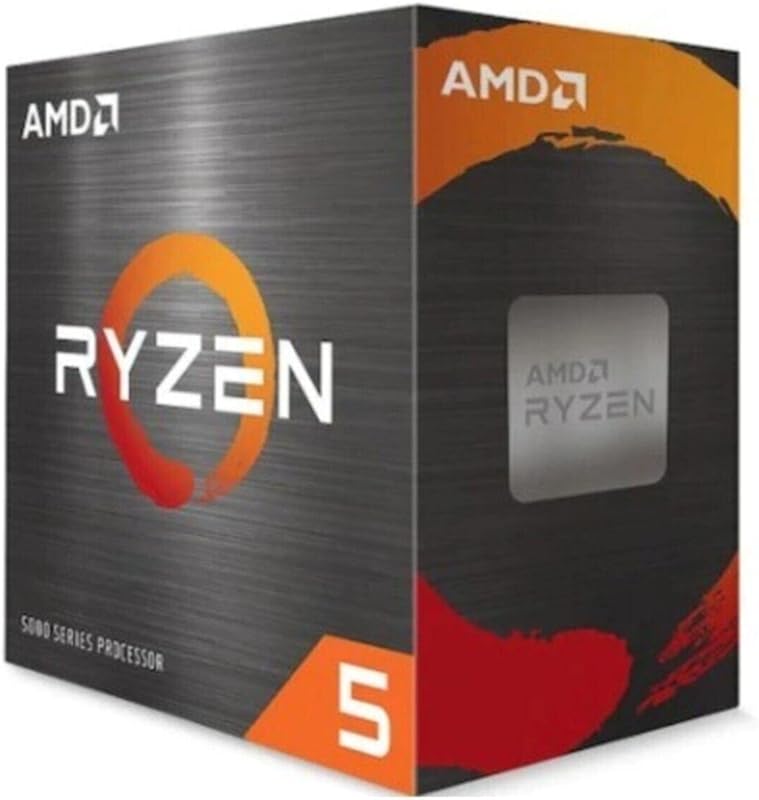
The core design philosophy separating these two mid-range processors comes down to thread density versus clock frequency: the Intel Core Ultra 5 245KF splits workloads across a 14-core hybrid layout designed for multi-tasking productivity, whereas the AMD Ryzen 5 9600X leverages a streamlined 6-core Zen 5 configuration reaching up to 5.4 GHz at roughly half the base power draw.
Creators and heavy multi-taskers who prioritize raw multi-threaded throughput across background tasks should choose the Intel processor, while system builders aiming for high single-core responsiveness, simplified cooling, and lower operating wattage should select the AMD chip.


Intel Core Ultra 5 245KF vs AMD Ryzen 5 9600X at a Glance
| Attribute | Intel Core Ultra 5 245KF | AMD Ryzen 5 9600X |
|---|---|---|
| Processor Architecture | Performance Hybrid (6 P-cores + 8 E-cores) | Zen 5 |
| Physical Core Count | 14 cores | 6 cores |
| Thread Count | 14 threads | 12 threads |
| Maximum Boost Frequency | 5.2 GHz | 5.4 GHz |
| Base Operating Clock | Not listed | 3.9 GHz |
| Total Installed Cache | 26 MB | 38 MB |
| Secondary Cache Size | 24 MB | 6 MB |
| Base Power Consumption | 125 watts | 65 watts |
| Motherboard Socket | LGA 1700 / Intel 800 Series Chipset | Socket AM5 |
| Memory Specification | DDR5 | DDR5-5600 |
| Best For | Multi-threaded productivity workflows | High-clock gaming and power-efficient setups |
Core Architecture and Multi-Threaded Productivity
The structural layout of execution units defines how modern desktop CPUs handle complex software stacks. When assessing the Intel Core Ultra 5 245KF, Intel implements a performance hybrid architecture that pairs 6 Performance cores with 8 Efficient cores, tallying 14 cores and 14 concurrent threads. This architecture dynamically shifts heavy foreground tasks to the P-cores while delegating continuous background operations, rendering threads, and encoding routines to the E-cores. Builders interested in higher tier desktop hybrid setups can see how this formula scales in our intel core ultra 5 245kf vs core ultra 7 265k breakdown.
In contrast, the Ryzen 5 9600X maintains AMD’s unified approach, relying on 6 high-density Zen 5 cores that support simultaneous multithreading to deliver 12 processing threads. Every core on the AMD die possesses identical execution capabilities, cache access, and peak clock potential. This uniform configuration eliminates any operating system scheduling friction between performance and efficiency nodes, making performance completely predictable across every active execution thread.
For demanding workloads like media compiling, local code compression, and heavy content generation, having 14 distinct execution cores gives the Intel chip a definitive structural advantage over a 6-core processor. When deciding on the Intel Core Ultra 5 245KF or AMD Ryzen 5 9600X for productivity, the 245KF handles multi-application saturation and distributed thread pipelines with greater headroom, even though the 9600X provides capable 12-thread output on its Zen 5 baseline.
Edge: Intel Core Ultra 5 245KF, providing 14 physical cores that offer superior multi-threaded bandwidth for background computing and heavy productivity suites.
Clock Speeds and Gaming Responsiveness
Single-threaded burst responsiveness directly governs in-game frame rates and latency in latency-sensitive interactive software. The Ryzen 5 9600X pushes single-core frequencies up to a 5.4 GHz Max Boost clock from a 3.9 GHz base frequency. Because most modern game engines still favor high clock speeds and rapid pipeline execution over high core counts, this elevated frequency headroom enables the Zen 5 processor to sustain exceptional frame output, which the product listing rates for smooth 100+ FPS in modern titles.
The Core Ultra 5 245KF achieves up to 5.2 GHz on its performance cores, aided by Turbo Boost Max Technology 3.0. While 5.2 GHz provides strong gaming velocity, the Intel processor runs 200 MHz lower at peak boost than its AMD counterpart. For an in-depth perspective on brand platform performance across various game engines, consult our guide to intel vs amd for gaming.
Evaluating Ryzen 5 9600X vs Core Ultra 245KF gaming performance highlights that the higher boost clock of the Zen 5 architecture delivers exceptional responsiveness in competitive e-sports titles and simulation titles. Choosing between the Intel Core Ultra 5 245KF or AMD Ryzen 5 9600X for gaming usually favors the AMD platform, where higher peak clocks directly translate into snappy frame delivery.
Edge: AMD Ryzen 5 9600X, thanks to its 5.4 GHz peak boost clock giving it an edge in single-core responsiveness and high-framerate gaming.
Power Consumption and Base Operating Wattage
Thermal dissipation and electrical requirements heavily influence power supply selection, case airflow requirements, and overall chassis acoustics. The Core Ultra 5 245KF vs Ryzen 5 9600X wattage comparison reveals an enormous delta: Intel lists a 125-watt base power rating, whereas AMD rates the 9600X at a modest 65 watts. Builders managing thermal ceilings can also compare other variants such as the intel core ultra 5 245kf vs intel core ultra 7 265kf to understand Intel’s broader thermal envelope.
At 65 watts, the Ryzen 5 9600X draws significantly less electrical power from the motherboard VRMs, producing less ambient heat inside the case. This allows builders to achieve quiet operation using standard air cooling towers without needing oversized dual-chamber chassis setups. The listing confirms air cooling compatibility, although neither processor includes an in-box thermal cooler.
Operating at a 125W base power rating means the Core Ultra 5 245KF generates a substantially larger heat signature under continuous load. While Intel highlights architectural efficiency improvements to help PCs run cooler and quieter than previous platforms, handling 14 physical cores at 125W requires a robust thermal solution and a high-capacity chassis cooling setup to prevent thermal throttling under sustained multi-threaded rendering.
Edge: AMD Ryzen 5 9600X, operating at a 65W thermal specification that generates less heat and requires less demanding cooling hardware.
Cache Memory Size and Architecture
Cache structures serve as the ultra-fast staging grounds for data immediately required by the execution pipelines. In any detailed AMD Ryzen 5 9600X review, the 38 MB total installed cache memory stands out as a primary design asset. AMD positions this pool near the execution cores, minimizing trips to system RAM and accelerating cache-bound operations like asset streaming and frame generation.
An Intel Core Ultra 5 245KF review shows a different cache partitioning strategy: 26 MB of total installed cache paired with an expansive 24 MB secondary cache. This deep secondary cache layer supports the hybrid core clusters, keeping large instruction sets resident close to both P-cores and E-cores during complex multi-tasking and data manipulation.
Despite Intel’s substantial 24 MB secondary cache pool, AMD’s total cache capacity advantage of 38 MB versus 26 MB provides higher overall data buffering for game execution. In the head-to-head matchup of Intel 245KF vs Ryzen 9600X, the AMD processor’s larger total memory buffer gives it a clear advantage in workloads that benefit from bulk low-latency cache storage.
Edge: AMD Ryzen 5 9600X, offering 38 MB of total installed cache compared to 26 MB on the Intel chip.
Socket Platform Compatibility and Motherboard Longevity
Platform decisions dictate upgrade potential, memory options, and connectivity over several build cycles. The AMD Ryzen 5 9600X drops into Socket AM5 motherboards, supporting high-speed DDR5-5600 memory modules natively along with PCIe 5.0 graphics and storage connectivity on select motherboards. For builders considering how modern platforms compare across enthusiast tiers, our analysis of the intel core ultra 7 265k vs amd ryzen 7 9800x3d reveals similar platform architectural trends.
The Core Ultra 5 245KF listing shows compatibility with Intel 800 series chipset-based motherboards while listing an LGA 1700 processor socket in its specification table. The platform incorporates PCIe 5.0 and 4.0 lane support, DDR5 memory capability, Turbo Boost Max Technology 3.0, and Intel Optane Memory support. Those considering enthusiast-level Intel silicon can see related configurations in our intel core ultra 5 245kf vs core ultra 9 285k evaluation.
Comparing AMD Ryzen 5 9600X vs Intel Core Ultra 5 245KF platform specifications shows both chips offering high-bandwidth DDR5 support and PCIe 5.0 data lines. However, Socket AM5 provides a clearly defined upgrade path for builders looking to retain their motherboards for future processor upgrades, whereas Intel’s specifications tie this unit to specific chipset and socket combinations.
Edge: AMD Ryzen 5 9600X, utilizing the stable Socket AM5 platform with verified DDR5-5600 support and PCIe 5.0 support on select motherboards.
Pros and Cons
Intel Core Ultra 5 245KF
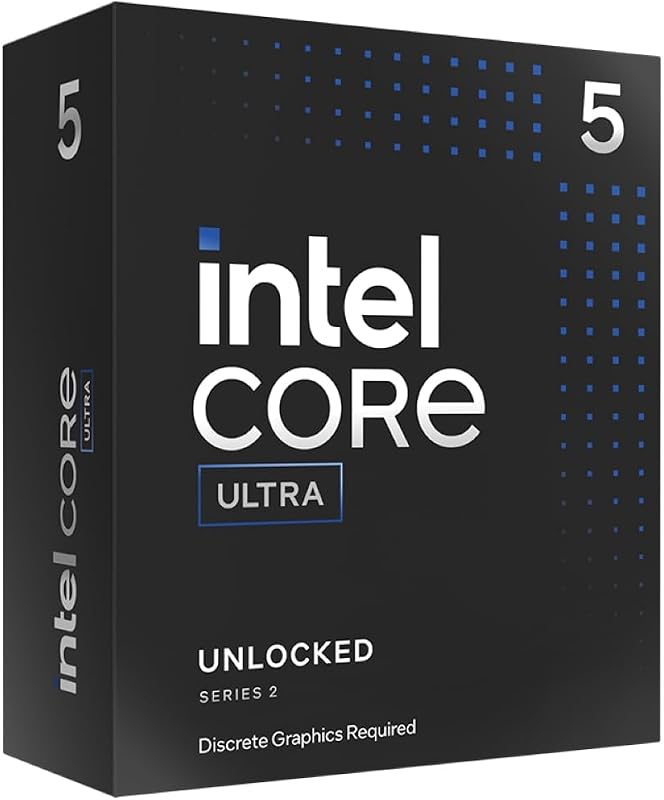
Pros
- 14 physical processing cores
- Performance hybrid architecture with 8 E-cores
- Substantial 24 MB secondary cache
- Turbo Boost Max Technology 3.0
Cons
- Higher 125W base power draw
- Requires discrete graphics card
- No included thermal cooler
View Intel Core Ultra 5 245KF on Amazon
AMD Ryzen 5 9600X

Pros
- High 5.4 GHz max boost clock
- Efficient 65W base operating wattage
- Large 38 MB total cache
- Native DDR5-5600 memory support
Cons
- Limited to 6 physical cores
- No thermal solution included
- PCIe 5.0 limited to select boards
View AMD Ryzen 5 9600X on Amazon
Who Should Buy Each One
Choose the Intel Core Ultra 5 245KF If
- You run multi-threaded productivity software that scales across 14 dedicated processor cores.
- You need the flexible workload management of a performance hybrid layout that separates background operations onto 8 E-cores.
- You require a deep 24 MB secondary cache layer alongside Intel Optane Memory and Turbo Boost Max Technology 3.0 support.
- You plan to install a high-performance discrete graphics card in a system equipped with an Intel 800 series chipset motherboard.
Choose the AMD Ryzen 5 9600X If
- You prioritize gaming responsiveness driven by a 5.4 GHz Max Boost clock and 38 MB of installed cache.
- You want to minimize power draw and cooling demands using an efficient 65-watt processor.
- You are building on the Socket AM5 ecosystem with native support for DDR5-5600 memory.
- You ask is AMD Ryzen 5 9600X worth it for a pure gaming rig that hits 100+ FPS without needing liquid cooling hardware.
Final Verdict
For the majority of PC builders and dedicated gamers, the AMD Ryzen 5 9600X is the superior overall choice. Its 5.4 GHz maximum boost frequency, combined with 38 MB of total cache and an efficient 65W base operating wattage, produces outstanding gaming responsiveness while remaining easy to cool. Combined with the forward-looking Socket AM5 platform and DDR5-5600 memory support, the 9600X represents a balanced, highly capable foundation for modern desktop gaming systems.
The Intel Core Ultra 5 245KF is the clear winner when multi-threaded productivity takes priority over pure power efficiency. With 14 physical cores divided between 6 P-cores and 8 E-cores, along with 24 MB of secondary cache, the 245KF provides the hardware bandwidth required for video rendering, compiling, and intensive concurrent applications. If your daily PC use centers around creative software and multi-tasking workloads, Intel’s core density delivers the processing throughput you need.
FAQ
Does the Intel Core Ultra 5 245KF include integrated graphics?
The product description for the Intel Core Ultra 5 245KF explicitly states that it operates without processor graphics and that discrete graphics are required. While one bullet point mentions integrated graphics, the KF designation and main technical description confirm that a dedicated graphics card must be installed for display output.
Does the AMD Ryzen 5 9600X come with a bundled CPU cooler?
No, the listing confirms that a cooler is not included with the AMD Ryzen 5 9600X. Because it features a modest 65-watt thermal design, you can easily pair it with a standard aftermarket air cooler rather than an elaborate liquid cooling loop.
What socket does the Intel Core Ultra 5 245KF use?
The listing states that the processor is compatible with Intel 800 series chipset-based motherboards, while also referencing LGA 1700 in its technical specifications table. Buyers should ensure their selected motherboard explicitly supports the Series 2 Core Ultra desktop processors before finalizing their parts list.
What type of memory do these processors support?
Both processors support modern high-speed DDR5 system memory. The AMD Ryzen 5 9600X listing explicitly lists support for DDR5-5600 speeds on Socket AM5, while the Intel Core Ultra 5 245KF specifies general unlocked DDR5 support.
Can the AMD Ryzen 5 9600X run on Windows 11?
Yes, the AMD Ryzen 5 9600X listing lists Windows 11 as its supported operating system platform, matching the platform requirements of the Intel Core Ultra 5 245KF.
Do both of these desktop processors support PCIe 5.0?
Yes, both CPUs support high-bandwidth PCIe 5.0 lanes. The Intel Core Ultra 5 245KF supports both PCIe 5.0 and 4.0 lanes, while the AMD Ryzen 5 9600X supports PCIe 5.0 on select Socket AM5 motherboards.
Is either processor unlocked for overclocking?
Both processors feature unlocked multipliers according to their official listings. The Intel Core Ultra 5 245KF supports performance tuning up to 5.2 GHz, while the AMD Ryzen 5 9600X is unlocked for overclocking up to its 5.4 GHz Max Boost clock.