The core engineering difference between these two power sources lies in how raw electricity is generated and conditioned: an inverter generator produces alternating current, rectifies it into direct current, and electronically refines it back into stable alternating current with a pure sine wave, whereas a conventional generator mechanically spins an engine-driven alternator at a fixed speed to output raw electricity straight to its receptacles.
Choose an inverter generator if you need quiet operation, high fuel efficiency, and clean power that protects sensitive modern electronics during camping or residential blackouts. Choose a conventional generator if your primary goal is generating massive continuous wattage and high starting surge capacity to run demanding job-site tools or whole-house transfer switches.

Inverter Generator vs Conventional Generator at a Glance
| Attribute | Inverter Generator | Conventional Generator |
|---|---|---|
| Electrical Waveform | Clean sine wave (<3% THD) | Modified or raw sine wave (10% to 25% THD) |
| Engine Speed Operation | Variable RPM matched to active load (Eco-mode) | Fixed 3,600 RPM continuous operation |
| Operating Sound Level | 57 to 59 dBA under typical light loads | The listing does not specify (commonly 68 to 80+ dBA) |
| Typical Starting Wattage Range | 1,600 to 3,800 watts (single portable unit) | The listing does not specify (commonly 4,000 to 12,000+ watts) |
| Fuel Source Capabilities | Gasoline or Dual-Fuel (Gas and Propane) | The listing does not specify |
| Housing and Frame | Fully enclosed, sound-attenuating composite casing | Open-frame tubular steel cage |
| Parallel Connection Ready | Supported on compatible models via parallel ports | Not supported on standard mechanical alternators |
| Physical Unit Weight | 28 pounds to moderate two-person carry | The listing does not specify (typically 100 to 250+ pounds) |
| Best For | Electronics, RV camping, quiet neighborhoods | Heavy-duty job sites, high-draw motor loads, emergency backup |
Electrical Cleanliness and Total Harmonic Distortion
The internal circuitry that delivers electricity to your outlets represents the starkest mechanical contrast in any conventional vs inverter generator comparison. A standard conventional machine relies entirely on engine speed to govern output voltage and frequency. Because the mechanical governor takes time to respond as heavy loads switch on and off, the resulting alternating current exhibits noticeable frequency drift, voltage fluctuations, and high total harmonic distortion (THD). When analyzing a conventional generator review, technical evaluators frequently note that open-frame alternators produce THD levels exceeding 10% to 20%, which introduces harmonic noise and erratic voltage spikes into connected equipment.
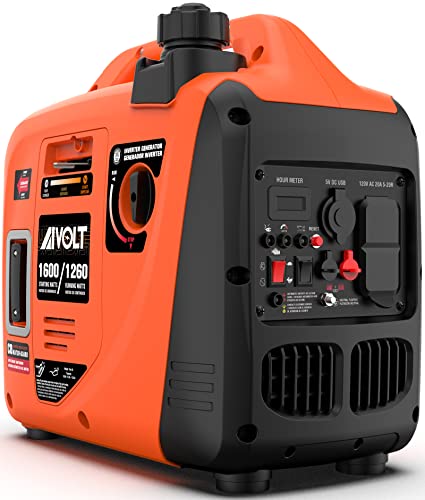
In contrast, modern inverter architecture decouples output frequency from engine RPM entirely. The multi-pole alternator first generates raw three-phase AC electricity, which internal circuitry rectifies into direct current (DC) before a digital microprocessor inverts that DC power back into a stable 120-volt, 60-hertz alternating current. Representative models like the AIVOLT 1600W Super Quiet Inverter Generator highlight an ultra-clean output profile with an inverter generator thd clean power rating under 3%. This pristine sine wave closely mirrors pure utility grid power, eliminating the electrical stress that causes overheating, component degradation, or erratic resets in laptops, smartphones, variable-speed furnace blowers, and smart appliances.
Running sensitive devices directly from unconditioned alternators carries measurable mechanical risk over extended durations. While simple incandescent work lights, heating elements, and basic brushed motors can easily absorb dirty power without failure, modern printed circuit boards and microprocessor power supplies cannot dissipate high electrical harmonic distortion safely. Readers reviewing broader hardware matchups, such as the generac gp8000e vs honda eu3000is evaluation, regularly encounter this exact trade-off between crude rotational alternator power and digitally synthesized electrical safety.
Edge: Inverter generator because solid-state digital inversion maintains total harmonic distortion under 3% to safeguard fragile electronic equipment.
Operating Sound and Noise Control
Acoustic performance is often the single factor that dictates where an engine can legally and comfortably operate. Conventional units utilize open tubular steel roll cages with direct mechanical engine mounts, exposing the uninsulated engine block, cooling fan, and mechanical valvetrain directly to the open air. Because the engine must maintain a relentless 3,600 RPM speed to generate the required 60 Hz frequency, the machine produces a continuous, loud mechanical drone regardless of whether you draw 50 watts or 4,000 watts. Decibel ratings on standard open-frame models routinely sit between 68 and 82 dBA at 23 feet, which equals the sound of heavy commercial traffic or an un-muffled lawnmower.
When measuring inverter vs standard generator noise level metrics, inverter technology operates in an entirely different sound category. Units incorporate sound-deadening plastic shells, acoustic baffling, tuned intake runners, and quiet low-restriction mufflers. More importantly, their engines can throttle down when demand is low. The AIVOLT 1600W machine, for example, is engineered to operate at just 57 dBA at 23 feet, which sits well below the volume of a standard human conversation. Similarly, larger dual-fuel units such as the PowerSmart 3800 Watt Dual Fuel Inverter Generator maintain an operating sound rating of just 59 dBA at 25% electrical load when running in Eco Mode.
This massive acoustic gap determines whether a power station is welcome in public or residential environments. If you are debating an inverter or conventional generator for camping, quiet campground regulations almost universally ban standard open-frame generators or enforce strict 60 dBA volume caps at 50 feet that conventional frames cannot meet. Similar noise concerns emerge when comparing mobile battery banks and small engines in head-to-head articles like the honda eu2200i vs ecoflow delta 2 overview, where low acoustic footprints prove crucial for tailgating, RVing, and quiet patio operation.
Edge: Inverter generator due to fully enclosed acoustic dampening cases and load-sensing engine speeds that operate under 60 dBA.
Engine Throttling and Fuel Economy
The mechanics of engine speed regulation create major differences in overall inverter vs conventional generator fuel efficiency. Because a standard mechanical generator relies on the rotational speed of its crankshaft to regulate the electrical frequency of its output, the engine governor forces the throttle open to maintain roughly 3,600 RPM from the moment it starts until it runs dry. If your electrical demand drops to a single phone charger or a low-wattage LED bulb, the engine continues screaming at top speed, burning through liquid fuel at a heavy baseline rate simply to keep the alternator rotating at 60 Hz.
Inverter generators eliminate this fuel-wasting design flaw by decoupling engine RPM from frequency regulation. Because the output current is electronically inverted, the engine speed can throttle down to idle when power draw is minimal, revving up only when an appliance demands more amperage. The AIVOLT 1600W model leverages this capability via its integrated eco-mode switch, achieving up to 8 hours of continuous runtime at 25% load on its 60cc 4-stroke OHV engine, while delivering 2 hours when pushed to its maximum 1,260 running watts capacity. The engine burns only the precise volume of gasoline required to satisfy current electrical consumption.
Dual-fuel inverter designs take this efficiency and operational flexibility even further. The PowerSmart 3800 runs for 8 hours at 25% load on its compact 1.3-gallon gasoline tank, but extends that continuous runtime up to 24 hours when connected to a standard 20-pound residential propane cylinder. When evaluating dual-fuel capabilities across broader platform comparisons like the westinghouse wgen9500df vs champion 100519 breakdown, fuel storage stability and throttle modulation emerge as primary operational advantages during prolonged power outages.
Edge: Inverter generator because intelligent eco-throttling adjusts engine speed dynamically to prevent wasteful high-RPM idling on partial loads.
Power Output and Motor Surge Capacity
While inverter machines dominate in power refinement and fuel economy, conventional generators maintain undisputed supremacy in sheer electrical output per unit. Building high-wattage electronic inverter modules requires complex, heat-dissipating solid-state components that become substantially heavier and more complex as wattage ratings climb past 4,000 watts. As a result, standalone portable inverters typically top out around 3,000 to 4,000 running watts. The PowerSmart 3800 provides 3,800 starting watts and 3,300 running watts on gasoline (and 3,500 starting watts / 3,100 running watts on propane), which handles multiple small appliances but struggles under the simultaneous strain of heavy home backup hardware.
Conventional generators, by contrast, use heavy-duty copper and steel mechanical alternators capable of delivering immense raw power without requiring delicate solid-state inversion hardware. Open-frame units frequently supply 5,000 to 12,000 continuous running watts with massive motor-starting surge capacities. This makes the mechanical platform uniquely suited for driving high-draw inductive loads that demand three to four times their operating wattage just to spin up from a dead stop, including 3-ton central air conditioning compressors, 240-volt multi-horsepower well pumps, and heavy industrial arc welders.
When homeowners decide between an inverter or conventional generator for home backup, total home wattage demand often forces the decision. While inverter users often resort to parallel kits-cabling two identical machines together like the parallel-ready AIVOLT or PowerSmart units to double their working wattage-a single high-capacity conventional unit plugs straight into a manual transfer switch to energize an entire home distribution panel without complex modular cabling. Large-scale comparisons like the honda eu3000is vs duromax xp13000eh show how critical massive mechanical surge buffers become when powering full-size residential properties.
Edge: Conventional generator because direct mechanical alternators deliver dramatically higher starting wattage and continuous output to support heavy motor loads.
Portability, Weight, and Enclosure Design
Physical handling and spatial footprint directly determine how practical an engine is for routine transit. Compact inverter generators are deliberately built for single-person hand transport. The AIVOLT 1600W model weighs an astonishingly light 28 pounds and features an integrated top carrying handle molded directly into its suitcase-style outer shell. Its diminutive 60cc engine and compact electrical components allow it to slide effortlessly into car trunks, RV underbelly storage bays, or boat compartments without demanding dedicated trailer space or lifting equipment.
Even mid-capacity inverter units like the PowerSmart 3800 remain comparatively manageable, housing their 149cc 4-stroke engine, dual-fuel regulator assemblies, and complete control panels-which include a 120V 30A L5-30R twist-lock receptacle, standard 20A duplex outlets, 12V DC ports, and USB charging slots-inside a streamlined enclosure. Both the AIVOLT and PowerSmart machines also come equipped with carbon monoxide detection sensors (meeting ANSI/PGMA G300 standards) that automatically shut down the engine if hazardous fumes pool around the housing, reflecting an intentional design emphasis on consumer residential and recreational safety.
Conventional open-frame generators feature an entirely different structural philosophy. Wrapped in thick tubular steel pipe to survive rough treatment on muddy commercial construction sites, standard units typically weigh well over 100 pounds, with large-frame 8,000-watt models pushing 200 to 250 pounds or more. Maneuvering them requires heavy steel wheel kits and fold-out handles, and lifting them into a pickup bed generally requires two capable adults or a mechanical ramp. In head-to-head field evaluations like the honda eu2200i vs champion 100519 matchup, physical transportability consistently sets compact enclosed generators apart from cumbersome open-frame hardware.
Edge: Inverter generator because lightweight composite housings and compact engine footprints allow effortless single-person transport.
Pros and Cons
Inverter Generator

Pros
- Clean power under 3% THD
- Ultra-quiet 57 to 59 dBA operation
- Lightweight 28-pound carrying design
- Eco-mode throttle optimizes fuel efficiency
Cons
- Lower maximum running wattage
- Requires parallel cables for large loads
View AIVOLT 1600W Super Quiet Inverter Generator on Amazon
Conventional Generator
Pros
- Immense continuous and surge wattage
- Drives heavy 240V inductive motor loads
- Direct single-connection home transfer switch power
Cons
- High harmonic distortion exceeding 10% THD
- Fixed 3600 RPM high fuel consumption
- Heavy open-frame steel construction
Who Should Buy Each One
Choose the Inverter Generator If
- You need clean electrical current with less than 3% total harmonic distortion to run microcomputers, smartphones, portable gaming rigs, and sensitive smart appliances safely.
- You plan to use the machine at national parks, public campgrounds, or neighborhood gatherings where noise ordinances mandate ultra-quiet sound profiles under 60 dBA.
- You want a lightweight, highly portable unit weighing under 30 to 60 pounds that a single person can load, carry, and store with zero mechanical assistance.
- You prioritize fuel efficiency and extended runtime during light-load operations, letting an electronic eco-throttle stretch small fuel reserves across an entire night.
Choose the Conventional Generator If
- You must power heavy inductive motor loads, such as high-tonnage central air conditioning units, submersible well pumps, large table saws, or industrial air compressors.
- You require massive electrical capacity exceeding 5,000 to 10,000 running watts connected directly through an exterior manual transfer switch into a home electrical panel.
- You work in rugged outdoor environments, such as active construction framing sites, agricultural fields, or utility repair locations where loud engine noise is not an issue.
- You want simple mechanical hardware without complex digital inverter boards that can withstand rough handling inside an open steel roll cage.
Final Verdict
For the vast majority of homeowners, campers, tailgaters, and remote workers, an inverter generator represents the distinctly superior choice. While it outputs lower total wattage per pound of engine, its whisper-quiet operation, lightweight form factor, and exceptional fuel conservation make it vastly more practical for modern living. Most importantly, its digitally synthesized pure sine wave guarantees that expensive modern devices-from laptops and smart television sets to high-efficiency refrigerators-operate safely without suffering heat damage from distorted electrical waves. If you are asking whether an inverter generator worth it for recreation and residential blackouts, the protection it affords your sensitive devices and the peace it preserves with your neighbors make it an easy winner.
However, asking whether is a conventional generator worth it yields an emphatic yes when sheer, unadulterated electrical muscle is your sole objective. If your emergency plan demands keeping a 240-volt well pump running, maintaining large multi-ton central air compressors, or supplying continuous high-amperage power across an active job site, an inverter simply cannot match the raw surge output and heavy wattage capability of an open-frame mechanical alternator. When massive wattage takes absolute priority over quiet sound levels and fuel frugality, the conventional generator remains the undisputed workhorse of heavy-duty power generation.
FAQ
Can an inverter generator run a full-size central home air conditioner
Most portable inverter generators cannot run a standard whole-home central air conditioner because central units require immense starting surge currents that exceed the 1,600-watt to 3,800-watt capacity of standalone inverter models. To start and run a multi-ton central AC compressor, you generally require either a massive conventional generator producing over 8,000 to 10,000 running watts or multiple high-output inverter generators linked in parallel and paired with soft-start capacitors.
Why do conventional generators produce higher electrical distortion
Conventional generators produce higher total harmonic distortion because their alternating current is generated mechanically straight from the rotating magnetic field inside the stator windings. Minor engine RPM variations, mechanical governor delays, and uneven magnetic fields introduce harmonic noise and voltage irregularities into the output wave, frequently resulting in THD ratings between 10% and 25% that can cause sensitive microprocessors to malfunction.
Can you parallel two conventional generators together
Standard open-frame conventional generators cannot be linked together with simple plug-in parallel cables because their mechanical alternators do not share synchronized AC frequencies. Inverter generators, such as the parallel-ready AIVOLT and PowerSmart models, use solid-state microprocessors that electronically communicate and synchronize their phase timing, allowing two matching inverters to seamlessly combine their wattage into a single output stream.
How does fuel consumption compare during low electrical loads
Inverter generators consume significantly less fuel under light electrical loads because their internal electronic throttle automatically reduces engine RPM to an idle when demand is low. A conventional generator must spin continuously at roughly 3,600 RPM to maintain an accurate 60-hertz frequency, meaning it burns a high baseline volume of gasoline even if it is only powering a single 15-watt phone charger.
Are conventional generators allowed in state and national parks
Most state and national campgrounds strictly enforce noise caps-typically between 60 and 65 dBA measured at 50 feet-and prohibit excessively loud equipment during designated quiet hours. Open-frame conventional generators frequently operate at 70 to 80+ dBA, which violates these acoustic regulations and can result in park citations, whereas quiet enclosed inverters like the 57 dBA AIVOLT easily comply with quiet-campground rules.
Will a conventional generator ruin a smartphone or laptop
Modern phone and laptop chargers contain switch-mode power supplies that can tolerate moderate harmonic distortion, but prolonged exposure to the heavy voltage spikes, frequency drift, and high harmonic distortion produced by conventional open-frame alternators can cause electronic power adapters to run hot, charge erratically, or suffer premature circuit failure. Connecting expensive computing gear to clean inverter power with under 3% THD is always the safer practice.