The primary distinction deciding between the Kingston Fury Renegade DDR5 and the TeamGroup T-Force Delta RGB DDR5 is the trade-off between maximum operational frequency and primary CAS latency timing. TeamGroup delivers a blistering 7200MHz data transfer rate tailored for bandwidth-hungry workloads, while Kingston prioritizes tighter CL32 timings at 6400MT/s paired with hardware-level lighting synchronization.
Builders running high-tier motherboards who want maximum raw bandwidth should choose the TeamGroup T-Force Delta RGB DDR5, whereas enthusiasts seeking tight out-of-the-box response times and synchronized illumination should opt for the Kingston Fury Renegade DDR5.

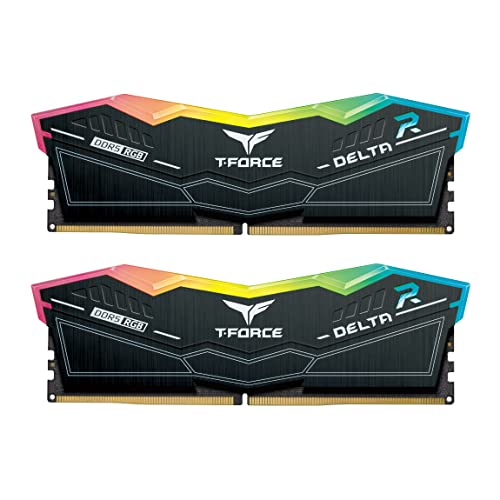
Kingston Fury Renegade DDR5 vs TeamGroup T-Force Delta RGB DDR5 at a Glance
| Feature | Kingston Fury Renegade DDR5 | TeamGroup T-Force Delta RGB DDR5 |
|---|---|---|
| Rated Transfer Speed | 6400 MT/s | 7200 MHz |
| CAS Latency | CL32 | CL34 |
| Operating Voltage | 1.4 Volts | 1.4 Volts |
| Kit Capacity and Configuration | 32 GB (2x16GB) | 32 GB (2x16GB) |
| Form Factor and Pin Count | 288-Pin DIMM | 288-Pin DIMM |
| Overclocking Profile Standard | Intel XMP 3.0 Certified | Intel XMP 3.0 Ready |
| Silicon Die Specification | Not listed | A-DIE |
| Platform Optimization | Desktop PCs | Intel 600 and 700 Series Chipsets |
| Power Architecture and ECC | Not listed | Power Management ICs, On-Die ECC |
| Lighting Technology | Dynamic RGB with Infrared Sync | Full-Frame LED Lights |
| Best For | Low-latency gaming and synced aesthetics | High-bandwidth throughput and Intel tuning |
Memory Speed and Bandwidth Throughput
Memory frequency dictates the peak volume of data passing between your processor and system memory every second. In the matchup of Kingston Fury Renegade DDR5 6400MHz vs TeamGroup T-Force Delta RGB 7200MHz, the raw bandwidth difference represents a meaningful operational gap. The Delta RGB pushes data at 7200MHz, generating immense transfer rates across a 64-bit per channel bus. This high rate proves particularly advantageous when handling tasks like 4K video rendering, high-resolution graphic design, and uncompressed asset decompression. Applications that continuously stream multi-gigabyte datasets saturate memory buses rapidly, making every megahertz count toward reducing execution stalls.
By contrast, the Fury Renegade runs at a factory-set 6400MT/s transfer speed. While 6400MT/s provides ample bandwidth for modern desktop workloads and outperforms baseline DDR5 standards, it moves less raw data per clock cycle than a 7200MHz module. Similar balance trade-offs appear in comparisons like kingston fury beast ddr5 vs teamgroup t-force delta rgb ddr5, where raw frequency directly dictates theoretical throughput limits. Users engaging in extensive simulation work or massive media production will notice that the extra 800MHz ceiling on the Delta RGB translates to tangible reductions in timeline scrubbing latency and render queue completions.
The operational cost of pushing 7200MHz centers on motherboard trace routing and processor integrated memory controller silicon quality. While the Delta RGB excels in throughput, sustaining 7200MHz requires a motherboard capable of high-frequency signal integrity. Kingston opts for a conservative 6400MT/s target to ensure broader compatibility across varied motherboard topologies without necessitating manual signal tuning.
Edge: TeamGroup T-Force Delta RGB DDR5 takes the win by delivering an 800MHz clock advantage that substantially increases overall throughput.
CAS Latency and Timing Response
Column Address Strobe latency measures the delay in clock cycles between when a memory controller requests data from a specific column and when that data becomes available. In evaluating Kingston Fury Renegade DDR5 vs TeamGroup T-Force Delta RGB DDR5 latency, the two kits reflect different engineering philosophies. The Fury Renegade operates at a tight CL32 timing, whereas the Delta RGB operates at CL34. Lower numbers indicate fewer elapsed clock cycles for column access, minimizing memory access wait states during latency-sensitive operations.
Examining the Kingston Fury Renegade DDR5 CL32 specs reveals an absolute latency profile of roughly 10.0 nanoseconds. The Delta RGB, despite carrying a higher CL34 specification, yields an absolute first-word latency of approximately 9.44 nanoseconds due to its faster 7200MHz clock cycle time. However, cycle-level timing parameters dictate internal bus turnaround times, command queuing, and memory bank switching delays. In workloads characterized by random access patterns and unpredictable data retrieval, tighter base cycle latencies help maintain predictable execution pipelines. Similar latency considerations are explored in the crucial pro ddr5 vs teamgroup t-force delta rgb ddr5 breakdown.
For builders who prioritize swift memory responsiveness without risking memory controller instability, the CL32 profile on the Fury Renegade provides an exceptionally refined configuration. It limits the delay penalties incurred during branching logic execution in software, giving the Kingston module a distinct mechanical advantage in cycle efficiency at its rated frequency.
Edge: Kingston Fury Renegade DDR5 claims the edge with tighter CL32 access timings that minimize latency cycle counts.
Overclocking Profiles and Silicon Architecture
Overclocking profiles determine how reliably a memory kit establishes high-speed parameters without requiring extensive manual timing entry in the BIOS. Both memory kits support Intel XMP 3.0 technology and operate at 1.4 volts to achieve their target performance tiers. However, the hardware underpinning these profiles differs substantially. The listing details that the Delta RGB utilizes high-performance A-DIE memory chips specifically matched for Intel 600 and 700 series chipsets. A-DIE silicon is celebrated within the enthusiast community for its exceptional scaling capabilities, thermal tolerance, and high-frequency stability.
TeamGroup T-Force Delta RGB DDR5 overclocking relies on this underlying A-DIE architecture alongside equipped power management ICs that stabilize power usage under intense load. Because high frequencies demand clean electrical delivery, having onboard PMIC hardware isolates voltage regulation on the module itself rather than depending entirely on motherboard VRMs. In comparisons such as kingston fury renegade ddr5 vs crucial pro ddr5, power delivery features frequently define the ceiling for sustained overclocks.
The Fury Renegade listing highlights Intel XMP 3.0 Certification and engineered overclocking stability, promising plug-and-play ease for desktop builders. Kingston specifies that the module allows users to squeeze maximum performance from a PC without compromising reliability, but the listing does not specify the exact memory die supplier. For builders targeting aggressive manual frequency exploration, the verified A-DIE composition of the Delta RGB provides clearer headroom documentation.
Edge: TeamGroup T-Force Delta RGB DDR5 wins due to documented A-DIE silicon and dedicated power management ICs designed for Intel 600 and 700 series platforms.
Lighting Technology and Aesthetic Integration
Aesthetic customization remains a central factor in modern desktop builds, where illuminated components must coordinate seamlessly. Kingston equips the Fury Renegade with patented Kingston FURY Infrared Sync Technology alongside 18 customizable RGB lighting effects managed through FURY CTRL software. Infrared Sync Technology uses optical sensors embedded in each module to communicate between slots, keeping lighting wave patterns and cycle transitions in lockstep without relying on system bus polling or external software bridges.
The Delta RGB features full-frame, wide-angle LED illumination across its upper diffuser. TeamGroup highlights the lightweight nature of the design and broad system lighting compatibility, making it visually striking inside open-view chassis. However, without dedicated optical synchronization hardware, keeping multiple high-speed RGB modules synchronized depends entirely on motherboard lighting utility polling, which can occasionally experience drift or software conflicts. Alternative configurations examined in kingston fury beast ddr5 vs fury renegade ddr5 show how Kingston leverages this proprietary hardware feature across its premium memory lines.
For builders who take pride in cohesive visual presentation, the inclusion of 18 distinct dynamic presets and hardware-based infrared coordination makes the Fury Renegade simpler to manage. It eliminates the frustration of desynchronized color shifts while sparing system resources from heavy background management processes.
Edge: Kingston Fury Renegade DDR5 wins with patented Infrared Sync Technology and an extensive library of 18 lighting presets.
Gaming and Demanding Application Performance
Choosing between the Kingston Fury Renegade DDR5 or TeamGroup T-Force Delta RGB DDR5 for gaming and production involves evaluating how underlying software architectures interact with bandwidth and latency. Modern game engines operate on massive asset streaming pools, where geometry, textures, and physics data shuttle rapidly between system RAM, storage, and the graphics card. The Delta RGB listing explicitly highlights that it is ideal for demanding applications like gaming, video editing, and graphic design, where its 7200MHz bus delivers sustained throughput that prevents frame-time stutter during intense gaming scenes.
At the same time, competitive gaming scenarios centered on esports titles often reward low memory latency over raw bandwidth. Titles running at high refresh rates place heavy burdens on the CPU memory controller, making the tight CL32 timing of the Fury Renegade an asset for minimizing minimum frame drops. Users deciding between high-frequency kits often consult comparisons like g.skill ripjaws s5 ddr5 vs teamgroup t-force delta rgb ddr5 to evaluate how high clock speeds influence real-world frame generation.
When broadening the scope to heavy video editing timelines and multi-layered graphic design compositions, raw memory bandwidth plays a decisive role. The 7200MHz rate provided by TeamGroup provides a wider data pipe for multi-core processors executing high-throughput media encoding, making the Delta RGB more versatile across hybrid workloads.
Edge: TeamGroup T-Force Delta RGB DDR5 takes the edge by pairing high gaming throughput with superior bandwidth for heavy productivity suites.
Reliability and Power Architecture
Operating high-speed memory requires stable electrical characteristics to prevent data corruption and unexpected system shutdowns. Both the Fury Renegade and the Delta RGB operate at an elevated 1.4V profile to sustain their high-performance XMP states, moving well past the baseline 1.1V standard of entry-level DDR5. Managing this electrical load safely requires sophisticated onboard circuitry.
The Delta RGB explicitly integrates power management ICs (PMIC) and onboard Error Correction Code (ECC). On-die ECC checks and corrects single-bit errors within the memory cells themselves before data exits the module, protecting background tasks, file renders, and system stability from random bit flips. The integrated PMIC ensures efficient and stable power usage directly on the module, shielding the delicate DRAM chips from transient voltage spikes.
Kingston focuses heavily on long-term reliability and extreme overclocking potential, noting that the Fury Renegade maximizes performance without compromising operational stability. However, the listing does not specify detailed power management components or on-die ECC integration on the Kingston spec sheet. The transparent inclusion of onboard ECC and dedicated power management circuitry gives TeamGroup the advantage in architectural data integrity.
Edge: TeamGroup T-Force Delta RGB DDR5 wins with explicitly listed on-die ECC data protection and integrated power management ICs.
Pros and Cons
Kingston Fury Renegade DDR5

Pros
- Tighter CL32 CAS latency timing
- Patented FURY Infrared Sync Technology
- Customizable RGB with 18 lighting effects
- Intel XMP 3.0 certified stability
Cons
- Lower 6400MT/s transfer speed
- Silicon die type not specified
View Kingston Fury Renegade DDR5 on Amazon
TeamGroup T-Force Delta RGB DDR5

Pros
- Blazing 7200MHz high-frequency bandwidth
- High-performance A-DIE memory modules
- Equipped with power management ICs
- Integrated on-die ECC support
Cons
- Looser CL34 column address latency
- Requires high-tier motherboard trace support
View TeamGroup T-Force Delta RGB DDR5 on Amazon
Who Should Buy Each One
Choose the Kingston Fury Renegade DDR5 If
- You want tight CL32 memory timings that lower latency cycles for competitive gaming.
- You demand hardware-synchronized RGB lighting powered by patented Infrared Sync Technology.
- You prefer a plug-and-play 6400MT/s speed that ensures broad platform and motherboard compatibility.
- You want complete lighting customization via FURY CTRL software featuring 18 visual presets.
Choose the TeamGroup T-Force Delta RGB DDR5 If
- You require a high 7200MHz frequency to maximize memory bandwidth in content creation and gaming.
- You are building on an Intel 600 or 700 series motherboard with high-frequency memory trace support.
- You want verified A-DIE silicon known for high-frequency tolerance and tuning headroom.
- You value dedicated power management ICs and integrated on-die ECC for continuous data integrity.
Final Verdict
In this head-to-head comparison of TeamGroup T-Force Delta RGB DDR5 vs Kingston Fury Renegade DDR5, the Delta RGB emerges as the superior performance choice for modern enthusiast builds. By delivering an impressive 7200MHz transfer rate backed by A-DIE silicon, integrated on-die ECC, and dedicated power management ICs, it unlocks higher memory bandwidth for video editing, heavy creative suites, and high-FPS gaming. When asking is TeamGroup T-Force Delta RGB DDR5 worth it, the answer is a resounding yes for builders equipped with Intel 600 or 700 series motherboards capable of handling high-speed DDR5 profiles.
The Kingston Fury Renegade DDR5 remains an outstanding option for builders who value tight cycle response and hassle-free system aesthetics. With its low CL32 latency, rock-solid 6400MT/s Intel XMP 3.0 profile, and patented Infrared Sync Technology, it bypasses the potential stability hurdles of ultra-high-frequency memory while providing top-tier lighting uniformity. Any comprehensive Kingston Fury Renegade DDR5 review or TeamGroup T-Force Delta RGB DDR5 review will confirm that while Kingston delivers superior lighting engineering and timing discipline, TeamGroup captures the performance crown through raw frequency and platform bandwidth.
FAQ
What is the primary speed difference between these two DDR5 memory kits?
The Kingston Fury Renegade DDR5 operates at a data transfer rate of 6400MT/s, while the TeamGroup T-Force Delta RGB DDR5 runs at a higher speed of 7200MHz. This gives the TeamGroup kit an 800MHz clock advantage, providing greater raw bandwidth for data-intensive computing tasks.
How do the CAS latencies compare between the Fury Renegade and the Delta RGB?
The Kingston Fury Renegade DDR5 features a tighter CAS latency of CL32, whereas the TeamGroup T-Force Delta RGB DDR5 operates at CL34. A lower CAS latency means the Kingston module requires fewer clock cycles to access data columns in memory.
What operating voltage do both memory kits require to run at their rated speeds?
Both the Kingston Fury Renegade DDR5 and the TeamGroup T-Force Delta RGB DDR5 require 1.4 volts to achieve their advertised Intel XMP 3.0 profile speeds.
How does Kingston FURY Infrared Sync Technology improve RGB lighting?
Kingston FURY Infrared Sync Technology uses optical sensors embedded in the memory modules to communicate wirelessly between DIMM slots. This ensures that RGB lighting patterns and color cycles remain perfectly in sync without relying entirely on motherboard software polling.
Which motherboard chipsets are recommended for the TeamGroup T-Force Delta RGB DDR5?
The TeamGroup T-Force Delta RGB DDR5 listing specifically designates the memory module for Intel 600 and 700 series chipsets, which feature the trace routing and memory controller support needed to sustain 7200MHz frequencies reliably.
Does the TeamGroup T-Force Delta RGB DDR5 include error correction hardware?
Yes, the listing confirms that the TeamGroup T-Force Delta RGB DDR5 features onboard ECC (Error Correction Code) support, which assists in correcting internal bit errors to maintain system stability during demanding workloads.
What capacity comes with each memory kit?
Both products are supplied as 32 GB dual-channel desktop memory kits consisting of two 16 GB 288-pin DIMM modules.


